Before Christ
The earliest civilisations and their founding figures — pharaohs, prophets, kings and builders, before the common era.
836 characters
836 characters
Mythology(281)
Abel
Abel is the second son of Adam and Eve in Genesis. A devout shepherd, he offers God the finest of his flock. Slain by his brother Cain, he becomes the first murder victim in the Abrahamic tradition.
Absyrtos
Absyrtos (or Apsyrtus) is a prince of Colchis, son of King Aeëtes and brother of Medea. He appears in the mythological cycle of the Argonauts, where he dies during the flight of Medea and Jason carrying off the Golden Fleece.
Aeëtes
King of Colchis in Greek mythology, son of the god Helios and the Oceanid Perseis. Father of Medea, he is the guardian of the Golden Fleece and the main adversary of Jason during the quest of the Argonauts.
Aegeus
Legendary king of Athens and father of Theseus. Believing his son dead after spotting the black sails on his ship returning from Crete, he threw himself into the sea that now bears his name.
Aethra
Aethra is an Oceanid of Greek mythology, one of the daughters of the Titan Oceanus and Tethys. The wife of the Titan Atlas, she is the mother of the Hyades and of their brother Hyas. Her figure belongs to the primordial deities connected with the waters.
Agamemnon
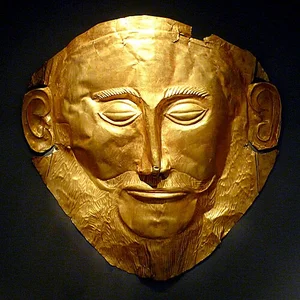
King of Mycenae and supreme commander of the Greek forces during the Trojan War. A central figure in Homer's Iliad and Aeschylus's Oresteia, his tragic fate — from the sacrifice of Iphigenia to his murder by Clytemnestra — makes him an archetype of hubris and fatality.
Agni
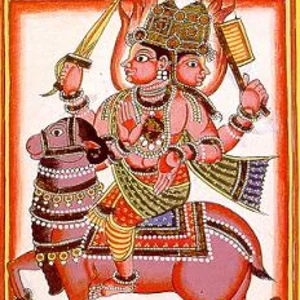
Agni is the god of fire in Vedic and Hindu mythology. The personification of sacrificial fire, he serves as an intermediary between humans and the gods by carrying offerings up to the heavens through smoke. He ranks among the most frequently invoked deities of the Rigveda.
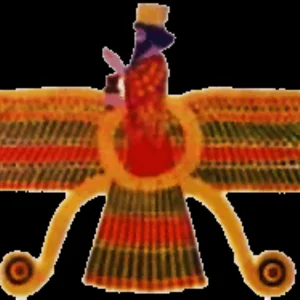
Ahura Mazda
The supreme deity of Zoroastrianism, Ahura Mazda is the creator god of wisdom and light in the religion founded by Zoroaster (Zarathustra) around the 6th century BCE in Persia. He embodies the principle of Good, opposed to Ahriman, the principle of Evil, in a dualistic vision of the cosmos.
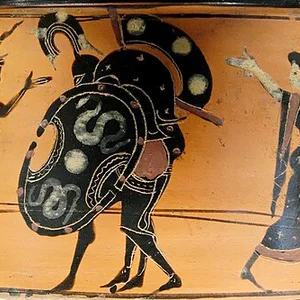
Ajax
Ajax, son of Telamon, king of Salamis, is one of the greatest Greek heroes of the Trojan War. Renowned for his colossal size and strength, he is considered, after Achilles, the finest warrior in the Achaean camp.
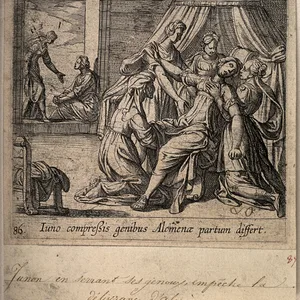
Alcmene
Greek princess, daughter of Electryon king of Mycenae and wife of Amphitryon. Zeus seduced her by taking on her husband's appearance, and she thus conceived Heracles, the most famous of all Greek heroes.
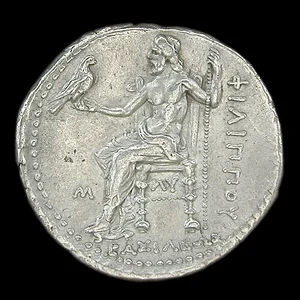
Alexander II of Macedon
King of Macedon from 370 to 368 BC, son of Amyntas III and elder brother of Philip II. His brief reign was marked by internal unrest before his assassination by Ptolemy of Aloros.
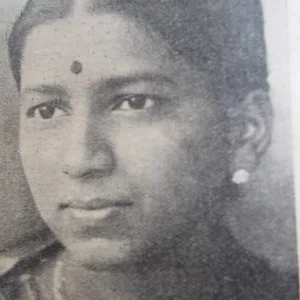
Ambika
Ambika is a figure from the Mahabharata, the Sanskrit epic of ancient India. Daughter of the king of Kashi and mother of Dhritarashtra, she plays a central role in the Kuru lineage. Her fate is bound to the practice of niyoga.
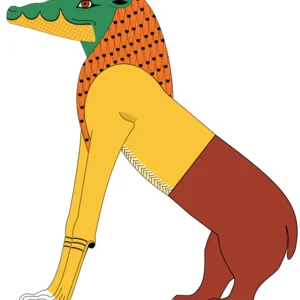
Ammit
Ammit is a hybrid Egyptian deity, part lion, part hippopotamus, part crocodile. She presides over the Weighing of the Heart in the Hall of Judgment of the Dead. Souls deemed unworthy are devoured by her, condemned to the second death.
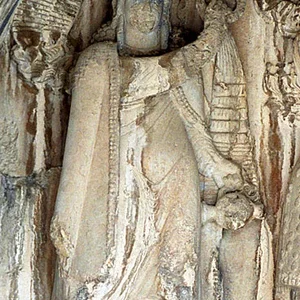
Anahita
Anahita is a major goddess of ancient Iranian mythology, associated with fertilizing waters, fertility, and victory. Venerated throughout the Achaemenid Empire and beyond, she was integrated into Zoroastrianism as a yazata (benevolent celestial being).
Anand (Nemain)
Nemain is a warrior goddess of Irish Celtic mythology, associated with the frenzy and panic of the battlefield. She is one of the figures linked to the Morrígan, a trinity of war goddesses, and her name is sometimes connected to Anann (Anu).
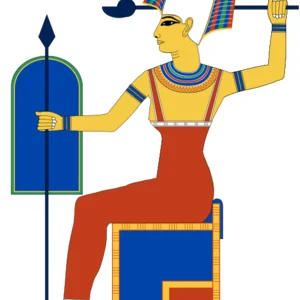
Anat
Anat is a warrior goddess of the Ugaritic pantheon (ancient Syria), venerated in the 2nd millennium BCE. A fierce virgin warrior, she is the sister of the god Baal and ranks among the most formidable deities of the ancient Near East.
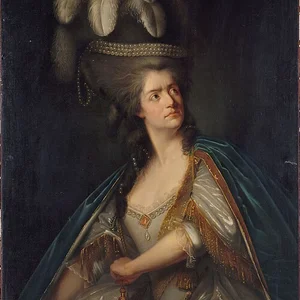
Andromache
Princess of Thebe in Mysia and wife of Hector in the Greek epic tradition, Andromache is the figure of the woman and mother struck by the Trojan War. Immortalized by Homer in the Iliad and by Racine in his eponymous tragedy (1667), she embodies conjugal fidelity and grief.
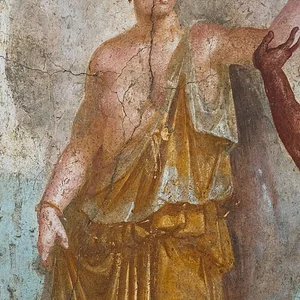
Andromeda
Andromeda is a princess of Greek mythology, the daughter of Cepheus, king of Ethiopia, and Cassiopeia. Chained to a rock to be offered to a sea monster, she is rescued by the hero Perseus, whom she later marries.
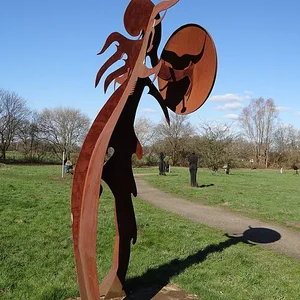
Angra Mainyu
Angra Mainyu, also known as Ahriman, is the evil deity of Zoroastrianism, opposed to Ahura Mazda. The embodiment of evil, deceit, and destruction, he stands at the heart of the cosmic dualism in the ancient Persian religion founded by Zarathustra.
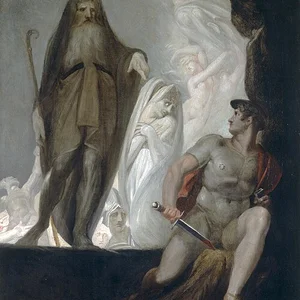
Anticleia
Anticleia is a figure from Greek mythology, daughter of the cunning Autolycus and mother of Odysseus (Ulysses). Wife of Laertes, king of Ithaca, she dies of grief during the long absence of her son, who has gone off to the Trojan War.
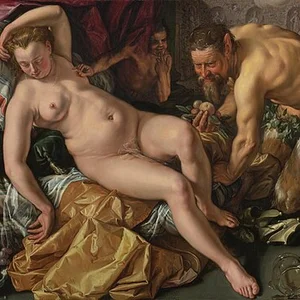
Antiope
Antiope is a figure from Greek mythology, daughter of Nycteus, king of Thebes (or of the river-god Asopus, depending on the version). Seduced by Zeus disguised as a satyr, she gave birth to the twins Amphion and Zethus, future builders of the walls of Thebes.
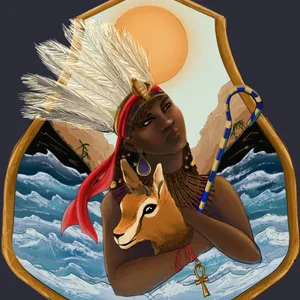
Anuket
Anuket is an Egyptian goddess personifying the Nile and its annual floods, venerated at Elephantine and in Nubia. She is depicted wearing a crown of feathers and is associated with the fertility of lands irrigated by the river.
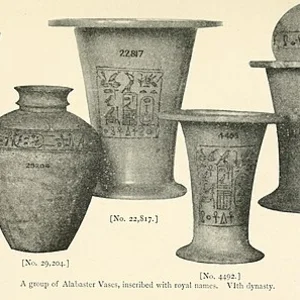
Apep
Apophis, or Apep, is the giant serpent of chaos in ancient Egyptian mythology. Each night, he attacks the solar barque of Ra in the underworld, threatening cosmic order. He is the absolute embodiment of chaos, darkness, and oblivion.

Apophis
Apophis is the great serpent of chaos in Egyptian mythology, the embodiment of darkness and absolute disorder. The eternal enemy of the sun god Ra, he attempts each night to swallow the solar barque during its journey through the underworld. The Egyptians performed daily rituals to ward off his attacks and preserve cosmic order.
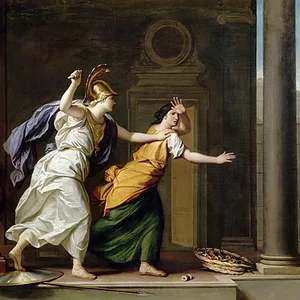
Arachne
A mortal weaver from Lydia in Greek mythology, Arachne challenged the goddess Athena to a weaving contest. Defeated or shamed, she was transformed into a spider — giving arachnids their name.
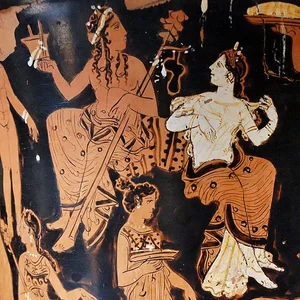
Ariadne
Cretan princess of Greek mythology, daughter of King Minos and Pasiphae. She helps the Athenian hero Theseus defeat the Minotaur by giving him a thread to navigate the labyrinth. Abandoned on the island of Naxos, she becomes the wife of the god Dionysus.
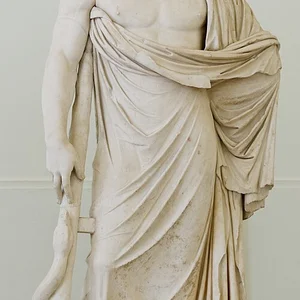
Asclepius
Greek god of medicine and healing, son of Apollo and Coronis. Raised by the centaur Chiron, he mastered the healing arts so completely that he could resurrect the dead — a transgression that led Zeus to strike him down with a thunderbolt.
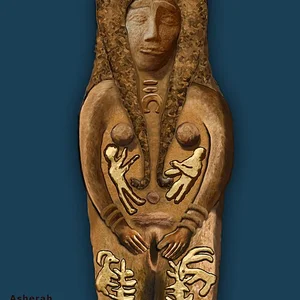
Asherah
Asherah is a major mother goddess of the Canaanite and Syrian pantheon, venerated as queen of the heavens and consort of the god El. Her cult, attested as early as the 2nd millennium BCE, stretched from Phoenicia to Ugarit and influenced the religious practices of the ancient Near East, including in Israel.
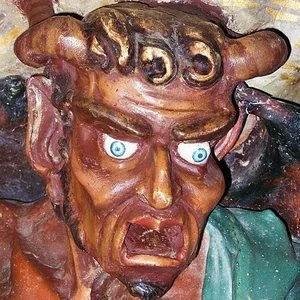
Asmodeus
A demon of lust and wrath in Judeo-Christian and Persian traditions, Asmodeus is one of the oldest demonic figures in religious literature. He appears notably in the Book of Tobit, a deuterocanonical text, under the name Asmodaeus.
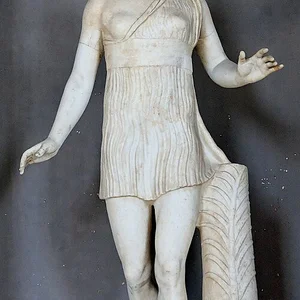
Atalanta
Heroine of Greek mythology, Atalanta is a huntress of unmatched agility and speed. An Argonaut and participant in the Calydonian Boar Hunt, she is famous for her challenge: any suitor had to outrun her on pain of death.

Aten
Aten is the solar deity of ancient Egypt, represented as the sun disk whose rays end in human hands. Elevated to the status of sole god by Pharaoh Akhenaten in the 14th century BCE, Aten stood at the heart of an unprecedented religious revolution.
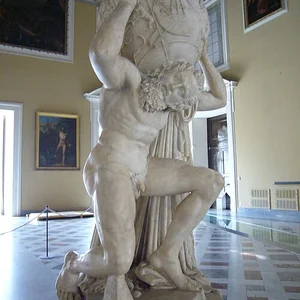
Atlas
Titan of Greek mythology, son of Iapetus and Clymene. Condemned by Zeus to hold up the sky on his shoulders after the defeat of the Titans in the Titanomachy. He is also the father of the Pleiades and the Hesperides.
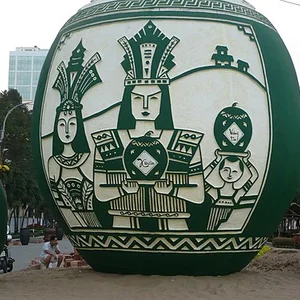
Âu Cơ
2825 — 2520
Âu Cơ is a legendary figure of Vietnamese mythology, wife of Lạc Long Quân and regarded as the mythical mother of the Viet people [1]. Her story, passed down through the Lĩnh Nam chích quái, tells of the birth of one hundred sons from a sack of eggs [1].

Azazel
Demonic figure from Hebrew traditions and fallen angel of the Book of Enoch. In Leviticus, he is associated with the scapegoat ritual. According to Enochic tradition, he taught humans the metallurgy of weapons and the art of cosmetics.
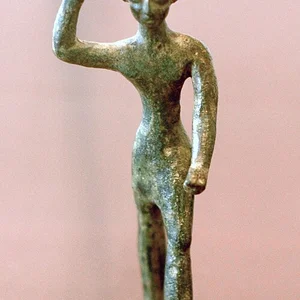
Baal
Supreme god of the Canaanite pantheon, master of rain, storms, and fertility. His cult was practiced across the ancient Near East from the 2nd millennium BCE and came into conflict with Hebrew monotheism. Demonized by the Abrahamic traditions, he became a demonic figure in medieval texts.

Badb
Badb is a war goddess from Irish Celtic mythology. Often depicted in the form of a crow, she soars above battlefields to spread terror and influence the outcome of the fighting. She sometimes forms a triad with Macha and the Morrígan.

Baiame
Baiame is the central creator deity of several Aboriginal peoples of southeastern Australia, notably the Kamilaroi and the Wiradjuri. Supreme being and sky father, he is considered the source of laws, initiation rites, and cosmic order.
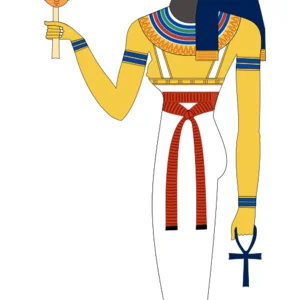
Bastet
Cat goddess of ancient Egyptian mythology, Bastet is the daughter of the sun god Ra and the protector of the home, women, and children. Venerated by the Egyptian people since the Old Kingdom, she embodies both maternal gentleness and protective power. Her cult, centered in Bubastis (Lower Egypt), reached its peak during the 1st millennium BCE.
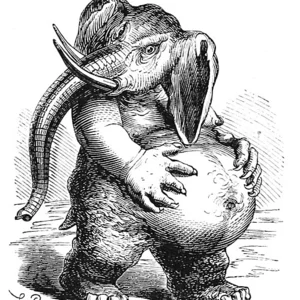
Behemoth
Behemoth is a monstrous creature from the Hebrew Bible, described as a colossal, primordial land beast. In the Book of Job, God invokes it to illustrate his omnipotence before humankind. Jewish tradition makes it the terrestrial counterpart of the sea monster Leviathan.
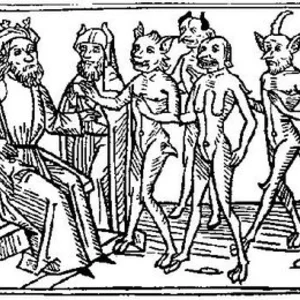
Belial
Belial is a demonic figure from ancient Hebrew and Jewish traditions, whose name means 'worthless' or 'wickedness'. He appears in the Dead Sea Scrolls as a prince of darkness opposed to the Archangel Michael. He is considered one of the four crowned princes of Hell in medieval demonology.
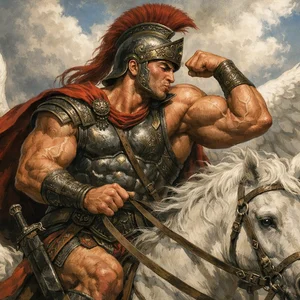
Bellerophon
Hero of Greek mythology from Corinth, Bellerophon tames the winged horse Pegasus and slays the Chimera. A victim of his own hubris, he attempts to reach Olympus and is cast down to earth by Zeus.
Bhumi Devi
Bhūmi Devi is the goddess of the Earth in Hindu mythology, the personification of the nurturing planet. Wife of the god Vishnu, she is also known by the names Bhūdevi or Prithvi. She embodies the patience, fertility, and generosity of the earth.
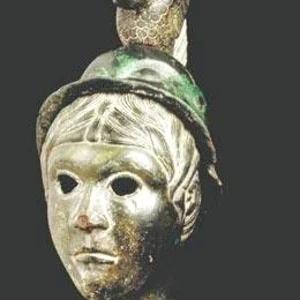
Brigid
A major goddess of Irish Celtic mythology, Brigid is the daughter of the Dagda and patroness of fire, poetry, and healing. Venerated by Celtic peoples, her cult survived Christianization by merging with that of Saint Brigid of Kildare.
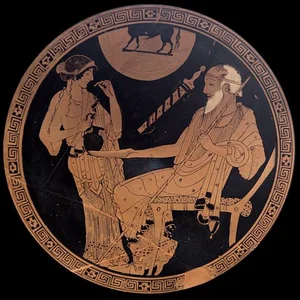
Briseis
Briseis is a figure from Greek mythology, a war captive whose possession sparks the famous quarrel between Achilles and Agamemnon in Homer's Iliad. Her seizure by Agamemnon drives Achilles to withdraw from the fighting, a pivotal event in the tale of the Trojan War.

Bunyip
The Bunyip is a creature from the mythology of the Aboriginal peoples of Australia, said to haunt swamps, billabongs, creeks, and waterholes. Described as a threatening water spirit that devours those who approach the water at night, it embodies the real dangers of Australian wetlands.

Cain
3899 av. J.-C. — 3199 av. J.-C.
Eldest son of Adam and Eve in the Bible, Cain committed the first murder in human history by killing his brother Abel out of jealousy. Condemned to wander the earth, he received a protective mark from God.
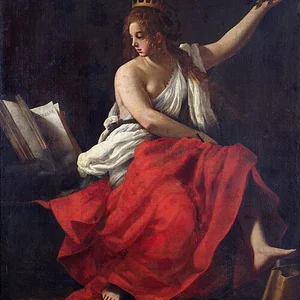
Calliope
Calliope, in Greek mythology, is the eldest of the nine Muses, daughters of Zeus and the Titaness Mnemosyne. She presides over epic poetry and eloquence, and is reputed to be the mother of the poet Orpheus. Her name means “she of the beautiful voice.”
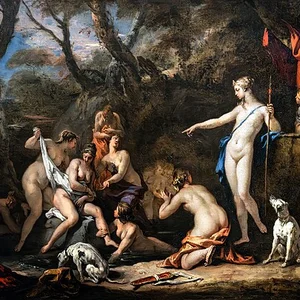
Callisto
Callisto is a nymph from Greek mythology and a companion of Artemis, goddess of the hunt. Seduced by Zeus, she was transformed into a bear by the jealous Hera, then placed in the sky as the constellation Ursa Major.

Calypso
An Oceanid nymph of Greek mythology, Calypso rules over the island of Ogygia. In Homer's Odyssey, she holds Odysseus captive through her love for seven years, offering him immortality in exchange for his company. Forced by Zeus to release him, she embodies the figure of impossible love set against the longing to return home.
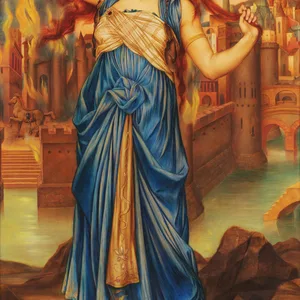
Cassandra
Trojan prophetess and daughter of King Priam, Cassandra was granted the gift of prophecy by Apollo, then cursed so that no one would ever believe her. A tragic figure of Greek mythology, she foretold the fall of Troy but could not prevent it.
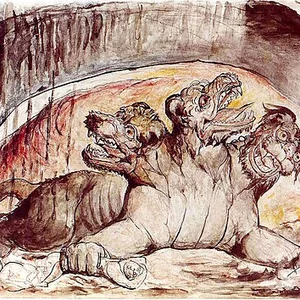
Cerberus
Cerberus is the monstrous three-headed dog who guards the entrance to the Underworld in Greek mythology. Son of Typhon and Echidna, he prevents the living from entering and the dead from leaving. Heracles captured him alive during his twelfth and final labor.
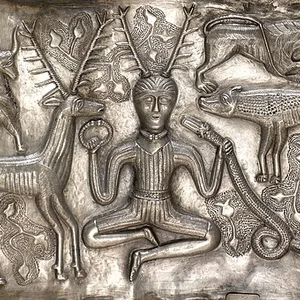
Cernunnos
Cernunnos is a horned Gaulish deity, god of wild animals and nature. His name is attested only once, on the Pillar of the Boatmen discovered in Paris. He is depicted seated cross-legged, wearing antlers, surrounded by deer and serpents.
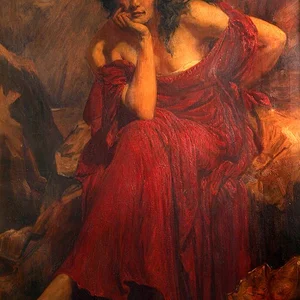
Cerridwen
An enchantress and goddess of Welsh Celtic mythology, Ceridwen is the keeper of the cauldron of knowledge and inspiration (Awen). A figure of wisdom, transformation, and magic, she appears in medieval Welsh tales passed down orally before being recorded in the Mabinogion and other bardic texts.
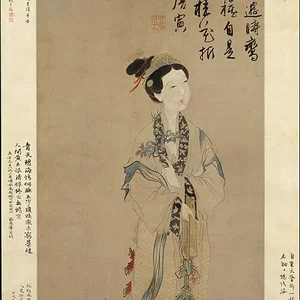
Chang'e
Chang'e is the goddess of the Moon in Chinese mythology. Wife of the divine archer Hou Yi, she swallowed the elixir of immortality and flew to the Moon, where she has resided ever since in her jade palace with the moon rabbit.
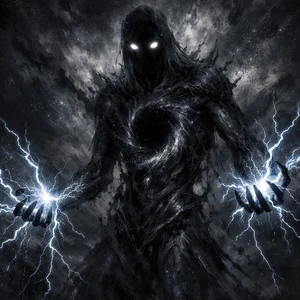
Chaos
Chaos is the primordial deity of Greek mythology, personification of the original void or abyss from which the universe was born. According to Hesiod in the Theogony (c. 700 BCE), Chaos is the first being to have existed. From Chaos emerge Gaia, Tartarus, Eros, Nyx, and Erebus.
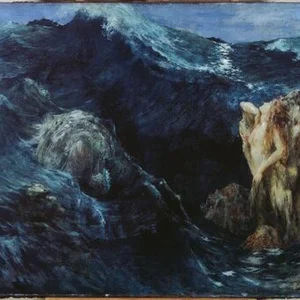
Charybdis
Charybdis is a sea monster from Greek mythology, daughter of Poseidon and Gaia, transformed into a devastating whirlpool by Zeus. She swallows the waters three times a day in the Strait of Messina, threatening any ship that draws near. Odysseus encounters her during his long journey home to Ithaca.
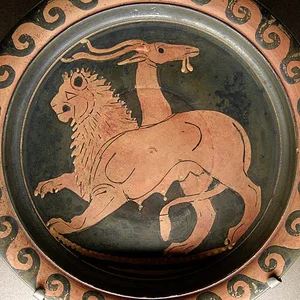
Chimera
Monster from Greek mythology, born of Typhon and Echidna. A flame-breathing hybrid creature, she was slain by the hero Bellerophon riding the winged horse Pegasus.
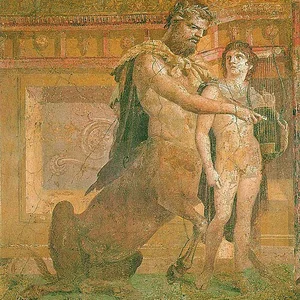
Chiron
Chiron is a centaur from Greek mythology, son of Cronus and the nymph Philyra. Renowned for his wisdom, he served as tutor to many Greek heroes, including Achilles, Jason, and Asclepius. He excelled in medicine, music, hunting, and philosophy.
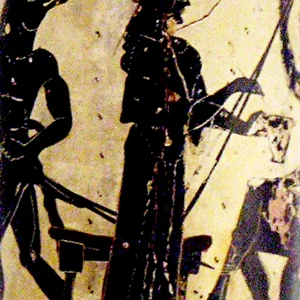
Circe
Circe is an enchantress from Greek mythology, daughter of the sun god Helios, known for her magical powers. In Homer's Odyssey, she transforms Odysseus's companions into pigs before becoming the hero's ally.
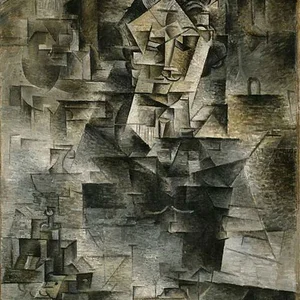
Clitô
Cléito is a figure from Greek mythology, daughter of Evenor and Leucippe, known through Plato's dialogue 'Critias'. A mortal woman living on the island that would become Atlantis, she was beloved by the god Poseidon, who surrounded her home with concentric ramparts and fathered with her the ten first kings of Atlantis.
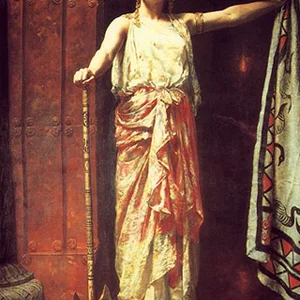
Clytemnestra
A major figure in Greek mythology, Clytemnestra is the wife of King Agamemnon of Mycenae. She murders him upon his return from the Trojan War to avenge the sacrifice of their daughter Iphigenia. She is the central character of Aeschylus's Oresteia (458 BCE).
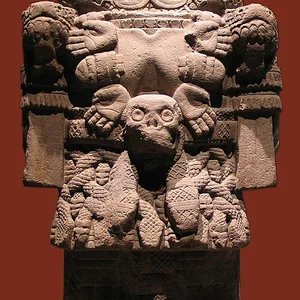
Coatlicue
Mother goddess of Aztec mythology, Coatlicue is the mother of the sun god Huitzilopochtli. Venerated by the Mexica people (Aztecs), she embodies life, death, and regeneration all at once. Her depiction — wearing a necklace of skulls and a skirt of serpents — symbolizes the perpetual cycle of creation and destruction.
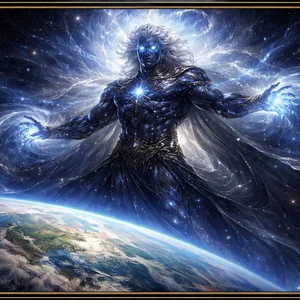
Coeus
Titan of Greek mythology, son of Uranus and Gaia, Coeus personifies heavenly intelligence and the axis of the world. Husband of Phoebe, he is the father of Leto and Asteria, and thus the grandfather of Apollo and Artemis.
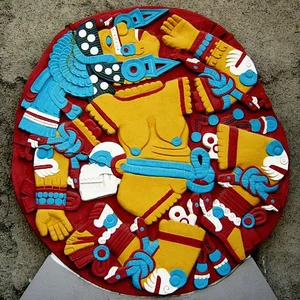
Coyolxauhqui
Coyolxauhqui is a lunar deity of Aztec mythology, daughter of the goddess Coatlicue and sister of the solar god Huitzilopochtli. According to the myth, she was beheaded and dismembered by her brother atop Mount Coatepec, becoming the Moon.
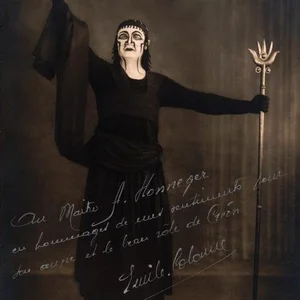
Creon
Creon is a character from Greek mythology, king of Thebes. Brother of Jocasta and uncle of Antigone, he seizes power after the death of Oedipus's sons. He embodies the authority of the state in conflict with divine and family laws.
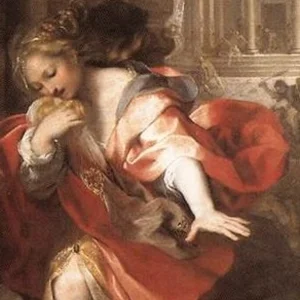
Creusa
Creusa is a princess from Greek mythology, daughter of King Priam and Hecuba, and wife of the Trojan hero Aeneas. She disappears during the fall of Troy, and her ghost appears to Aeneas to foretell his destiny.
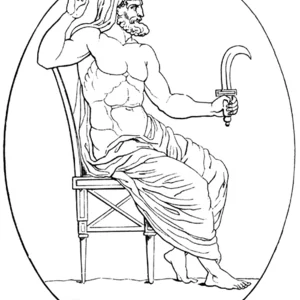
Cronos
Cronos is the youngest of the Titans, son of Uranus and Gaia. He overthrew his father, ruled over the Golden Age, then devoured his own children for fear of being dethroned. Zeus, saved by his mother Rhea, eventually defeated him.
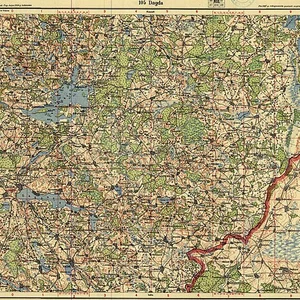
Dagda
The Dagda is one of the great deities of Irish Celtic mythology, father and chief of the Tuatha Dé Danann. God of fertility, wisdom, and the arts, he owns an inexhaustible cauldron of abundance and a club with magical powers.
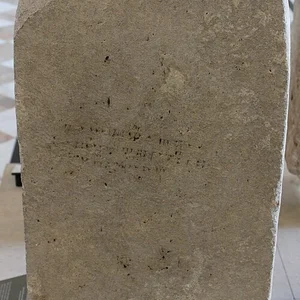
Dagon
Dagon is a Semitic deity worshipped by the Philistines and Canaanites, associated with fertility and the harvest. His cult is attested throughout the ancient Near East, notably at Ugarit and Gaza. He was later reinterpreted as a demonic figure in Christian literature and in John Milton's Paradise Lost.
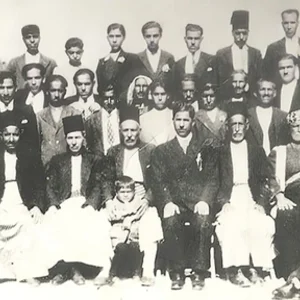
Daji
A nine-tailed fox spirit who transformed herself into the concubine of King Zhou, the last ruler of the Shang dynasty (11th century BCE). A demonic figure in Chinese mythology, she embodies seductive evil and tyranny. Her legendary cruelty helped bring about the fall of the Shang dynasty, which was defeated by King Wu of Zhou.
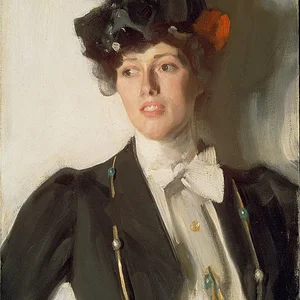
Dana
Mother goddess of Irish Celtic mythology, Dana is the ancestral figure of the Tuatha Dé Danann, the divine people of Ireland. Known only through oral tradition and medieval Irish texts, she embodies the nurturing earth and the primordial forces of nature.
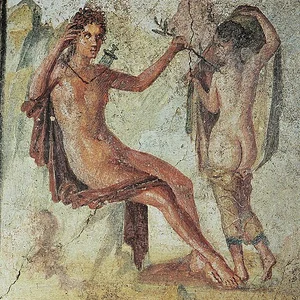
Daphne
Daphne is a nymph from Greek mythology, daughter of the river-god Peneus (or of the river Ladon according to some versions). Pursued by the god Apollo who had fallen in love with her, she is transformed into a laurel tree to escape his embrace. Her myth is one of the most famous tales of metamorphosis from antiquity.
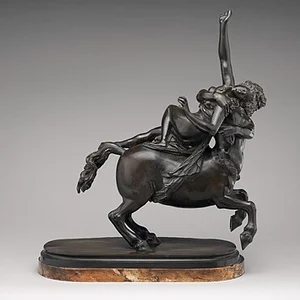
Deianira
Wife of Heracles and princess of Calydon, Deianira is a tragic figure in Greek mythology. Deceived by the centaur Nessus, she gives her husband a tunic soaked in poison, believing it to be a love potion, thereby causing his death.
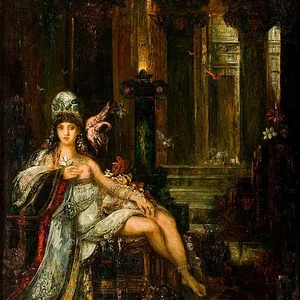
Delilah
1100 av. J.-C. — 1100 av. J.-C.
Delilah is a female figure from the Book of Judges, in the Hebrew Bible. Loved by Samson, she is bribed by the Philistine lords to discover the secret of the hero's superhuman strength: his hair. She betrays him by having his head shaved, thus delivering him to his enemies.
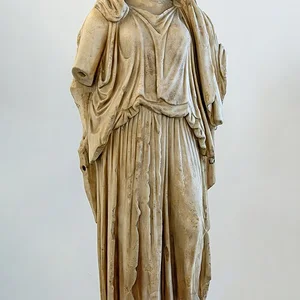
Demeter
Greek goddess of agriculture and the harvest, venerated in ancient Greek religion. Daughter of Cronus and Rhea, she is the mother of Persephone. Her myth, passed down through oral tradition and later codified by the Greeks, explains the cycle of the seasons.
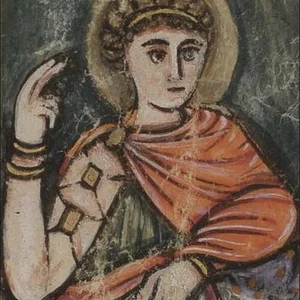
Dido
A Phoenician princess from Tyre, Dido is the legendary founder of Carthage (in present-day Tunisia), according to Greek and Latin tradition. Made famous by Virgil's Aeneid, she embodies the figure of the queen-builder and the tragic woman abandoned by Aeneas.
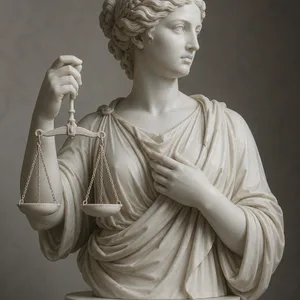
Dike
Dike is the Greek goddess of human justice and moral order. The daughter of Zeus and Themis, she is one of the Horae (Hours) and watches over the upholding of law among mortals, denouncing injustices to her father.
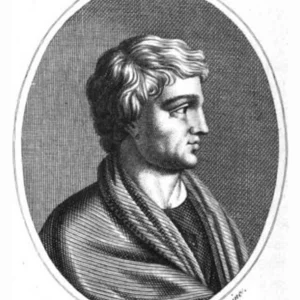
Diodorus Siculus
89 av. J.-C. — 19 av. J.-C.
Greek historian of the 1st century BC, born in Sicily, author of the Bibliotheca historica, a vast universal history encyclopedia in 40 volumes covering mythical origins through the age of Caesar.
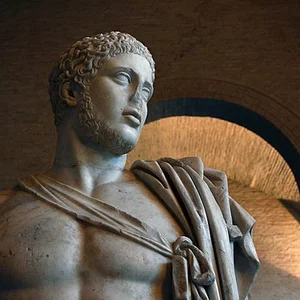
Diomedes
Hero of Greek mythology, king of Argos and son of Tydeus, Diomedes is one of the greatest Greek warriors of the Trojan War. Renowned for his exceptional bravery, he dared to wound the gods Ares and Aphrodite in battle.
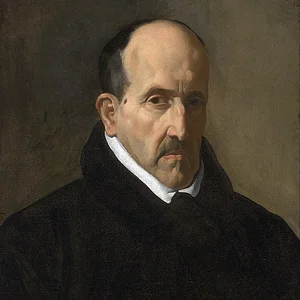
Don
Dôn is the mother goddess of Welsh mythology, ancestor of the divine family known as the “Children of Dôn” (Plant Dôn) mentioned in the Mabinogi. The Welsh equivalent of the Irish goddess Danu, she embodies the matriarchal figure of the Celtic deities of Britain, of whom she is the source.

Dragon of Colchis
A creature of Greek mythology, the Dragon of Colchis is a gigantic serpent with ever-open eyes that guards the Golden Fleece in the sacred grove of Ares, in Colchis. It never sleeps — until the sorceress Medea lulls it into slumber so that Jason can seize the precious trophy.
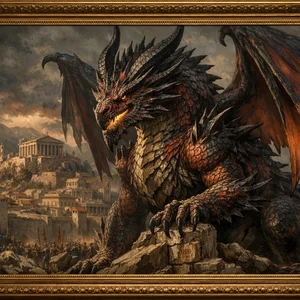
Dragon of Thebes
A monstrous creature sacred to Ares in Greek mythology, it guarded the divine spring near Thebes. Slain by the Phoenician hero Cadmus, its teeth were sown into the earth and gave rise to the Spartoi, the ancestral warriors of Thebes.
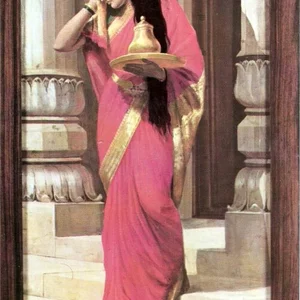
Draupadi
Central heroine of the Mahābhārata, the Sanskrit epic of the Hindu tradition. Shared wife of the five Pandava brothers, she symbolizes justice, dignity, and resistance to humiliation. Her story was passed down through a long oral tradition before being written down around the 4th century BCE.
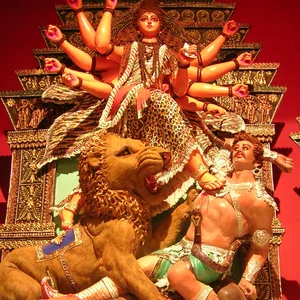
Durga
A warrior goddess of Hinduism, Durga embodies Shakti, the divine feminine energy and protective force of the universe. Venerated in the Hindu tradition since the Vedic era, she is the great goddess (Mahadevi) who vanquishes the forces of evil.
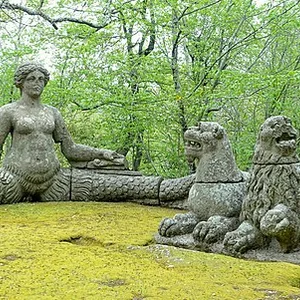
Echidna
Echidna is a creature from Greek mythology, half-woman and half-serpent, known as the "Mother of All Monsters." Mate of the giant Typhon, she gave birth to the most terrifying creatures of the ancient Greek world.
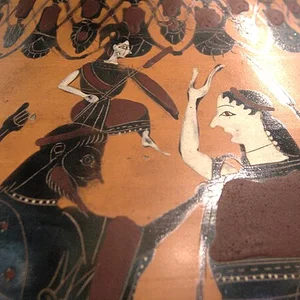
Eileithyia
Eileithyia (Ilithyia) is the Greek goddess of childbirth and labor. The daughter of Zeus and Hera, she presides over births and either eases or prolongs the pains of women in labor. She plays a decisive role in several myths, notably during the births of Heracles and Apollo.
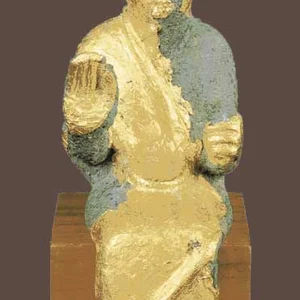
El
El is the supreme deity of the Canaanite and Ugaritic pantheon, father of gods and men. A creator god and divine judge, he presides over the council of the gods. His cult is attested throughout the ancient Semitic Near East.
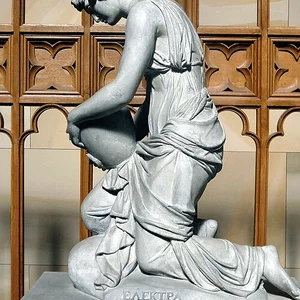
Electra
Electra is a heroine of Greek mythology, daughter of Agamemnon and Clytemnestra. After her father is murdered by her mother and her lover Aegisthus, she convinces her brother Orestes to avenge him. Her tragic fate inspired all three of the great Greek tragedians.
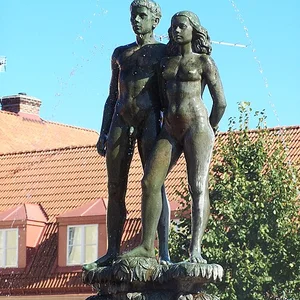
Embla
In Norse mythology, Embla is the first woman, created along with Ask (the first man) by the gods from two pieces of wood found on the shore. The couple are the ancestors of humankind in Scandinavian cosmogony.

Emer
Emer is the wife of Cúchulainn, the central hero of the Ulster Cycle of Irish Celtic mythology. The daughter of Forgall Monach, she is said to possess the six gifts of the ideal woman (beauty, voice, sweet speech, wisdom, skill at needlework, and virtue). Her meeting with the hero is told in “The Wooing of Emer” (Tochmarc Emire).
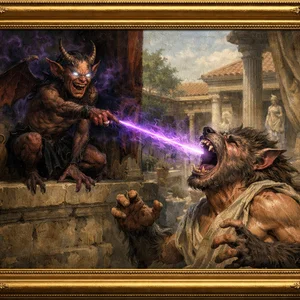
Empousa
A demonic creature of Greek mythology, servant of Hecate. Endowed with one leg of bronze and one leg of a donkey, she transforms herself to seduce lone travelers before devouring them.
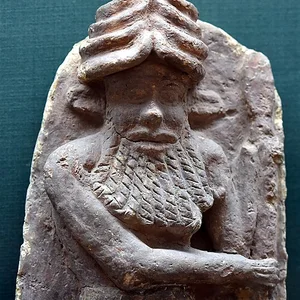
Enkidu
Legendary figure from the Epic of Gilgamesh, created by the gods to be the companion of King Gilgamesh. Born wild and raised among animals, he becomes the hero's inseparable friend before his death triggers the quest for immortality.
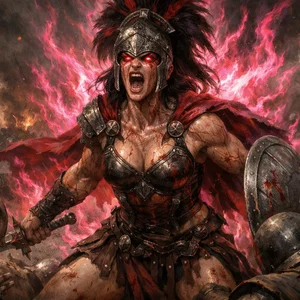
Enyo
Greek goddess of war and destruction, Enyo is the companion or sister of Ares. She embodies the bloody turmoil of battle and spreads terror across the battlefield in Greek mythology.
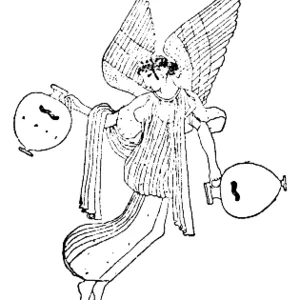
Eos
Eos is the Greek goddess of the Dawn, daughter of the Titans Hyperion and Theia, sister of Helios (the Sun) and Selene (the Moon). Each morning, she opens the gates of the sky to herald the rising of the day, riding her chariot drawn by two winged horses.
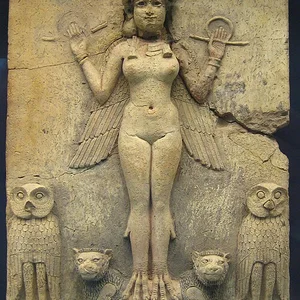
Ereshkigal
Sumerian queen of the Underworld in Mesopotamian mythology, Ereshkigal rules the kingdom of the dead known as Kur or Irkalla. Sister of the goddess Inanna, she embodies the relentless power of death and the underworld, as described in Sumerian cuneiform texts.
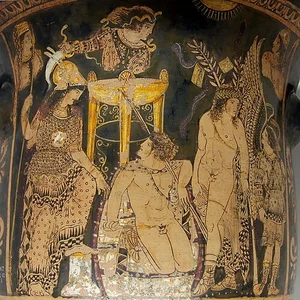
Erinyes
The Erinyes are three chthonic deities of Greek mythology tasked with punishing crimes against the natural order, especially perjury and the murder of kin. Alecto, Megaera, and Tisiphone relentlessly pursue the guilty, driving them to madness and torment.
Ernmas
Ernmas is a mother goddess of Irish Celtic mythology, belonging to the Tuatha Dé Danann. She is best known as the mother of the three goddesses of war and sovereignty of Ireland.
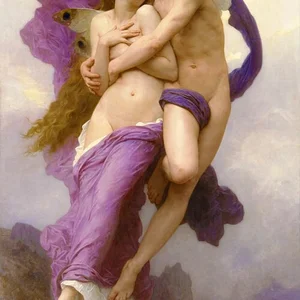
Eros
Eros is the Greek god of love and desire. The son of Aphrodite and Ares according to classical tradition, he is depicted as a winged young child armed with a bow and golden arrows. His Roman equivalent is Cupid.
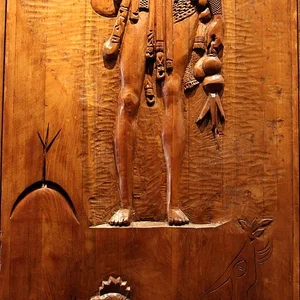
Eshu
Eshu is a trickster orisha from the Yoruba tradition of West Africa, guardian of crossroads and messenger between humans and the gods. Master of communication and cunning, he must be propitiated before any ritual.
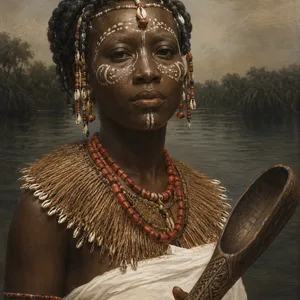
Esimirin
Esimirin is an aquatic deity from the Ijaw (Ijo) mythology, a people of the Niger Delta in Nigeria. A spiritual figure associated with water and prosperity, she holds a central place in the beliefs and traditional rituals of this community.

Eteocles
Eteocles is a mythical king of Thebes, son of Oedipus and Jocasta, brother of Polynices, Antigone, and Ismene. He refuses to hand over the throne to his brother as their power-sharing agreement required, triggering the war of the Seven against Thebes, at the end of which the two brothers kill each other.
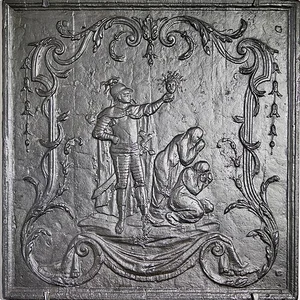
Euryale
Euryale is one of the three Gorgons of Greek mythology, sister of Stheno and of the famous Medusa. Unlike the latter, Euryale is immortal. Daughter of the primordial sea deities Phorcys and Ceto, she is often depicted as a monster with a petrifying gaze.
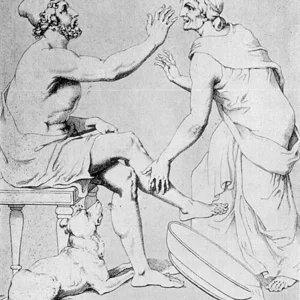
Eurycleia
In Greek mythology, Eurycleia is the faithful nurse of Odysseus, king of Ithaca, whom she raised from his birth. A character in Homer's Odyssey, she is the first to recognize her master on his return, thanks to a scar on his leg.
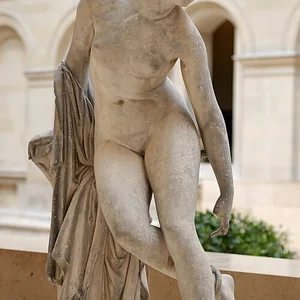
Eurydice
Nymph of Greek mythology and wife of the poet Orpheus. Bitten by a serpent, she descends to the Underworld. Orpheus attempts to bring her back to life through his music, but loses her forever by looking back.
Fotla
Fódla (or Fotla) is a goddess of Irish mythology, a member of the Tuatha Dé Danann. Along with her sisters Banba and Ériu, she personifies the sovereignty of Ireland and gives the island one of its poetic names.

Fujin
Fujin is the god of wind in Japanese Shinto mythology. He is depicted as a demon carrying a large bag containing the winds of the world. Twin of Raijin, the god of thunder, he is one of the oldest deities in the Japanese pantheon.
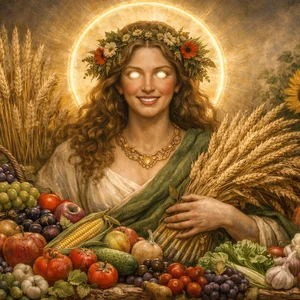
Gaia
A primordial deity of Greek mythology, Gaia personifies the Earth Mother. Emerging from the primordial Chaos, she gives birth to Uranus (the Sky), the Mountains, and Pontus (the Sea). With Uranus, she bears the Titans, the Cyclopes, and the Hecatoncheires.
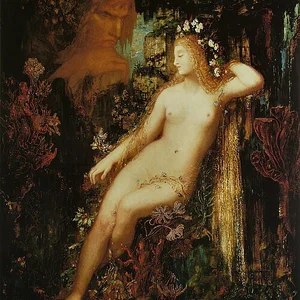
Galatea
Galatea is a Nereid in Greek mythology, one of the fifty daughters of the sea god Nereus and the Oceanid Doris. She is famous for her love affair with the Sicilian shepherd Acis and for the advances of the Cyclops Polyphemus, who, out of jealousy, crushes Acis beneath a boulder.
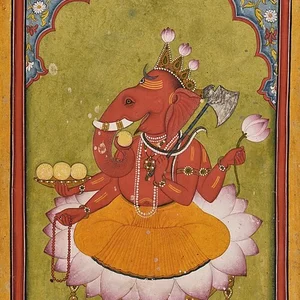
Ganesh
Ganesh is one of the most revered deities in Hinduism, instantly recognizable by his elephant head. Son of Shiva and Parvati, he is the god of wisdom, intellect, and success, and the “Lord of Obstacles,” invoked at the beginning of any new endeavor.
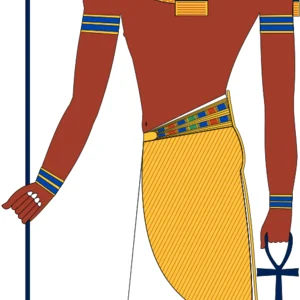
Geb
Geb is the Egyptian god of the Earth, son of Shu and Tefnut, and husband of Nut, the goddess of the sky. He belongs to the Ennead of Heliopolis and is the father of Osiris, Isis, Seth, and Nephthys.
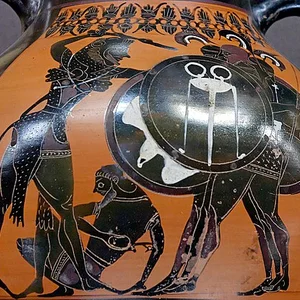
Geryon
Geryon is a monstrous giant of Greek mythology, endowed with three bodies joined at the waist. The guardian of a herd of red cattle on the island of Erytheia, he is slain by Heracles during the hero's tenth Labour.
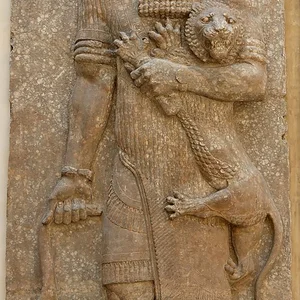
Gilgamesh
Gilgamesh is a legendary king of Sumer, whose story is told in the Epic of Gilgamesh, the oldest known literary text in human history. This Mesopotamian work explores themes of friendship, the quest for immortality, and the human condition in the face of death.

Glooscap
Creator hero and central figure of Mi'kmaq and Abenaki mythology in North America. A cultural being who shaped the world, defeated monsters, and taught humans the arts of survival. A figure from the Indigenous oral tradition of northeastern America, passed down from generation to generation.
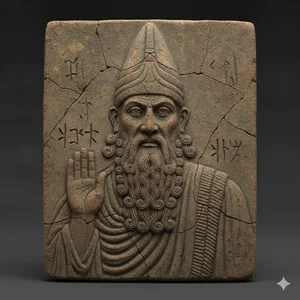
God (Yahweh)
Principal deity of the ancient Hebrew religion, Yahweh is the one God worshiped by the Israelites. His cult, attested from the 2nd millennium BCE, structures the foundational narratives of the Hebrew Bible and gives rise to Abrahamic monotheism.
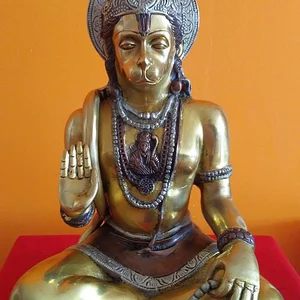
Hanuman
A Hindu deity in the form of a monkey, Hanuman is the devoted servant of the god Rama in the epic Ramayana. A symbol of devotion, strength, and courage, he is one of the most venerated figures in Hinduism.
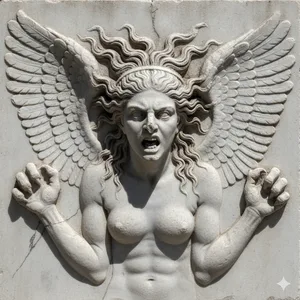
Harpies
The Harpies are creatures from Greek mythology, half-woman and half-bird, personifying violent and destructive winds. Sent by the gods to torment the blind prophet Phineus, they would defile or steal his food. They were driven away by the Argonauts Zetes and Calais, sons of the wind god Boreas.
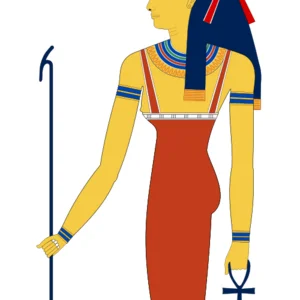
Hathor
An Egyptian goddess venerated since the Old Kingdom (c. 2700 BCE), Hathor is associated with love, music, joy, femininity, and the sky. Depicted as a cow or as a woman with bovine horns bearing the solar disk, she is one of the most popular deities in the Egyptian pantheon.
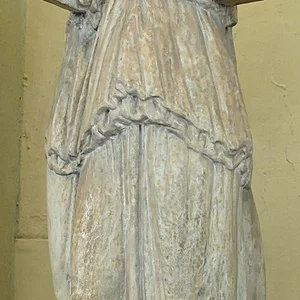
Hecate
Greek goddess of magic, crossroads, and the underworld, daughter of Perses and Asteria. Often depicted with three faces, holding torches and accompanied by dogs. A chthonic deity associated with the moon, nocturnal rites, and witchcraft.
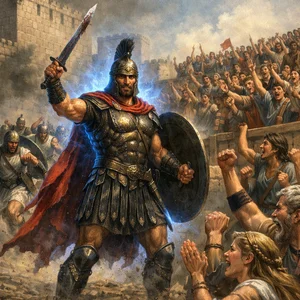
Hector
Prince of Troy and eldest son of King Priam, Hector is the greatest Trojan warrior of the Trojan War according to the Greek tradition handed down by Homer. Husband of Andromache and father of Astyanax, he embodies martial honor and love of his homeland. He kills Patroclus before being defeated by Achilles, whose fury leads him to drag Hector's body around the city walls.
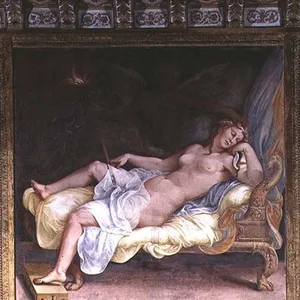
Hecuba
Queen of Troy in Greek mythology, wife of King Priam and mother of Hector, Paris, and Cassandra. A central figure in the Iliad and Greek tragedies, she embodies maternal grief and the fall of an entire civilization.
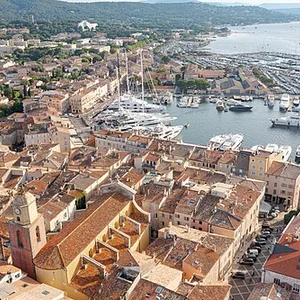
Heraclea
Heraclea refers to several Greek cities founded in honor of the hero Heracles, the most famous of which is Heraclea Pontica. These colonial foundations illustrate the role of mythological heroes in shaping ancient Greek identity.
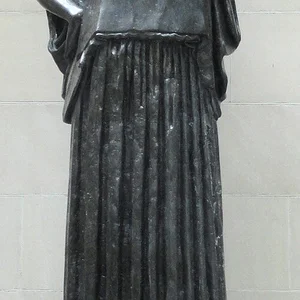
Hestia
Hestia is the Greek goddess of the hearth, domestic fire, and family in ancient Greek mythology. Daughter of Cronus and Rhea, sister of Zeus, she is one of the twelve Olympian deities. An eternal virgin, she embodies stability, purity, and the sacred heart of the home.
Hiʻiaka
Hiʻiaka is a goddess of Hawaiian mythology, the younger sister of the volcano goddess Pele. Patron of hula dancers, of chant, and of medicine, she is the heroine of a cycle of epic chants recounting her journey across the archipelago.
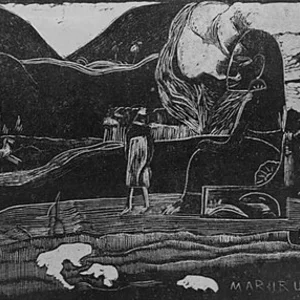
Hina
Hina is a major goddess of the Polynesian pantheon, venerated across many Pacific cultures (Tahiti, Hawaii, Māori, Samoa). The quintessential lunar figure, she embodies femininity, natural cycles, and the arts of tapa cloth-making. Her tradition is exclusively oral, passed down through myths and sacred chants since the pre-colonial era.
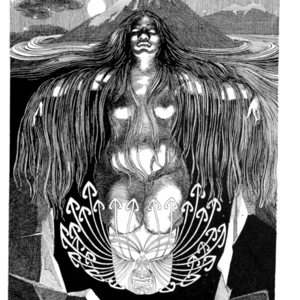
Hine-nui-te-pō
Māori goddess of death and guardian of the underworld (Te Pō), according to Polynesian oral traditions. Daughter of Tāne, she rules over the realm of the dead and receives the souls of the departed. Her myth illustrates the fundamental life-death cycle in Māori cosmology.
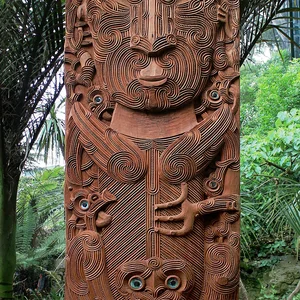
Hineahuone
Hineahuone is the first woman in Māori cosmogony, fashioned by the god Tāne from the red earth (one) of Kurawaka. A founding figure of Māori oral tradition, she embodies the sacred bond between humanity and the earth.
Hinetītama
Hinetītama is the “dawn maiden” in the Māori mythology of New Zealand. The daughter of the god Tāne, she becomes Hine-nui-te-pō, the great goddess of night and of the dead, after discovering that he was also her father.
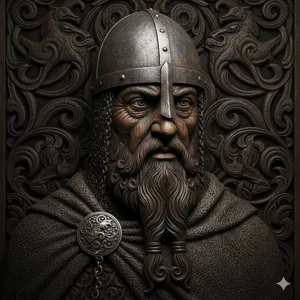
Hjalmgunnar
Hjalmgunnar is a warrior king from Norse mythology, mentioned in the heroic sagas. He was slain by the valkyrie Brynhildr on Odin's orders, which led to her being punished by the chief god.
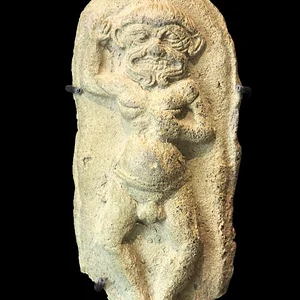
Humbaba
Humbaba (or Huwawa) is a monstrous creature from Mesopotamian mythology, the guardian of the Cedar Forest on behalf of the god Enlil. He appears in the Epic of Gilgamesh, where he is defeated and killed by Gilgamesh and Enkidu.
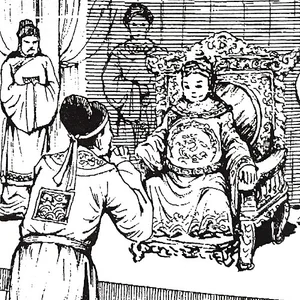
Hùng Vương
Title held by the semi-legendary rulers of the kingdom of Văn Lang, founded by the Lạc Việt people and attested between the 7th and 2nd centuries BCE [1]. Eighteen generations of kings are said to have held this title, but their historicity remains debated among historians [1].
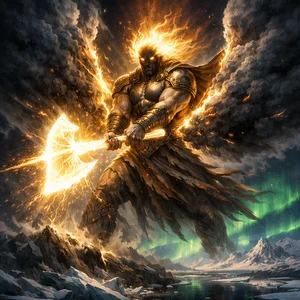
Hyperion
Titan of light in Greek mythology, son of Ouranos and Gaia. Husband of Theia, he is the father of Helios (the Sun), Selene (the Moon), and Eos (the Dawn). His name means "the one who walks above" in ancient Greek.

Icarus
Son of Daedalus, the ingenious craftsman of Greek mythology, Icarus escapes the Labyrinth of Crete using wings made of feathers and wax. Intoxicated by flight, he soars too close to the sun despite his father's warnings, melts his wings, and perishes in the sea that now bears his name.
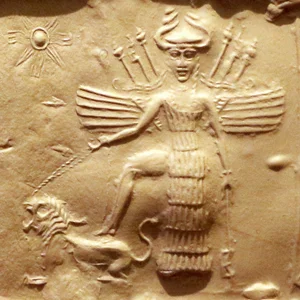
Inanna
Sumerian goddess of love, war, and fertility, venerated in Mesopotamia since the 4th millennium BCE. She is the best-documented female deity of the ancient world, celebrated in cuneiform hymns among the oldest known literary texts. Her cult, centered on the city of Uruk, influenced the religious traditions of the ancient Near East.
Inanna / Ishtar
Inanna (Sumerian) or Ishtar (Akkadian) is the great goddess of love, war, and fertility in ancient Mesopotamia. She stands at the heart of many foundational myths, including the famous Descent into the Underworld. Her cult, one of the most important in the ancient Near East, spans more than three millennia.
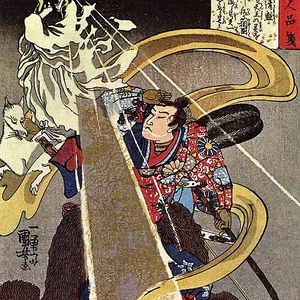
Inari
Japanese Shintō deity associated with rice, fertility, foxes, and commerce. Inari is one of the most venerated deities in Japan, with shrines (inari-sha) found throughout the country.
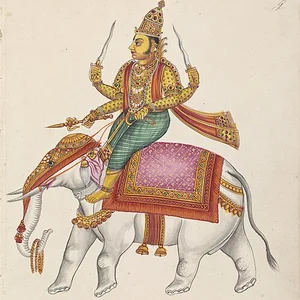
Indra
Indra is the king of the gods and the master of the sky in the Vedic mythology of ancient India. A warrior god of thunder, storms, and rain, he fights demons with his weapon, the thunderbolt (vajra). He is one of the central deities of the Rig Veda.
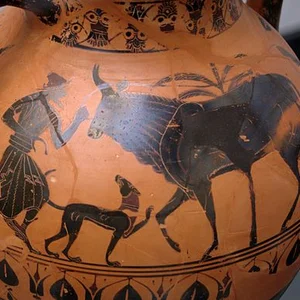
Io
Io is a figure from Greek mythology, a priestess of Hera and daughter of the river-god Inachus. Loved by Zeus, she was transformed into a heifer and pursued across the world by Hera's jealousy before regaining her human form in Egypt.
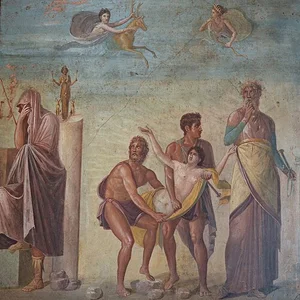
Iphigenia
Daughter of Agamemnon and Clytemnestra, Iphigenia was condemned to be sacrificed at Aulis to appease Artemis and allow the Greek fleet to sail for Troy. Saved by the goddess, she was transported to Tauris where she became a priestess. Her fate inspired major tragedies by Euripides.
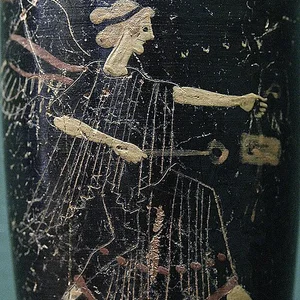
Iris
Iris is the Greek goddess of the rainbow and messenger of the Olympian gods, most notably Zeus and Hera. Daughter of Thaumas and Electra, she serves as an intermediary between the divine world and the human world, carrying messages from the immortals to mortals.
Itzamná
Itzamná is the supreme deity of the Maya pantheon, creator of the world and inventor of hieroglyphic writing. God of the sky, wisdom, and medicine, he is depicted as a wise old man. He is the husband of Ixchel, goddess of the moon.
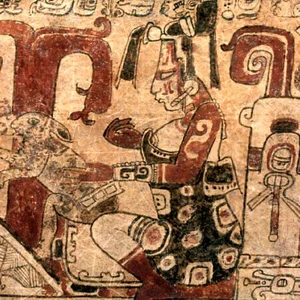
Ixchel
Ix Chel is a goddess of Maya mythology, venerated as a figure of the moon, medicine, weaving, and fertility. According to oral traditions and colonial written sources (Maya codices), she embodied both the creative power and the destruction associated with water and lunar cycles.
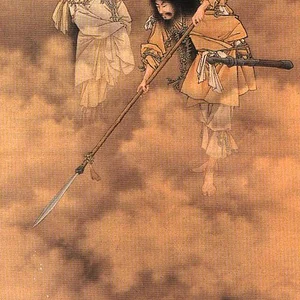
Izanami
Japanese goddess of creation and death, wife of Izanagi, from the Shinto tradition. According to the Kojiki (c. 8th century), she and Izanagi gave birth to the islands of Japan and the primordial deities. Her death during the birth of the fire god led her to reign over the land of the dead, Yomi.
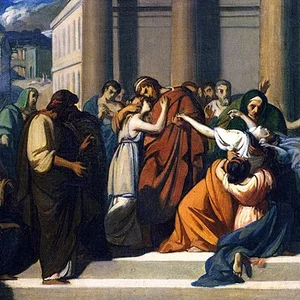
Jocasta
Queen of Thebes in Greek mythology, Jocasta is the mother and wife of Oedipus. Unaware of the true identity of the man she had married, she took her own life upon the revelation of the incest. Her story is at the heart of Sophocles' tragedy Oedipus Rex.
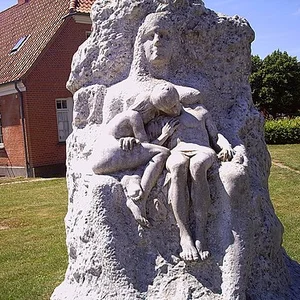
Jörð
Jörð (“the Earth”) is a goddess of Norse mythology, the personification of the Earth. A giantess or goddess depending on the source, she is one of Odin's companions and the mother of Thor, the god of thunder.
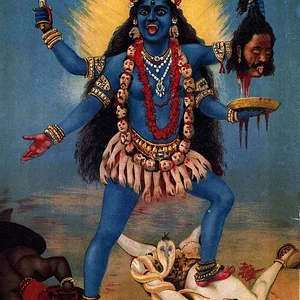
Kali
A Hindu goddess rooted in Vedic and Tantric tradition, Kali is the fierce and destructive aspect of the goddess Durga. Venerated by the people of India since antiquity, she embodies both the destruction of evil and cosmic renewal. Her complex figure symbolizes the cycle of death and rebirth.

Kuntî
Kuntî is a major figure in the Indian epic of the Mahâbhârata. Mother of the Pândava, she is known for having obtained a boon granting her the power to conceive children by gods. She embodies devotion, maternal sacrifice, and wisdom in the Hindu tradition.
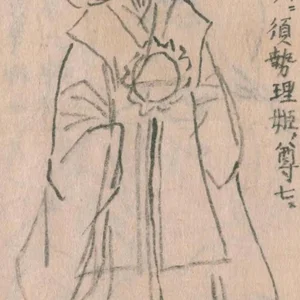
Kushinadahime
A divine princess of Japanese Shinto mythology, Kushinadahime is known through the Kojiki (712 AD) and the Nihon Shoki (720 AD), two imperial Japanese chronicles recording oral traditions that are far older. According to these sacred texts, she was rescued from the eight-headed serpent Yamata no Orochi by the god Susanoo, who then took her as his wife.
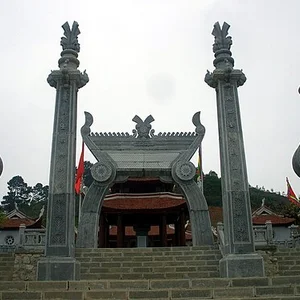
Lạc Long Quân
Lạc Long Quân, a semi-legendary figure of Vietnamese mythology, is regarded as one of the founding ancestors of the Vietnamese people [1]. According to the legend of the “sack of a hundred eggs,” he united with Âu Cơ to beget a hundred sons, the eldest of whom became the first Hùng King [1]. He is said to have ruled the legendary state of Xích Quỷ before the founding of Văn Lang [1].
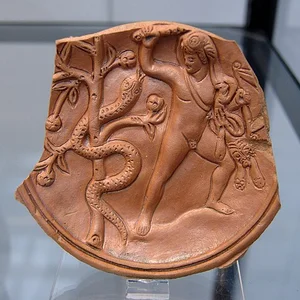
Ladon
Ladon is a dragon from Greek mythology tasked with guarding the golden apples of the Garden of the Hesperides. Often described as a many-headed creature whose sleep was eternally watchful, he was defeated during the eleventh of the Labors of Heracles.
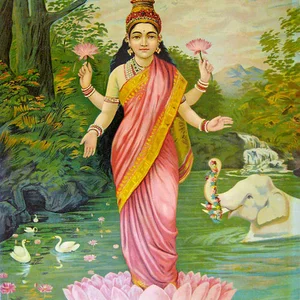
Lakshmi
Hindu goddess of prosperity, fortune, and beauty, venerated in the Vedic tradition since antiquity. Consort of the god Vishnu, she symbolizes abundance, grace, and good fortune in the mythology of Indian civilization.
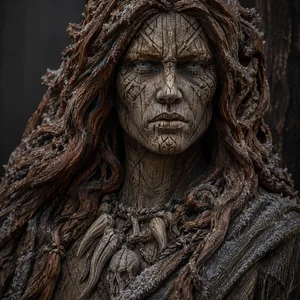
Laufey
Laufey, also called Nál, is a figure from Norse mythology known as the mother of the god Loki. Medieval sources present her as a giantess (or goddess), wife of the giant Fárbauti.
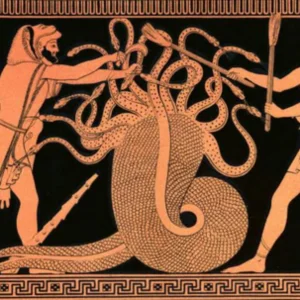
Lernaean Hydra
An aquatic monster from Greek mythology, the Lernaean Hydra was a multi-headed serpent whose heads would grow back two-fold whenever they were cut off. It was slain by Heracles during his second labor, with the help of his nephew Iolaus.
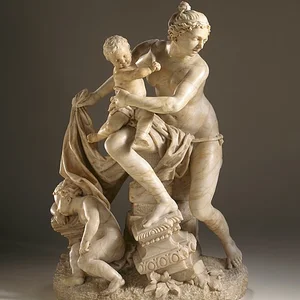
Leto
A Titaness of Greek mythology, Leto is the mother of Apollo and Artemis, born of her union with Zeus. Pursued by a jealous Hera, she gave birth on the island of Delos after a long wandering.
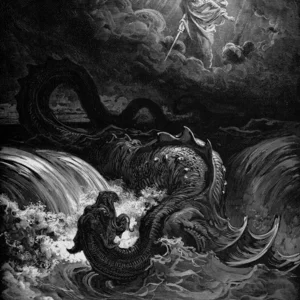
Leviathan
A sea monster from biblical texts and the mythologies of the ancient Near East, Leviathan embodies primordial chaos and the forces of evil. Described as a gigantic sea serpent, it appears notably in the Book of Job and the Psalms. During the Middle Ages, it became the guardian of the gates of Hell in the Christian tradition.
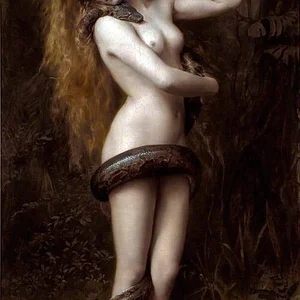
Lilith
A demonic figure rooted in Mesopotamian mythology (Lilitu), Lilith was incorporated into Jewish tradition as Adam's first wife, before Eve. Refusing to submit, she leaves the Garden of Eden and becomes a nocturnal demon threatening newborns and sleeping men.
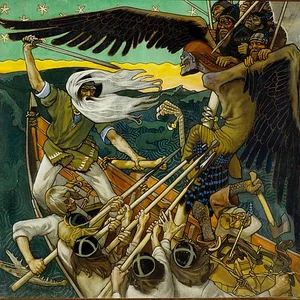
Louhi
Louhi is the powerful witch-queen of Pohjola in Finnish mythology, a central figure of the Kalevala. Mistress of magic and dark forces, she opposes the heroes Väinämöinen and Ilmarinen. She holds the Sampo, a mysterious object that brings prosperity.
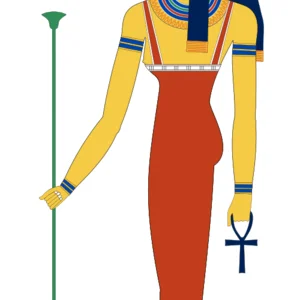
Maat
Egyptian goddess of justice, truth, and cosmic order, Maat is a central figure in the religion and moral thought of ancient Egypt. Depicted with an ostrich feather on her head, she embodies the universal principle of balance and harmony that governs the cosmos, society, and the afterlife.
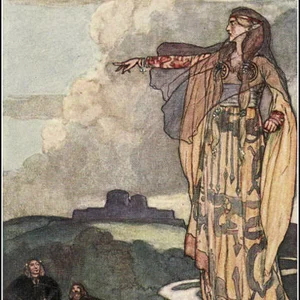
Macha
Macha is a goddess of Irish Celtic mythology, a sovereign figure linked to war, fertility, and kingship. She appears in several forms and is one of the goddesses associated with the warrior triad of the Morrígna.
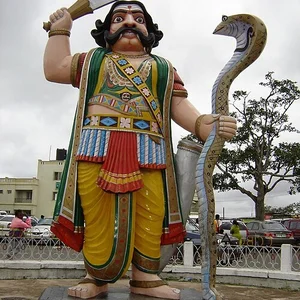
Mahishasura
Mahishasura is a buffalo-demon (asura) from Hindu mythology who, after obtaining invincibility against any man or god, conquered the three worlds and drove the gods from paradise. The goddess Durga, created from the combined energy of all the gods, ultimately defeated him after nine days of battle.
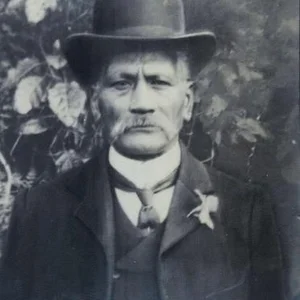
Mahuika
Mahuika is the goddess of fire in the Māori mythology of New Zealand. Guardian of the flames she carries in her fingernails, she is famous for her confrontation with the hero Māui, to whom she ultimately yields the secret of fire.
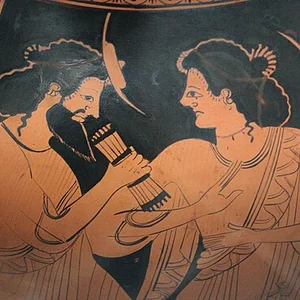
Maia
Maia is a deity of Greek mythology, daughter of the Titan Atlas and the Oceanid Pleione. She is the eldest and most beautiful of the seven Pleiades. She is best known as the mother of Hermes, whom she conceived with Zeus in a cave on Mount Cyllene.
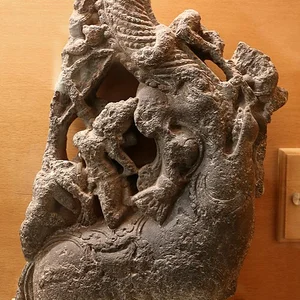
Makara
The makara is a hybrid aquatic creature from Hindu mythology, blending features of a crocodile, an elephant and a fish. It serves as the mount (vahana) of the deities Varuna, god of the waters, and Ganga, goddess of the Ganges.
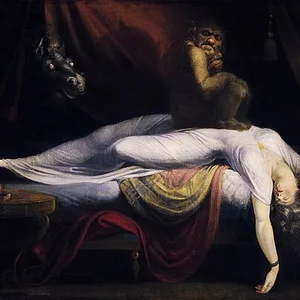
Mara
In Buddhist tradition, Mara is the supreme demon of desire and illusion. He attempted to prevent Siddhartha Gautama from attaining Enlightenment by subjecting him to temptations and trials beneath the Bodhi tree. He personifies the forces of attachment and ignorance that bind beings to the cycle of rebirth.
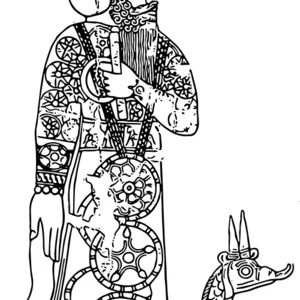
Marduk
Marduk is the supreme god of the Babylonian pantheon, tutelary deity of the city of Babylon. He embodies creation, justice, and divine sovereignty. His rise to king of the gods is narrated in the creation epic *Enûma Eliš*.
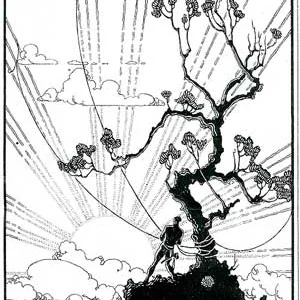
Maui-tikitiki-a-Taranga
Demigod and trickster hero of Māori and Polynesian mythology. Born prematurely and abandoned in the ocean by his mother Taranga, he accomplished extraordinary feats: fishing up the islands, slowing the sun, and stealing fire from the gods.
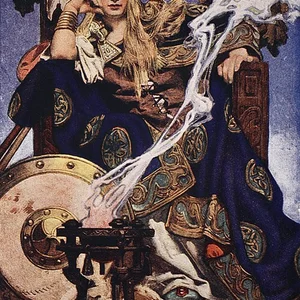
Medb
Legendary queen of Connacht in Irish mythology. A central figure of the Ulster Cycle, she leads the great cattle raid of the Táin Bó Cúailnge to seize the Brown Bull of Cooley. She embodies sovereignty, war, and fertility in the Celtic tradition.
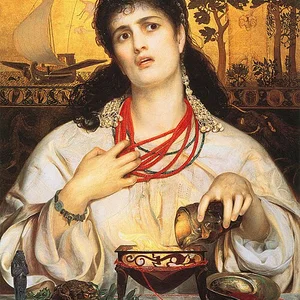
Medea
A tragic figure of Greek mythology, Medea is a sorceress from Colchis, daughter of King Aeëtes and granddaughter of Helios. Driven by love for Jason, she helps him seize the Golden Fleece, but when he betrays her, she exacts a terrible revenge by killing her own children.

Menā
Menā is a goddess of Hindu mythology, the wife of Himavat, the personification of the Himalayas, and queen of the mountains. Mother of the great goddess Pārvatī as well as of Gangā and Mount Maināka, she is celebrated in the Purāṇas as the mind-born daughter (mānasaputrī) of the Pitṛ ancestors.
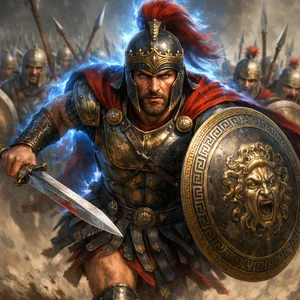
Menelaus
King of Sparta in Greek mythology, husband of Helen, the most beautiful woman in the world. The abduction of Helen by the Trojan Paris leads him to seek the aid of his brother Agamemnon and to unite the Greek kings against Troy.
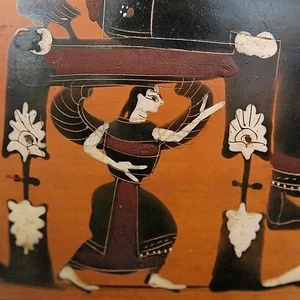
Metis
Metis is an Oceanid of Greek mythology, daughter of the Titans Oceanus and Tethys. The personification of cunning and wisdom, she was Zeus's first wife and the mother of Athena. Zeus swallowed her while she was pregnant, fearing a prophecy that their child would dethrone him.
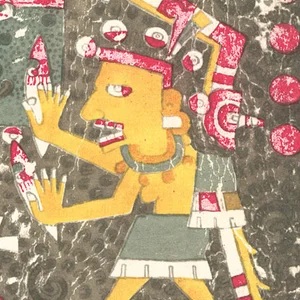
Mictecacihuatl
Aztec goddess of death and queen of Mictlan, the realm of the dead. She rules alongside her husband Mictlantecuhtli and watches over the bones of the deceased. She is celebrated today during Día de los Muertos.
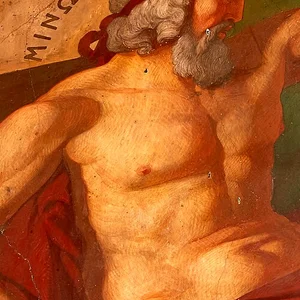
Minos
Legendary king of Crete, son of Zeus and Europa. He had the Labyrinth built to imprison the Minotaur, a monster born of the union between his wife Pasiphae and a divine bull. After his death, he became one of the judges of the Underworld.
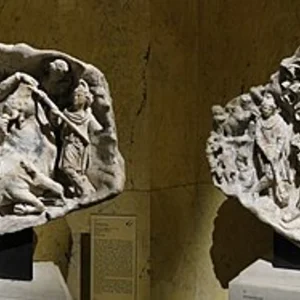
Mithra
An Indo-Iranian deity of contracts and light, Mithra was venerated in Persian Zoroastrianism before becoming a mysterious solar god of the Roman Empire. His cult, Mithraism, spread among Roman soldiers from the 1st to the 4th centuries AD.
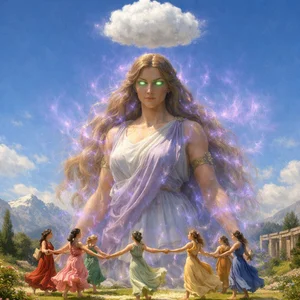
Mnemosyne
Greek Titaness personifying Memory, daughter of Ouranos and Gaia. United with Zeus for nine consecutive nights, she gave birth to the nine Muses, divine patrons of the arts and sciences. Her name is the origin of the word “mnemonic.”
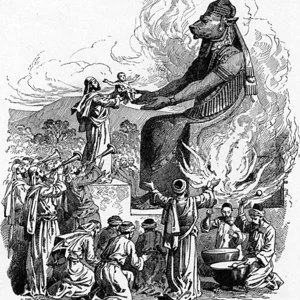
Moloch
A Canaanite Semitic deity associated with child sacrifice, Moloch is mentioned in the Bible as an abhorrent idol. Depicted as a bull or a bronze statue, he became in Judeo-Christian and literary tradition the symbol of idolatrous cruelty.
Morrigan
Irish Celtic goddess of war, fate, and death, belonging to the mythical people of the Tuatha Dé Danann. Present in medieval Irish texts that preserve much older oral traditions, she embodies sovereignty and the violence of the battlefield. She appears notably in the Ulster Cycle epic, in confrontation with the hero Cú Chulainn.
Muri-ranga-whenua
Muri-ranga-whenua is an ancestor (grandmother) of the hero Māui in the Māori mythology of New Zealand. She entrusts him with her enchanted jawbone, from which he fashions the weapon and magic fish-hook of his great deeds, notably the fishing up of the North Island and the snaring of the Sun.
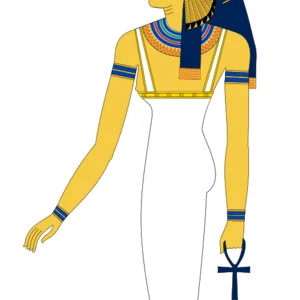
Mut
Mut is a goddess of Egyptian mythology, venerated as a mother goddess and queen of the deities. Wife of the god Amun and mother of Khonsu, she forms the Theban triad with them. Her cult was centered in Thebes, in the temple of Karnak.

Nāmaka
Nāmaka (or Nāmaka-o-Kahaʻi) is a goddess of water and the sea in Hawaiian mythology. The elder sister and rival of the fire goddess Pele, she embodies the forces of the ocean that are eternally opposed to those of the volcano.
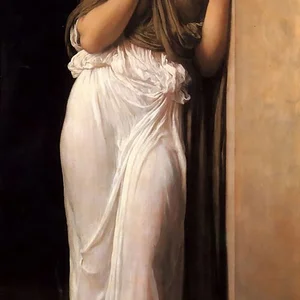
Nausicaa
Nausicaa is a Phaeacian princess from Greek mythology, the daughter of King Alcinous and Queen Arete. In Homer's Odyssey, she discovers the shipwrecked Odysseus on the shore of the island of Scheria and welcomes him to her father's court.
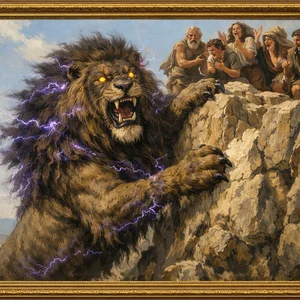
Nemean Lion
A monstrous creature of Greek mythology, the Nemean Lion terrorized the region of Nemea in Argolis. Its hide was said to be impenetrable by any weapon. Heracles strangled it with his bare hands during the first of his twelve labors, then wore its skin as armor.
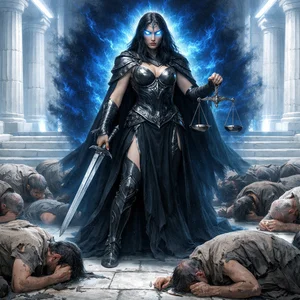
Nemesis
Greek goddess of divine vengeance and just retribution, Nemesis punishes hubris — the arrogance and excess of mortals who rise above their station. She embodies cosmic balance and immanent justice in the tradition of Greek mythology.
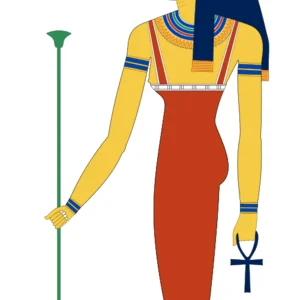
Nephthys
An ancient Egyptian goddess, Nephthys is the protector of the dead and the deceased. Sister of Isis, Osiris, and Set, she plays a fundamental role in Egyptian funerary rites. Her tradition is passed down through the Pyramid Texts and the Coffin Texts.
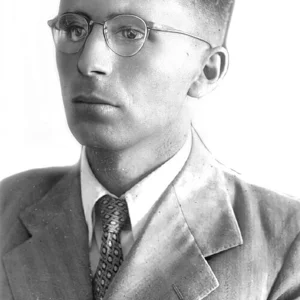
Nestis
Nestis is a deity from Greek mythology associated with water, mentioned by the philosopher Empedocles (5th century BCE) as one of the four fundamental roots of the universe. Sometimes identified with Persephone, she personifies the element of water in Empedoclean cosmology.
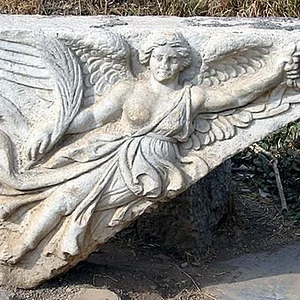
Nike
Nike is the personified goddess of victory in Greek mythology. Daughter of Pallas and Styx, she is depicted as winged, holding a laurel wreath or a palm branch. She accompanies Zeus and Athena and presides over both military and athletic victories.

Nitocris
2250 av. J.-C. — 2191 av. J.-C.
Nitocris is a legendary queen or female pharaoh of ancient Egypt, associated with the end of the Sixth Dynasty (c. 2184 BC). Mentioned by Herodotus and Manetho, she is said to have avenged the murder of her brother before taking her own life. Her historical existence remains debated.
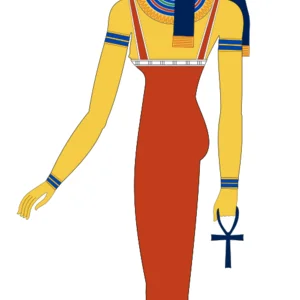
Nut
Nut is the Egyptian goddess of the sky in ancient Egyptian mythology. Her arched body, scattered with stars, forms the celestial vault that protects the earth. She swallows the sun each evening and gives birth to it again each morning.
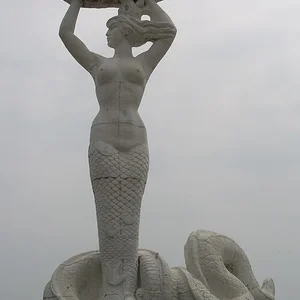
Nüwa
Creator goddess of Chinese mythology, Nüwa molded the first humans from yellow clay. She then repaired the vault of heaven by melting stones of five colors after the pillars of the sky collapsed.
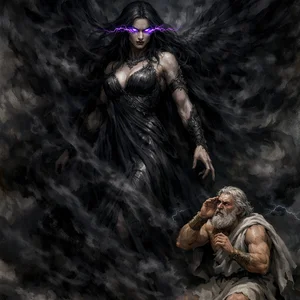
Nyx
Primordial goddess of Night in Greek mythology, born from the original Chaos. Mother of countless deities including Hypnos (Sleep), Thanatos (Death), and the Moirai (Fate). So fearsome that even Zeus refused to cross her.
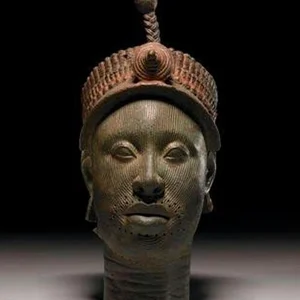
Olokun
Olokun is a Yoruba deity of the ocean depths, venerated in West Africa and in Afro-diasporic traditions. Orisha of the abyss, he symbolizes wealth, unfathomable mysteries, and the power of the deep waters.
Otrera
In Greek mythology, Otrera is a queen of the Amazons, the people of warrior women. As the daughter or consort of Ares, the god of war, she is presented as the mother of the famous queens Hippolyta and Penthesilea.
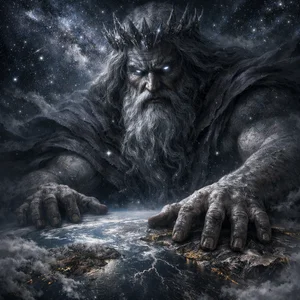
Ouranos
A primordial Greek deity personifying the starry Sky, Ouranos is the husband of Gaia (the Earth) and the father of the Titans, the Cyclopes, and the Hecatoncheires. Hated by the children he refused to release, he was castrated by his son Cronus, giving rise to Aphrodite according to the Hesiodic tradition.
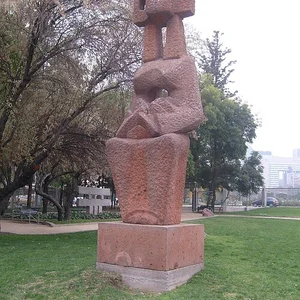
Pachamama
A major deity of the Andean peoples, particularly the Inca, Pachamama is the Earth Mother — goddess of fertility, agriculture, and the cycle of seasons. Venerated since pre-colonial times, she embodies the nourishing earth and is the subject of ritual offerings still practiced today in the Andes.
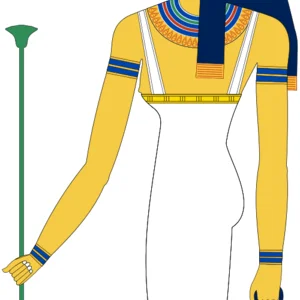
Pakhet
Pakhet (“she who scratches”) is a lioness goddess of Egyptian mythology, a deity of the hunt associated with the desert and the wadis. A protective figure with a warlike nature, she was identified by the Greeks with Artemis during the Ptolemaic period.
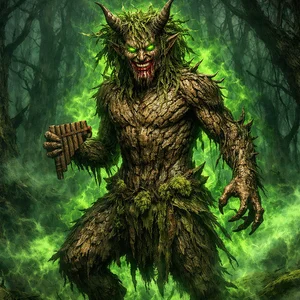
Pan
Greek deity of wild nature, shepherds, and flocks, Pan is depicted as half-man, half-goat. Inventor of the reed flute (syrinx), he embodies the uncontrollable forces of nature and is the origin of the word "panic."

Papatuanuku
Papatuanuku is the Earth Mother of Māori cosmogony, a central figure passed down through oral tradition in Polynesia. Wife of Ranginui (Sky Father), her separation from him by their children gave birth to the world as the Māori conceive it.
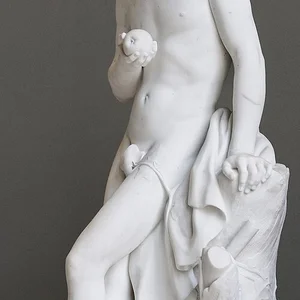
Paris
Trojan prince, son of Priam and Hecuba, Paris triggers the Trojan War by abducting Helen, wife of the Spartan king Menelaus. His judgment among the three goddesses determines the fate of Troy.
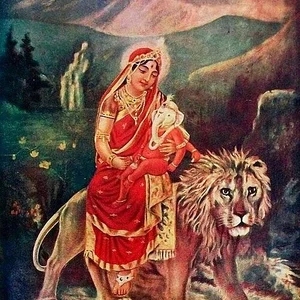
Parvati
Pārvatī is a major goddess of the Hindu tradition, daughter of the mountain god Himavat and consort of Shiva. Venerated as the goddess of fertility, maternal love, and devotion, she embodies the divine feminine energy (Shakti). Her figure appears in the great Sanskrit epics and the Purāṇas, texts composed between the 4th and 12th centuries CE.

Pasiphae
Pasiphae is a figure from Greek mythology, daughter of Helios and wife of Minos, king of Crete. Struck by an unnatural passion for a bull sent by Poseidon, she gave birth to the Minotaur — half man, half bull — who was imprisoned in the Labyrinth built by Daedalus.
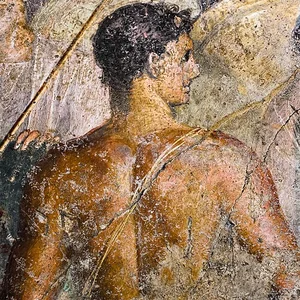
Patroclus
Greek hero of mythology and faithful companion of Achilles during the Trojan War. After donning Achilles' armor to restore the Greeks' courage, he is killed by Hector, triggering his friend's furious revenge.
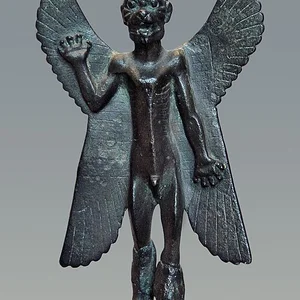
Pazuzu
Pazuzu is a Mesopotamian demon of the evil wind, depicted with a canine face, raptor wings, and a hybrid body. Paradoxically, he was invoked as a protector against Lamashtu, the demon of childbirth. His image adorned amulets to protect pregnant women and newborns.
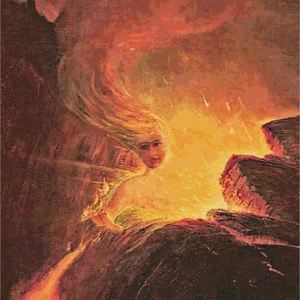
Pele
Goddess of fire, volcanoes, and creation in Hawaiian mythology, Pele is a central figure in Polynesian oral tradition. She is said to dwell in the Halemaʻumaʻu crater of the Kīlauea volcano on the island of Hawaiʻi. Her myth, passed down orally by the Hawaiian people, explains the formation of the volcanic islands of the Pacific.
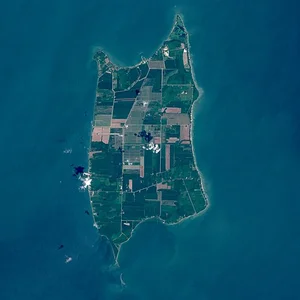
Peleus
Hero of Greek mythology, king of Phthia in Thessaly. Son of Aeacus and grandson of Zeus, he is famous for his marriage to the Nereid Thetis and for being the father of Achilles.
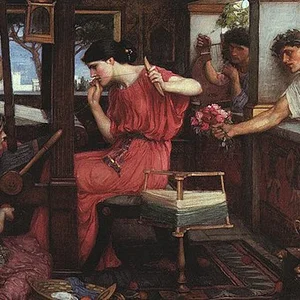
Penelope
A figure from Greek mythology, wife of Odysseus and mother of Telemachus. During her husband's twenty-year absence, she fends off her suitors with a famous trick: each night she unravels the shroud she weaves by day. She embodies faithfulness, patience, and female intelligence in the Homeric epic.
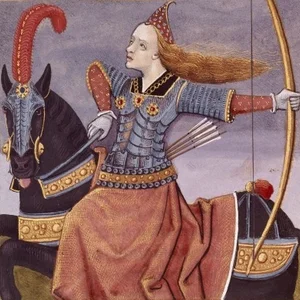
Penthesilea
Queen of the Amazons in Greek mythology, daughter of Ares and Otrera. According to the epic tradition, she led her warrior women to the aid of Troy after Hector's death and faced Achilles in single combat, who killed her even as he fell in love with her.
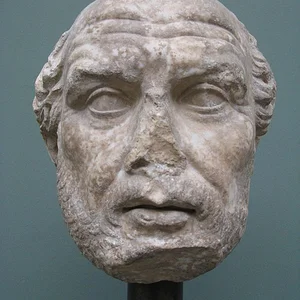
Phidias
499 av. J.-C. — 429 av. J.-C.
Phidias is considered the greatest sculptor of ancient Greece in the 5th century BC. He created the chryselephantine statue of Athena Parthenos and the statue of Zeus at Olympia, counted among the Seven Wonders of the Ancient World.

Pisistratus
Youngest son of Nestor, king of Pylos, Pisistratus is a character in Homer's Odyssey. He welcomes Telemachus at Pylos and accompanies him to Sparta to meet Menelaus. A figure of friendship and hospitality, he embodies the aristocratic virtues of the Greek epic.

Polybus
In Greek mythology, Polybus is the king of Corinth who takes in and raises Oedipus, abandoned as a child, knowing nothing of his true origins. Oedipus believes himself to be his legitimate son, which drives him to flee Corinth to escape the oracle foretelling that he will kill his father and marry his mother.
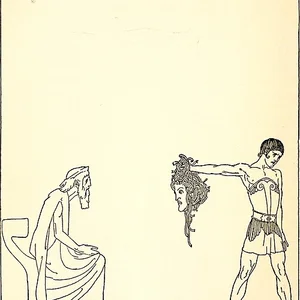
Polydectes
King of the island of Seriphos in Greek mythology, son of Magnes. Consumed by desire for Danaë, he sent her son Perseus to retrieve the head of the Gorgon Medusa in order to get rid of him. Upon his return, Perseus turned Polydectes to stone by showing him Medusa's head.
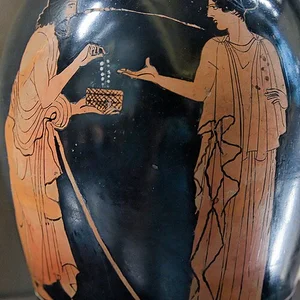
Polynices
Polynices is a figure from Greek mythology, the son of Oedipus and Jocasta, and brother of Eteocles, Antigone, and Ismene. His conflict with his brother over the throne of Thebes triggers the war of the Seven Champions and inspires Sophocles's tragedy.
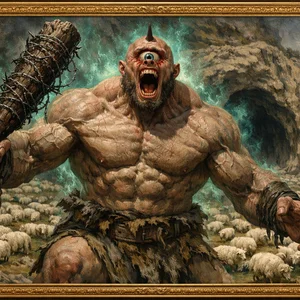
Polyphemus
A one-eyed Cyclops, son of Poseidon and the nymph Thoosa, Polyphemus is one of the monstrous giants of Greek mythology. Famous for imprisoning Odysseus and his companions in his cave, he is ultimately blinded by the hero, who outsmarts his revenge by calling himself “Nobody.”
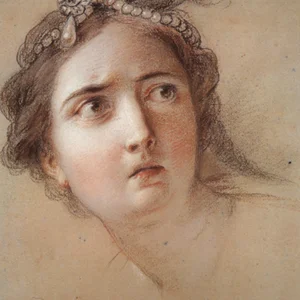
Potiphar's Wife
Biblical character from the Old Testament, wife of Potiphar, captain of Pharaoh's guard. She attempts to seduce Joseph, son of Jacob, and, after being rejected, falsely accuses him of assault, leading to Joseph's imprisonment.
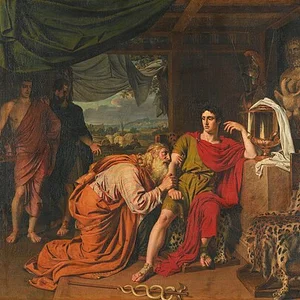
Priam
Priam is the last king of Troy in Greek mythology, father of fifty sons including Hector and Paris. His reign is defined by the Trojan War, triggered by the abduction of Helen. He dies during the fall of the city, killed by Neoptolemus.
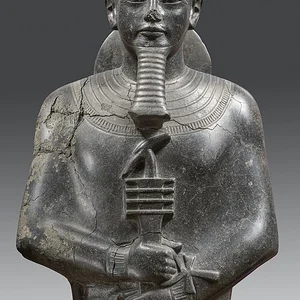
Ptah
Ptah is one of the oldest and most important gods of ancient Egypt, a creator god and patron of craftsmen and architects. Venerated at Memphis since the Old Kingdom, he embodies creation through thought and speech. His triad with Sekhmet and Nefertum forms the heart of the Memphite cult.
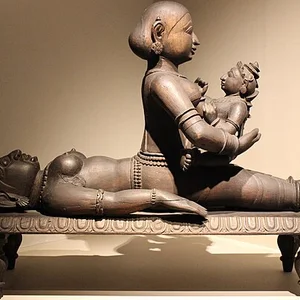
Putana
Putana is a demoness from Hindu mythology, sent by King Kamsa to kill the infant Krishna by nursing him with poisoned milk. Krishna, recognizing her divine nature, slew her while granting her spiritual liberation.
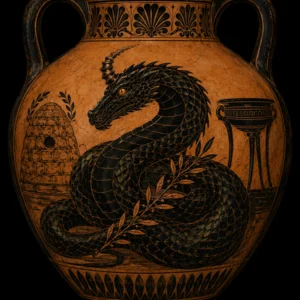
Python
A massive serpent-dragon of Greek mythology, guardian of the sanctuary of Delphi. Slain by the god Apollo, who seized the site and established the famous oracle there. Its name was given to the Pythia, the prophetic priestess of Apollo.
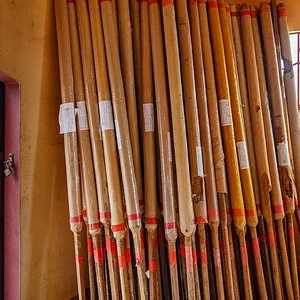
Qilin
A fabulous creature of Chinese mythology, the Qilin is a benevolent chimera with the body of a deer, horse's hooves, and dragon's scales, often nicknamed the “unicorn of the East.” A creature of good omen, it heralds the birth or death of a sage and embodies peace and prosperity.
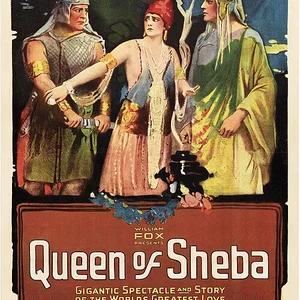
Queen of Sheba
Legendary ruler mentioned in the Bible, the Quran, and Ethiopian tradition. She is said to have visited King Solomon in Jerusalem, drawn by his wisdom. An iconic figure of exchange between ancient Arabia, Africa, and the Near East.
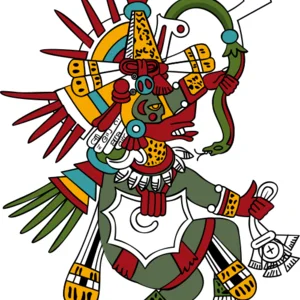
Quetzalcoatl
Quetzalcoatl, the "Feathered Serpent," is one of the most important deities in Mesoamerica. Venerated by the Aztecs and the Toltecs, he is the god of wind, wisdom, and creation. His figure spans several pre-Hispanic civilizations across more than two millennia.
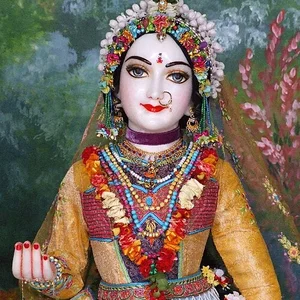
Radha
A central figure in Hindu tradition, Radha is the divine companion of Krishna and the embodiment of pure, absolute love (bhakti). Rooted in Vedic culture and popularized through medieval Sanskrit texts, she symbolizes the human soul seeking union with the divine. Her legend, passed down primarily through oral tradition before being set in writing in texts such as the Gita Govinda (12th century), lies at the heart of Vaishnava spirituality.

Raijin
Raijin is the god of thunder and lightning in Japanese Shinto mythology. He is depicted as a demon surrounded by drums that he strikes to produce thunder. Often paired with Fūjin, the god of wind, he stands as a guardian at the gates of major Buddhist and Shinto temples.
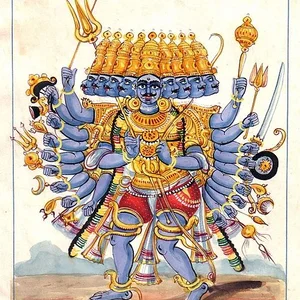
Ravana
Ravana is the ten-headed demon king of Lanka in the Hindu epic the Ramayana. As the principal antagonist, he abducts Sita, the wife of Rama, triggering a cosmic war. Despite his demonic nature, he is recognized as a scholar, accomplished musician, and devoted worshipper of Shiva.
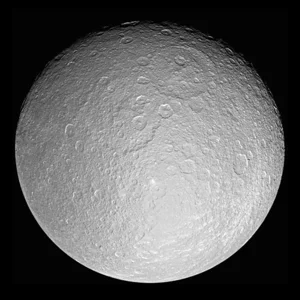
Rhea
Titaness of Greek mythology, daughter of Uranus and Gaia, wife of Cronus. Mother of the six great Olympian gods, she saved Zeus by substituting a swaddled stone for the infant to deceive Cronus. Identified with Cybele, she is venerated as the Great Mother of all the gods.
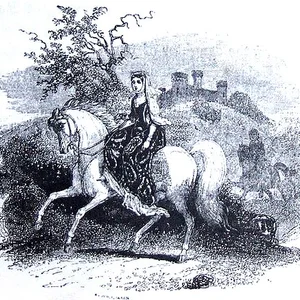
Rhiannon
A Welsh goddess from Celtic mythology, Rhiannon appears in the Mabinogion, a collection of Welsh prose tales compiled around the 11th–12th centuries from older oral traditions. A figure of the Otherworld (Annwn), she is associated with white horses, magic, and sovereignty.
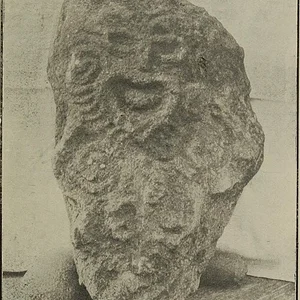
Rongo
Rongo is a major deity of Polynesian mythology, venerated especially by the Māori of New Zealand. God of peace, agriculture, and cultivated plants, he is one of the great atua (gods) born of the union of Ranginui (the sky) and Papatūānuku (the earth). He symbolizes harmony and fertility, in contrast to his brother Tū, god of war.
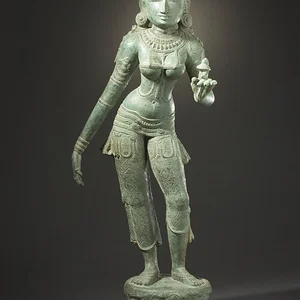
Rukmini
Rukmini is the principal wife of Krishna and the goddess of prosperity in Hinduism. A princess of the kingdom of Vidarbha, she eloped with Krishna to escape a forced marriage, symbolizing divine love and absolute devotion.

Rusalka
The rusalka is a female water spirit from Slavic folklore, often depicted as a young woman with long hair haunting rivers, lakes, and ponds. According to tradition, she is said to be the soul of a drowned woman or of a young girl who died before marriage, luring men down into the depths.
Sammu-ramat (Semiramis)
Regent of the Assyrian Empire around 811–808 BC, Sammu-ramat held power in the name of her son Adad-nirari III. A historical figure, she quickly became a legendary character in the Greek world, symbolizing the warrior queen and great builder of the ancient Near East.
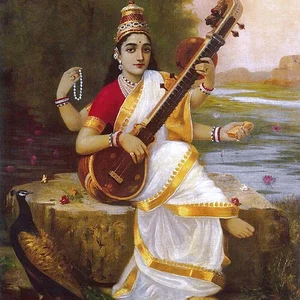
Sarasvati
A major goddess of the Hindu tradition, Saraswati is venerated as the deity of knowledge, speech, the arts, and music. Rooted in the Vedic civilization of ancient India, she is mentioned as early as the hymns of the Rig-Veda (c. 1500–1200 BCE). She embodies the ideal of pure knowledge and spiritual creativity.
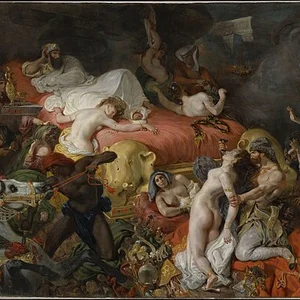
Sardanapalus
Sardanapalus is a legendary king of Assyria, a figure from ancient Greek tradition. Renowned for his extreme luxury and dissolute lifestyle, he is said to have chosen to die in flames rather than surrender to his enemies. His tragic fate inspired numerous works of art, most notably the painting by Eugène Delacroix.
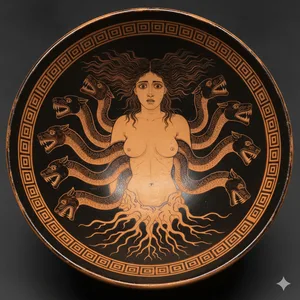
Scylla
A sea monster of Greek mythology, Scylla was a nymph transformed into a six-headed creature by the sorceress Circe. She devours sailors from her rock in the Strait of Messina, forcing Odysseus to choose between her and the whirlpool Charybdis.

Sedna
Sedna is the Inuit goddess of the sea and marine animals, drawn from the oral traditions of Arctic peoples (Inuit, Yupik). A central figure in circumpolar cosmology, she rules the ocean depths and determines the abundance or scarcity of sea game.
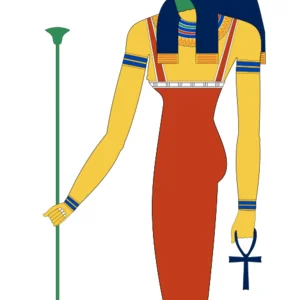
Sekhmet
A lioness goddess of ancient Egyptian mythology, Sekhmet embodies both warlike destruction and healing power. Daughter of Ra, she is the protector of the pharaoh on the battlefield and the patron of physicians. Her cult, attested as far back as the Old Kingdom, was especially vibrant in Memphis.

Selene
A Greek Titaness personifying the Moon, Selene crosses the sky each night on her silver chariot drawn by white horses. Daughter of Hyperion and Theia, she is the sister of Helios (the Sun) and Eos (the Dawn). Her passion for the shepherd Endymion, whom she caused to fall into an eternal sleep so she could gaze upon him forever, is one of the most celebrated myths in the Greek tradition.
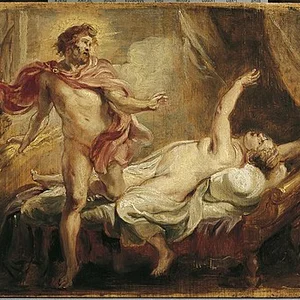
Semele
Semele is a princess of Thebes in Greek mythology, daughter of Cadmus and Harmonia. Loved by Zeus, she becomes the mother of Dionysus, god of wine. She perishes struck by lightning after asking to see Zeus in all his divine splendor.
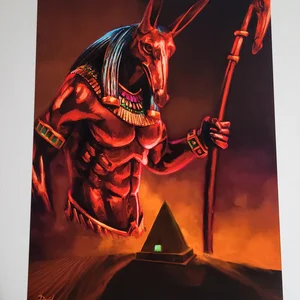
Set
Set is the Egyptian god of chaos, storms, and the desert. Brother of Osiris, whom he murdered to seize the throne of Egypt, he was later defeated by his nephew Horus. An ambivalent figure, he was also venerated as the protector of Ra against the serpent Apophis.
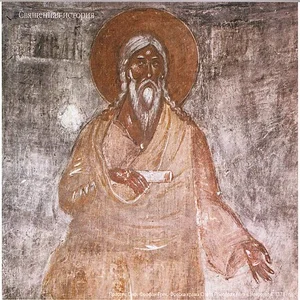
Seth
3873 av. J.-C. — 2957 av. J.-C.
Egyptian god of chaos, storms, and the desert, Seth is one of the most complex deities in the Egyptian pantheon. Brother of Osiris, whom he murdered, he embodies primal violence but also the protective force necessary for cosmic order.
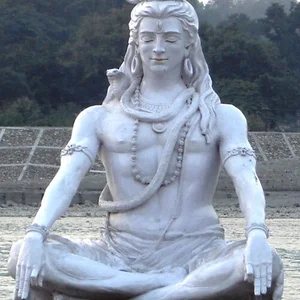
Shiva
Shiva is one of the three principal deities of Hinduism, forming the Trimūrti alongside Brahmā and Vishnu. God of destruction and transformation, he also embodies meditation, the arts, and fertility. His cult, rooted in the Indus Valley civilization, is one of the oldest in the world.
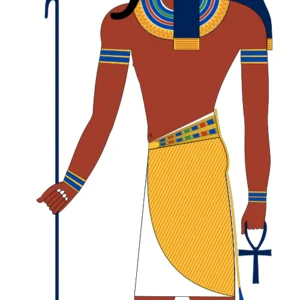
Shou
Shou is the ancient Egyptian deity personifying air and light. Son of Ra and husband of Tefnut, he supports the vault of the sky by separating Nut (the sky) from Geb (the earth). He embodies the vital space between the cosmos and the earthly world.
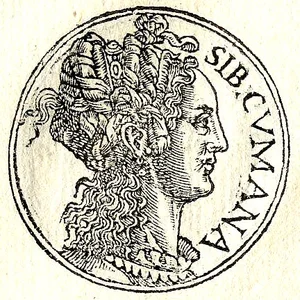
Sibyl of Cumae
A legendary prophetess of Antiquity, she presided over Apollo's oracle at Cumae, in Campania. According to tradition, she lived for a thousand years and sold the Sibylline Books to King Tarquin. Virgil makes her the guide of Aeneas in the Underworld in the Aeneid.
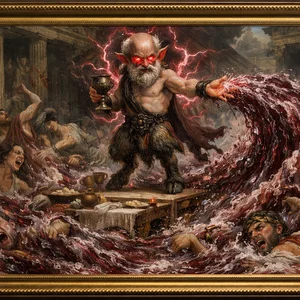
Silenus
A deity of Greek mythology, Silenus is the old satyr companion and foster-father of Dionysus, god of wine. Perpetually drunk yet reputed for profound wisdom, he is often depicted riding a donkey, unable to stand on his own. His paradoxical figure — drunkenness as a path to truth — resonated throughout Greek and Roman Antiquity.
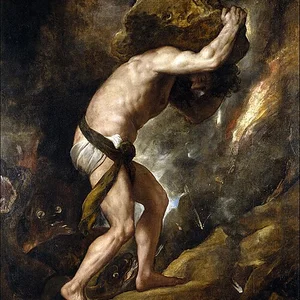
Sisyphus
Legendary king of Corinth, Sisyphus is famous for having outsmarted the gods on several occasions. Condemned by Zeus to the Underworld, he must eternally push a boulder to the top of a mountain, from which it rolls back down endlessly.
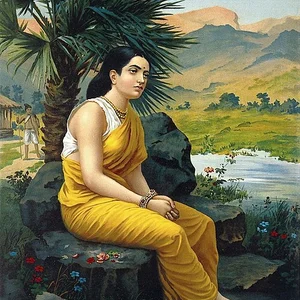
Sita
Central heroine of the Ramayana, the Sanskrit epic of the Hindu tradition, Sita is the wife of Rama and the adopted daughter of King Janaka. Born of the earth according to tradition (her name means "furrow"), she embodies purity, faithfulness, and virtue in Indian culture.
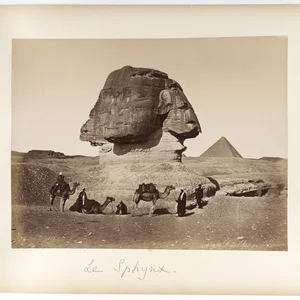
Sphinx
A monster from Greek mythology with the body of a lion and the head of a woman, the Sphinx guarded the gates of Thebes. It posed a deadly riddle to travelers and devoured those who failed to answer. Defeated by Oedipus, it threw itself off a cliff.
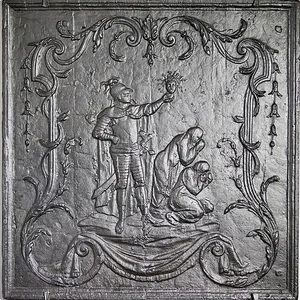
Stheno
In Greek mythology, Stheno is the eldest of the three Gorgons, daughters of the sea deities Phorcys and Ceto. Unlike her sister Medusa, she is immortal. Her name means “the strong one” or “the mighty one.”
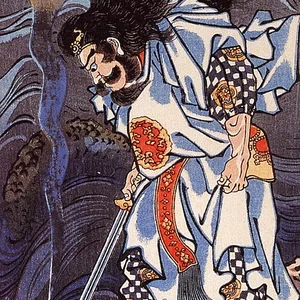
Susanoo
Susanoo is the god of storms in Japanese Shinto, son of Izanagi and brother of Amaterasu. Banished from the heavens, he accomplished the feat of slaying the eight-headed serpent Yamata no Orochi, discovering within its body the sacred sword Kusanagi.
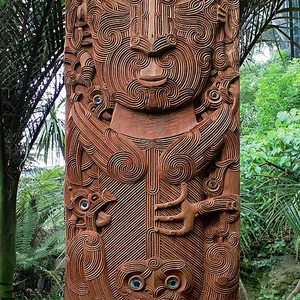
Tane
Tāne is the god of the forest and birds in Māori mythology. Son of Rangi (the Sky) and Papa (the Earth), he separated them to let light into the world. He is also the creator of the first woman, shaped from the red clay of the earth.
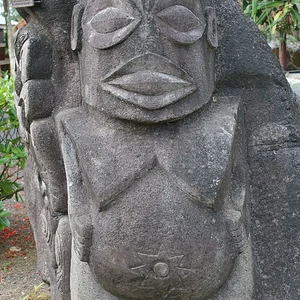
Tangaroa
Tangaroa is the god of the sea and oceans in Polynesian mythology, venerated across the Pacific (Māori, Samoa, Tahiti, Hawaii). Son of Rangi (sky) and Papa (earth), he rules over the ocean depths and is often regarded as the creator of many islands and living beings.
Tantalus
Legendary king of Lydia or Phrygia, son of Zeus, Tantalus was condemned to the Underworld for offending the gods by serving them the flesh of his son Pelops. His eternal torment — surrounded by water and fruit forever out of reach — gave rise to the word "tantalize."
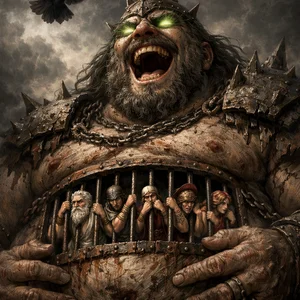
Tartarus
In Greek mythology, Tartarus is both a primordial deity born of Chaos and a cosmic place: the deepest abyss in the universe, located beneath the Underworld, where Zeus imprisoned the defeated Titans and where the greatest criminals atone for their crimes for eternity.
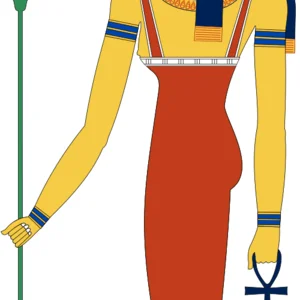
Tefnut
Tefnut is an Egyptian goddess with the head of a lioness, personification of moisture and dew. Daughter of Ra and sister-wife of Shu, she is part of the Ennead of Heliopolis. She embodies life-giving rain and plays a role in maintaining cosmic balance.

Telegonus
Son of Odysseus and the sorceress Circe, Telegonus is a figure from Greek mythology. He accidentally killed his father Odysseus without recognizing him, thus fulfilling a tragic prophecy.
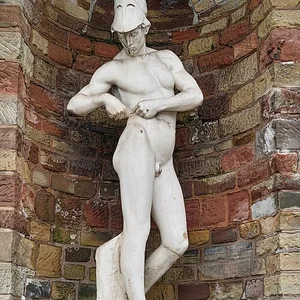
Telemachus
Telemachus is the son of Odysseus and Penelope in Greek mythology. A young man at the time of his father's return to Ithaca, he sets out to search for him and then helps him eliminate the suitors besieging his mother.

Tethys
Titaness of the sea and freshwaters in Greek mythology, daughter of Gaia and Ouranos. Wife of the Titan Oceanus, she is the mother of the 3,000 Oceanids and the great river gods, personifying the nourishing waters of the world.
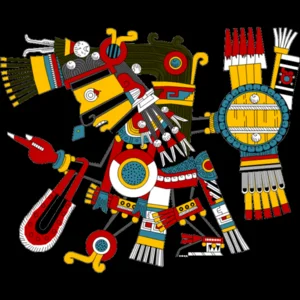
Tezcatlipoca
Tezcatlipoca, "Smoking Mirror," is one of the major deities of the Aztec pantheon. God of the night, the starry sky, sorcery, and fate, he is the eternal rival of Quetzalcóatl. His emblematic attribute is an obsidian mirror in which he reads the thoughts of men.
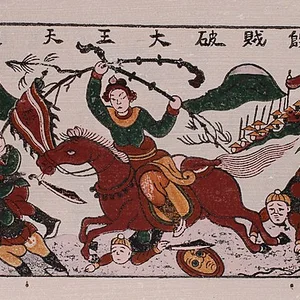
Thánh Gióng
Legendary hero of Vietnam, one of the Four Immortals (Tứ bất tử) of Vietnamese popular belief. A miraculous child who remained mute until the age of three, he suddenly awakens to repel a foreign invasion, then ascends to the heavens. He symbolizes resistance against invaders and the strength of youth.
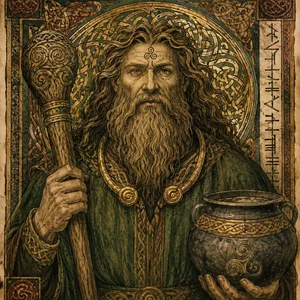
The Dagda
A major deity of Irish mythology, father and chief of the Tuatha Dé Danann. God of fertility, wisdom, and abundance, he wields a colossal club and owns a magical cauldron with inexhaustible provisions.

The Moirai
Greek goddesses embodying Fate, the Moirai are three sisters who spin, measure, and cut the thread of life of every mortal and immortal. Daughters of Zeus and Themis according to Hesiod, they hold absolute authority over the course of all lives — an authority that no one, not even the gods, can challenge.
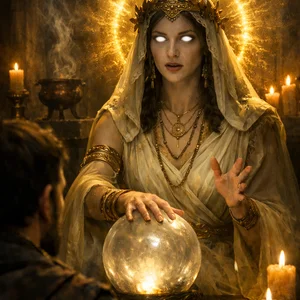
The Pythia
Priestess of Apollo at Delphi, the Pythia delivered her oracles in a trance, seated on a tripod above a fissure in the earth. A central figure in ancient Greek polytheistic religion, her oracle influenced the decisions of city-states and kings.
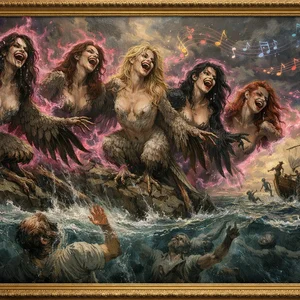
The Sirens
Hybrid creatures of Greek mythology — half-woman, half-bird (later half-fish in the Middle Ages) — whose bewitching song lures sailors to their deaths. Odysseus, lashed to the mast of his ship, is the only mortal ever to have heard them and survived.
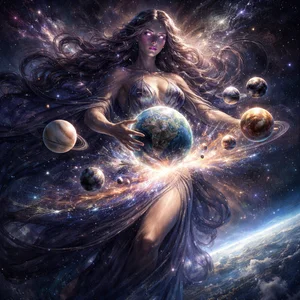
Theia
Titaness of celestial light and vision in Greek mythology. Daughter of Ouranos and Gaia, she united with her brother Hyperion and gave birth to the three great astral deities: Helios (the Sun), Selene (the Moon), and Eos (the Dawn).
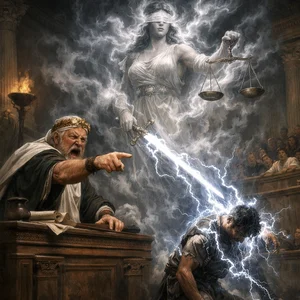
Themis
A Titaness daughter of Ouranos and Gaia, Themis personifies divine law, justice, and cosmic order in the Greek tradition. A privileged counselor of Zeus and his second divine wife, she is the mother of the Horae and the Moirai, guardians of fate and the seasons.

Thetis
Thetis is a Nereid, a sea deity of Greek mythology, daughter of Nereus and mother of the hero Achilles. She plays a central role in Homer's Iliad, interceding with the gods on behalf of her son. An embodiment of divine maternal power, she stands at the heart of Greece's great epic narratives.
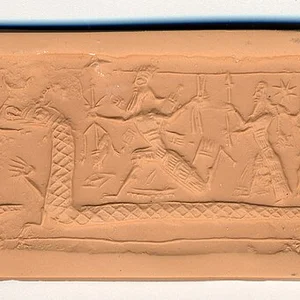
Tiamat
Primordial Babylonian goddess personifying the salt ocean and original chaos. In the Enuma Elish, the Mesopotamian creation epic, she is defeated by the god Marduk, whose body is used to create the sky and the earth.
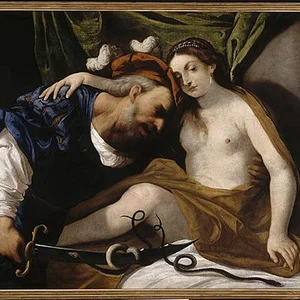
Tiresias
The blind seer of Greek mythology, Tiresias was the most celebrated prophet of Thebes, serving Apollo. Struck blind by the gods, he received in return the gift of prophecy and an exceptionally long life. He appears in many of the greatest works of antiquity, from Sophocles to Homer.
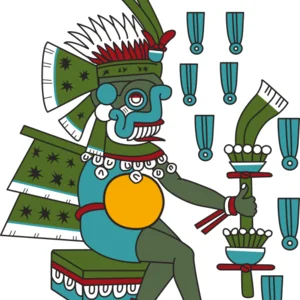
Tlaloc
Tlaloc is the Aztec god of rain, water, and fertility. Venerated since the pre-Classic Mesoamerican civilizations, he was one of the most important deities in the Aztec pantheon, associated with both life and death.
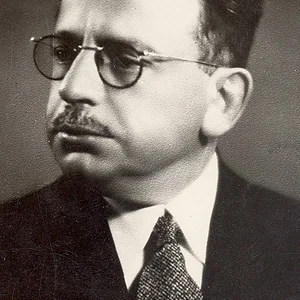
Toci
Toci, whose name means “Our Grandmother” in Nahuatl, is a mother goddess in Aztec mythology. Associated with the earth, healing, and midwives, she was venerated as the “heart of the Earth” and ranks among the major deities of the Mexica pantheon.
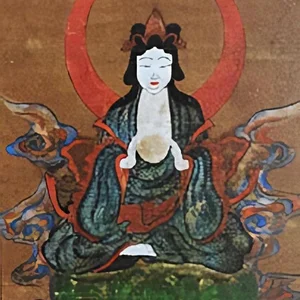
Tsukuyomi
Tsukuyomi is the god of the Moon in Japanese Shintō mythology. Born from the right eye of Izanagi during the primordial purification, he reigns over the night. His quarrel with the sun goddess Amaterasu explains the separation of day and night.
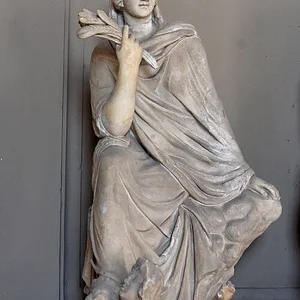
Tyche
Tyche is the Greek goddess of fortune, chance, and destiny. Daughter of Oceanus and Tethys, she personifies the whims of fate that govern the lives of mortals and the destinies of cities. Her cult spread throughout the Hellenistic world.
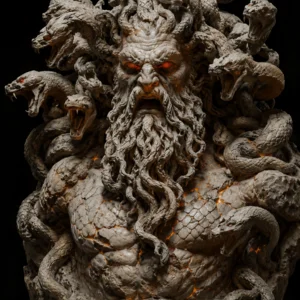
Typhon
Typhon is the ultimate monster of Greek mythology, born of Gaia and Tartarus. A giant with a hundred fire-breathing serpent heads, he challenged Zeus for dominion over the cosmos and was ultimately crushed beneath Mount Etna. He is considered the father of all monstrous creatures.

Ushas
Ushas is the goddess of the dawn in Vedic and Hindu mythology. Celebrated in the Rigveda, she personifies the rising morning light that chases away the darkness and awakens the living world.
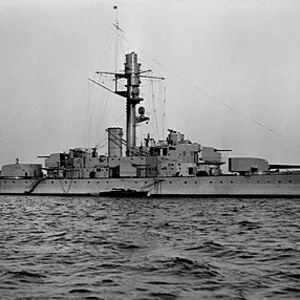
Väinämöinen
Väinämöinen is the central hero of the Kalevala, Finland's national epic. A primordial sage and shamanic bard, he embodies wisdom, magic, and music in Finnic mythology. His kantele casts spells over men, animals, and nature alike.
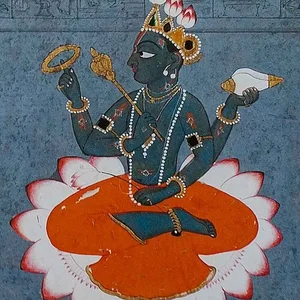
Vishnu
Vishnu is one of the three principal deities of Hinduism, forming the Trimurti alongside Brahma and Shiva. God of protection and preservation of the universe, he manifests in multiple avatars including Krishna and Rama, central figures in Indian mythology.
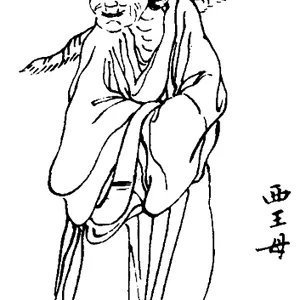
Xiwangmu
Xiwangmu, the Queen Mother of the West, is one of the great deities of Chinese mythology and religion. Guardian of the peaches of immortality, she reigns over Mount Kunlun and presides over the fate of immortals. Her cult, attested as early as the Shang dynasty, spans the entire religious history of China.
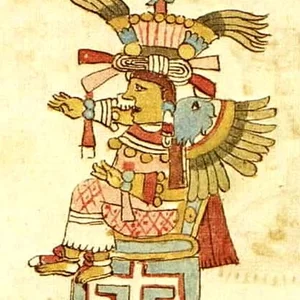
Xochiquetzal
Aztec goddess of beauty, love, fertility, and the creative arts, associated with flowers, plants, and femininity. She represents eternal youth and sensuality in the Mesoamerican pantheon.
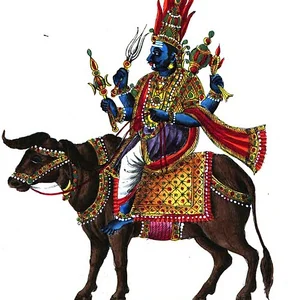
Yama
Yama is the god of death and justice in Hindu and Buddhist traditions. He rules over the realm of the dead and weighs souls to determine their rebirth according to the deeds performed during their lifetime.
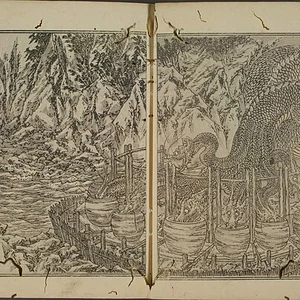
Yamata no Orochi
Yamata no Orochi is a colossal eight-headed, eight-tailed serpent-dragon from Japanese mythology. It is defeated by the storm god Susanoo, who gets it drunk on sake and beheads it, discovering inside one of its tails the sacred sword Kusanagi-no-Tsurugi.
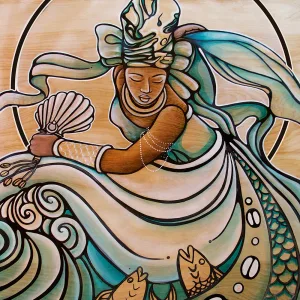
Yemanjá
Yemanjá is a female water deity from the Yoruba religion of West Africa, venerated as the mother of the gods (orishas) and protector of the sea. Carried to the Americas by the Atlantic slave trade, she became a major figure in Brazilian Candomblé and Cuban Santería.
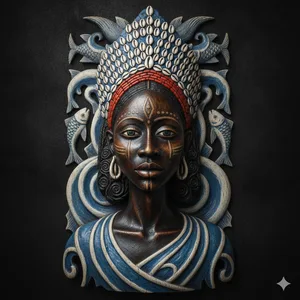
Yemoja
Yemoja is a major orisha of the Yoruba pantheon, goddess of waters and protective mother. Venerated in West Africa, she became a central figure in Afro-American religions (candomblé, santería) born of the diaspora.

Yhi
Yhi is the goddess of the sun, light, and creation in the mythology of the Aboriginal peoples of Australia, particularly the Karraur. Asleep at the beginning of time, her awakening illuminated the world and brought all life on Earth into being.
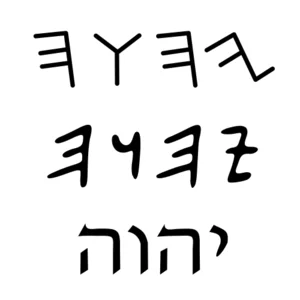
YHWH
YHWH is the divine name in the Hebrew religion, composed of four letters (yod, he, vav, he). It designates the one God of Israel, at the heart of the Abrahamic monotheistic tradition.
Spirituality(158)
Agni
Agni is the god of fire in Vedic and Hindu mythology. The personification of sacrificial fire, he serves as an intermediary between humans and the gods by carrying offerings up to the heavens through smoke. He ranks among the most frequently invoked deities of the Rigveda.
Ahura Mazda
The supreme deity of Zoroastrianism, Ahura Mazda is the creator god of wisdom and light in the religion founded by Zoroaster (Zarathustra) around the 6th century BCE in Persia. He embodies the principle of Good, opposed to Ahriman, the principle of Evil, in a dualistic vision of the cosmos.
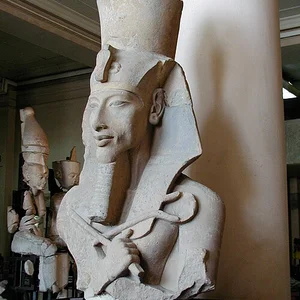
Akhenaten
1400 av. J.-C. — 1335 av. J.-C.
Pharaoh of the 18th Dynasty of Egypt (c. 1353–1336 BCE), Akhenaten revolutionized religion by imposing the monotheistic worship of Aten, the solar disk. He relocated the capital to Akhetaten (Amarna) and profoundly transformed Egyptian art.
Ambika
Ambika is a figure from the Mahabharata, the Sanskrit epic of ancient India. Daughter of the king of Kashi and mother of Dhritarashtra, she plays a central role in the Kuru lineage. Her fate is bound to the practice of niyoga.
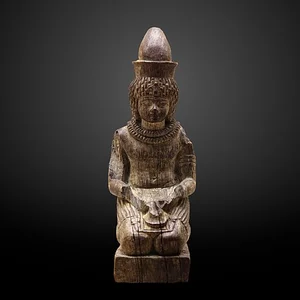
Amenhotep III
1399 av. J.-C. — 1350 av. J.-C.
Pharaoh of the 18th Egyptian dynasty (c. 1391–1353 BC), he ruled Egypt at the height of its diplomatic and artistic power. His reign was marked by relative peace, intensive building activity, and exceptional cultural refinement.
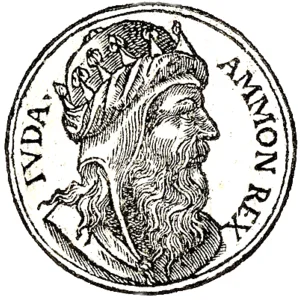
Amon
663 av. J.-C. — 639 av. J.-C.
Amon was the fourteenth king of Judah, son of Manasseh, who reigned around 642–640 BC. Like his father, he practiced idol worship and abandoned the Yahwist faith. He was assassinated by his own servants after only two years of rule.
Anahita
Anahita is a major goddess of ancient Iranian mythology, associated with fertilizing waters, fertility, and victory. Venerated throughout the Achaemenid Empire and beyond, she was integrated into Zoroastrianism as a yazata (benevolent celestial being).
Anat
Anat is a warrior goddess of the Ugaritic pantheon (ancient Syria), venerated in the 2nd millennium BCE. A fierce virgin warrior, she is the sister of the god Baal and ranks among the most formidable deities of the ancient Near East.
Angra Mainyu
Angra Mainyu, also known as Ahriman, is the evil deity of Zoroastrianism, opposed to Ahura Mazda. The embodiment of evil, deceit, and destruction, he stands at the heart of the cosmic dualism in the ancient Persian religion founded by Zarathustra.
Anuket
Anuket is an Egyptian goddess personifying the Nile and its annual floods, venerated at Elephantine and in Nubia. She is depicted wearing a crown of feathers and is associated with the fertility of lands irrigated by the river.
Apep
Apophis, or Apep, is the giant serpent of chaos in ancient Egyptian mythology. Each night, he attacks the solar barque of Ra in the underworld, threatening cosmic order. He is the absolute embodiment of chaos, darkness, and oblivion.
Asherah
Asherah is a major mother goddess of the Canaanite and Syrian pantheon, venerated as queen of the heavens and consort of the god El. Her cult, attested as early as the 2nd millennium BCE, stretched from Phoenicia to Ugarit and influenced the religious practices of the ancient Near East, including in Israel.
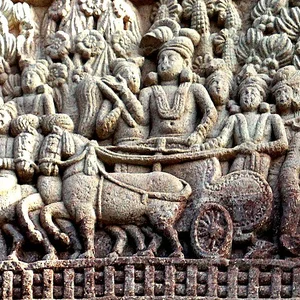
Ashoka
303 av. J.-C. — 231 av. J.-C.
Ashoka was the third emperor of the Maurya dynasty, ruling over nearly the entire Indian subcontinent in the 3rd century BC. Shaken by the carnage of the Kalinga War, he converted to Buddhism and promoted a policy of non-violence (ahimsa) and tolerance. He spread his moral precepts, carved on stone edicts, throughout his empire.
Asmodeus
A demon of lust and wrath in Judeo-Christian and Persian traditions, Asmodeus is one of the oldest demonic figures in religious literature. He appears notably in the Book of Tobit, a deuterocanonical text, under the name Asmodaeus.
Aten
Aten is the solar deity of ancient Egypt, represented as the sun disk whose rays end in human hands. Elevated to the status of sole god by Pharaoh Akhenaten in the 14th century BCE, Aten stood at the heart of an unprecedented religious revolution.
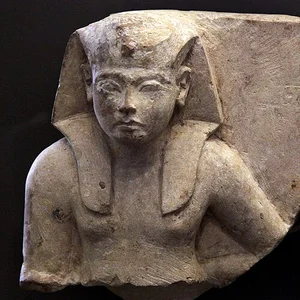
Ay
1400 av. J.-C. — 1400 av. J.-C.
Ay was pharaoh of Egypt around 1323–1319 BCE, successor to Tutankhamun. A senior official and priest, he played a key role at the close of the Amarna period by restoring the traditional worship of the Egyptian gods.
Azazel
Demonic figure from Hebrew traditions and fallen angel of the Book of Enoch. In Leviticus, he is associated with the scapegoat ritual. According to Enochic tradition, he taught humans the metallurgy of weapons and the art of cosmetics.
Baal
Supreme god of the Canaanite pantheon, master of rain, storms, and fertility. His cult was practiced across the ancient Near East from the 2nd millennium BCE and came into conflict with Hebrew monotheism. Demonized by the Abrahamic traditions, he became a demonic figure in medieval texts.
Baiame
Baiame is the central creator deity of several Aboriginal peoples of southeastern Australia, notably the Kamilaroi and the Wiradjuri. Supreme being and sky father, he is considered the source of laws, initiation rites, and cosmic order.
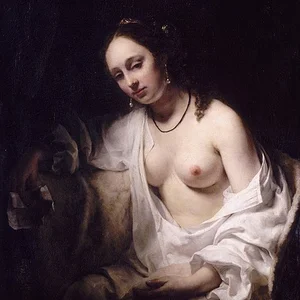
Bathsheba
1008 av. J.-C. — 936 av. J.-C.
Bathsheba is a figure from the Old Testament, wife of Uriah the Hittite and later of King David after Uriah's death. As the mother of Solomon, she played a decisive role in the royal succession by interceding with David to ensure her son would inherit the throne of Israel.
Behemoth
Behemoth is a monstrous creature from the Hebrew Bible, described as a colossal, primordial land beast. In the Book of Job, God invokes it to illustrate his omnipotence before humankind. Jewish tradition makes it the terrestrial counterpart of the sea monster Leviathan.
Belial
Belial is a demonic figure from ancient Hebrew and Jewish traditions, whose name means 'worthless' or 'wickedness'. He appears in the Dead Sea Scrolls as a prince of darkness opposed to the Archangel Michael. He is considered one of the four crowned princes of Hell in medieval demonology.
Bhumi Devi
Bhūmi Devi is the goddess of the Earth in Hindu mythology, the personification of the nurturing planet. Wife of the god Vishnu, she is also known by the names Bhūdevi or Prithvi. She embodies the patience, fertility, and generosity of the earth.
Brigid
A major goddess of Irish Celtic mythology, Brigid is the daughter of the Dagda and patroness of fire, poetry, and healing. Venerated by Celtic peoples, her cult survived Christianization by merging with that of Saint Brigid of Kildare.
Bunyip
The Bunyip is a creature from the mythology of the Aboriginal peoples of Australia, said to haunt swamps, billabongs, creeks, and waterholes. Described as a threatening water spirit that devours those who approach the water at night, it embodies the real dangers of Australian wetlands.
Cernunnos
Cernunnos is a horned Gaulish deity, god of wild animals and nature. His name is attested only once, on the Pillar of the Boatmen discovered in Paris. He is depicted seated cross-legged, wearing antlers, surrounded by deer and serpents.
Cerridwen
An enchantress and goddess of Welsh Celtic mythology, Ceridwen is the keeper of the cauldron of knowledge and inspiration (Awen). A figure of wisdom, transformation, and magic, she appears in medieval Welsh tales passed down orally before being recorded in the Mabinogion and other bardic texts.
Chang'e
Chang'e is the goddess of the Moon in Chinese mythology. Wife of the divine archer Hou Yi, she swallowed the elixir of immortality and flew to the Moon, where she has resided ever since in her jade palace with the moon rabbit.
Coatlicue
Mother goddess of Aztec mythology, Coatlicue is the mother of the sun god Huitzilopochtli. Venerated by the Mexica people (Aztecs), she embodies life, death, and regeneration all at once. Her depiction — wearing a necklace of skulls and a skirt of serpents — symbolizes the perpetual cycle of creation and destruction.
Coyolxauhqui
Coyolxauhqui is a lunar deity of Aztec mythology, daughter of the goddess Coatlicue and sister of the solar god Huitzilopochtli. According to the myth, she was beheaded and dismembered by her brother atop Mount Coatepec, becoming the Moon.
Dagda
The Dagda is one of the great deities of Irish Celtic mythology, father and chief of the Tuatha Dé Danann. God of fertility, wisdom, and the arts, he owns an inexhaustible cauldron of abundance and a club with magical powers.
Dagon
Dagon is a Semitic deity worshipped by the Philistines and Canaanites, associated with fertility and the harvest. His cult is attested throughout the ancient Near East, notably at Ugarit and Gaza. He was later reinterpreted as a demonic figure in Christian literature and in John Milton's Paradise Lost.
Dana
Mother goddess of Irish Celtic mythology, Dana is the ancestral figure of the Tuatha Dé Danann, the divine people of Ireland. Known only through oral tradition and medieval Irish texts, she embodies the nurturing earth and the primordial forces of nature.
Delilah
1100 av. J.-C. — 1100 av. J.-C.
Delilah is a female figure from the Book of Judges, in the Hebrew Bible. Loved by Samson, she is bribed by the Philistine lords to discover the secret of the hero's superhuman strength: his hair. She betrays him by having his head shaved, thus delivering him to his enemies.
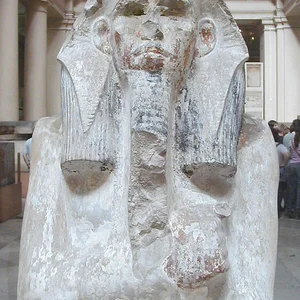
Djoser
2800 av. J.-C. — 2700 av. J.-C.
Pharaoh of the Third Egyptian Dynasty (c. 2650 BCE), Djoser is famous for commissioning the Step Pyramid of Saqqara, the first great funerary monument built in stone in history.
Don
Dôn is the mother goddess of Welsh mythology, ancestor of the divine family known as the “Children of Dôn” (Plant Dôn) mentioned in the Mabinogi. The Welsh equivalent of the Irish goddess Danu, she embodies the matriarchal figure of the Celtic deities of Britain, of whom she is the source.
Dragon of Thebes
A monstrous creature sacred to Ares in Greek mythology, it guarded the divine spring near Thebes. Slain by the Phoenician hero Cadmus, its teeth were sown into the earth and gave rise to the Spartoi, the ancestral warriors of Thebes.
Durga
A warrior goddess of Hinduism, Durga embodies Shakti, the divine feminine energy and protective force of the universe. Venerated in the Hindu tradition since the Vedic era, she is the great goddess (Mahadevi) who vanquishes the forces of evil.
El
El is the supreme deity of the Canaanite and Ugaritic pantheon, father of gods and men. A creator god and divine judge, he presides over the council of the gods. His cult is attested throughout the ancient Semitic Near East.
Empousa
A demonic creature of Greek mythology, servant of Hecate. Endowed with one leg of bronze and one leg of a donkey, she transforms herself to seduce lone travelers before devouring them.
Énheduana
High priestess of the moon at Ur and daughter of Sargon of Akkad, Enheduana is the first known author in history. Around 2300 BCE, she composed hymns to the goddess Inanna and songs for the Sumerian temples, laying the foundations of religious literature.
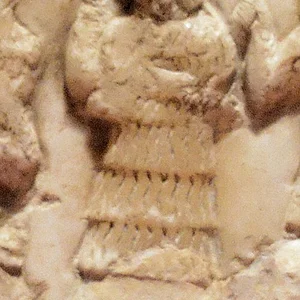
Enheduanna
2300 av. J.-C. — 2300 av. J.-C.
Enheduanna, high priestess of the moon god at Ur and daughter of Sargon of Akkad, is the first known author in history. Around 2300 BCE, she composed hymns to the goddess Inanna of rare poetic power, laying the foundations of world religious literature.
Eos
Eos is the Greek goddess of the Dawn, daughter of the Titans Hyperion and Theia, sister of Helios (the Sun) and Selene (the Moon). Each morning, she opens the gates of the sky to herald the rising of the day, riding her chariot drawn by two winged horses.
Ereshkigal
Sumerian queen of the Underworld in Mesopotamian mythology, Ereshkigal rules the kingdom of the dead known as Kur or Irkalla. Sister of the goddess Inanna, she embodies the relentless power of death and the underworld, as described in Sumerian cuneiform texts.
Eros
Eros is the Greek god of love and desire. The son of Aphrodite and Ares according to classical tradition, he is depicted as a winged young child armed with a bow and golden arrows. His Roman equivalent is Cupid.
Eshu
Eshu is a trickster orisha from the Yoruba tradition of West Africa, guardian of crossroads and messenger between humans and the gods. Master of communication and cunning, he must be propitiated before any ritual.
Eurydice
Nymph of Greek mythology and wife of the poet Orpheus. Bitten by a serpent, she descends to the Underworld. Orpheus attempts to bring her back to life through his music, but loses her forever by looking back.
Gaia
A primordial deity of Greek mythology, Gaia personifies the Earth Mother. Emerging from the primordial Chaos, she gives birth to Uranus (the Sky), the Mountains, and Pontus (the Sea). With Uranus, she bears the Titans, the Cyclopes, and the Hecatoncheires.
Ganesh
Ganesh is one of the most revered deities in Hinduism, instantly recognizable by his elephant head. Son of Shiva and Parvati, he is the god of wisdom, intellect, and success, and the “Lord of Obstacles,” invoked at the beginning of any new endeavor.
Geb
Geb is the Egyptian god of the Earth, son of Shu and Tefnut, and husband of Nut, the goddess of the sky. He belongs to the Ennead of Heliopolis and is the father of Osiris, Isis, Seth, and Nephthys.
Glooscap
Creator hero and central figure of Mi'kmaq and Abenaki mythology in North America. A cultural being who shaped the world, defeated monsters, and taught humans the arts of survival. A figure from the Indigenous oral tradition of northeastern America, passed down from generation to generation.
Hanuman
A Hindu deity in the form of a monkey, Hanuman is the devoted servant of the god Rama in the epic Ramayana. A symbol of devotion, strength, and courage, he is one of the most venerated figures in Hinduism.
Hathor
An Egyptian goddess venerated since the Old Kingdom (c. 2700 BCE), Hathor is associated with love, music, joy, femininity, and the sky. Depicted as a cow or as a woman with bovine horns bearing the solar disk, she is one of the most popular deities in the Egyptian pantheon.
Hecate
Greek goddess of magic, crossroads, and the underworld, daughter of Perses and Asteria. Often depicted with three faces, holding torches and accompanied by dogs. A chthonic deity associated with the moon, nocturnal rites, and witchcraft.
Hiʻiaka
Hiʻiaka is a goddess of Hawaiian mythology, the younger sister of the volcano goddess Pele. Patron of hula dancers, of chant, and of medicine, she is the heroine of a cycle of epic chants recounting her journey across the archipelago.
Hine-nui-te-pō
Māori goddess of death and guardian of the underworld (Te Pō), according to Polynesian oral traditions. Daughter of Tāne, she rules over the realm of the dead and receives the souls of the departed. Her myth illustrates the fundamental life-death cycle in Māori cosmology.
Hinetītama
Hinetītama is the “dawn maiden” in the Māori mythology of New Zealand. The daughter of the god Tāne, she becomes Hine-nui-te-pō, the great goddess of night and of the dead, after discovering that he was also her father.
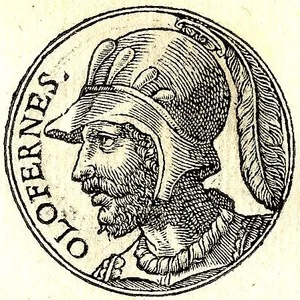
Holofernes
Assyrian general of Nebuchadnezzar's army, Holofernes is the central character of the Book of Judith in the Hebrew Bible. His beheading by Judith, a courageous Hebrew widow, is one of the most celebrated narratives in biblical literature.
Hyperion
Titan of light in Greek mythology, son of Ouranos and Gaia. Husband of Theia, he is the father of Helios (the Sun), Selene (the Moon), and Eos (the Dawn). His name means "the one who walks above" in ancient Greek.
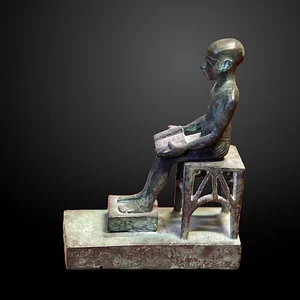
Imhotep
2800 av. J.-C. — 2700 av. J.-C.
A high official, architect, and physician of ancient Egypt in the 3rd millennium BC, Imhotep is considered the first known engineer and architect in history. Designer of the Step Pyramid of Saqqara, he was later deified as a god of medicine.
Inanna
Sumerian goddess of love, war, and fertility, venerated in Mesopotamia since the 4th millennium BCE. She is the best-documented female deity of the ancient world, celebrated in cuneiform hymns among the oldest known literary texts. Her cult, centered on the city of Uruk, influenced the religious traditions of the ancient Near East.
Inanna / Ishtar
Inanna (Sumerian) or Ishtar (Akkadian) is the great goddess of love, war, and fertility in ancient Mesopotamia. She stands at the heart of many foundational myths, including the famous Descent into the Underworld. Her cult, one of the most important in the ancient Near East, spans more than three millennia.
Inari
Japanese Shintō deity associated with rice, fertility, foxes, and commerce. Inari is one of the most venerated deities in Japan, with shrines (inari-sha) found throughout the country.
Iris
Iris is the Greek goddess of the rainbow and messenger of the Olympian gods, most notably Zeus and Hera. Daughter of Thaumas and Electra, she serves as an intermediary between the divine world and the human world, carrying messages from the immortals to mortals.
Itzamná
Itzamná is the supreme deity of the Maya pantheon, creator of the world and inventor of hieroglyphic writing. God of the sky, wisdom, and medicine, he is depicted as a wise old man. He is the husband of Ixchel, goddess of the moon.
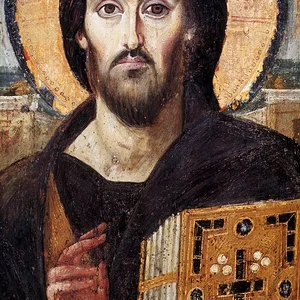
Jesus Christ
5 av. J.-C. — 30
Jewish preacher from Galilee and founder of Christianity. His teachings on love, forgiveness, and the Kingdom of God transformed the course of human history. Crucified around 30 AD, he is considered by Christians to be the risen Son of God.
Kali
A Hindu goddess rooted in Vedic and Tantric tradition, Kali is the fierce and destructive aspect of the goddess Durga. Venerated by the people of India since antiquity, she embodies both the destruction of evil and cosmic renewal. Her complex figure symbolizes the cycle of death and rebirth.
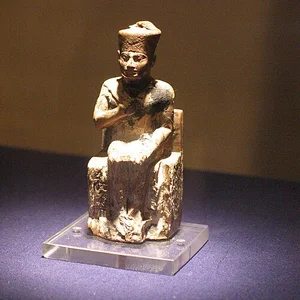
Khufu
2700 av. J.-C. — 2565 av. J.-C.
Pharaoh of the 4th Dynasty of ancient Egypt (c. 2589–2566 BC), Khufu is famous for commissioning the Great Pyramid of Giza, one of the Seven Wonders of the Ancient World. His reign stands as a symbol of the absolute power of pharaonic rule.
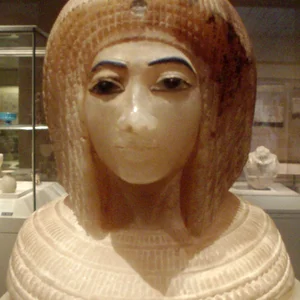
Kiya
1400 av. J.-C. — 1400 av. J.-C.
A secondary wife of Pharaoh Akhenaten, Kiya held a singular place at the court of Amarna in the 14th century BCE. Her identity and origins remain partly mysterious, though her name and likeness appear on several monuments from the Amarna period.
Kuntî
Kuntî is a major figure in the Indian epic of the Mahâbhârata. Mother of the Pândava, she is known for having obtained a boon granting her the power to conceive children by gods. She embodies devotion, maternal sacrifice, and wisdom in the Hindu tradition.
Lakshmi
Hindu goddess of prosperity, fortune, and beauty, venerated in the Vedic tradition since antiquity. Consort of the god Vishnu, she symbolizes abundance, grace, and good fortune in the mythology of Indian civilization.
Leviathan
A sea monster from biblical texts and the mythologies of the ancient Near East, Leviathan embodies primordial chaos and the forces of evil. Described as a gigantic sea serpent, it appears notably in the Book of Job and the Psalms. During the Middle Ages, it became the guardian of the gates of Hell in the Christian tradition.
Lilith
A demonic figure rooted in Mesopotamian mythology (Lilitu), Lilith was incorporated into Jewish tradition as Adam's first wife, before Eve. Refusing to submit, she leaves the Garden of Eden and becomes a nocturnal demon threatening newborns and sleeping men.
Louhi
Louhi is the powerful witch-queen of Pohjola in Finnish mythology, a central figure of the Kalevala. Mistress of magic and dark forces, she opposes the heroes Väinämöinen and Ilmarinen. She holds the Sampo, a mysterious object that brings prosperity.
Maat
Egyptian goddess of justice, truth, and cosmic order, Maat is a central figure in the religion and moral thought of ancient Egypt. Depicted with an ostrich feather on her head, she embodies the universal principle of balance and harmony that governs the cosmos, society, and the afterlife.
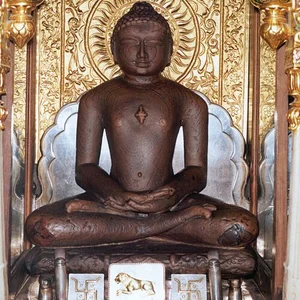
Mahavira
598 av. J.-C. — 526 av. J.-C.
Mahāvīra is the twenty-fourth and last tīrthankara of Jainism, regarded as the major reformer of this Indian tradition. Renouncing his princely life, he preached asceticism, non-violence, and the liberation of the soul.
Mahishasura
Mahishasura is a buffalo-demon (asura) from Hindu mythology who, after obtaining invincibility against any man or god, conquered the three worlds and drove the gods from paradise. The goddess Durga, created from the combined energy of all the gods, ultimately defeated him after nine days of battle.
Maia
Maia is a deity of Greek mythology, daughter of the Titan Atlas and the Oceanid Pleione. She is the eldest and most beautiful of the seven Pleiades. She is best known as the mother of Hermes, whom she conceived with Zeus in a cave on Mount Cyllene.

Maitreyi
1000 av. J.-C. — 1000 av. J.-C.
A philosopher and poet of the Indian Vedic tradition, Maitreyi is celebrated in the Upanishads for her dialogue with the sage Yajnavalkya on the nature of the absolute and the atman. An exceptional female figure passed down through oral tradition, she embodies the spiritual quest at the heart of ancient Brahminic thought.
Makara
The makara is a hybrid aquatic creature from Hindu mythology, blending features of a crocodile, an elephant and a fish. It serves as the mount (vahana) of the deities Varuna, god of the waters, and Ganga, goddess of the Ganges.
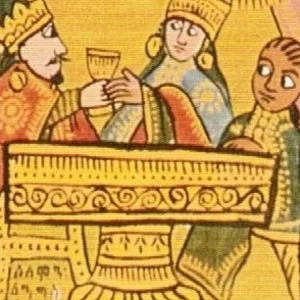
Makeda
Makeda is the central figure of the Ethiopian tradition (Kebra Nagast), venerated as the legendary queen of the Kingdom of Sheba. Rooted in Ethiopian and Eritrean oral tradition, she is known for her encounter with King Solomon of Jerusalem, from which Menelik I would be born — the founding ancestor of the Ethiopian imperial lineage.
Mara
In Buddhist tradition, Mara is the supreme demon of desire and illusion. He attempted to prevent Siddhartha Gautama from attaining Enlightenment by subjecting him to temptations and trials beneath the Bodhi tree. He personifies the forces of attachment and ignorance that bind beings to the cycle of rebirth.
Marduk
Marduk is the supreme god of the Babylonian pantheon, tutelary deity of the city of Babylon. He embodies creation, justice, and divine sovereignty. His rise to king of the gods is narrated in the creation epic *Enûma Eliš*.
Menā
Menā is a goddess of Hindu mythology, the wife of Himavat, the personification of the Himalayas, and queen of the mountains. Mother of the great goddess Pārvatī as well as of Gangā and Mount Maināka, she is celebrated in the Purāṇas as the mind-born daughter (mānasaputrī) of the Pitṛ ancestors.
Meritaten
Eldest daughter of Pharaoh Akhenaten and Queen Nefertiti, Meritaten lived during the Amarna religious revolution in the 14th century BCE. She became Great Royal Wife of Pharaoh Smenkhkare and was abundantly depicted in the art of the Amarna period.
Mictecacihuatl
Aztec goddess of death and queen of Mictlan, the realm of the dead. She rules alongside her husband Mictlantecuhtli and watches over the bones of the deceased. She is celebrated today during Día de los Muertos.
Mithra
An Indo-Iranian deity of contracts and light, Mithra was venerated in Persian Zoroastrianism before becoming a mysterious solar god of the Roman Empire. His cult, Mithraism, spread among Roman soldiers from the 1st to the 4th centuries AD.
Moloch
A Canaanite Semitic deity associated with child sacrifice, Moloch is mentioned in the Bible as an abhorrent idol. Depicted as a bull or a bronze statue, he became in Judeo-Christian and literary tradition the symbol of idolatrous cruelty.
Mut
Mut is a goddess of Egyptian mythology, venerated as a mother goddess and queen of the deities. Wife of the god Amun and mother of Khonsu, she forms the Theban triad with them. Her cult was centered in Thebes, in the temple of Karnak.
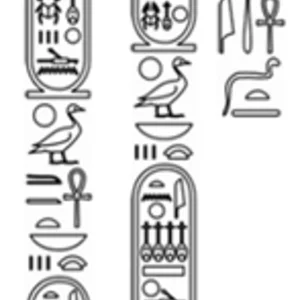
Neferneferuaten
1400 av. J.-C. — 1400 av. J.-C.
Neferneferuaten was a queen of Egypt from the 18th Dynasty, probably co-regent or direct successor to Akhenaten around 1335 BCE. Her exact identity remains debated: she may be Nefertiti under a new name, or a daughter of Akhenaten.
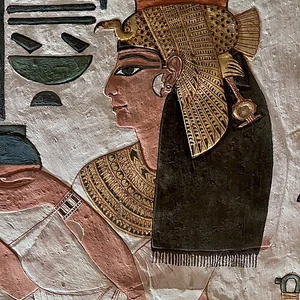
Nefertari
1289 av. J.-C. — 1254 av. J.-C.
Great Royal Wife of Ramesses II, Nefertari is one of the most celebrated queens of ancient Egypt. Her tomb in the Valley of the Queens, with its exceptionally well-preserved paintings, reflects her extraordinary status. Ramesses II dedicated the smaller temple at Abu Simbel to her, where she was depicted at the same scale as the pharaoh himself.
Nemesis
Greek goddess of divine vengeance and just retribution, Nemesis punishes hubris — the arrogance and excess of mortals who rise above their station. She embodies cosmic balance and immanent justice in the tradition of Greek mythology.
Nephthys
An ancient Egyptian goddess, Nephthys is the protector of the dead and the deceased. Sister of Isis, Osiris, and Set, she plays a fundamental role in Egyptian funerary rites. Her tradition is passed down through the Pyramid Texts and the Coffin Texts.
Nestis
Nestis is a deity from Greek mythology associated with water, mentioned by the philosopher Empedocles (5th century BCE) as one of the four fundamental roots of the universe. Sometimes identified with Persephone, she personifies the element of water in Empedoclean cosmology.
Nike
Nike is the personified goddess of victory in Greek mythology. Daughter of Pallas and Styx, she is depicted as winged, holding a laurel wreath or a palm branch. She accompanies Zeus and Athena and presides over both military and athletic victories.
Nüwa
Creator goddess of Chinese mythology, Nüwa molded the first humans from yellow clay. She then repaired the vault of heaven by melting stones of five colors after the pillars of the sky collapsed.
Nyx
Primordial goddess of Night in Greek mythology, born from the original Chaos. Mother of countless deities including Hypnos (Sleep), Thanatos (Death), and the Moirai (Fate). So fearsome that even Zeus refused to cross her.
Olokun
Olokun is a Yoruba deity of the ocean depths, venerated in West Africa and in Afro-diasporic traditions. Orisha of the abyss, he symbolizes wealth, unfathomable mysteries, and the power of the deep waters.
Ouranos
A primordial Greek deity personifying the starry Sky, Ouranos is the husband of Gaia (the Earth) and the father of the Titans, the Cyclopes, and the Hecatoncheires. Hated by the children he refused to release, he was castrated by his son Cronus, giving rise to Aphrodite according to the Hesiodic tradition.
Pachamama
A major deity of the Andean peoples, particularly the Inca, Pachamama is the Earth Mother — goddess of fertility, agriculture, and the cycle of seasons. Venerated since pre-colonial times, she embodies the nourishing earth and is the subject of ritual offerings still practiced today in the Andes.

Padmavati
278 av. J.-C. — ?
Wife of Emperor Ashoka (3rd century BCE), Padmavati is a figure of the Mauryan court in ancient India. She is mentioned in Buddhist sources as one of the queens of the great ruler who unified the Indian subcontinent and embraced Buddhism.
Pan
Greek deity of wild nature, shepherds, and flocks, Pan is depicted as half-man, half-goat. Inventor of the reed flute (syrinx), he embodies the uncontrollable forces of nature and is the origin of the word "panic."
Papatuanuku
Papatuanuku is the Earth Mother of Māori cosmogony, a central figure passed down through oral tradition in Polynesia. Wife of Ranginui (Sky Father), her separation from him by their children gave birth to the world as the Māori conceive it.
Parvati
Pārvatī is a major goddess of the Hindu tradition, daughter of the mountain god Himavat and consort of Shiva. Venerated as the goddess of fertility, maternal love, and devotion, she embodies the divine feminine energy (Shakti). Her figure appears in the great Sanskrit epics and the Purāṇas, texts composed between the 4th and 12th centuries CE.
Pasiphae
Pasiphae is a figure from Greek mythology, daughter of Helios and wife of Minos, king of Crete. Struck by an unnatural passion for a bull sent by Poseidon, she gave birth to the Minotaur — half man, half bull — who was imprisoned in the Labyrinth built by Daedalus.
Pazuzu
Pazuzu is a Mesopotamian demon of the evil wind, depicted with a canine face, raptor wings, and a hybrid body. Paradoxically, he was invoked as a protector against Lamashtu, the demon of childbirth. His image adorned amulets to protect pregnant women and newborns.
Potiphar's Wife
Biblical character from the Old Testament, wife of Potiphar, captain of Pharaoh's guard. She attempts to seduce Joseph, son of Jacob, and, after being rejected, falsely accuses him of assault, leading to Joseph's imprisonment.
Ptah
Ptah is one of the oldest and most important gods of ancient Egypt, a creator god and patron of craftsmen and architects. Venerated at Memphis since the Old Kingdom, he embodies creation through thought and speech. His triad with Sekhmet and Nefertum forms the heart of the Memphite cult.
Putana
Putana is a demoness from Hindu mythology, sent by King Kamsa to kill the infant Krishna by nursing him with poisoned milk. Krishna, recognizing her divine nature, slew her while granting her spiritual liberation.
Qilin
A fabulous creature of Chinese mythology, the Qilin is a benevolent chimera with the body of a deer, horse's hooves, and dragon's scales, often nicknamed the “unicorn of the East.” A creature of good omen, it heralds the birth or death of a sage and embodies peace and prosperity.
Queen of Sheba
Legendary ruler mentioned in the Bible, the Quran, and Ethiopian tradition. She is said to have visited King Solomon in Jerusalem, drawn by his wisdom. An iconic figure of exchange between ancient Arabia, Africa, and the Near East.
Quetzalcoatl
Quetzalcoatl, the "Feathered Serpent," is one of the most important deities in Mesoamerica. Venerated by the Aztecs and the Toltecs, he is the god of wind, wisdom, and creation. His figure spans several pre-Hispanic civilizations across more than two millennia.
Radha
A central figure in Hindu tradition, Radha is the divine companion of Krishna and the embodiment of pure, absolute love (bhakti). Rooted in Vedic culture and popularized through medieval Sanskrit texts, she symbolizes the human soul seeking union with the divine. Her legend, passed down primarily through oral tradition before being set in writing in texts such as the Gita Govinda (12th century), lies at the heart of Vaishnava spirituality.
Ravana
Ravana is the ten-headed demon king of Lanka in the Hindu epic the Ramayana. As the principal antagonist, he abducts Sita, the wife of Rama, triggering a cosmic war. Despite his demonic nature, he is recognized as a scholar, accomplished musician, and devoted worshipper of Shiva.
Rhea
Titaness of Greek mythology, daughter of Uranus and Gaia, wife of Cronus. Mother of the six great Olympian gods, she saved Zeus by substituting a swaddled stone for the infant to deceive Cronus. Identified with Cybele, she is venerated as the Great Mother of all the gods.
Rongo
Rongo is a major deity of Polynesian mythology, venerated especially by the Māori of New Zealand. God of peace, agriculture, and cultivated plants, he is one of the great atua (gods) born of the union of Ranginui (the sky) and Papatūānuku (the earth). He symbolizes harmony and fertility, in contrast to his brother Tū, god of war.
Rukmini
Rukmini is the principal wife of Krishna and the goddess of prosperity in Hinduism. A princess of the kingdom of Vidarbha, she eloped with Krishna to escape a forced marriage, symbolizing divine love and absolute devotion.
Sarasvati
A major goddess of the Hindu tradition, Saraswati is venerated as the deity of knowledge, speech, the arts, and music. Rooted in the Vedic civilization of ancient India, she is mentioned as early as the hymns of the Rig-Veda (c. 1500–1200 BCE). She embodies the ideal of pure knowledge and spiritual creativity.
Selene
A Greek Titaness personifying the Moon, Selene crosses the sky each night on her silver chariot drawn by white horses. Daughter of Hyperion and Theia, she is the sister of Helios (the Sun) and Eos (the Dawn). Her passion for the shepherd Endymion, whom she caused to fall into an eternal sleep so she could gaze upon him forever, is one of the most celebrated myths in the Greek tradition.
Set
Set is the Egyptian god of chaos, storms, and the desert. Brother of Osiris, whom he murdered to seize the throne of Egypt, he was later defeated by his nephew Horus. An ambivalent figure, he was also venerated as the protector of Ra against the serpent Apophis.
Seth
3873 av. J.-C. — 2957 av. J.-C.
Egyptian god of chaos, storms, and the desert, Seth is one of the most complex deities in the Egyptian pantheon. Brother of Osiris, whom he murdered, he embodies primal violence but also the protective force necessary for cosmic order.
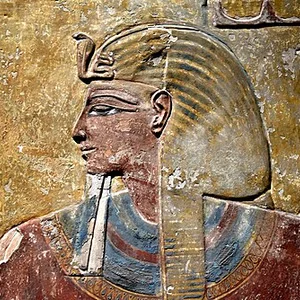
Seti I
1322 av. J.-C. — 1278 av. J.-C.
Seti I was the second pharaoh of the Nineteenth Dynasty of Egypt, reigning around 1294–1279 BC. Son of Ramesses I, he restored Egypt's military and religious power following the Amarna period. He is renowned for his campaigns in Canaan and Libya, as well as for his magnificent temple at Abydos.
Shiva
Shiva is one of the three principal deities of Hinduism, forming the Trimūrti alongside Brahmā and Vishnu. God of destruction and transformation, he also embodies meditation, the arts, and fertility. His cult, rooted in the Indus Valley civilization, is one of the oldest in the world.
Shou
Shou is the ancient Egyptian deity personifying air and light. Son of Ra and husband of Tefnut, he supports the vault of the sky by separating Nut (the sky) from Geb (the earth). He embodies the vital space between the cosmos and the earthly world.
Sita
Central heroine of the Ramayana, the Sanskrit epic of the Hindu tradition, Sita is the wife of Rama and the adopted daughter of King Janaka. Born of the earth according to tradition (her name means "furrow"), she embodies purity, faithfulness, and virtue in Indian culture.
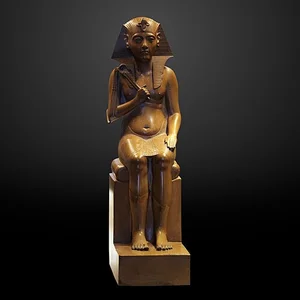
Smenkhkare
1400 av. J.-C. — 1333 av. J.-C.
A short-lived pharaoh of ancient Egypt's 18th Dynasty, Smenkhkare reigned briefly around 1338–1336 BC, succeeding Akhenaten. His identity remains one of the most enigmatic puzzles of ancient Egypt.
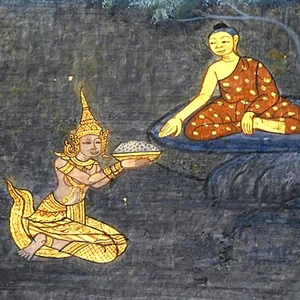
Sujata
Sujata was a young village woman from ancient India who offered a bowl of rice pudding to Siddhartha Gautama, allowing him to break his extreme fast before attaining Enlightenment. This act of generosity is considered a founding moment of Buddhism.
Tane
Tāne is the god of the forest and birds in Māori mythology. Son of Rangi (the Sky) and Papa (the Earth), he separated them to let light into the world. He is also the creator of the first woman, shaped from the red clay of the earth.
Tangaroa
Tangaroa is the god of the sea and oceans in Polynesian mythology, venerated across the Pacific (Māori, Samoa, Tahiti, Hawaii). Son of Rangi (sky) and Papa (earth), he rules over the ocean depths and is often regarded as the creator of many islands and living beings.
Tartarus
In Greek mythology, Tartarus is both a primordial deity born of Chaos and a cosmic place: the deepest abyss in the universe, located beneath the Underworld, where Zeus imprisoned the defeated Titans and where the greatest criminals atone for their crimes for eternity.
Tefnut
Tefnut is an Egyptian goddess with the head of a lioness, personification of moisture and dew. Daughter of Ra and sister-wife of Shu, she is part of the Ennead of Heliopolis. She embodies life-giving rain and plays a role in maintaining cosmic balance.
Tethys
Titaness of the sea and freshwaters in Greek mythology, daughter of Gaia and Ouranos. Wife of the Titan Oceanus, she is the mother of the 3,000 Oceanids and the great river gods, personifying the nourishing waters of the world.
Tezcatlipoca
Tezcatlipoca, "Smoking Mirror," is one of the major deities of the Aztec pantheon. God of the night, the starry sky, sorcery, and fate, he is the eternal rival of Quetzalcóatl. His emblematic attribute is an obsidian mirror in which he reads the thoughts of men.
Thánh Gióng
Legendary hero of Vietnam, one of the Four Immortals (Tứ bất tử) of Vietnamese popular belief. A miraculous child who remained mute until the age of three, he suddenly awakens to repel a foreign invasion, then ascends to the heavens. He symbolizes resistance against invaders and the strength of youth.
The Dagda
A major deity of Irish mythology, father and chief of the Tuatha Dé Danann. God of fertility, wisdom, and abundance, he wields a colossal club and owns a magical cauldron with inexhaustible provisions.
The Moirai
Greek goddesses embodying Fate, the Moirai are three sisters who spin, measure, and cut the thread of life of every mortal and immortal. Daughters of Zeus and Themis according to Hesiod, they hold absolute authority over the course of all lives — an authority that no one, not even the gods, can challenge.
The Pythia
Priestess of Apollo at Delphi, the Pythia delivered her oracles in a trance, seated on a tripod above a fissure in the earth. A central figure in ancient Greek polytheistic religion, her oracle influenced the decisions of city-states and kings.
Theia
Titaness of celestial light and vision in Greek mythology. Daughter of Ouranos and Gaia, she united with her brother Hyperion and gave birth to the three great astral deities: Helios (the Sun), Selene (the Moon), and Eos (the Dawn).
Themis
A Titaness daughter of Ouranos and Gaia, Themis personifies divine law, justice, and cosmic order in the Greek tradition. A privileged counselor of Zeus and his second divine wife, she is the mother of the Horae and the Moirai, guardians of fate and the seasons.
Thetis
Thetis is a Nereid, a sea deity of Greek mythology, daughter of Nereus and mother of the hero Achilles. She plays a central role in Homer's Iliad, interceding with the gods on behalf of her son. An embodiment of divine maternal power, she stands at the heart of Greece's great epic narratives.
Tlaloc
Tlaloc is the Aztec god of rain, water, and fertility. Venerated since the pre-Classic Mesoamerican civilizations, he was one of the most important deities in the Aztec pantheon, associated with both life and death.
Toci
Toci, whose name means “Our Grandmother” in Nahuatl, is a mother goddess in Aztec mythology. Associated with the earth, healing, and midwives, she was venerated as the “heart of the Earth” and ranks among the major deities of the Mexica pantheon.
Tsukuyomi
Tsukuyomi is the god of the Moon in Japanese Shintō mythology. Born from the right eye of Izanagi during the primordial purification, he reigns over the night. His quarrel with the sun goddess Amaterasu explains the separation of day and night.
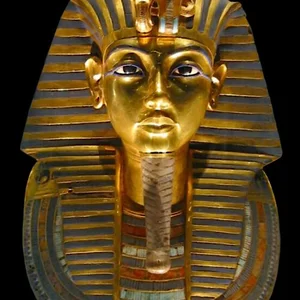
Tutankhamun
1340 av. J.-C. — 1323 av. J.-C.
An Egyptian pharaoh of the 18th Dynasty, he reigned around 1332–1323 BCE. Ascending to the throne at approximately nine years old, he restored polytheistic worship after the Atenist revolution of Akhenaten. His tomb, discovered intact in 1922, is one of the greatest archaeological discoveries of the 20th century.
Tyche
Tyche is the Greek goddess of fortune, chance, and destiny. Daughter of Oceanus and Tethys, she personifies the whims of fate that govern the lives of mortals and the destinies of cities. Her cult spread throughout the Hellenistic world.
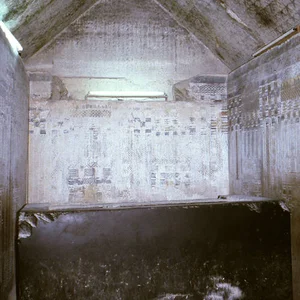
Unas
2374 av. J.-C. — 2349 av. J.-C.
Unas was the last pharaoh of the Fifth Dynasty of ancient Egypt, reigning around 2375–2345 BCE. His pyramid at Saqqara is world-famous for containing the Pyramid Texts, the oldest known corpus of religious writings in human history.
Ushas
Ushas is the goddess of the dawn in Vedic and Hindu mythology. Celebrated in the Rigveda, she personifies the rising morning light that chases away the darkness and awakens the living world.
Väinämöinen
Väinämöinen is the central hero of the Kalevala, Finland's national epic. A primordial sage and shamanic bard, he embodies wisdom, magic, and music in Finnic mythology. His kantele casts spells over men, animals, and nature alike.
Vishnu
Vishnu is one of the three principal deities of Hinduism, forming the Trimurti alongside Brahma and Shiva. God of protection and preservation of the universe, he manifests in multiple avatars including Krishna and Rama, central figures in Indian mythology.
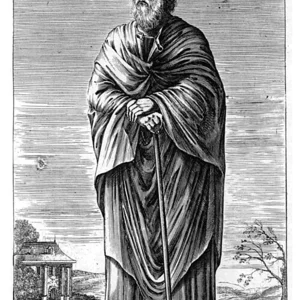
Xenophanes
569 av. J.-C. — 477 av. J.-C.
Pre-Socratic Greek philosopher and poet born in Colophon around 570 BC. He criticized the anthropomorphic polytheism of Homer and Hesiod, and argued for a single, universal, non-human god. A forerunner of rational theology and epistemology.
Xiwangmu
Xiwangmu, the Queen Mother of the West, is one of the great deities of Chinese mythology and religion. Guardian of the peaches of immortality, she reigns over Mount Kunlun and presides over the fate of immortals. Her cult, attested as early as the Shang dynasty, spans the entire religious history of China.
Xochiquetzal
Aztec goddess of beauty, love, fertility, and the creative arts, associated with flowers, plants, and femininity. She represents eternal youth and sensuality in the Mesoamerican pantheon.
Yama
Yama is the god of death and justice in Hindu and Buddhist traditions. He rules over the realm of the dead and weighs souls to determine their rebirth according to the deeds performed during their lifetime.
Yemanjá
Yemanjá is a female water deity from the Yoruba religion of West Africa, venerated as the mother of the gods (orishas) and protector of the sea. Carried to the Americas by the Atlantic slave trade, she became a major figure in Brazilian Candomblé and Cuban Santería.
Yemoja
Yemoja is a major orisha of the Yoruba pantheon, goddess of waters and protective mother. Venerated in West Africa, she became a central figure in Afro-American religions (candomblé, santería) born of the diaspora.
Yhi
Yhi is the goddess of the sun, light, and creation in the mythology of the Aboriginal peoples of Australia, particularly the Karraur. Asleep at the beginning of time, her awakening illuminated the world and brought all life on Earth into being.
YHWH
YHWH is the divine name in the Hebrew religion, composed of four letters (yod, he, vav, he). It designates the one God of Israel, at the heart of the Abrahamic monotheistic tradition.
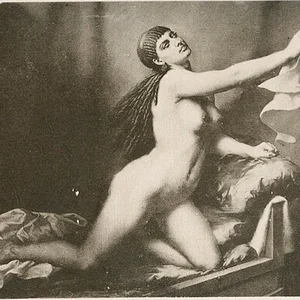
Zulaikha
Zulaikha is the wife of Potiphar, a high Egyptian dignitary, famous in the Bible (Genesis 39) and the Quran (Surah Yusuf) for attempting to seduce Joseph. Joseph's refusal and her false accusation lead him to prison. She has become a major literary figure, particularly in classical Persian poetry.
Politics(99)
Abel
Abel is the second son of Adam and Eve in Genesis. A devout shepherd, he offers God the finest of his flock. Slain by his brother Cain, he becomes the first murder victim in the Abrahamic tradition.
Aeëtes
King of Colchis in Greek mythology, son of the god Helios and the Oceanid Perseis. Father of Medea, he is the guardian of the Golden Fleece and the main adversary of Jason during the quest of the Argonauts.

Agariste
600 av. J.-C. — 460 av. J.-C.
Athenian aristocrat from the powerful Alcmaeonid family, daughter of Hippocrates and niece of the reformer Cleisthenes. Wife of Xanthippus, she was the mother of Pericles, the great statesman of classical Athens.
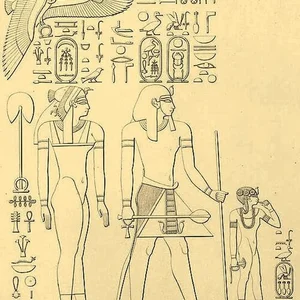
Ahmose
1504 av. J.-C. — 1492 av. J.-C.
Ahmose was an Egyptian queen of the 18th Dynasty, wife of Pharaoh Thutmose I. She is the mother of the famous pharaoh Hatshepsut. Her role at court illustrates the importance of queens in establishing Egyptian dynastic legitimacy.
Akhenaten
1400 av. J.-C. — 1335 av. J.-C.
Pharaoh of the 18th Dynasty of Egypt (c. 1353–1336 BCE), Akhenaten revolutionized religion by imposing the monotheistic worship of Aten, the solar disk. He relocated the capital to Akhetaten (Amarna) and profoundly transformed Egyptian art.
Alexander II of Macedon
King of Macedon from 370 to 368 BC, son of Amyntas III and elder brother of Philip II. His brief reign was marked by internal unrest before his assassination by Ptolemy of Aloros.
Amenhotep III
1399 av. J.-C. — 1350 av. J.-C.
Pharaoh of the 18th Egyptian dynasty (c. 1391–1353 BC), he ruled Egypt at the height of its diplomatic and artistic power. His reign was marked by relative peace, intensive building activity, and exceptional cultural refinement.
Amon
663 av. J.-C. — 639 av. J.-C.
Amon was the fourteenth king of Judah, son of Manasseh, who reigned around 642–640 BC. Like his father, he practiced idol worship and abandoned the Yahwist faith. He was assassinated by his own servants after only two years of rule.

Amytis
559 av. J.-C. — 600 av. J.-C.
Achaemenid queen presented by certain ancient sources, notably Ctesias of Cnidus, as the daughter of the Median king Astyages and the wife of Cyrus II the Great, founder of the Persian Empire. Her union is said to have sealed the alliance between the Medes and the Persians in the 6th century BC.
An Dương Vương
250 av. J.-C. — 206 av. J.-C.
An Dương Vương, whose real name was Thục Phán, was the founder and sole ruler of the kingdom of Âu Lạc, formed by the union of the Âu Việt and the Lạc Việt after his victory over the last Hùng king of Văn Lang. He reigned until his defeat by Triệu Đà in 179 BCE, which brought his kingdom to an end.
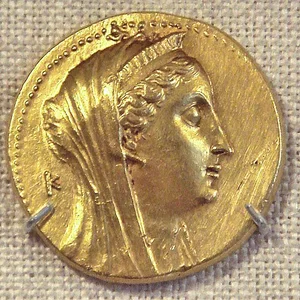
Arsinoe II
315 av. J.-C. — 269 av. J.-C.
A Macedonian princess born around 316 BCE, daughter of Ptolemy I, she became queen of Ptolemaic Egypt. Co-regent alongside her brother and husband Ptolemy II, she wielded considerable political influence and was deified during her own lifetime.
Ashoka
303 av. J.-C. — 231 av. J.-C.
Ashoka was the third emperor of the Maurya dynasty, ruling over nearly the entire Indian subcontinent in the 3rd century BC. Shaken by the carnage of the Kalinga War, he converted to Buddhism and promoted a policy of non-violence (ahimsa) and tolerance. He spread his moral precepts, carved on stone edicts, throughout his empire.
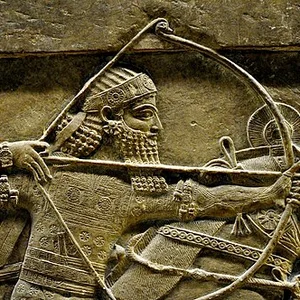
Ashurbanipal
684 av. J.-C. — 630 av. J.-C.
Ashurbanipal was one of the last great kings of the Neo-Assyrian Empire, reigning from 669 to roughly 627 BC. A warrior and scholar king, he brought Assyria to its greatest territorial extent and founded at Nineveh a vast library gathering tens of thousands of cuneiform tablets.
Aten
Aten is the solar deity of ancient Egypt, represented as the sun disk whose rays end in human hands. Elevated to the status of sole god by Pharaoh Akhenaten in the 14th century BCE, Aten stood at the heart of an unprecedented religious revolution.
Ay
1400 av. J.-C. — 1400 av. J.-C.
Ay was pharaoh of Egypt around 1323–1319 BCE, successor to Tutankhamun. A senior official and priest, he played a key role at the close of the Amarna period by restoring the traditional worship of the Egyptian gods.
Bathsheba
1008 av. J.-C. — 936 av. J.-C.
Bathsheba is a figure from the Old Testament, wife of Uriah the Hittite and later of King David after Uriah's death. As the mother of Solomon, she played a decisive role in the royal succession by interceding with David to ensure her son would inherit the throne of Israel.
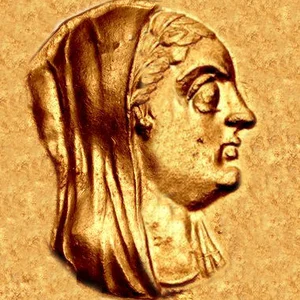
Berenice I
339 av. J.-C. — ?
Macedonian queen who became the wife of Ptolemy I, founder of the Lagid dynasty in Egypt. Mother of Ptolemy II Philadelphus, she was deified after her death and played a foundational role in establishing the dynastic legitimacy of the Ptolemies.
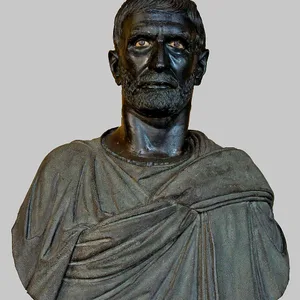
Brutus
1983 — ?
A Roman senator and statesman of the late Republic, Brutus was one of the main instigators of the assassination of Julius Caesar on the Ides of March, 44 BC. Defeated by the triumvirs Octavian and Mark Antony at Philippi, he took his own life in 42 BC.
Cain
3899 av. J.-C. — 3199 av. J.-C.
Eldest son of Adam and Eve in the Bible, Cain committed the first murder in human history by killing his brother Abel out of jealousy. Condemned to wander the earth, he received a protective mark from God.
Cambyses II
558 av. J.-C. — 521 av. J.-C.
Cambyses II was a king of the Achaemenid Persian Empire, son and successor of Cyrus the Great. He conquered Egypt in 525 BC and proclaimed himself pharaoh, thereby greatly expanding the empire founded by his father.
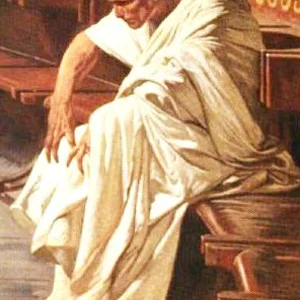
Catiline
107 av. J.-C. — 61 av. J.-C.
Lucius Sergius Catiline was a Roman patrician and politician, famous for plotting a conspiracy to seize power in 63 BC. Exposed by Cicero, he died fighting at the Battle of Pistoria in 62 BC.
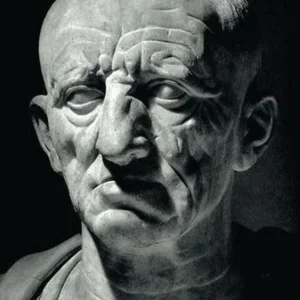
Cato the Elder
233 av. J.-C. — 148 av. J.-C.
Roman statesman and writer (234–149 BC), consul in 195 BC and censor in 184 BC. An uncompromising defender of traditional Roman values, he opposed Greek influence and pursued strict economic policies. He is also considered the first great Latin prose writer, known for his treatise on agriculture.
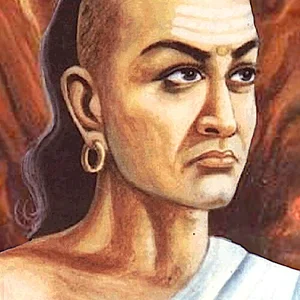
Chanakya
374 av. J.-C. — 282 av. J.-C.
An Indian philosopher, economist, and political strategist of the 4th century BCE, Chanakya served as advisor to Chandragupta Maurya, founder of the Maurya Empire. Often called the "Indian Machiavelli," he authored the Arthashastra, a foundational treatise on politics and economics.
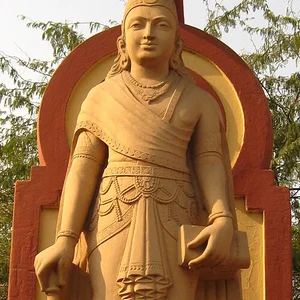
Chandragupta Maurya
339 av. J.-C. — 296 av. J.-C.
Founder of the Maurya Empire in the 4th century BCE, Chandragupta unified the Indian subcontinent after overthrowing the Nanda dynasty. He established the first great centralized empire in Indian history.
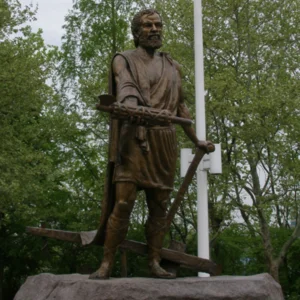
Cincinnatus
518 av. J.-C. — 430 av. J.-C.
Roman patrician of the 5th century BC, appointed dictator in 458 BC to rescue an army surrounded by the Aequi. After his victory in sixteen days, he immediately renounced absolute power to return to tilling his field, becoming the model of Roman civic virtue.
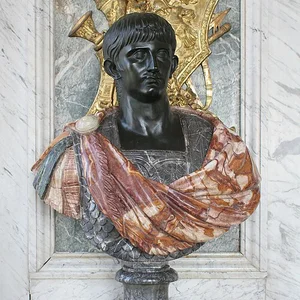
Claudius
9 av. J.-C. — 54
Fourth Roman emperor (41–54 AD), Claudius succeeded Caligula. Despite physical disabilities that long kept him on the margins of power, he proved to be a skilled administrator, reformer, and conqueror of Britain.
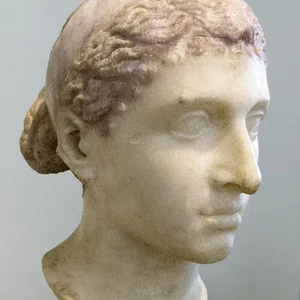
Cleopatra
68 av. J.-C. — 29 av. J.-C.
The last queen of Egypt's Ptolemaic dynasty, Cleopatra VII ruled from 51 to 30 BC. A woman of power and learning, she allied herself with Julius Caesar and later Mark Antony in an effort to preserve her kingdom's independence against Rome.
Clodia Metella
Roman aristocrat of the late Republic, sister of the tribune Publius Clodius Pulcher and wife of the consul Metellus Celer. A cultured and independent woman, she is traditionally identified as the “Lesbia” celebrated by Catullus and was violently attacked by Cicero in the Pro Caelio.
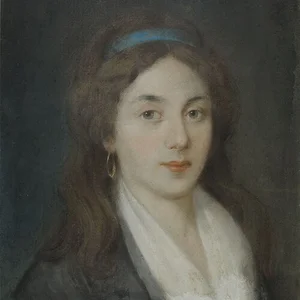
Cornelia
190 av. J.-C. — 100 av. J.-C.
Daughter of Scipio Africanus and wife of Tiberius Sempronius Gracchus, Cornelia (c. 190–100 BC) is the model of the virtuous Roman matron. She raised her twelve children alone after being widowed, refusing a royal remarriage. She is famous for pointing to her sons Tiberius and Gaius as "her most precious jewels."
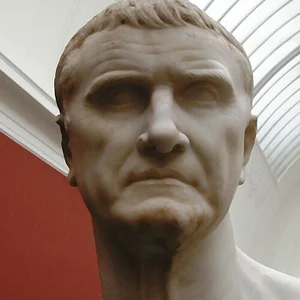
Crassus
114 av. J.-C. — 52 av. J.-C.
A Roman politician and general of the 1st century BC, Crassus was the wealthiest man in Rome. He formed the First Triumvirate with Caesar and Pompey in 60 BC. He died in the disastrous Battle of Carrhae against the Parthians.

Croesus of Lydia
The last king of Lydia (c. 561–546 BC), Croesus remained famous for his legendary wealth, drawn from the gold mines of the Pactolus River. His kingdom was conquered by Cyrus the Great, marking the end of Lydian independence.
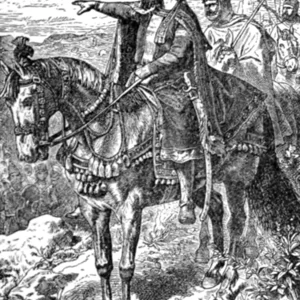
Cyrus II
599 av. J.-C. — 529 av. J.-C.
Founder of the Persian Achaemenid Empire in the 6th century BCE, Cyrus II unified the Median and Persian peoples. Renowned for his tolerance toward conquered peoples, he notably freed the Jewish captives held in Babylon.
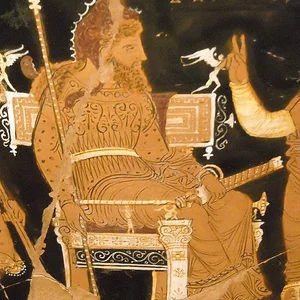
Darius I
549 av. J.-C. — 485 av. J.-C.
Darius I (c. 549–485 BC) was the third great king of the Achaemenid Persian Empire. He expanded the empire to its greatest territorial extent, from the Indus River to Thrace, and profoundly reorganized its administration. He was defeated by the Greeks at the Battle of Marathon in 490 BC.
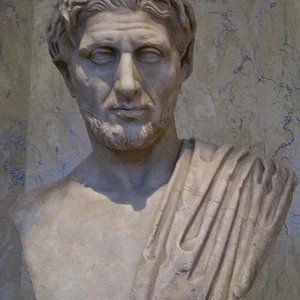
Demetrius of Phalerum
349 av. J.-C. — 282 av. J.-C.
Demetrius of Phalerum was an Athenian philosopher and statesman, a disciple of Aristotle and the Lyceum. As governor of Athens on behalf of Macedonia from 317 to 307 BC, he later took refuge in Alexandria, where he advised Ptolemy I and helped found the Library and the Museum.
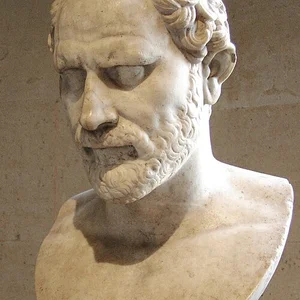
Demosthenes
383 av. J.-C. — 321 av. J.-C.
Demosthenes (384–322 BC) was the greatest orator of ancient Greece. An Athenian statesman, he vigorously opposed the expansion of Philip II of Macedon through his famous speeches, the Philippics.
Dido
A Phoenician princess from Tyre, Dido is the legendary founder of Carthage (in present-day Tunisia), according to Greek and Latin tradition. Made famous by Virgil's Aeneid, she embodies the figure of the queen-builder and the tragic woman abandoned by Aeneas.
Diodorus Siculus
89 av. J.-C. — 19 av. J.-C.
Greek historian of the 1st century BC, born in Sicily, author of the Bibliotheca historica, a vast universal history encyclopedia in 40 volumes covering mythical origins through the age of Caesar.
Djoser
2800 av. J.-C. — 2700 av. J.-C.
Pharaoh of the Third Egyptian Dynasty (c. 2650 BCE), Djoser is famous for commissioning the Step Pyramid of Saqqara, the first great funerary monument built in stone in history.
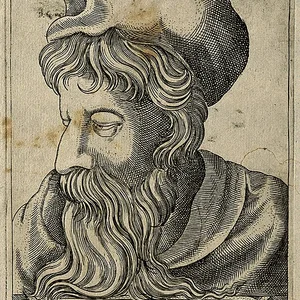
Empedocles
493 av. J.-C. — 433 av. J.-C.
Greek philosopher, physician, and statesman of the 5th century BC, from Akragas in Sicily. He is famous for his theory of the four elements (earth, water, fire, air) and two cosmic forces (Love and Strife). A major figure in Presocratic philosophy, he also had deep interests in medicine and natural phenomena.
Esimirin
Esimirin is an aquatic deity from the Ijaw (Ijo) mythology, a people of the Niger Delta in Nigeria. A spiritual figure associated with water and prosperity, she holds a central place in the beliefs and traditional rituals of this community.
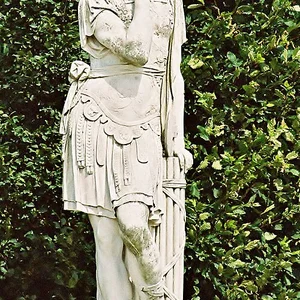
Fabius Cunctator
Roman general and statesman of the late 3rd century BC. Appointed dictator after the disaster at Lake Trasimene (217 BC), he opposed Hannibal through a strategy of attrition and avoidance of pitched battle, earning him the nickname Cunctator, “the Delayer.”
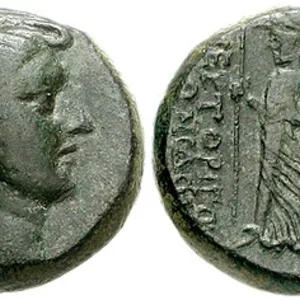
Fulvia
76 av. J.-C. — 39 av. J.-C.
Fulvia was a Roman aristocrat of the late Republic, famous for her exceptional political involvement for a woman of her time. Successively the wife of Clodius, Curio, and then Mark Antony, she led the armed resistance against Octavian during the Perusine War.
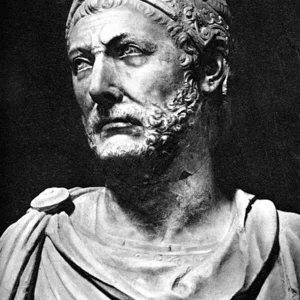
Hannibal Barca
246 av. J.-C. — 182 av. J.-C.
Carthaginian general (246–182 BC), son of Hamilcar Barca, he is one of the greatest military strategists of the ancient world. He led the Second Punic War against Rome, crossing the Alps with his war elephants to invade Italy. His victory at Cannae (216 BC) remains one of the most studied battles in military history.

Hanno the Navigator
500 av. J.-C. — 500 av. J.-C.
A Carthaginian explorer of the 5th century BC, Hanno led an expedition along the West African coast with a fleet of sixty ships. His voyage, recorded in the Periplus of Hanno, is one of the earliest accounts of African exploration from antiquity.
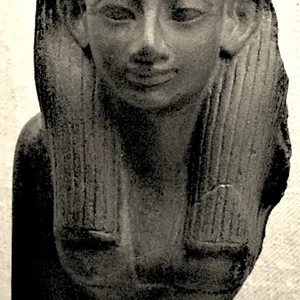
Hatshepsut
1506 av. J.-C. — 1457 av. J.-C.
Hatshepsut is one of the rare women to have reigned as pharaoh of Egypt. After serving as regent for her stepson Thutmose III, she took power around 1478 BCE and ruled for more than twenty years. Her reign was marked by prosperity, major architectural projects, and a celebrated trading expedition to the land of Punt.
Heraclea
Heraclea refers to several Greek cities founded in honor of the hero Heracles, the most famous of which is Heraclea Pontica. These colonial foundations illustrate the role of mythological heroes in shaping ancient Greek identity.
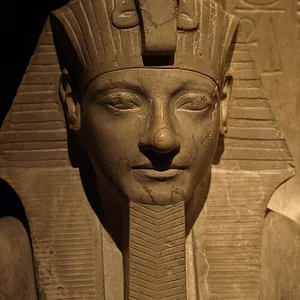
Horemheb
1350 av. J.-C. — 1291 av. J.-C.
The last pharaoh of the Eighteenth Dynasty of Egypt, Horemheb was first a general under Tutankhamun and Ay before seizing the throne. He restored the traditional order and erased the traces of Akhenaten's religious revolution.
Hùng Vương
Title held by the semi-legendary rulers of the kingdom of Văn Lang, founded by the Lạc Việt people and attested between the 7th and 2nd centuries BCE [1]. Eighteen generations of kings are said to have held this title, but their historicity remains debated among historians [1].
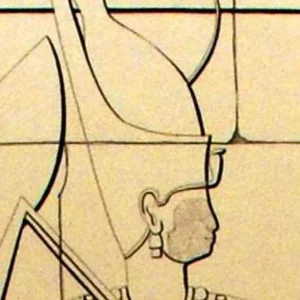
Kandake Amanirenas
Warrior queen of the Kingdom of Meroë (Nubia, present-day Sudan), Amanirenas led Kushite armies against the Roman legions of Augustus around 27–21 BCE. According to Roman sources and Sudanese oral tradition, she lost an eye in battle yet never surrendered, ultimately securing a peace treaty favorable to her kingdom.
Khufu
2700 av. J.-C. — 2565 av. J.-C.
Pharaoh of the 4th Dynasty of ancient Egypt (c. 2589–2566 BC), Khufu is famous for commissioning the Great Pyramid of Giza, one of the Seven Wonders of the Ancient World. His reign stands as a symbol of the absolute power of pharaonic rule.
Kiya
1400 av. J.-C. — 1400 av. J.-C.
A secondary wife of Pharaoh Akhenaten, Kiya held a singular place at the court of Amarna in the 14th century BCE. Her identity and origins remain partly mysterious, though her name and likeness appear on several monuments from the Amarna period.
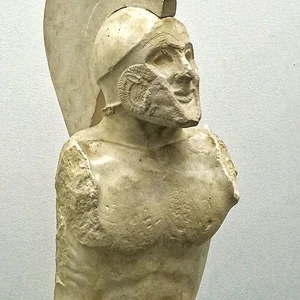
Leonidas
Leonidas I was king of Sparta in the 5th century BC. A member of the Agiad dynasty, he commanded the Greek coalition at the Battle of Thermopylae against the Persian army of Xerxes I in 480 BC. His heroic resistance and death in battle made him a lasting symbol of patriotic sacrifice.
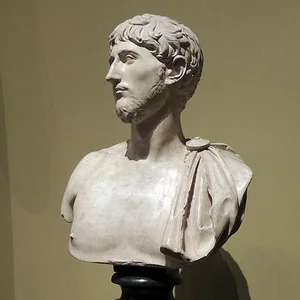
Lepidus
89 av. J.-C. — 12 av. J.-C.
Roman politician and general of the 1st century BC, Lepidus formed the Second Triumvirate with Octavian and Mark Antony in 43 BC. Gradually marginalized, he was removed from power by Octavian in 36 BC.
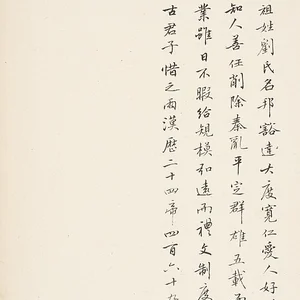
Liu Bang
Liu Bang, of peasant origin, led the revolt against the Qin dynasty and then triumphed over Xiang Yu during the Chu–Han Contention. In 202 BC he founded the Han dynasty, one of the longest-lasting in Chinese history, and reigned under the name Gaozu.
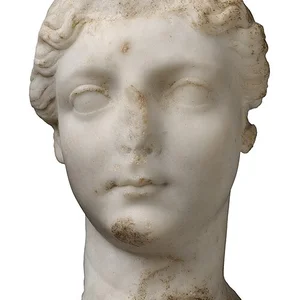
Livia
58 av. J.-C. — 29
Wife of Emperor Augustus, Livia was one of the most powerful women in ancient Rome. For more than fifty years, she wielded considerable influence over imperial politics. Mother of Emperor Tiberius, she was granted the title of "Augusta" after her death.
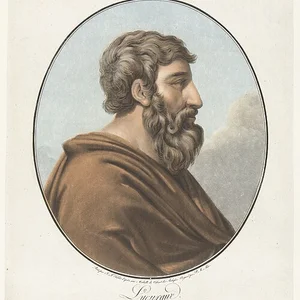
Lycurgus
250 av. J.-C. — 210 av. J.-C.
Lycurgus is the legendary lawgiver of Sparta, traditionally regarded as the founder of the city's political, social, and military institutions (the “Great Rhetra”). His historical existence is uncertain and largely belongs to the realm of myth.
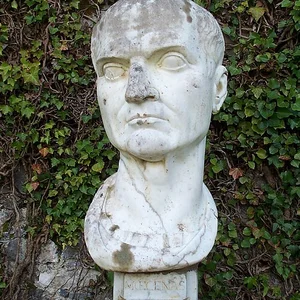
Maecenas
69 av. J.-C. — 7 av. J.-C.
A close advisor to Augustus and great patron of the arts in Rome, Maecenas supported poets such as Virgil and Horace. His name has become synonymous with support for artists and men of letters.
Makeda
Makeda is the central figure of the Ethiopian tradition (Kebra Nagast), venerated as the legendary queen of the Kingdom of Sheba. Rooted in Ethiopian and Eritrean oral tradition, she is known for her encounter with King Solomon of Jerusalem, from which Menelik I would be born — the founding ancestor of the Ethiopian imperial lineage.
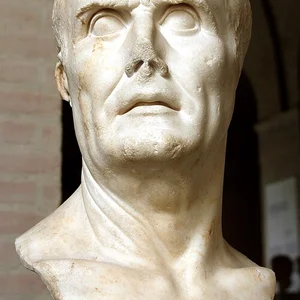
Marius
157 av. J.-C. — 85 av. J.-C.
Roman general and statesman, seven times consul. Victor over Jugurtha and over the Cimbri and Teuton invasions, he profoundly reformed the Roman army by opening recruitment to the poorest citizens.
Menelaus
King of Sparta in Greek mythology, husband of Helen, the most beautiful woman in the world. The abduction of Helen by the Trojan Paris leads him to seek the aid of his brother Agamemnon and to unite the Greek kings against Troy.
Meritaten
Eldest daughter of Pharaoh Akhenaten and Queen Nefertiti, Meritaten lived during the Amarna religious revolution in the 14th century BCE. She became Great Royal Wife of Pharaoh Smenkhkare and was abundantly depicted in the art of the Amarna period.
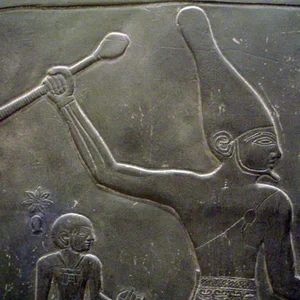
Narmer
3200 av. J.-C. — 3124 av. J.-C.
Narmer is considered the first pharaoh of unified Egypt, around 3100 BCE. He is credited with uniting Upper and Lower Egypt under a single crown, thereby founding the first Egyptian dynasty.
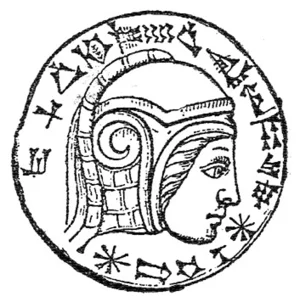
Nebuchadnezzar II
641 av. J.-C. — 561 av. J.-C.
King of Babylon from 604 to 562 BC, Nebuchadnezzar II brought the Neo-Babylonian Empire to its height. He conquered Jerusalem, destroyed the Temple of Solomon, and deported the Hebrews to Babylonia. A great builder, he is associated with the legendary Hanging Gardens of Babylon.
Neferneferuaten
1400 av. J.-C. — 1400 av. J.-C.
Neferneferuaten was a queen of Egypt from the 18th Dynasty, probably co-regent or direct successor to Akhenaten around 1335 BCE. Her exact identity remains debated: she may be Nefertiti under a new name, or a daughter of Akhenaten.
Nefertari
1289 av. J.-C. — 1254 av. J.-C.
Great Royal Wife of Ramesses II, Nefertari is one of the most celebrated queens of ancient Egypt. Her tomb in the Valley of the Queens, with its exceptionally well-preserved paintings, reflects her extraordinary status. Ramesses II dedicated the smaller temple at Abu Simbel to her, where she was depicted at the same scale as the pharaoh himself.
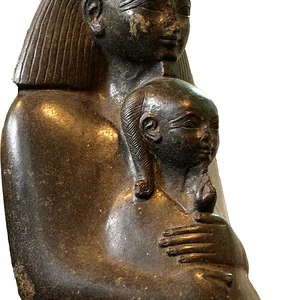
Neferure
1500 av. J.-C. — 1500 av. J.-C.
Daughter of pharaoh Hatshepsut and Thutmose II, Neferure was raised at the Egyptian court in the 18th century BC. Educated by the renowned royal steward Senenmut, she held the title of God's Wife of Amun.
Nitocris
2250 av. J.-C. — 2191 av. J.-C.
Nitocris is a legendary queen or female pharaoh of ancient Egypt, associated with the end of the Sixth Dynasty (c. 2184 BC). Mentioned by Herodotus and Manetho, she is said to have avenged the murder of her brother before taking her own life. Her historical existence remains debated.
Octavia
Sister of Octavian (the future Augustus) and wife of Mark Antony, Octavia was a major figure in the final years of the Roman Republic. Renowned for her loyalty and dignity, she tried in vain to reconcile her feuding brother and husband.
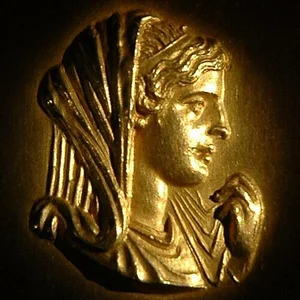
Olympias
374 av. J.-C. — 315 av. J.-C.
Princess of Epirus and Queen of Macedon, Olympias was the wife of Philip II and the mother of Alexander the Great. A formidable wielder of power, she played a major political role during the Wars of the Diadochi following her son's death.
Padmavati
278 av. J.-C. — ?
Wife of Emperor Ashoka (3rd century BCE), Padmavati is a figure of the Mauryan court in ancient India. She is mentioned in Buddhist sources as one of the queens of the great ruler who unified the Indian subcontinent and embraced Buddhism.
Phidias
499 av. J.-C. — 429 av. J.-C.
Phidias is considered the greatest sculptor of ancient Greece in the 5th century BC. He created the chryselephantine statue of Athena Parthenos and the statue of Zeus at Olympia, counted among the Seven Wonders of the Ancient World.
Pisistratus
Youngest son of Nestor, king of Pylos, Pisistratus is a character in Homer's Odyssey. He welcomes Telemachus at Pylos and accompanies him to Sparta to meet Menelaus. A figure of friendship and hospitality, he embodies the aristocratic virtues of the Greek epic.

Polycrates
Tyrant of the island of Samos in the 6th century BC, Polycrates raised his city to the height of its power through a formidable fleet and strategic alliances. His brilliant reign, marked by patronage of the arts and prosperity, ended in a violent death at the hands of the Persian satrap Oroites.
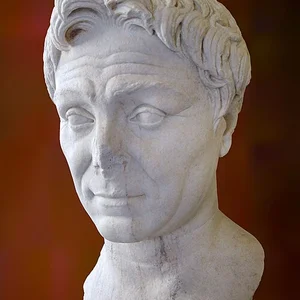
Pompey
105 av. J.-C. — 47 av. J.-C.
Pompey (106–48 BC) was a Roman general and statesman who distinguished himself through his military victories in the East. A rival and later enemy of Caesar, he was one of the key figures in the fall of the Roman Republic.
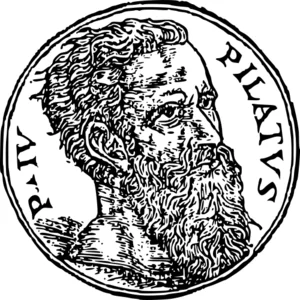
Pontius Pilate
11 av. J.-C. — ?
Pontius Pilate was a Roman prefect of Judaea from 26 to 36 AD. He is best known for ordering the crucifixion of Jesus of Nazareth. His governorship was marked by several conflicts with the Jewish population.
Ptah
Ptah is one of the oldest and most important gods of ancient Egypt, a creator god and patron of craftsmen and architects. Venerated at Memphis since the Old Kingdom, he embodies creation through thought and speech. His triad with Sekhmet and Nefertum forms the heart of the Memphite cult.
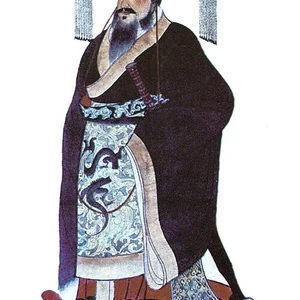
Qin Shi Huang
258 av. J.-C. — 209 av. J.-C.
Qin Shi Huang (258–210 BC) unified the Chinese kingdoms for the first time in 221 BC, founding the Qin dynasty. As China's first emperor, he standardized writing, weights and measures, and initiated construction of the Great Wall.
Queen of Sheba
Legendary ruler mentioned in the Bible, the Quran, and Ethiopian tradition. She is said to have visited King Solomon in Jerusalem, drawn by his wisdom. An iconic figure of exchange between ancient Arabia, Africa, and the Near East.
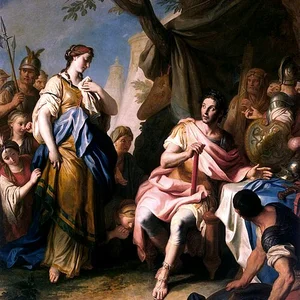
Roxana
346 av. J.-C. — 309 av. J.-C.
Roxana was a Bactrian princess, the first wife of Alexander the Great, whom he married in 327 BC following the conquest of Bactria. She was the mother of Alexander IV, the posthumous heir to the empire.
Saṃghamittā
Daughter of Emperor Ashoka, she was a Buddhist nun who brought Buddhism to Sri Lanka around 246 BCE. She founded the first order of Buddhist nuns (bhikkhunis) on the island and brought a cutting from the sacred fig tree of Bodh Gaya.
Sammu-ramat (Semiramis)
Regent of the Assyrian Empire around 811–808 BC, Sammu-ramat held power in the name of her son Adad-nirari III. A historical figure, she quickly became a legendary character in the Greek world, symbolizing the warrior queen and great builder of the ancient Near East.
Sardanapalus
Sardanapalus is a legendary king of Assyria, a figure from ancient Greek tradition. Renowned for his extreme luxury and dissolute lifestyle, he is said to have chosen to die in flames rather than surrender to his enemies. His tragic fate inspired numerous works of art, most notably the painting by Eugène Delacroix.
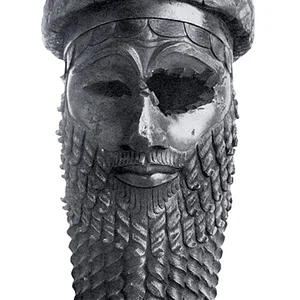
Sargon of Akkad
2350 av. J.-C. — 2300 av. J.-C.
Sargon of Akkad (c. 2334–2279 BCE) was the founder of the first empire in history, the Akkadian Empire. Rising from humble origins according to legend, he unified Mesopotamia under his rule and governed a territory stretching from the Persian Gulf to the Mediterranean.
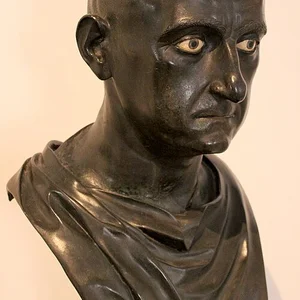
Scipio Africanus
234 av. J.-C. — 182 av. J.-C.
Roman general of the 2nd century BC, victor over Hannibal at the Battle of Zama (202 BC). He brought the Second Punic War to an end and secured Rome's dominance over Carthage.
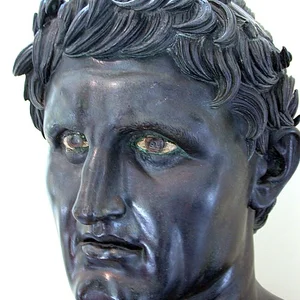
Seleucus I Nicator
357 av. J.-C. — 280 av. J.-C.
A Macedonian general under Alexander the Great, Seleucus became one of the Diadochi after his death and founded the Seleucid dynasty. He built the largest of the Hellenistic kingdoms, stretching from Anatolia to the Indus.
Seti I
1322 av. J.-C. — 1278 av. J.-C.
Seti I was the second pharaoh of the Nineteenth Dynasty of Egypt, reigning around 1294–1279 BC. Son of Ramesses I, he restored Egypt's military and religious power following the Amarna period. He is renowned for his campaigns in Canaan and Libya, as well as for his magnificent temple at Abydos.
Shanakdakhete
200 av. J.-C. — 160 av. J.-C.
Shanakdakhete is the earliest known reigning queen of Meroë, capital of the Kingdom of Kush (Nubia), in the 2nd century BCE. A product of Meroitic civilization, she ruled in her own right, with no attested male consort. Her memory has been passed down through inscriptions in the Meroitic script and through the oral traditions of Nubian peoples.
Shiva
Shiva is one of the three principal deities of Hinduism, forming the Trimūrti alongside Brahmā and Vishnu. God of destruction and transformation, he also embodies meditation, the arts, and fertility. His cult, rooted in the Indus Valley civilization, is one of the oldest in the world.
Sisygambis
301 av. J.-C. — 322 av. J.-C.
Sisygambis was an Achaemenid princess, the mother of Darius III, the last king of the Persian Empire. Captured by Alexander the Great after the Battle of Issus in 333 BC, she became a symbol of royal dignity in defeat and was treated with a respect that became famous.
Smenkhkare
1400 av. J.-C. — 1333 av. J.-C.
A short-lived pharaoh of ancient Egypt's 18th Dynasty, Smenkhkare reigned briefly around 1338–1336 BC, succeeding Akhenaten. His identity remains one of the most enigmatic puzzles of ancient Egypt.
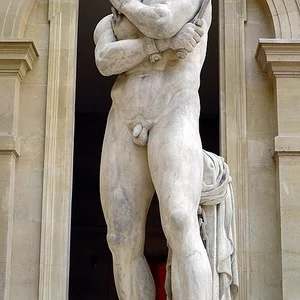
Spartacus
102 av. J.-C. — 70 av. J.-C.
A gladiator of Thracian origin, Spartacus led the Third Servile War against Rome (73–71 BC), commanding an army of rebel slaves that threatened the very existence of the Roman Republic before being defeated by Crassus.
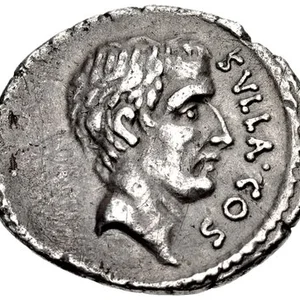
Sulla
137 av. J.-C. — 77 av. J.-C.
A Roman general and statesman, Sulla seized power by force in the aftermath of civil wars. Appointed dictator, he reformed the institutions of the Republic in favor of the Senate before stepping down.
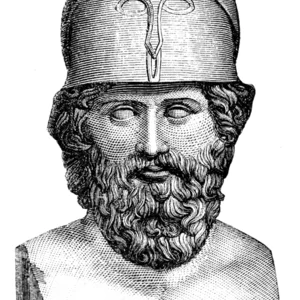
Themistocles
523 av. J.-C. — 458 av. J.-C.
Athenian statesman and strategist, architect of Athens' naval power. He led the Greeks to the decisive victory at Salamis against the Persians in 480 BC.
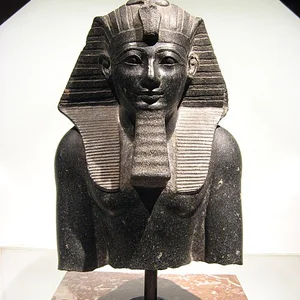
Thutmose III
1480 av. J.-C. — 1424 av. J.-C.
Pharaoh of the 18th Egyptian Dynasty (c. 1479–1425 BCE), Thutmose III is considered the greatest conqueror of ancient Egypt. He led seventeen military campaigns and brought the Egyptian empire to its greatest territorial extent.
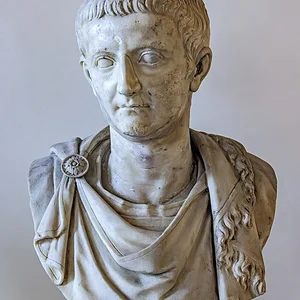
Tiberius
41 av. J.-C. — 37
Tiberius (42 BC – 37 AD) was the second Roman emperor, successor to Augustus. He reigned from 14 to 37 AD and withdrew to Capri from 27 AD onward, leaving power in the hands of Sejanus.
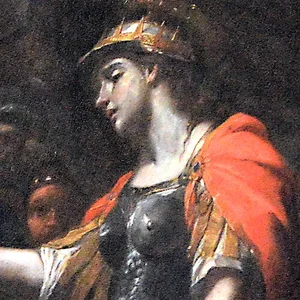
Tomyris
600 av. J.-C. — 600 av. J.-C.
Queen of the Massagetae, a nomadic people of Central Asia, Tomyris is famous for defeating and killing Cyrus the Great around 530 BC. She embodies the resistance of the steppe peoples against the expansion of the Achaemenid Persian Empire.
Tutankhamun
1340 av. J.-C. — 1323 av. J.-C.
An Egyptian pharaoh of the 18th Dynasty, he reigned around 1332–1323 BCE. Ascending to the throne at approximately nine years old, he restored polytheistic worship after the Atenist revolution of Akhenaten. His tomb, discovered intact in 1922, is one of the greatest archaeological discoveries of the 20th century.
Unas
2374 av. J.-C. — 2349 av. J.-C.
Unas was the last pharaoh of the Fifth Dynasty of ancient Egypt, reigning around 2375–2345 BCE. His pyramid at Saqqara is world-famous for containing the Pyramid Texts, the oldest known corpus of religious writings in human history.
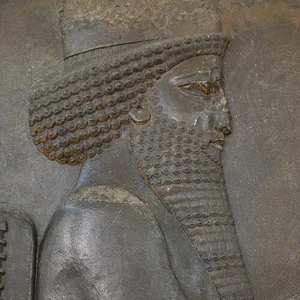
Xerxes I
518 av. J.-C. — 464 av. J.-C.
King of the Achaemenid Persian Empire from 485 to 465 BC, son of Darius I. He is famous for leading the second Greco-Persian War against the Greek city-states, notably at the battles of Thermopylae and Salamis.
Literature(75)
Abel
Abel is the second son of Adam and Eve in Genesis. A devout shepherd, he offers God the finest of his flock. Slain by his brother Cain, he becomes the first murder victim in the Abrahamic tradition.
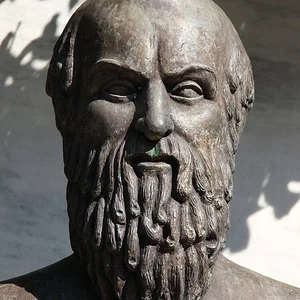
Aeschylus
524 av. J.-C. — 455 av. J.-C.
Aeschylus (524–455 BC) is considered the father of Greek tragedy. He introduced a second actor on stage, revolutionizing ancient theatre. His works, most notably the Oresteia, explore divine justice and the human condition.
Agamemnon
King of Mycenae and supreme commander of the Greek forces during the Trojan War. A central figure in Homer's Iliad and Aeschylus's Oresteia, his tragic fate — from the sacrifice of Iphigenia to his murder by Clytemnestra — makes him an archetype of hubris and fatality.

Alcaeus
450 av. J.-C. — 400 av. J.-C.
Alcaeus is a Greek lyric poet of the late 7th and early 6th century BC, born in Mytilene on the island of Lesbos. A contemporary and compatriot of Sappho, he is one of the great representatives of Greek monodic poetry.
Alcmene
Greek princess, daughter of Electryon king of Mycenae and wife of Amphitryon. Zeus seduced her by taking on her husband's appearance, and she thus conceived Heracles, the most famous of all Greek heroes.
Alexander II of Macedon
King of Macedon from 370 to 368 BC, son of Amyntas III and elder brother of Philip II. His brief reign was marked by internal unrest before his assassination by Ptolemy of Aloros.
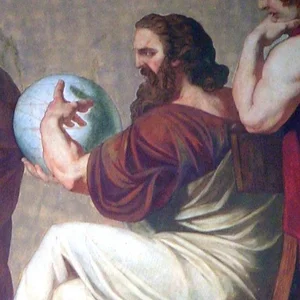
Anaxagoras of Clazomenae
499 av. J.-C. — 427 av. J.-C.
Greek pre-Socratic philosopher (c. 500–428 BC), born in Ionia. He introduced the concept of Nous (Cosmic Mind) as the organizing principle of the universe and was the first to offer a rational explanation for solar eclipses. A close friend of Pericles, he lived in Athens before being banished on charges of impiety.
Anaximander
609 av. J.-C. — 545 av. J.-C.
Pre-Socratic Greek philosopher born around 609 BCE in Miletus, a disciple of Thales. He proposed the apeiron (the boundless, indeterminate infinite) as the originating principle of all things, and created one of the earliest known maps of the world.
Andromache
Princess of Thebe in Mysia and wife of Hector in the Greek epic tradition, Andromache is the figure of the woman and mother struck by the Trojan War. Immortalized by Homer in the Iliad and by Racine in his eponymous tragedy (1667), she embodies conjugal fidelity and grief.
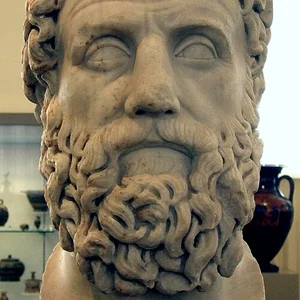
Archilochus
687 av. J.-C. — 644 av. J.-C.
Archilochus was an archaic Greek poet of the 7th century BC, native to the island of Paros. A mercenary soldier and poet, he is regarded as the inventor of iambic poetry and one of the first to express a personal and satirical voice in Greek literature.
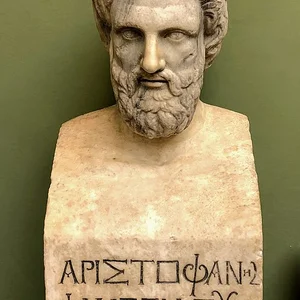
Aristophanes
444 av. J.-C. — 384 av. J.-C.
Aristophanes is the foremost representative of ancient Greek comedy, author of around forty plays, eleven of which have survived. His works blend political satire, social criticism, and poetic fantasy. He humorously staged the conflicts of his time, most notably the Peloponnesian War.
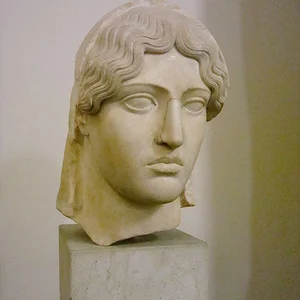
Aspasia
469 av. J.-C. — 399 av. J.-C.
Born in Miletus around 470 BC, Aspasia was the companion of Pericles and a major intellectual figure in Athens. Renowned for her eloquence and mastery of rhetoric, she hosted a philosophical salon attended by Socrates, Plato, and the greatest minds of her era.
Atlas
Titan of Greek mythology, son of Iapetus and Clymene. Condemned by Zeus to hold up the sky on his shoulders after the defeat of the Titans in the Titanomachy. He is also the father of the Pleiades and the Hesperides.
Berenice I
339 av. J.-C. — ?
Macedonian queen who became the wife of Ptolemy I, founder of the Lagid dynasty in Egypt. Mother of Ptolemy II Philadelphus, she was deified after her death and played a foundational role in establishing the dynastic legitimacy of the Ptolemies.
Cain
3899 av. J.-C. — 3199 av. J.-C.
Eldest son of Adam and Eve in the Bible, Cain committed the first murder in human history by killing his brother Abel out of jealousy. Condemned to wander the earth, he received a protective mark from God.
Catiline
107 av. J.-C. — 61 av. J.-C.
Lucius Sergius Catiline was a Roman patrician and politician, famous for plotting a conspiracy to seize power in 63 BC. Exposed by Cicero, he died fighting at the Battle of Pistoria in 62 BC.
Cato the Elder
233 av. J.-C. — 148 av. J.-C.
Roman statesman and writer (234–149 BC), consul in 195 BC and censor in 184 BC. An uncompromising defender of traditional Roman values, he opposed Greek influence and pursued strict economic policies. He is also considered the first great Latin prose writer, known for his treatise on agriculture.
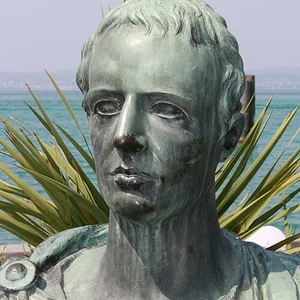
Catullus
83 av. J.-C. — 53 av. J.-C.
Catullus was a Latin lyric poet of the Roman Republic, born around 83 BC in Verona. A contemporary of Caesar and Cicero, he authored a collection of 116 poems blending passionate love, friendship, and political satire.
Chanakya
374 av. J.-C. — 282 av. J.-C.
An Indian philosopher, economist, and political strategist of the 4th century BCE, Chanakya served as advisor to Chandragupta Maurya, founder of the Maurya Empire. Often called the "Indian Machiavelli," he authored the Arthashastra, a foundational treatise on politics and economics.
Claudius
9 av. J.-C. — 54
Fourth Roman emperor (41–54 AD), Claudius succeeded Caligula. Despite physical disabilities that long kept him on the margins of power, he proved to be a skilled administrator, reformer, and conqueror of Britain.
Clodia Metella
Roman aristocrat of the late Republic, sister of the tribune Publius Clodius Pulcher and wife of the consul Metellus Celer. A cultured and independent woman, she is traditionally identified as the “Lesbia” celebrated by Catullus and was violently attacked by Cicero in the Pro Caelio.
Clytemnestra
A major figure in Greek mythology, Clytemnestra is the wife of King Agamemnon of Mycenae. She murders him upon his return from the Trojan War to avenge the sacrifice of their daughter Iphigenia. She is the central character of Aeschylus's Oresteia (458 BCE).
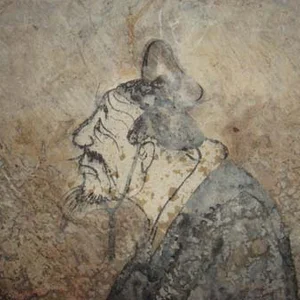
Confucius
550 av. J.-C. — 478 av. J.-C.
A Chinese thinker and philosopher of the 5th century BC, Confucius is the founder of Confucianism. His moral and political teachings, passed down by his disciples in the Analects, have profoundly influenced Chinese civilization and East Asia for more than two millennia.
Cornelia
190 av. J.-C. — 100 av. J.-C.
Daughter of Scipio Africanus and wife of Tiberius Sempronius Gracchus, Cornelia (c. 190–100 BC) is the model of the virtuous Roman matron. She raised her twelve children alone after being widowed, refusing a royal remarriage. She is famous for pointing to her sons Tiberius and Gaius as "her most precious jewels."
Crassus
114 av. J.-C. — 52 av. J.-C.
A Roman politician and general of the 1st century BC, Crassus was the wealthiest man in Rome. He formed the First Triumvirate with Caesar and Pompey in 60 BC. He died in the disastrous Battle of Carrhae against the Parthians.
Deianira
Wife of Heracles and princess of Calydon, Deianira is a tragic figure in Greek mythology. Deceived by the centaur Nessus, she gives her husband a tunic soaked in poison, believing it to be a love potion, thereby causing his death.
Demetrius of Phalerum
349 av. J.-C. — 282 av. J.-C.
Demetrius of Phalerum was an Athenian philosopher and statesman, a disciple of Aristotle and the Lyceum. As governor of Athens on behalf of Macedonia from 317 to 307 BC, he later took refuge in Alexandria, where he advised Ptolemy I and helped found the Library and the Museum.
Demosthenes
383 av. J.-C. — 321 av. J.-C.
Demosthenes (384–322 BC) was the greatest orator of ancient Greece. An Athenian statesman, he vigorously opposed the expansion of Philip II of Macedon through his famous speeches, the Philippics.
Diodorus Siculus
89 av. J.-C. — 19 av. J.-C.
Greek historian of the 1st century BC, born in Sicily, author of the Bibliotheca historica, a vast universal history encyclopedia in 40 volumes covering mythical origins through the age of Caesar.
Electra
Electra is a heroine of Greek mythology, daughter of Agamemnon and Clytemnestra. After her father is murdered by her mother and her lover Aegisthus, she convinces her brother Orestes to avenge him. Her tragic fate inspired all three of the great Greek tragedians.
Empedocles
493 av. J.-C. — 433 av. J.-C.
Greek philosopher, physician, and statesman of the 5th century BC, from Akragas in Sicily. He is famous for his theory of the four elements (earth, water, fire, air) and two cosmic forces (Love and Strife). A major figure in Presocratic philosophy, he also had deep interests in medicine and natural phenomena.
Énheduana
High priestess of the moon at Ur and daughter of Sargon of Akkad, Enheduana is the first known author in history. Around 2300 BCE, she composed hymns to the goddess Inanna and songs for the Sumerian temples, laying the foundations of religious literature.
Enheduanna
2300 av. J.-C. — 2300 av. J.-C.
Enheduanna, high priestess of the moon god at Ur and daughter of Sargon of Akkad, is the first known author in history. Around 2300 BCE, she composed hymns to the goddess Inanna of rare poetic power, laying the foundations of world religious literature.
Enkidu
Legendary figure from the Epic of Gilgamesh, created by the gods to be the companion of King Gilgamesh. Born wild and raised among animals, he becomes the hero's inseparable friend before his death triggers the quest for immortality.
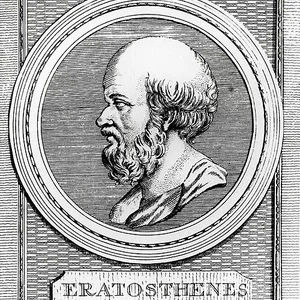
Eratosthenes
275 av. J.-C. — 193 av. J.-C.
Greek scholar of the 3rd century BC and director of the Library of Alexandria. He measured the circumference of the Earth with remarkable accuracy and laid the foundations of scientific geography.
Heraclea
Heraclea refers to several Greek cities founded in honor of the hero Heracles, the most famous of which is Heraclea Pontica. These colonial foundations illustrate the role of mythological heroes in shaping ancient Greek identity.
Heraclitus
534 av. J.-C. — 470 av. J.-C.
Pre-Socratic Greek philosopher born around 534 BC in Ephesus (present-day Turkey). He is famous for his doctrine of universal flux and fire as the fundamental principle of all things. His work, known under the title "On Nature", has survived only in fragments.
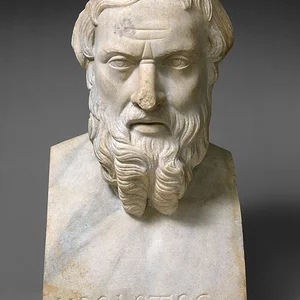
Herodotus
483 av. J.-C. — 424 av. J.-C.
Greek historian and geographer born around 484 BC in Halicarnassus, considered the "Father of History". He is the author of the Histories, a vast inquiry into the Greco-Persian Wars and the peoples of the ancient world.
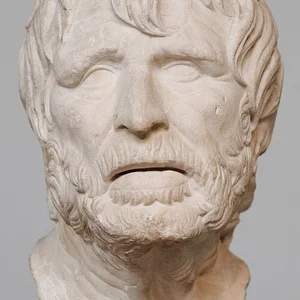
Hesiod
775 av. J.-C. — ?
Greek poet of the 8th–7th centuries BCE, a contemporary of Homer, born in Ascra in Boeotia. He is the author of the Theogony and Works and Days, two foundational works of Greek literature and mythology.
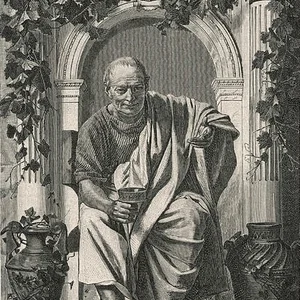
Horace
64 av. J.-C. — 7 av. J.-C.
Horace is a major Latin poet of the Augustan age, born in 65 BC in Venusia. A friend of Virgil and protégé of Maecenas, he is the author of the Odes, the Satires, and the Ars Poetica. His work celebrates wisdom, friendship, and the simple pleasures of life.
Iphigenia
Daughter of Agamemnon and Clytemnestra, Iphigenia was condemned to be sacrificed at Aulis to appease Artemis and allow the Greek fleet to sail for Troy. Saved by the goddess, she was transported to Tauris where she became a priestess. Her fate inspired major tragedies by Euripides.

Juno
Juno is the queen of the gods in Roman mythology, wife of Jupiter and goddess of marriage and motherhood. Identified with the Greek Hera, she belongs to the Capitoline Triad and plays a central role in Virgil's epic, the *Aeneid*.
Lepidus
89 av. J.-C. — 12 av. J.-C.
Roman politician and general of the 1st century BC, Lepidus formed the Second Triumvirate with Octavian and Mark Antony in 43 BC. Gradually marginalized, he was removed from power by Octavian in 36 BC.
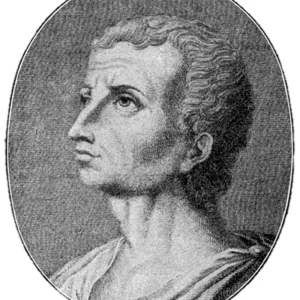
Livy
58 av. J.-C. — 17
Livy was a Latin historian born in Patavium (Padua) around 58 BC. He is the author of a monumental History of Rome in 142 books, of which 35 have survived. His work traces the history of Rome from its legendary founding to his own time.
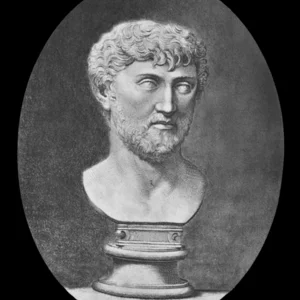
Lucretius
93 av. J.-C. — 54 av. J.-C.
Lucretius was a Latin Epicurean poet and philosopher of the 1st century BC. He is the author of De rerum natura, a sweeping poem in six books expounding the philosophy of Epicurus and the atomism of Democritus. His work seeks to free humanity from the fear of the gods and of death.
Maecenas
69 av. J.-C. — 7 av. J.-C.
A close advisor to Augustus and great patron of the arts in Rome, Maecenas supported poets such as Virgil and Horace. His name has become synonymous with support for artists and men of letters.
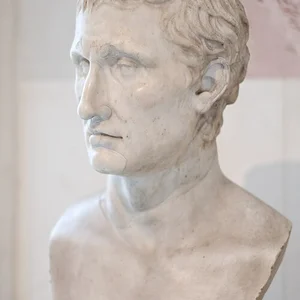
Menander
340 av. J.-C. — 290 av. J.-C.
Menander (342–290 BC) was the greatest representative of Greek New Comedy. A prolific Athenian playwright, he wrote more than a hundred plays depicting everyday life and the social customs of his time.
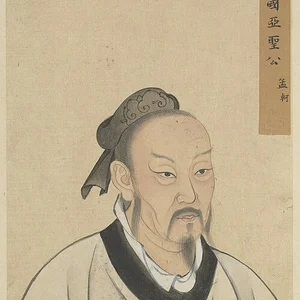
Mencius
371 av. J.-C. — 288 av. J.-C.
Mencius was a Chinese philosopher of the 4th century BCE, considered the second great sage of Confucianism after Confucius. He developed the idea that human nature is fundamentally good and that a legitimate ruler must govern with benevolence. His work, the Mengzi, is one of the Four Books of the Confucian canon.
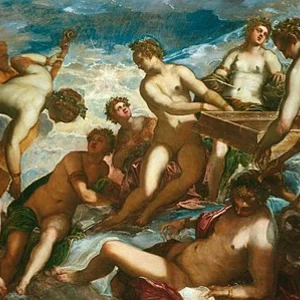
Muses
The nine Muses are the daughters of Zeus and Mnemosyne in Greek mythology. Goddesses of the arts and sciences, they inspire poets, musicians, and scholars. Calliope, Clio, Erato, Euterpe, Melpomene, Polyhymnia, Terpsichore, Thalia, and Urania each preside over an artistic or intellectual domain.
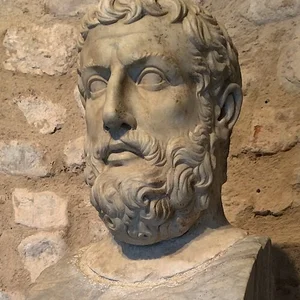
Parmenides
514 av. J.-C. — 469 av. J.-C.
Greek philosopher of the 5th century BC and founder of the Eleatic school. He developed a radical metaphysics asserting that Being is one, unchanging, and eternal — rejecting any notion of change or multiplicity.
Patroclus
Greek hero of mythology and faithful companion of Achilles during the Trojan War. After donning Achilles' armor to restore the Greeks' courage, he is killed by Hector, triggering his friend's furious revenge.
Peleus
Hero of Greek mythology, king of Phthia in Thessaly. Son of Aeacus and grandson of Zeus, he is famous for his marriage to the Nereid Thetis and for being the father of Achilles.
Penelope
A figure from Greek mythology, wife of Odysseus and mother of Telemachus. During her husband's twenty-year absence, she fends off her suitors with a famous trick: each night she unravels the shroud she weaves by day. She embodies faithfulness, patience, and female intelligence in the Homeric epic.
Phidias
499 av. J.-C. — 429 av. J.-C.
Phidias is considered the greatest sculptor of ancient Greece in the 5th century BC. He created the chryselephantine statue of Athena Parthenos and the statue of Zeus at Olympia, counted among the Seven Wonders of the Ancient World.
Pisistratus
Youngest son of Nestor, king of Pylos, Pisistratus is a character in Homer's Odyssey. He welcomes Telemachus at Pylos and accompanies him to Sparta to meet Menelaus. A figure of friendship and hospitality, he embodies the aristocratic virtues of the Greek epic.
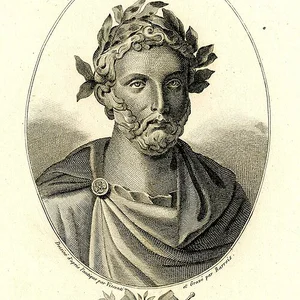
Plautus
249 av. J.-C. — 183 av. J.-C.
A Latin comic playwright of the 3rd–2nd century BC, Plautus is the leading figure of Roman comedy. He adapted Greek New Comedy for Roman audiences, creating characters that became archetypes: the cunning slave, the miser, the braggart soldier.
Scipio Africanus
234 av. J.-C. — 182 av. J.-C.
Roman general of the 2nd century BC, victor over Hannibal at the Battle of Zama (202 BC). He brought the Second Punic War to an end and secured Rome's dominance over Carthage.
Sibyl of Cumae
A legendary prophetess of Antiquity, she presided over Apollo's oracle at Cumae, in Campania. According to tradition, she lived for a thousand years and sold the Sibylline Books to King Tarquin. Virgil makes her the guide of Aeneas in the Underworld in the Aeneid.
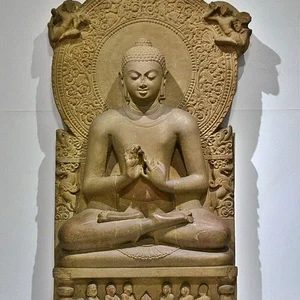
Siddhartha Gautama
500 av. J.-C. — 500 av. J.-C.
An Indian prince born around 563 BCE in Nepal, he renounced his privileged life to seek the truth about human suffering. After years of asceticism and meditation, he attained Enlightenment beneath the Bodhi tree and became the Buddha, the "Awakened One."
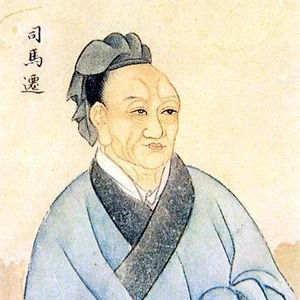
Sima Qian
144 av. J.-C. — 85 av. J.-C.
A historian and annalist of the Han dynasty, Sima Qian is the author of the Records of the Grand Historian (Shiji), considered the first great work of Chinese historiography. Despite disgrace and castration imposed by Emperor Wu, he completed this monumental work covering three millennia of history.

Sima Tan
164 av. J.-C. — 109 av. J.-C.
A Chinese astrologer and historian of the 2nd century BC, Sima Tan served as Grand Astrologer at the Han court. He undertook the writing of the *Shiji* (Records of the Grand Historian), a work his son Sima Qian completed after his death.
Spartacus
102 av. J.-C. — 70 av. J.-C.
A gladiator of Thracian origin, Spartacus led the Third Servile War against Rome (73–71 BC), commanding an army of rebel slaves that threatened the very existence of the Roman Republic before being defeated by Crassus.
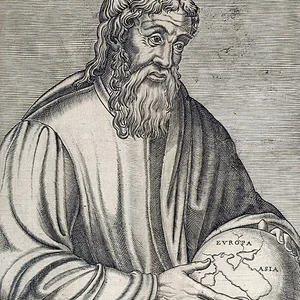
Strabo
62 av. J.-C. — 23
Greek geographer, historian, and philosopher born around 62 BC in Amaseia (modern-day Turkey). He is the author of the Geography in 17 books, a description of the known world of his time. An heir to the Stoic tradition, he traveled extensively throughout the Mediterranean and the East.
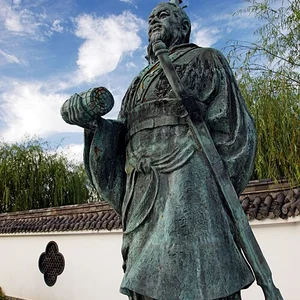
Sun Tzu
543 av. J.-C. — 495 av. J.-C.
Sun Tzu was a Chinese general and philosopher of the 6th century BC, author of The Art of War. This military treatise, one of the oldest in the world, continues to influence military, political, and economic strategy to this day.
Telegonus
Son of Odysseus and the sorceress Circe, Telegonus is a figure from Greek mythology. He accidentally killed his father Odysseus without recognizing him, thus fulfilling a tragic prophecy.
Telemachus
Telemachus is the son of Odysseus and Penelope in Greek mythology. A young man at the time of his father's return to Ithaca, he sets out to search for him and then helps him eliminate the suitors besieging his mother.
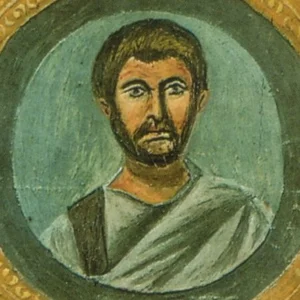
Terence
184 av. J.-C. — 158 av. J.-C.
Terence was a Roman comic playwright of African origin, freed by his master. He wrote six comedies inspired by Greek New Comedy, celebrated for their elegant Latin style and psychological depth.
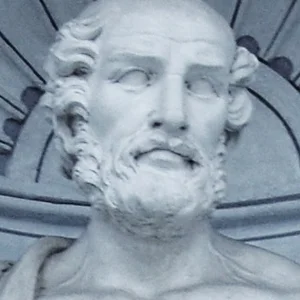
Theophrastus
370 av. J.-C. — 286 av. J.-C.
Greek philosopher and scholar, successor to Aristotle as head of the Lyceum in Athens. Considered the father of botany, he systematized the study of plants and continued his master's encyclopedic work.
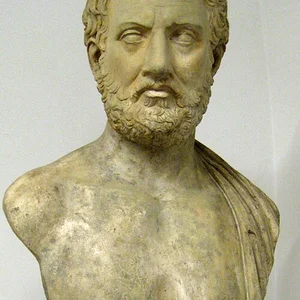
Thucydides
460 av. J.-C. — 394 av. J.-C.
An Athenian historian and general of the 5th century BC, Thucydides is the author of the History of the Peloponnesian War, an account of the conflict between Athens and Sparta. Regarded as the founder of scientific historiography, he sought to establish facts with rigor and impartiality.
Xenophanes
569 av. J.-C. — 477 av. J.-C.
Pre-Socratic Greek philosopher and poet born in Colophon around 570 BC. He criticized the anthropomorphic polytheism of Homer and Hesiod, and argued for a single, universal, non-human god. A forerunner of rational theology and epistemology.
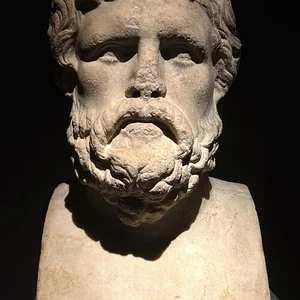
Xenophon
430 av. J.-C. — 353 av. J.-C.
Greek historian, soldier, and philosopher born around 430 BC, and a disciple of Socrates. He led the retreat of the Ten Thousand Greek mercenaries from Persia, recounted in the Anabasis. A prolific author, he left behind historical, philosophical, and military works.
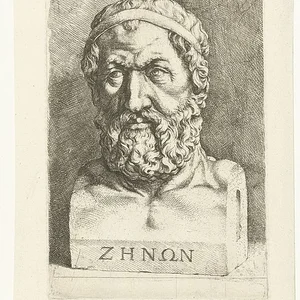
Zeno of Elea
489 av. J.-C. — 424 av. J.-C.
Pre-Socratic Greek philosopher and disciple of Parmenides, born around 489 BCE in Elea (Magna Graecia). He is famous for his paradoxes demonstrating the impossibility of motion and plurality, laying the groundwork for dialectic as a method of argumentation.
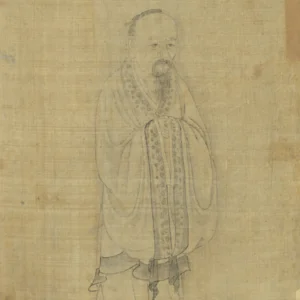
Zhuangzi
368 av. J.-C. — 287 av. J.-C.
A Chinese Taoist philosopher of the 4th century BCE, Zhuangzi is one of the founding thinkers of philosophical Taoism. His writings, collected in the work that bears his name, explore freedom, the relativity of things, and harmony with the Tao.
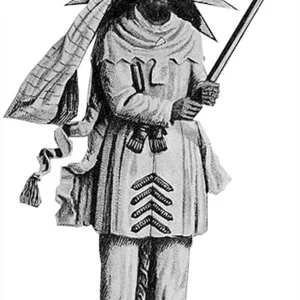
Zoroaster
627 av. J.-C. — 550 av. J.-C.
Iranian prophet and founder of Zoroastrianism, one of the oldest monotheistic religions. He is believed to have lived between 1500 and 550 BCE and received divine revelations from Ahura Mazda. His teachings are recorded in the Gathas, sacred hymns that form part of the Avesta.
Zulaikha
Zulaikha is the wife of Potiphar, a high Egyptian dignitary, famous in the Bible (Genesis 39) and the Quran (Surah Yusuf) for attempting to seduce Joseph. Joseph's refusal and her false accusation lead him to prison. She has become a major literary figure, particularly in classical Persian poetry.
Military(62)
Abel
Abel is the second son of Adam and Eve in Genesis. A devout shepherd, he offers God the finest of his flock. Slain by his brother Cain, he becomes the first murder victim in the Abrahamic tradition.
Ajax
Ajax, son of Telamon, king of Salamis, is one of the greatest Greek heroes of the Trojan War. Renowned for his colossal size and strength, he is considered, after Achilles, the finest warrior in the Achaean camp.
An Dương Vương
250 av. J.-C. — 206 av. J.-C.
An Dương Vương, whose real name was Thục Phán, was the founder and sole ruler of the kingdom of Âu Lạc, formed by the union of the Âu Việt and the Lạc Việt after his victory over the last Hùng king of Văn Lang. He reigned until his defeat by Triệu Đà in 179 BCE, which brought his kingdom to an end.
Anat
Anat is a warrior goddess of the Ugaritic pantheon (ancient Syria), venerated in the 2nd millennium BCE. A fierce virgin warrior, she is the sister of the god Baal and ranks among the most formidable deities of the ancient Near East.
Ashurbanipal
684 av. J.-C. — 630 av. J.-C.
Ashurbanipal was one of the last great kings of the Neo-Assyrian Empire, reigning from 669 to roughly 627 BC. A warrior and scholar king, he brought Assyria to its greatest territorial extent and founded at Nineveh a vast library gathering tens of thousands of cuneiform tablets.
Ay
1400 av. J.-C. — 1400 av. J.-C.
Ay was pharaoh of Egypt around 1323–1319 BCE, successor to Tutankhamun. A senior official and priest, he played a key role at the close of the Amarna period by restoring the traditional worship of the Egyptian gods.
Brutus
1983 — ?
A Roman senator and statesman of the late Republic, Brutus was one of the main instigators of the assassination of Julius Caesar on the Ides of March, 44 BC. Defeated by the triumvirs Octavian and Mark Antony at Philippi, he took his own life in 42 BC.
Cain
3899 av. J.-C. — 3199 av. J.-C.
Eldest son of Adam and Eve in the Bible, Cain committed the first murder in human history by killing his brother Abel out of jealousy. Condemned to wander the earth, he received a protective mark from God.
Cambyses II
558 av. J.-C. — 521 av. J.-C.
Cambyses II was a king of the Achaemenid Persian Empire, son and successor of Cyrus the Great. He conquered Egypt in 525 BC and proclaimed himself pharaoh, thereby greatly expanding the empire founded by his father.
Catiline
107 av. J.-C. — 61 av. J.-C.
Lucius Sergius Catiline was a Roman patrician and politician, famous for plotting a conspiracy to seize power in 63 BC. Exposed by Cicero, he died fighting at the Battle of Pistoria in 62 BC.
Chandragupta Maurya
339 av. J.-C. — 296 av. J.-C.
Founder of the Maurya Empire in the 4th century BCE, Chandragupta unified the Indian subcontinent after overthrowing the Nanda dynasty. He established the first great centralized empire in Indian history.
Cincinnatus
518 av. J.-C. — 430 av. J.-C.
Roman patrician of the 5th century BC, appointed dictator in 458 BC to rescue an army surrounded by the Aequi. After his victory in sixteen days, he immediately renounced absolute power to return to tilling his field, becoming the model of Roman civic virtue.
Crassus
114 av. J.-C. — 52 av. J.-C.
A Roman politician and general of the 1st century BC, Crassus was the wealthiest man in Rome. He formed the First Triumvirate with Caesar and Pompey in 60 BC. He died in the disastrous Battle of Carrhae against the Parthians.
Diodorus Siculus
89 av. J.-C. — 19 av. J.-C.
Greek historian of the 1st century BC, born in Sicily, author of the Bibliotheca historica, a vast universal history encyclopedia in 40 volumes covering mythical origins through the age of Caesar.
Enyo
Greek goddess of war and destruction, Enyo is the companion or sister of Ares. She embodies the bloody turmoil of battle and spreads terror across the battlefield in Greek mythology.
Fabius Cunctator
Roman general and statesman of the late 3rd century BC. Appointed dictator after the disaster at Lake Trasimene (217 BC), he opposed Hannibal through a strategy of attrition and avoidance of pitched battle, earning him the nickname Cunctator, “the Delayer.”
Fulvia
76 av. J.-C. — 39 av. J.-C.
Fulvia was a Roman aristocrat of the late Republic, famous for her exceptional political involvement for a woman of her time. Successively the wife of Clodius, Curio, and then Mark Antony, she led the armed resistance against Octavian during the Perusine War.
Geb
Geb is the Egyptian god of the Earth, son of Shu and Tefnut, and husband of Nut, the goddess of the sky. He belongs to the Ennead of Heliopolis and is the father of Osiris, Isis, Seth, and Nephthys.
Hector
Prince of Troy and eldest son of King Priam, Hector is the greatest Trojan warrior of the Trojan War according to the Greek tradition handed down by Homer. Husband of Andromache and father of Astyanax, he embodies martial honor and love of his homeland. He kills Patroclus before being defeated by Achilles, whose fury leads him to drag Hector's body around the city walls.
Hjalmgunnar
Hjalmgunnar is a warrior king from Norse mythology, mentioned in the heroic sagas. He was slain by the valkyrie Brynhildr on Odin's orders, which led to her being punished by the chief god.
Holofernes
Assyrian general of Nebuchadnezzar's army, Holofernes is the central character of the Book of Judith in the Hebrew Bible. His beheading by Judith, a courageous Hebrew widow, is one of the most celebrated narratives in biblical literature.
Horemheb
1350 av. J.-C. — 1291 av. J.-C.
The last pharaoh of the Eighteenth Dynasty of Egypt, Horemheb was first a general under Tutankhamun and Ay before seizing the throne. He restored the traditional order and erased the traces of Akhenaten's religious revolution.
Kandake Amanirenas
Warrior queen of the Kingdom of Meroë (Nubia, present-day Sudan), Amanirenas led Kushite armies against the Roman legions of Augustus around 27–21 BCE. According to Roman sources and Sudanese oral tradition, she lost an eye in battle yet never surrendered, ultimately securing a peace treaty favorable to her kingdom.
Khufu
2700 av. J.-C. — 2565 av. J.-C.
Pharaoh of the 4th Dynasty of ancient Egypt (c. 2589–2566 BC), Khufu is famous for commissioning the Great Pyramid of Giza, one of the Seven Wonders of the Ancient World. His reign stands as a symbol of the absolute power of pharaonic rule.
Leonidas
Leonidas I was king of Sparta in the 5th century BC. A member of the Agiad dynasty, he commanded the Greek coalition at the Battle of Thermopylae against the Persian army of Xerxes I in 480 BC. His heroic resistance and death in battle made him a lasting symbol of patriotic sacrifice.
Lepidus
89 av. J.-C. — 12 av. J.-C.
Roman politician and general of the 1st century BC, Lepidus formed the Second Triumvirate with Octavian and Mark Antony in 43 BC. Gradually marginalized, he was removed from power by Octavian in 36 BC.
Liu Bang
Liu Bang, of peasant origin, led the revolt against the Qin dynasty and then triumphed over Xiang Yu during the Chu–Han Contention. In 202 BC he founded the Han dynasty, one of the longest-lasting in Chinese history, and reigned under the name Gaozu.
Lycurgus
250 av. J.-C. — 210 av. J.-C.
Lycurgus is the legendary lawgiver of Sparta, traditionally regarded as the founder of the city's political, social, and military institutions (the “Great Rhetra”). His historical existence is uncertain and largely belongs to the realm of myth.
Marius
157 av. J.-C. — 85 av. J.-C.
Roman general and statesman, seven times consul. Victor over Jugurtha and over the Cimbri and Teuton invasions, he profoundly reformed the Roman army by opening recruitment to the poorest citizens.
Medb
Legendary queen of Connacht in Irish mythology. A central figure of the Ulster Cycle, she leads the great cattle raid of the Táin Bó Cúailnge to seize the Brown Bull of Cooley. She embodies sovereignty, war, and fertility in the Celtic tradition.
Menelaus
King of Sparta in Greek mythology, husband of Helen, the most beautiful woman in the world. The abduction of Helen by the Trojan Paris leads him to seek the aid of his brother Agamemnon and to unite the Greek kings against Troy.
Morrigan
Irish Celtic goddess of war, fate, and death, belonging to the mythical people of the Tuatha Dé Danann. Present in medieval Irish texts that preserve much older oral traditions, she embodies sovereignty and the violence of the battlefield. She appears notably in the Ulster Cycle epic, in confrontation with the hero Cú Chulainn.
Narmer
3200 av. J.-C. — 3124 av. J.-C.
Narmer is considered the first pharaoh of unified Egypt, around 3100 BCE. He is credited with uniting Upper and Lower Egypt under a single crown, thereby founding the first Egyptian dynasty.
Otrera
In Greek mythology, Otrera is a queen of the Amazons, the people of warrior women. As the daughter or consort of Ares, the god of war, she is presented as the mother of the famous queens Hippolyta and Penthesilea.
Paris
Trojan prince, son of Priam and Hecuba, Paris triggers the Trojan War by abducting Helen, wife of the Spartan king Menelaus. His judgment among the three goddesses determines the fate of Troy.
Penthesilea
Queen of the Amazons in Greek mythology, daughter of Ares and Otrera. According to the epic tradition, she led her warrior women to the aid of Troy after Hector's death and faced Achilles in single combat, who killed her even as he fell in love with her.
Polycrates
Tyrant of the island of Samos in the 6th century BC, Polycrates raised his city to the height of its power through a formidable fleet and strategic alliances. His brilliant reign, marked by patronage of the arts and prosperity, ended in a violent death at the hands of the Persian satrap Oroites.
Pompey
105 av. J.-C. — 47 av. J.-C.
Pompey (106–48 BC) was a Roman general and statesman who distinguished himself through his military victories in the East. A rival and later enemy of Caesar, he was one of the key figures in the fall of the Roman Republic.
Priam
Priam is the last king of Troy in Greek mythology, father of fifty sons including Hector and Paris. His reign is defined by the Trojan War, triggered by the abduction of Helen. He dies during the fall of the city, killed by Neoptolemus.
Ptah
Ptah is one of the oldest and most important gods of ancient Egypt, a creator god and patron of craftsmen and architects. Venerated at Memphis since the Old Kingdom, he embodies creation through thought and speech. His triad with Sekhmet and Nefertum forms the heart of the Memphite cult.
Roxana
346 av. J.-C. — 309 av. J.-C.
Roxana was a Bactrian princess, the first wife of Alexander the Great, whom he married in 327 BC following the conquest of Bactria. She was the mother of Alexander IV, the posthumous heir to the empire.
Sammu-ramat (Semiramis)
Regent of the Assyrian Empire around 811–808 BC, Sammu-ramat held power in the name of her son Adad-nirari III. A historical figure, she quickly became a legendary character in the Greek world, symbolizing the warrior queen and great builder of the ancient Near East.
Sardanapalus
Sardanapalus is a legendary king of Assyria, a figure from ancient Greek tradition. Renowned for his extreme luxury and dissolute lifestyle, he is said to have chosen to die in flames rather than surrender to his enemies. His tragic fate inspired numerous works of art, most notably the painting by Eugène Delacroix.
Sargon of Akkad
2350 av. J.-C. — 2300 av. J.-C.
Sargon of Akkad (c. 2334–2279 BCE) was the founder of the first empire in history, the Akkadian Empire. Rising from humble origins according to legend, he unified Mesopotamia under his rule and governed a territory stretching from the Persian Gulf to the Mediterranean.
Scipio Africanus
234 av. J.-C. — 182 av. J.-C.
Roman general of the 2nd century BC, victor over Hannibal at the Battle of Zama (202 BC). He brought the Second Punic War to an end and secured Rome's dominance over Carthage.
Sekhmet
A lioness goddess of ancient Egyptian mythology, Sekhmet embodies both warlike destruction and healing power. Daughter of Ra, she is the protector of the pharaoh on the battlefield and the patron of physicians. Her cult, attested as far back as the Old Kingdom, was especially vibrant in Memphis.
Seleucus I Nicator
357 av. J.-C. — 280 av. J.-C.
A Macedonian general under Alexander the Great, Seleucus became one of the Diadochi after his death and founded the Seleucid dynasty. He built the largest of the Hellenistic kingdoms, stretching from Anatolia to the Indus.
Seti I
1322 av. J.-C. — 1278 av. J.-C.
Seti I was the second pharaoh of the Nineteenth Dynasty of Egypt, reigning around 1294–1279 BC. Son of Ramesses I, he restored Egypt's military and religious power following the Amarna period. He is renowned for his campaigns in Canaan and Libya, as well as for his magnificent temple at Abydos.
Shou
Shou is the ancient Egyptian deity personifying air and light. Son of Ra and husband of Tefnut, he supports the vault of the sky by separating Nut (the sky) from Geb (the earth). He embodies the vital space between the cosmos and the earthly world.
Smenkhkare
1400 av. J.-C. — 1333 av. J.-C.
A short-lived pharaoh of ancient Egypt's 18th Dynasty, Smenkhkare reigned briefly around 1338–1336 BC, succeeding Akhenaten. His identity remains one of the most enigmatic puzzles of ancient Egypt.
Spartacus
102 av. J.-C. — 70 av. J.-C.
A gladiator of Thracian origin, Spartacus led the Third Servile War against Rome (73–71 BC), commanding an army of rebel slaves that threatened the very existence of the Roman Republic before being defeated by Crassus.
Sulla
137 av. J.-C. — 77 av. J.-C.
A Roman general and statesman, Sulla seized power by force in the aftermath of civil wars. Appointed dictator, he reformed the institutions of the Republic in favor of the Senate before stepping down.
Sun Tzu
543 av. J.-C. — 495 av. J.-C.
Sun Tzu was a Chinese general and philosopher of the 6th century BC, author of The Art of War. This military treatise, one of the oldest in the world, continues to influence military, political, and economic strategy to this day.
Tefnut
Tefnut is an Egyptian goddess with the head of a lioness, personification of moisture and dew. Daughter of Ra and sister-wife of Shu, she is part of the Ennead of Heliopolis. She embodies life-giving rain and plays a role in maintaining cosmic balance.
Thánh Gióng
Legendary hero of Vietnam, one of the Four Immortals (Tứ bất tử) of Vietnamese popular belief. A miraculous child who remained mute until the age of three, he suddenly awakens to repel a foreign invasion, then ascends to the heavens. He symbolizes resistance against invaders and the strength of youth.
The Dagda
A major deity of Irish mythology, father and chief of the Tuatha Dé Danann. God of fertility, wisdom, and abundance, he wields a colossal club and owns a magical cauldron with inexhaustible provisions.
Themistocles
523 av. J.-C. — 458 av. J.-C.
Athenian statesman and strategist, architect of Athens' naval power. He led the Greeks to the decisive victory at Salamis against the Persians in 480 BC.
Thutmose III
1480 av. J.-C. — 1424 av. J.-C.
Pharaoh of the 18th Egyptian Dynasty (c. 1479–1425 BCE), Thutmose III is considered the greatest conqueror of ancient Egypt. He led seventeen military campaigns and brought the Egyptian empire to its greatest territorial extent.
Tiberius
41 av. J.-C. — 37
Tiberius (42 BC – 37 AD) was the second Roman emperor, successor to Augustus. He reigned from 14 to 37 AD and withdrew to Capri from 27 AD onward, leaving power in the hands of Sejanus.
Tomyris
600 av. J.-C. — 600 av. J.-C.
Queen of the Massagetae, a nomadic people of Central Asia, Tomyris is famous for defeating and killing Cyrus the Great around 530 BC. She embodies the resistance of the steppe peoples against the expansion of the Achaemenid Persian Empire.
Xenophon
430 av. J.-C. — 353 av. J.-C.
Greek historian, soldier, and philosopher born around 430 BC, and a disciple of Socrates. He led the retreat of the Ten Thousand Greek mercenaries from Persia, recounted in the Anabasis. A prolific author, he left behind historical, philosophical, and military works.
Xerxes I
518 av. J.-C. — 464 av. J.-C.
King of the Achaemenid Persian Empire from 485 to 465 BC, son of Darius I. He is famous for leading the second Greco-Persian War against the Greek city-states, notably at the battles of Thermopylae and Salamis.
Philosophy(54)
Ahura Mazda
The supreme deity of Zoroastrianism, Ahura Mazda is the creator god of wisdom and light in the religion founded by Zoroaster (Zarathustra) around the 6th century BCE in Persia. He embodies the principle of Good, opposed to Ahriman, the principle of Evil, in a dualistic vision of the cosmos.
Alexander II of Macedon
King of Macedon from 370 to 368 BC, son of Amyntas III and elder brother of Philip II. His brief reign was marked by internal unrest before his assassination by Ptolemy of Aloros.
Anaxagoras of Clazomenae
499 av. J.-C. — 427 av. J.-C.
Greek pre-Socratic philosopher (c. 500–428 BC), born in Ionia. He introduced the concept of Nous (Cosmic Mind) as the organizing principle of the universe and was the first to offer a rational explanation for solar eclipses. A close friend of Pericles, he lived in Athens before being banished on charges of impiety.
Anaximander
609 av. J.-C. — 545 av. J.-C.
Pre-Socratic Greek philosopher born around 609 BCE in Miletus, a disciple of Thales. He proposed the apeiron (the boundless, indeterminate infinite) as the originating principle of all things, and created one of the earliest known maps of the world.
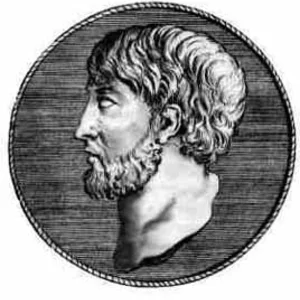
Anaximenes
584 av. J.-C. — 527 av. J.-C.
Anaximenes is a Pre-Socratic Greek philosopher of the Milesian school, active in the 6th century BC. A disciple of Anaximander, he held that air (pneuma) was the first principle of all things.

Arete of Cyrene
Greek philosopher of the 5th century BCE, daughter of Aristippus of Cyrene, founder of the Cyrenaic school. She is said to have taught philosophy and led the school after her father, personally educating her own son Aristippus the Younger.
Asclepius
Greek god of medicine and healing, son of Apollo and Coronis. Raised by the centaur Chiron, he mastered the healing arts so completely that he could resurrect the dead — a transgression that led Zeus to strike him down with a thunderbolt.
Aspasia
469 av. J.-C. — 399 av. J.-C.
Born in Miletus around 470 BC, Aspasia was the companion of Pericles and a major intellectual figure in Athens. Renowned for her eloquence and mastery of rhetoric, she hosted a philosophical salon attended by Socrates, Plato, and the greatest minds of her era.
Callisto
Callisto is a nymph from Greek mythology and a companion of Artemis, goddess of the hunt. Seduced by Zeus, she was transformed into a bear by the jealous Hera, then placed in the sky as the constellation Ursa Major.
Catiline
107 av. J.-C. — 61 av. J.-C.
Lucius Sergius Catiline was a Roman patrician and politician, famous for plotting a conspiracy to seize power in 63 BC. Exposed by Cicero, he died fighting at the Battle of Pistoria in 62 BC.
Chaos
Chaos is the primordial deity of Greek mythology, personification of the original void or abyss from which the universe was born. According to Hesiod in the Theogony (c. 700 BCE), Chaos is the first being to have existed. From Chaos emerge Gaia, Tartarus, Eros, Nyx, and Erebus.
Chiron
Chiron is a centaur from Greek mythology, son of Cronus and the nymph Philyra. Renowned for his wisdom, he served as tutor to many Greek heroes, including Achilles, Jason, and Asclepius. He excelled in medicine, music, hunting, and philosophy.
Coeus
Titan of Greek mythology, son of Uranus and Gaia, Coeus personifies heavenly intelligence and the axis of the world. Husband of Phoebe, he is the father of Leto and Asteria, and thus the grandfather of Apollo and Artemis.
Confucius
550 av. J.-C. — 478 av. J.-C.
A Chinese thinker and philosopher of the 5th century BC, Confucius is the founder of Confucianism. His moral and political teachings, passed down by his disciples in the Analects, have profoundly influenced Chinese civilization and East Asia for more than two millennia.
Crassus
114 av. J.-C. — 52 av. J.-C.
A Roman politician and general of the 1st century BC, Crassus was the wealthiest man in Rome. He formed the First Triumvirate with Caesar and Pompey in 60 BC. He died in the disastrous Battle of Carrhae against the Parthians.
Demetrius of Phalerum
349 av. J.-C. — 282 av. J.-C.
Demetrius of Phalerum was an Athenian philosopher and statesman, a disciple of Aristotle and the Lyceum. As governor of Athens on behalf of Macedonia from 317 to 307 BC, he later took refuge in Alexandria, where he advised Ptolemy I and helped found the Library and the Museum.
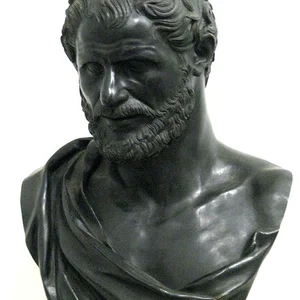
Democritus
460 av. J.-C. — 360 av. J.-C.
A Greek philosopher of the 5th century BC, Democritus is the father of atomic theory: he proposed that all matter is made up of indivisible particles called atoms. A student of Leucippus, he developed a materialist and rationalist philosophy that would have a lasting influence on scientific thought.
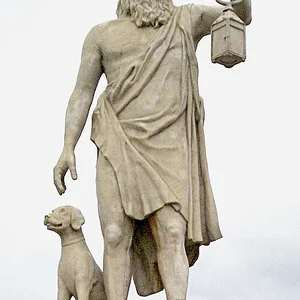
Diogenes of Sinope
399 av. J.-C. — 322 av. J.-C.
Greek philosopher of the 4th century BC and founder of the Cynic school. He advocated the rejection of social conventions and lived in voluntary poverty, sleeping in a large jar. He is famous for his verbal sparring with Alexander the Great.
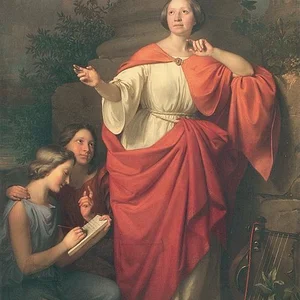
Diotima
450 av. J.-C. — 300 av. J.-C.
Diotima of Mantinea is a figure presented by Plato in the *Symposium* as the priestess and philosopher who is said to have initiated Socrates into the mysteries of love (Eros). Her historical existence is uncertain, but her teaching on the ascent toward the Beautiful is central to Platonic thought.
Eratosthenes
275 av. J.-C. — 193 av. J.-C.
Greek scholar of the 3rd century BC and director of the Library of Alexandria. He measured the circumference of the Earth with remarkable accuracy and laid the foundations of scientific geography.
Heraclea
Heraclea refers to several Greek cities founded in honor of the hero Heracles, the most famous of which is Heraclea Pontica. These colonial foundations illustrate the role of mythological heroes in shaping ancient Greek identity.
Heraclitus
534 av. J.-C. — 470 av. J.-C.
Pre-Socratic Greek philosopher born around 534 BC in Ephesus (present-day Turkey). He is famous for his doctrine of universal flux and fire as the fundamental principle of all things. His work, known under the title "On Nature", has survived only in fragments.

Herpyllis
Aristotle's companion after the death of his wife Pythias, Herpyllis lived with the philosopher until his death in 322 BC. He showed her great affection and bequeathed her property in his will.
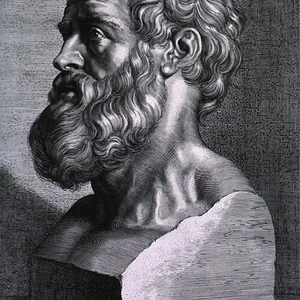
Hippocrates
459 av. J.-C. — 369 av. J.-C.
Greek physician of the 5th century BC, considered the "father of medicine". He established a rational and empirical approach to medicine, separating it from religious and magical practices. His body of work, the Hippocratic Corpus, has influenced Western medicine for more than two millennia.
Horace
64 av. J.-C. — 7 av. J.-C.
Horace is a major Latin poet of the Augustan age, born in 65 BC in Venusia. A friend of Virgil and protégé of Maecenas, he is the author of the Odes, the Satires, and the Ars Poetica. His work celebrates wisdom, friendship, and the simple pleasures of life.
Jesus Christ
5 av. J.-C. — 30
Jewish preacher from Galilee and founder of Christianity. His teachings on love, forgiveness, and the Kingdom of God transformed the course of human history. Crucified around 30 AD, he is considered by Christians to be the risen Son of God.
Lepidus
89 av. J.-C. — 12 av. J.-C.
Roman politician and general of the 1st century BC, Lepidus formed the Second Triumvirate with Octavian and Mark Antony in 43 BC. Gradually marginalized, he was removed from power by Octavian in 36 BC.
Lucretius
93 av. J.-C. — 54 av. J.-C.
Lucretius was a Latin Epicurean poet and philosopher of the 1st century BC. He is the author of De rerum natura, a sweeping poem in six books expounding the philosophy of Epicurus and the atomism of Democritus. His work seeks to free humanity from the fear of the gods and of death.
Maecenas
69 av. J.-C. — 7 av. J.-C.
A close advisor to Augustus and great patron of the arts in Rome, Maecenas supported poets such as Virgil and Horace. His name has become synonymous with support for artists and men of letters.
Mahavira
598 av. J.-C. — 526 av. J.-C.
Mahāvīra is the twenty-fourth and last tīrthankara of Jainism, regarded as the major reformer of this Indian tradition. Renouncing his princely life, he preached asceticism, non-violence, and the liberation of the soul.
Maitreyi
1000 av. J.-C. — 1000 av. J.-C.
A philosopher and poet of the Indian Vedic tradition, Maitreyi is celebrated in the Upanishads for her dialogue with the sage Yajnavalkya on the nature of the absolute and the atman. An exceptional female figure passed down through oral tradition, she embodies the spiritual quest at the heart of ancient Brahminic thought.
Mencius
371 av. J.-C. — 288 av. J.-C.
Mencius was a Chinese philosopher of the 4th century BCE, considered the second great sage of Confucianism after Confucius. He developed the idea that human nature is fundamentally good and that a legitimate ruler must govern with benevolence. His work, the Mengzi, is one of the Four Books of the Confucian canon.
Nemesis
Greek goddess of divine vengeance and just retribution, Nemesis punishes hubris — the arrogance and excess of mortals who rise above their station. She embodies cosmic balance and immanent justice in the tradition of Greek mythology.
Parmenides
514 av. J.-C. — 469 av. J.-C.
Greek philosopher of the 5th century BC and founder of the Eleatic school. He developed a radical metaphysics asserting that Being is one, unchanging, and eternal — rejecting any notion of change or multiplicity.
Phidias
499 av. J.-C. — 429 av. J.-C.
Phidias is considered the greatest sculptor of ancient Greece in the 5th century BC. He created the chryselephantine statue of Athena Parthenos and the statue of Zeus at Olympia, counted among the Seven Wonders of the Ancient World.
Pisistratus
Youngest son of Nestor, king of Pylos, Pisistratus is a character in Homer's Odyssey. He welcomes Telemachus at Pylos and accompanies him to Sparta to meet Menelaus. A figure of friendship and hospitality, he embodies the aristocratic virtues of the Greek epic.
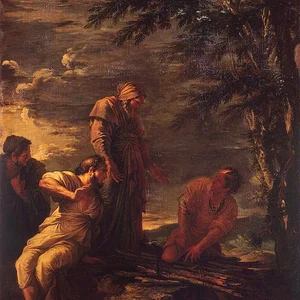
Protagoras
489 av. J.-C. — 419 av. J.-C.
Protagoras of Abdera (c. 489 – c. 419 BC) was one of the earliest and most celebrated Greek Sophists. He is best known for his relativist thesis: "Man is the measure of all things."
Scipio Africanus
234 av. J.-C. — 182 av. J.-C.
Roman general of the 2nd century BC, victor over Hannibal at the Battle of Zama (202 BC). He brought the Second Punic War to an end and secured Rome's dominance over Carthage.
Siddhartha Gautama
500 av. J.-C. — 500 av. J.-C.
An Indian prince born around 563 BCE in Nepal, he renounced his privileged life to seek the truth about human suffering. After years of asceticism and meditation, he attained Enlightenment beneath the Bodhi tree and became the Buddha, the "Awakened One."
Silenus
A deity of Greek mythology, Silenus is the old satyr companion and foster-father of Dionysus, god of wine. Perpetually drunk yet reputed for profound wisdom, he is often depicted riding a donkey, unable to stand on his own. His paradoxical figure — drunkenness as a path to truth — resonated throughout Greek and Roman Antiquity.
Sima Qian
144 av. J.-C. — 85 av. J.-C.
A historian and annalist of the Han dynasty, Sima Qian is the author of the Records of the Grand Historian (Shiji), considered the first great work of Chinese historiography. Despite disgrace and castration imposed by Emperor Wu, he completed this monumental work covering three millennia of history.
Spartacus
102 av. J.-C. — 70 av. J.-C.
A gladiator of Thracian origin, Spartacus led the Third Servile War against Rome (73–71 BC), commanding an army of rebel slaves that threatened the very existence of the Roman Republic before being defeated by Crassus.
Strabo
62 av. J.-C. — 23
Greek geographer, historian, and philosopher born around 62 BC in Amaseia (modern-day Turkey). He is the author of the Geography in 17 books, a description of the known world of his time. An heir to the Stoic tradition, he traveled extensively throughout the Mediterranean and the East.
Sun Tzu
543 av. J.-C. — 495 av. J.-C.
Sun Tzu was a Chinese general and philosopher of the 6th century BC, author of The Art of War. This military treatise, one of the oldest in the world, continues to influence military, political, and economic strategy to this day.
The Moirai
Greek goddesses embodying Fate, the Moirai are three sisters who spin, measure, and cut the thread of life of every mortal and immortal. Daughters of Zeus and Themis according to Hesiod, they hold absolute authority over the course of all lives — an authority that no one, not even the gods, can challenge.

Theano
600 av. J.-C. — 500 av. J.-C.
A Greek philosopher and mathematician of the 6th century BCE, Theano was a student and later the wife of Pythagoras. She contributed to the development of the Pythagorean school and carried on its teachings after her master's death.
Themis
A Titaness daughter of Ouranos and Gaia, Themis personifies divine law, justice, and cosmic order in the Greek tradition. A privileged counselor of Zeus and his second divine wife, she is the mother of the Horae and the Moirai, guardians of fate and the seasons.
Theophrastus
370 av. J.-C. — 286 av. J.-C.
Greek philosopher and scholar, successor to Aristotle as head of the Lyceum in Athens. Considered the father of botany, he systematized the study of plants and continued his master's encyclopedic work.
Xenophanes
569 av. J.-C. — 477 av. J.-C.
Pre-Socratic Greek philosopher and poet born in Colophon around 570 BC. He criticized the anthropomorphic polytheism of Homer and Hesiod, and argued for a single, universal, non-human god. A forerunner of rational theology and epistemology.
Xenophon
430 av. J.-C. — 353 av. J.-C.
Greek historian, soldier, and philosopher born around 430 BC, and a disciple of Socrates. He led the retreat of the Ten Thousand Greek mercenaries from Persia, recounted in the Anabasis. A prolific author, he left behind historical, philosophical, and military works.
Yan Zhengzai
Yan Zhengzai (颜征在, c. 568–535 BCE) was the mother of Confucius, the founding philosopher of Confucianism. Widowed at a young age, she devoted herself entirely to her son's education in the state of Lu (present-day China). Her maternal devotion is celebrated as a model in the Confucian tradition.
YHWH
YHWH is the divine name in the Hebrew religion, composed of four letters (yod, he, vav, he). It designates the one God of Israel, at the heart of the Abrahamic monotheistic tradition.
Zeno of Elea
489 av. J.-C. — 424 av. J.-C.
Pre-Socratic Greek philosopher and disciple of Parmenides, born around 489 BCE in Elea (Magna Graecia). He is famous for his paradoxes demonstrating the impossibility of motion and plurality, laying the groundwork for dialectic as a method of argumentation.
Zhuangzi
368 av. J.-C. — 287 av. J.-C.
A Chinese Taoist philosopher of the 4th century BCE, Zhuangzi is one of the founding thinkers of philosophical Taoism. His writings, collected in the work that bears his name, explore freedom, the relativity of things, and harmony with the Tao.
Culture(37)
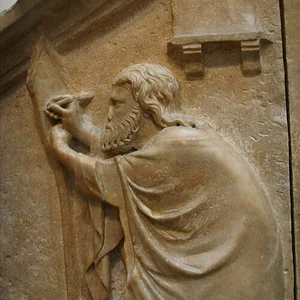
Apelles
369 av. J.-C. — 305 av. J.-C.
Apelles was the most celebrated painter of Greek Antiquity, active in the 4th century BC. He served as the official painter of Alexander the Great and the Macedonian court. None of his works have survived, but ancient texts bear witness to his exceptional mastery.
Ashurbanipal
684 av. J.-C. — 630 av. J.-C.
Ashurbanipal was one of the last great kings of the Neo-Assyrian Empire, reigning from 669 to roughly 627 BC. A warrior and scholar king, he brought Assyria to its greatest territorial extent and founded at Nineveh a vast library gathering tens of thousands of cuneiform tablets.
Aten
Aten is the solar deity of ancient Egypt, represented as the sun disk whose rays end in human hands. Elevated to the status of sole god by Pharaoh Akhenaten in the 14th century BCE, Aten stood at the heart of an unprecedented religious revolution.
Bunyip
The Bunyip is a creature from the mythology of the Aboriginal peoples of Australia, said to haunt swamps, billabongs, creeks, and waterholes. Described as a threatening water spirit that devours those who approach the water at night, it embodies the real dangers of Australian wetlands.
Chang'e
Chang'e is the goddess of the Moon in Chinese mythology. Wife of the divine archer Hou Yi, she swallowed the elixir of immortality and flew to the Moon, where she has resided ever since in her jade palace with the moon rabbit.
Dragon of Colchis
A creature of Greek mythology, the Dragon of Colchis is a gigantic serpent with ever-open eyes that guards the Golden Fleece in the sacred grove of Ares, in Colchis. It never sleeps — until the sorceress Medea lulls it into slumber so that Jason can seize the precious trophy.
Enkidu
Legendary figure from the Epic of Gilgamesh, created by the gods to be the companion of King Gilgamesh. Born wild and raised among animals, he becomes the hero's inseparable friend before his death triggers the quest for immortality.
Eshu
Eshu is a trickster orisha from the Yoruba tradition of West Africa, guardian of crossroads and messenger between humans and the gods. Master of communication and cunning, he must be propitiated before any ritual.
Glooscap
Creator hero and central figure of Mi'kmaq and Abenaki mythology in North America. A cultural being who shaped the world, defeated monsters, and taught humans the arts of survival. A figure from the Indigenous oral tradition of northeastern America, passed down from generation to generation.
Holofernes
Assyrian general of Nebuchadnezzar's army, Holofernes is the central character of the Book of Judith in the Hebrew Bible. His beheading by Judith, a courageous Hebrew widow, is one of the most celebrated narratives in biblical literature.
Louhi
Louhi is the powerful witch-queen of Pohjola in Finnish mythology, a central figure of the Kalevala. Mistress of magic and dark forces, she opposes the heroes Väinämöinen and Ilmarinen. She holds the Sampo, a mysterious object that brings prosperity.
Makara
The makara is a hybrid aquatic creature from Hindu mythology, blending features of a crocodile, an elephant and a fish. It serves as the mount (vahana) of the deities Varuna, god of the waters, and Ganga, goddess of the Ganges.
Mnemosyne
Greek Titaness personifying Memory, daughter of Ouranos and Gaia. United with Zeus for nine consecutive nights, she gave birth to the nine Muses, divine patrons of the arts and sciences. Her name is the origin of the word “mnemonic.”
Narmer
3200 av. J.-C. — 3124 av. J.-C.
Narmer is considered the first pharaoh of unified Egypt, around 3100 BCE. He is credited with uniting Upper and Lower Egypt under a single crown, thereby founding the first Egyptian dynasty.
Nefertari
1289 av. J.-C. — 1254 av. J.-C.
Great Royal Wife of Ramesses II, Nefertari is one of the most celebrated queens of ancient Egypt. Her tomb in the Valley of the Queens, with its exceptionally well-preserved paintings, reflects her extraordinary status. Ramesses II dedicated the smaller temple at Abu Simbel to her, where she was depicted at the same scale as the pharaoh himself.
Nüwa
Creator goddess of Chinese mythology, Nüwa molded the first humans from yellow clay. She then repaired the vault of heaven by melting stones of five colors after the pillars of the sky collapsed.
Pasiphae
Pasiphae is a figure from Greek mythology, daughter of Helios and wife of Minos, king of Crete. Struck by an unnatural passion for a bull sent by Poseidon, she gave birth to the Minotaur — half man, half bull — who was imprisoned in the Labyrinth built by Daedalus.
Potiphar's Wife
Biblical character from the Old Testament, wife of Potiphar, captain of Pharaoh's guard. She attempts to seduce Joseph, son of Jacob, and, after being rejected, falsely accuses him of assault, leading to Joseph's imprisonment.
Qilin
A fabulous creature of Chinese mythology, the Qilin is a benevolent chimera with the body of a deer, horse's hooves, and dragon's scales, often nicknamed the “unicorn of the East.” A creature of good omen, it heralds the birth or death of a sage and embodies peace and prosperity.
Quetzalcoatl
Quetzalcoatl, the "Feathered Serpent," is one of the most important deities in Mesoamerica. Venerated by the Aztecs and the Toltecs, he is the god of wind, wisdom, and creation. His figure spans several pre-Hispanic civilizations across more than two millennia.
Rongo
Rongo is a major deity of Polynesian mythology, venerated especially by the Māori of New Zealand. God of peace, agriculture, and cultivated plants, he is one of the great atua (gods) born of the union of Ranginui (the sky) and Papatūānuku (the earth). He symbolizes harmony and fertility, in contrast to his brother Tū, god of war.
Rusalka
The rusalka is a female water spirit from Slavic folklore, often depicted as a young woman with long hair haunting rivers, lakes, and ponds. According to tradition, she is said to be the soul of a drowned woman or of a young girl who died before marriage, luring men down into the depths.
Set
Set is the Egyptian god of chaos, storms, and the desert. Brother of Osiris, whom he murdered to seize the throne of Egypt, he was later defeated by his nephew Horus. An ambivalent figure, he was also venerated as the protector of Ra against the serpent Apophis.
Silenus
A deity of Greek mythology, Silenus is the old satyr companion and foster-father of Dionysus, god of wine. Perpetually drunk yet reputed for profound wisdom, he is often depicted riding a donkey, unable to stand on his own. His paradoxical figure — drunkenness as a path to truth — resonated throughout Greek and Roman Antiquity.
Sima Tan
164 av. J.-C. — 109 av. J.-C.
A Chinese astrologer and historian of the 2nd century BC, Sima Tan served as Grand Astrologer at the Han court. He undertook the writing of the *Shiji* (Records of the Grand Historian), a work his son Sima Qian completed after his death.
Sisyphus
Legendary king of Corinth, Sisyphus is famous for having outsmarted the gods on several occasions. Condemned by Zeus to the Underworld, he must eternally push a boulder to the top of a mountain, from which it rolls back down endlessly.
Sujata
Sujata was a young village woman from ancient India who offered a bowl of rice pudding to Siddhartha Gautama, allowing him to break his extreme fast before attaining Enlightenment. This act of generosity is considered a founding moment of Buddhism.
Tangaroa
Tangaroa is the god of the sea and oceans in Polynesian mythology, venerated across the Pacific (Māori, Samoa, Tahiti, Hawaii). Son of Rangi (sky) and Papa (earth), he rules over the ocean depths and is often regarded as the creator of many islands and living beings.
The Sirens
Hybrid creatures of Greek mythology — half-woman, half-bird (later half-fish in the Middle Ages) — whose bewitching song lures sailors to their deaths. Odysseus, lashed to the mast of his ship, is the only mortal ever to have heard them and survived.
Thetis
Thetis is a Nereid, a sea deity of Greek mythology, daughter of Nereus and mother of the hero Achilles. She plays a central role in Homer's Iliad, interceding with the gods on behalf of her son. An embodiment of divine maternal power, she stands at the heart of Greece's great epic narratives.
Tutankhamun
1340 av. J.-C. — 1323 av. J.-C.
An Egyptian pharaoh of the 18th Dynasty, he reigned around 1332–1323 BCE. Ascending to the throne at approximately nine years old, he restored polytheistic worship after the Atenist revolution of Akhenaten. His tomb, discovered intact in 1922, is one of the greatest archaeological discoveries of the 20th century.
Unas
2374 av. J.-C. — 2349 av. J.-C.
Unas was the last pharaoh of the Fifth Dynasty of ancient Egypt, reigning around 2375–2345 BCE. His pyramid at Saqqara is world-famous for containing the Pyramid Texts, the oldest known corpus of religious writings in human history.
Väinämöinen
Väinämöinen is the central hero of the Kalevala, Finland's national epic. A primordial sage and shamanic bard, he embodies wisdom, magic, and music in Finnic mythology. His kantele casts spells over men, animals, and nature alike.
Vishnu
Vishnu is one of the three principal deities of Hinduism, forming the Trimurti alongside Brahma and Shiva. God of protection and preservation of the universe, he manifests in multiple avatars including Krishna and Rama, central figures in Indian mythology.
Yan Zhengzai
Yan Zhengzai (颜征在, c. 568–535 BCE) was the mother of Confucius, the founding philosopher of Confucianism. Widowed at a young age, she devoted herself entirely to her son's education in the state of Lu (present-day China). Her maternal devotion is celebrated as a model in the Confucian tradition.
Yemanjá
Yemanjá is a female water deity from the Yoruba religion of West Africa, venerated as the mother of the gods (orishas) and protector of the sea. Carried to the Americas by the Atlantic slave trade, she became a major figure in Brazilian Candomblé and Cuban Santería.
Yemoja
Yemoja is a major orisha of the Yoruba pantheon, goddess of waters and protective mother. Venerated in West Africa, she became a central figure in Afro-American religions (candomblé, santería) born of the diaspora.
Sciences(29)
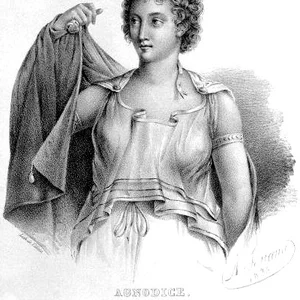
Agnodice
400 av. J.-C. — 360 av. J.-C.
Agnodice is a legendary figure from ancient Greece, presented as the first female physician and gynecologist in Athens in the 4th century BCE. According to the account of the Latin author Hyginus, she disguised herself as a man in order to study medicine under Herophilus in Alexandria, and then to practice in Athens.
Alexander II of Macedon
King of Macedon from 370 to 368 BC, son of Amyntas III and elder brother of Philip II. His brief reign was marked by internal unrest before his assassination by Ptolemy of Aloros.
Anaxagoras of Clazomenae
499 av. J.-C. — 427 av. J.-C.
Greek pre-Socratic philosopher (c. 500–428 BC), born in Ionia. He introduced the concept of Nous (Cosmic Mind) as the organizing principle of the universe and was the first to offer a rational explanation for solar eclipses. A close friend of Pericles, he lived in Athens before being banished on charges of impiety.
Anaximander
609 av. J.-C. — 545 av. J.-C.
Pre-Socratic Greek philosopher born around 609 BCE in Miletus, a disciple of Thales. He proposed the apeiron (the boundless, indeterminate infinite) as the originating principle of all things, and created one of the earliest known maps of the world.
Anaximenes
584 av. J.-C. — 527 av. J.-C.
Anaximenes is a Pre-Socratic Greek philosopher of the Milesian school, active in the 6th century BC. A disciple of Anaximander, he held that air (pneuma) was the first principle of all things.
Aristarchus
Greek astronomer and mathematician of Antiquity, born on the island of Samos. He was the first to propose a heliocentric model placing the Sun, rather than the Earth, at the center of the known world.
Asclepius
Greek god of medicine and healing, son of Apollo and Coronis. Raised by the centaur Chiron, he mastered the healing arts so completely that he could resurrect the dead — a transgression that led Zeus to strike him down with a thunderbolt.
Callisto
Callisto is a nymph from Greek mythology and a companion of Artemis, goddess of the hunt. Seduced by Zeus, she was transformed into a bear by the jealous Hera, then placed in the sky as the constellation Ursa Major.
Democritus
460 av. J.-C. — 360 av. J.-C.
A Greek philosopher of the 5th century BC, Democritus is the father of atomic theory: he proposed that all matter is made up of indivisible particles called atoms. A student of Leucippus, he developed a materialist and rationalist philosophy that would have a lasting influence on scientific thought.
Empedocles
493 av. J.-C. — 433 av. J.-C.
Greek philosopher, physician, and statesman of the 5th century BC, from Akragas in Sicily. He is famous for his theory of the four elements (earth, water, fire, air) and two cosmic forces (Love and Strife). A major figure in Presocratic philosophy, he also had deep interests in medicine and natural phenomena.
Eratosthenes
275 av. J.-C. — 193 av. J.-C.
Greek scholar of the 3rd century BC and director of the Library of Alexandria. He measured the circumference of the Earth with remarkable accuracy and laid the foundations of scientific geography.
Heraclitus
534 av. J.-C. — 470 av. J.-C.
Pre-Socratic Greek philosopher born around 534 BC in Ephesus (present-day Turkey). He is famous for his doctrine of universal flux and fire as the fundamental principle of all things. His work, known under the title "On Nature", has survived only in fragments.
Herodotus
483 av. J.-C. — 424 av. J.-C.
Greek historian and geographer born around 484 BC in Halicarnassus, considered the "Father of History". He is the author of the Histories, a vast inquiry into the Greco-Persian Wars and the peoples of the ancient world.
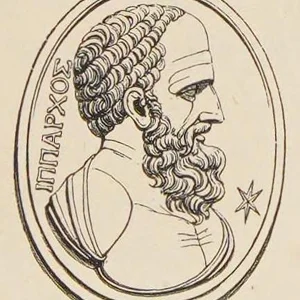
Hipparchus of Nicaea
189 av. J.-C. — 119 av. J.-C.
Hipparchus of Nicaea was a Greek astronomer, geographer, and mathematician of the 2nd century BC. Regarded as the greatest astronomer of antiquity, he discovered the precession of the equinoxes and compiled the first major star catalogue. He is also one of the founders of trigonometry.
Hippocrates
459 av. J.-C. — 369 av. J.-C.
Greek physician of the 5th century BC, considered the "father of medicine". He established a rational and empirical approach to medicine, separating it from religious and magical practices. His body of work, the Hippocratic Corpus, has influenced Western medicine for more than two millennia.
Imhotep
2800 av. J.-C. — 2700 av. J.-C.
A high official, architect, and physician of ancient Egypt in the 3rd millennium BC, Imhotep is considered the first known engineer and architect in history. Designer of the Step Pyramid of Saqqara, he was later deified as a god of medicine.
Ixchel
Ix Chel is a goddess of Maya mythology, venerated as a figure of the moon, medicine, weaving, and fertility. According to oral traditions and colonial written sources (Maya codices), she embodied both the creative power and the destruction associated with water and lunar cycles.
Panacea
Greek goddess of universal healing, daughter of Asclepius and Epione. She personified the remedy capable of curing all ailments. Her name, meaning “she who heals all” in Greek, is the origin of the word “panacea” in modern languages.
Phidias
499 av. J.-C. — 429 av. J.-C.
Phidias is considered the greatest sculptor of ancient Greece in the 5th century BC. He created the chryselephantine statue of Athena Parthenos and the statue of Zeus at Olympia, counted among the Seven Wonders of the Ancient World.
Pytheas
358 av. J.-C. — 288 av. J.-C.
A Greek navigator and geographer from Massalia (Marseille), Pytheas undertook an extraordinary voyage around 325 BCE toward northern Europe, reaching the mysterious island of Thule. He was one of the first to give a scientific description of tides and the Arctic regions.
Pythias
361 av. J.-C. — 400 av. J.-C.
Greek biologist and embryologist of the 4th century BC, wife of Aristotle. She is believed to have actively participated in the philosopher's natural research, particularly in embryology and marine biology. A rare female figure in ancient science.
Siddhartha Gautama
500 av. J.-C. — 500 av. J.-C.
An Indian prince born around 563 BCE in Nepal, he renounced his privileged life to seek the truth about human suffering. After years of asceticism and meditation, he attained Enlightenment beneath the Bodhi tree and became the Buddha, the "Awakened One."
Sima Qian
144 av. J.-C. — 85 av. J.-C.
A historian and annalist of the Han dynasty, Sima Qian is the author of the Records of the Grand Historian (Shiji), considered the first great work of Chinese historiography. Despite disgrace and castration imposed by Emperor Wu, he completed this monumental work covering three millennia of history.
Sima Tan
164 av. J.-C. — 109 av. J.-C.
A Chinese astrologer and historian of the 2nd century BC, Sima Tan served as Grand Astrologer at the Han court. He undertook the writing of the *Shiji* (Records of the Grand Historian), a work his son Sima Qian completed after his death.
Sosigenes
Sosigenes of Alexandria was a Greek astronomer and mathematician of the 1st century BC. He advised Julius Caesar on the reform of the Roman calendar, which led to the Julian calendar in 46 BC. His work introduced the 365-day year with a leap day every four years.
Tapputi-Belatekallim
1200 av. J.-C. — ?
Tapputi-Belatekallim was a Babylonian perfume-maker of the second millennium BCE, often regarded as the first chemist in recorded history. Her name appears on a cuneiform tablet describing her perfume-making processes.
Theano
600 av. J.-C. — 500 av. J.-C.
A Greek philosopher and mathematician of the 6th century BCE, Theano was a student and later the wife of Pythagoras. She contributed to the development of the Pythagorean school and carried on its teachings after her master's death.
Theophrastus
370 av. J.-C. — 286 av. J.-C.
Greek philosopher and scholar, successor to Aristotle as head of the Lyceum in Athens. Considered the father of botany, he systematized the study of plants and continued his master's encyclopedic work.
Zeno of Elea
489 av. J.-C. — 424 av. J.-C.
Pre-Socratic Greek philosopher and disciple of Parmenides, born around 489 BCE in Elea (Magna Graecia). He is famous for his paradoxes demonstrating the impossibility of motion and plurality, laying the groundwork for dialectic as a method of argumentation.
Society(14)
Agariste
600 av. J.-C. — 460 av. J.-C.
Athenian aristocrat from the powerful Alcmaeonid family, daughter of Hippocrates and niece of the reformer Cleisthenes. Wife of Xanthippus, she was the mother of Pericles, the great statesman of classical Athens.
Antonia
49 av. J.-C. — 100
Greek aristocrat from Asia Minor of the late Hellenistic period, known as the wife of Pythodoros of Tralles, a wealthy notable of the city of Tralles. She belonged to a family connected to the provincial elites of the late Roman Republic in the East.
Bathsheba
1008 av. J.-C. — 936 av. J.-C.
Bathsheba is a figure from the Old Testament, wife of Uriah the Hittite and later of King David after Uriah's death. As the mother of Solomon, she played a decisive role in the royal succession by interceding with David to ensure her son would inherit the throne of Israel.
Chaerestrate
Chaerestrate is known as the mother of the Greek philosopher Epicurus, founder of Epicureanism. She lived in Athens and, according to tradition, accompanied her husband Neocles in ritual purification activities.
Clodia Metella
Roman aristocrat of the late Republic, sister of the tribune Publius Clodius Pulcher and wife of the consul Metellus Celer. A cultured and independent woman, she is traditionally identified as the “Lesbia” celebrated by Catullus and was violently attacked by Cicero in the Pro Caelio.
Fulvia
76 av. J.-C. — 39 av. J.-C.
Fulvia was a Roman aristocrat of the late Republic, famous for her exceptional political involvement for a woman of her time. Successively the wife of Clodius, Curio, and then Mark Antony, she led the armed resistance against Octavian during the Perusine War.
Herpyllis
Aristotle's companion after the death of his wife Pythias, Herpyllis lived with the philosopher until his death in 322 BC. He showed her great affection and bequeathed her property in his will.
Jesus Christ
5 av. J.-C. — 30
Jewish preacher from Galilee and founder of Christianity. His teachings on love, forgiveness, and the Kingdom of God transformed the course of human history. Crucified around 30 AD, he is considered by Christians to be the risen Son of God.
Lycurgus
250 av. J.-C. — 210 av. J.-C.
Lycurgus is the legendary lawgiver of Sparta, traditionally regarded as the founder of the city's political, social, and military institutions (the “Great Rhetra”). His historical existence is uncertain and largely belongs to the realm of myth.
Octavia
Sister of Octavian (the future Augustus) and wife of Mark Antony, Octavia was a major figure in the final years of the Roman Republic. Renowned for her loyalty and dignity, she tried in vain to reconcile her feuding brother and husband.
Padmavati
278 av. J.-C. — ?
Wife of Emperor Ashoka (3rd century BCE), Padmavati is a figure of the Mauryan court in ancient India. She is mentioned in Buddhist sources as one of the queens of the great ruler who unified the Indian subcontinent and embraced Buddhism.
Roxana
346 av. J.-C. — 309 av. J.-C.
Roxana was a Bactrian princess, the first wife of Alexander the Great, whom he married in 327 BC following the conquest of Bactria. She was the mother of Alexander IV, the posthumous heir to the empire.
Tullia
78 av. J.-C. — 44 av. J.-C.
Tullia was the only and beloved daughter of the great Roman orator Cicero and Terentia. Her premature death plunged her father into deep grief, as his correspondence attests. She embodies the condition of the elite Roman woman at the end of the Republic.
Yan Zhengzai
Yan Zhengzai (颜征在, c. 568–535 BCE) was the mother of Confucius, the founding philosopher of Confucianism. Widowed at a young age, she devoted herself entirely to her son's education in the state of Lu (present-day China). Her maternal devotion is celebrated as a model in the Confucian tradition.
Visual Arts(9)
Akhenaten
1400 av. J.-C. — 1335 av. J.-C.
Pharaoh of the 18th Dynasty of Egypt (c. 1353–1336 BCE), Akhenaten revolutionized religion by imposing the monotheistic worship of Aten, the solar disk. He relocated the capital to Akhetaten (Amarna) and profoundly transformed Egyptian art.
Amenhotep III
1399 av. J.-C. — 1350 av. J.-C.
Pharaoh of the 18th Egyptian dynasty (c. 1391–1353 BC), he ruled Egypt at the height of its diplomatic and artistic power. His reign was marked by relative peace, intensive building activity, and exceptional cultural refinement.
Apelles
369 av. J.-C. — 305 av. J.-C.
Apelles was the most celebrated painter of Greek Antiquity, active in the 4th century BC. He served as the official painter of Alexander the Great and the Macedonian court. None of his works have survived, but ancient texts bear witness to his exceptional mastery.
Arachne
A mortal weaver from Lydia in Greek mythology, Arachne challenged the goddess Athena to a weaving contest. Defeated or shamed, she was transformed into a spider — giving arachnids their name.
Aten
Aten is the solar deity of ancient Egypt, represented as the sun disk whose rays end in human hands. Elevated to the status of sole god by Pharaoh Akhenaten in the 14th century BCE, Aten stood at the heart of an unprecedented religious revolution.
Kiya
1400 av. J.-C. — 1400 av. J.-C.
A secondary wife of Pharaoh Akhenaten, Kiya held a singular place at the court of Amarna in the 14th century BCE. Her identity and origins remain partly mysterious, though her name and likeness appear on several monuments from the Amarna period.
Meritaten
Eldest daughter of Pharaoh Akhenaten and Queen Nefertiti, Meritaten lived during the Amarna religious revolution in the 14th century BCE. She became Great Royal Wife of Pharaoh Smenkhkare and was abundantly depicted in the art of the Amarna period.
Mnemosyne
Greek Titaness personifying Memory, daughter of Ouranos and Gaia. United with Zeus for nine consecutive nights, she gave birth to the nine Muses, divine patrons of the arts and sciences. Her name is the origin of the word “mnemonic.”
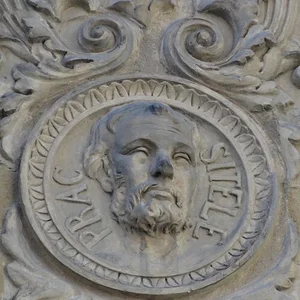
Praxiteles
394 av. J.-C. — 329 av. J.-C.
Praxiteles is one of the greatest sculptors of ancient Greece, active in Athens in the 4th century BC. He is famous for introducing grace, sensuality, and naturalness into statuary, notably with his Aphrodite of Knidos, the first major female nude in Greek art.
Exploration(6)
Hanno the Navigator
500 av. J.-C. — 500 av. J.-C.
A Carthaginian explorer of the 5th century BC, Hanno led an expedition along the West African coast with a fleet of sixty ships. His voyage, recorded in the Periplus of Hanno, is one of the earliest accounts of African exploration from antiquity.
Herodotus
483 av. J.-C. — 424 av. J.-C.
Greek historian and geographer born around 484 BC in Halicarnassus, considered the "Father of History". He is the author of the Histories, a vast inquiry into the Greco-Persian Wars and the peoples of the ancient world.
Icarus
Son of Daedalus, the ingenious craftsman of Greek mythology, Icarus escapes the Labyrinth of Crete using wings made of feathers and wax. Intoxicated by flight, he soars too close to the sun despite his father's warnings, melts his wings, and perishes in the sea that now bears his name.
Phidias
499 av. J.-C. — 429 av. J.-C.
Phidias is considered the greatest sculptor of ancient Greece in the 5th century BC. He created the chryselephantine statue of Athena Parthenos and the statue of Zeus at Olympia, counted among the Seven Wonders of the Ancient World.
Pytheas
358 av. J.-C. — 288 av. J.-C.
A Greek navigator and geographer from Massalia (Marseille), Pytheas undertook an extraordinary voyage around 325 BCE toward northern Europe, reaching the mysterious island of Thule. He was one of the first to give a scientific description of tides and the Arctic regions.
Thutmose III
1480 av. J.-C. — 1424 av. J.-C.
Pharaoh of the 18th Egyptian Dynasty (c. 1479–1425 BCE), Thutmose III is considered the greatest conqueror of ancient Egypt. He led seventeen military campaigns and brought the Egyptian empire to its greatest territorial extent.
Economics(5)
Alexander II of Macedon
King of Macedon from 370 to 368 BC, son of Amyntas III and elder brother of Philip II. His brief reign was marked by internal unrest before his assassination by Ptolemy of Aloros.
Cato the Elder
233 av. J.-C. — 148 av. J.-C.
Roman statesman and writer (234–149 BC), consul in 195 BC and censor in 184 BC. An uncompromising defender of traditional Roman values, he opposed Greek influence and pursued strict economic policies. He is also considered the first great Latin prose writer, known for his treatise on agriculture.
Chanakya
374 av. J.-C. — 282 av. J.-C.
An Indian philosopher, economist, and political strategist of the 4th century BCE, Chanakya served as advisor to Chandragupta Maurya, founder of the Maurya Empire. Often called the "Indian Machiavelli," he authored the Arthashastra, a foundational treatise on politics and economics.
Croesus of Lydia
The last king of Lydia (c. 561–546 BC), Croesus remained famous for his legendary wealth, drawn from the gold mines of the Pactolus River. His kingdom was conquered by Cyrus the Great, marking the end of Lydian independence.
Scipio Africanus
234 av. J.-C. — 182 av. J.-C.
Roman general of the 2nd century BC, victor over Hannibal at the Battle of Zama (202 BC). He brought the Second Punic War to an end and secured Rome's dominance over Carthage.
Technology(3)
Djoser
2800 av. J.-C. — 2700 av. J.-C.
Pharaoh of the Third Egyptian Dynasty (c. 2650 BCE), Djoser is famous for commissioning the Step Pyramid of Saqqara, the first great funerary monument built in stone in history.
Imhotep
2800 av. J.-C. — 2700 av. J.-C.
A high official, architect, and physician of ancient Egypt in the 3rd millennium BC, Imhotep is considered the first known engineer and architect in history. Designer of the Step Pyramid of Saqqara, he was later deified as a god of medicine.
Tapputi-Belatekallim
1200 av. J.-C. — ?
Tapputi-Belatekallim was a Babylonian perfume-maker of the second millennium BCE, often regarded as the first chemist in recorded history. Her name appears on a cuneiform tablet describing her perfume-making processes.
Performing Arts(2)
Electra
Electra is a heroine of Greek mythology, daughter of Agamemnon and Clytemnestra. After her father is murdered by her mother and her lover Aegisthus, she convinces her brother Orestes to avenge him. Her tragic fate inspired all three of the great Greek tragedians.
Iphigenia
Daughter of Agamemnon and Clytemnestra, Iphigenia was condemned to be sacrificed at Aulis to appease Artemis and allow the Greek fleet to sail for Troy. Saved by the goddess, she was transported to Tauris where she became a priestess. Her fate inspired major tragedies by Euripides.