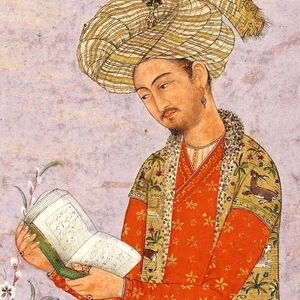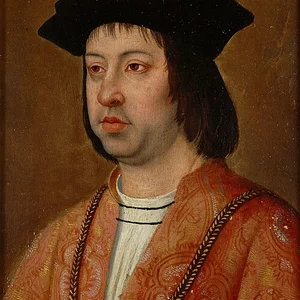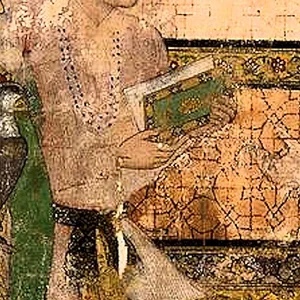

Jalal ud-Din Muhammad Akbar (1542-1605) was the third and greatest Mughal emperor of India. He unified the Indian subcontinent under his rule and championed a policy of religious tolerance remarkable for his time.
Akbar(1542 — 1605)
Akbar
8 min read
Frequently asked questions
Key Facts
- 1556: Akbar ascends the throne at age 13 following the death of his father Humayun
- 1556: Victory at the Second Battle of Panipat against Hemu, consolidating Mughal power
- 1571: Foundation of Fatehpur Sikri, the new capital of the empire
- 1582: Proclamation of the Din-i-Ilahi, an attempt at religious syncretism
- 1605: At his death, the Mughal Empire covers most of the Indian subcontinent
Works & Achievements
An imperial city built entirely from scratch by Akbar, now a UNESCO World Heritage Site. A masterpiece of Mughal architecture, it symbolizes the power and syncretic vision of its founder.
Akbar divided the empire into subas (provinces) administered by governors of his own appointment, separating civil and military authority. He established a rational taxation system based on land productivity (dahsala), which stabilized state revenues.
By abolishing this discriminatory tax, Akbar established the principle of fiscal and religious equality among all his subjects. This founding act of his policy of tolerance earned him the lasting loyalty of his empire's Hindu majority.
A one-of-a-kind institution, the Ibadat Khana brought together theologians of all faiths for inter-religious debates held before the emperor. This remarkable intellectual experiment anticipated the ideals of interfaith dialogue by several centuries.
An attempt at a universal religion blending Islamic, Hindu, Zoroastrian, and Christian elements, founded on divine light and devotion to the emperor. Though short-lived, it stands as a testament to Akbar's philosophical originality and his ambition to unite his diverse subjects.
A great red sandstone fortress built on the banks of the Yamuna River, which became the administrative heart of the Mughal Empire. Akbar made it at once an imperial residence, a center of government, and an architectural symbol of his power.
Anecdotes
Akbar was illiterate, but he compensated for this lack with a prodigious memory and an insatiable intellectual curiosity. He would have works of philosophy, theology, and history read aloud for hours, and could then discuss them with the greatest scholars of his court.
In 1582, Akbar founded his own syncretic religion, the Din-i-Ilahi (“Divine Faith”), which attempted to fuse Islam, Hinduism, Zoroastrianism, and Christianity. This surprising initiative aimed to spiritually unify his subjects of diverse beliefs, but convinced only a handful of courtiers.
Akbar abolished the jizya, the special tax that non-Muslims had to pay in Islamic states. This decision, unheard of at the time, earned him the hostility of many Muslim clerics but the loyalty of his tens of millions of Hindu subjects.
A great animal lover, Akbar owned a menagerie of over five thousand war elephants, as well as cheetahs trained for hunting. He was known for riding particularly fierce elephants, seeking to prove his physical courage despite the warnings of his advisors.
At Akbar's court, Muslim theologians, Hindu priests, Portuguese Jesuit monks, and Zoroastrian priests regularly gathered. These public debates, called the Ibadat Khana (“House of Worship”), sometimes lasted all night and testified to a religious openness unique in 16th-century history.
Primary Sources
His Majesty treats men of all religions with equal benevolence and makes no distinction between the faithful and the infidel. He regards all men as his subjects and loves them all as his children.
The empire comprises seventy-five sub-provinces (sarkars), administered according to uniform rules for tax collection and justice, so that every inhabitant, regardless of their faith, is treated fairly.
Akbar received us with great kindness and showed much interest in our holy books and images of Christ. He gave us permission to build a chapel in Agra and to preach freely there.
In the ninth year of his reign, Akbar abolished the pilgrimage tax imposed on Hindus travelling to their holy sites, declaring that no one should have to pay to practice their religion within his empire.
Key Places
Imperial capital built by Akbar between 1571 and 1585, abandoned due to water supply problems. This architectural gem blends Indo-Islamic and Hindu styles, a perfect reflection of Akbar's policy of cultural syncretism.
The main capital of the Mughal Empire under Akbar, home to the Agra Red Fort, which he had rebuilt in red sandstone. It is also where he died in 1605 and where he is buried at Sikandra, in a mausoleum he commissioned during his own lifetime.
Akbar made Lahore a second capital of his empire between 1585 and 1598, building an imposing citadel there. The city was a strategic crossroads for controlling the empire's northwestern borders against the Uzbeks.
Within the complex of Fatehpur Sikri stands the tomb of the Sufi saint Salim Chishti, whose prayers are said to have foretold the birth of Akbar's son. This site illustrates Akbar's veneration of Sufism and his respect for holy figures of all religions.
Site of the decisive 1556 battle in which the young Akbar, guided by Bairam Khan, crushed the forces of Hemu and consolidated Mughal dominance over northern India. This plain was the stage for three great battles that shaped the history of medieval India.
Liens externes & ressources
Références
Œuvres
Fondation de Fatehpur Sikri
1571-1585
Réforme administrative et fiscale (Ain-i-Akbari)
vers 1570-1580
Abolition de la jizya (taxe sur les non-musulmans)
1564
Création de l'Ibadat Khana (Maison du culte)
1575
Codification du Din-i-Ilahi
1582
Construction du Fort Rouge d'Agra
1565-1573