 flip
flipMedovik — Layered Honey Cake
Medovik — Layered Honey Cake
Why this dish? For birthdays and big occasions, the Russo-Soviet table of Eskin's childhood is crowned with a torte. Medovik — thin layers of honey dough filled with cream — is the quintessential celebration cake, the one prepared to mark an event. A sweet medallion that could celebrate, who knows, a Breakthrough Prize.
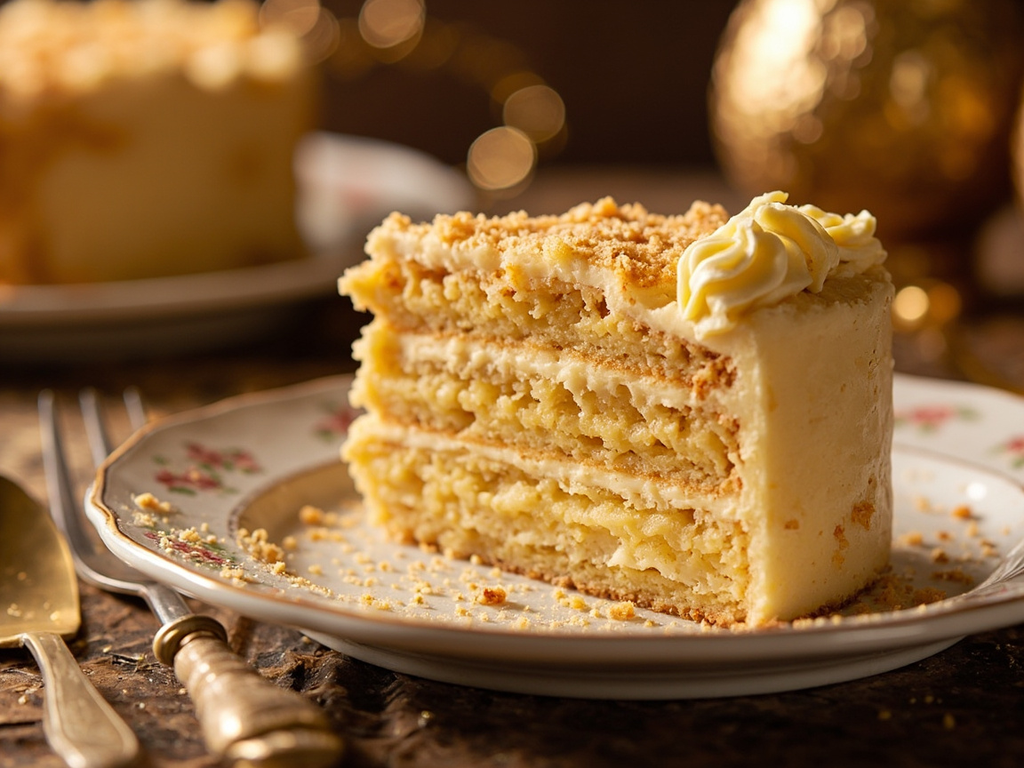
Six to eight discs of honey dough, golden and thin, stacked with a creamy filling (sour cream or buttercream). The cake rests overnight so the layers soften and melt in the mouth — patience rewarded.
Medovik is not eaten the same day: that's the rule. You bake your layers, stack them with cream, and you wait — a whole night in the cold, time for everything to soak in and the dough to soften. It's frustrating for a child, and still a bit frustrating for me, but the result is worth the wait: it melts, it's honeyed, it's celebration. The finest things, in cooking as in a proof, need to be left to mature before you taste them.
- •Honey — generous (dough flavor)
- •Wheat flour — according to dough (layers)
- •Eggs — a few (dough)
- •Butter — some (dough)
- •Baking soda — a pinch (light rise)
- •Sour cream, sugar — for the cream (filling)
Medovik — Layered Honey Cake
Six to eight discs of honey dough, golden and thin, stacked with a creamy filling (sour cream or buttercream). The cake rests overnight so the layers soften and melt in the mouth — patience rewarded.
Why this dish? For birthdays and big occasions, the Russo-Soviet table of Eskin's childhood is crowned with a torte. Medovik — thin layers of honey dough filled with cream — is the quintessential celebration cake, the one prepared to mark an event. A sweet medallion that could celebrate, who knows, a Breakthrough Prize.
Medovik is not eaten the same day: that's the rule. You bake your layers, stack them with cream, and you wait — a whole night in the cold, time for everything to soak in and the dough to soften. It's frustrating for a child, and still a bit frustrating for me, but the result is worth the wait: it melts, it's honeyed, it's celebration. The finest things, in cooking as in a proof, need to be left to mature before you taste them.
Ingredients (period version)
- Honey — generous (dough flavor)
- Wheat flour — according to dough (layers)
- Eggs — a few (dough)
- Butter — some (dough)
- Baking soda — a pinch (light rise)
- Sour cream, sugar — for the cream (filling)
Ingredients
- Honey — 3 tbsp (dough flavor)
- All-purpose flour — 400 g (layers)
- Eggs — 2 (dough)
- Butter — 100 g (dough)
- Sugar — 150 g (dough) + 100 g (cream) (sweetener)
- Baking soda — 1 tsp (light rise)
- Thick sour cream (smetana) — 600 g (filling)
Method
- In a double boiler, melt butter, honey, and sugar; add baking soda (the mixture will foam and darken slightly).
- Remove from heat, stir in beaten eggs, then flour to form a soft dough; divide into 6–8 balls.
- Roll each ball very thin, cut into a regular disc, bake at 180°C for 4–5 minutes until golden; reserve the scraps.
- Whip sour cream with sugar until smooth.
- Assemble the cake by alternating disc and cream; cover the top and sides with cream, then sprinkle with ground scrap crumbs.
- Refrigerate at least overnight before serving, so the layers soften.
How it was made : Legend attributes medovik to the court of Emperor Alexander I in the early 19th century, but honey cakes are much older in the Slavic and Germanic world. It became a staple of Soviet family celebrations, each household having its own recipe.
The contemporary twist : Name the slice "magic wand theorem" and arrange it in geometrically perfect layers, or tint the cream in two colors to visualize "strata" like sheets of a moduli space.
Alex Eskin · Charactorium