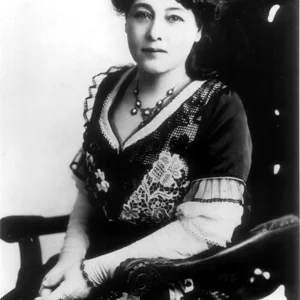

The first female filmmaker in history, Alice Guy directed her first narrative film at Gaumont around 1896. She went on to found the Solax Company in the United States, one of the largest production companies of the era, before falling into obscurity despite a remarkable body of work.
Alice Guy(1873 — 1968)
Alice Guy
France
9 min read
Frequently asked questions
Key Facts
- Around 1896: directed La Fée aux Choux, considered one of the earliest narrative films in cinema history
- 1900–1906: headed film production at Gaumont, overseeing hundreds of short films
- 1910: founded the Solax Company in Fort Lee, New Jersey, becoming one of the first women to run her own production company
- 1912–1914: produced and directed more than 150 films under her own banner in the United States
- Long forgotten, she was only rediscovered and rehabilitated by film historians toward the end of the 20th century
Works & Achievements
Short fiction film often cited as one of the earliest narrative works in the history of cinema. Alice Guy stages a fairy bringing babies to life in a vegetable garden, pioneering the use of film as a storytelling tool rather than a mere recording of reality.
A collection of short films synchronized with sound recordings via the Gaumont Chronophone, featuring opera arias, popular songs, and spoken scenes. Through this series, Alice Guy effectively invented the foundations of sound cinema two decades before the talking picture.
An ambitious multi-tableau re-enactment of the life of Christ featuring around three hundred extras, and one of the largest French productions of its era. The film demonstrates Alice Guy's ability to orchestrate large-scale spectacles from the very beginning of the twentieth century.
A satirical film in which women seize power and men find themselves confined to domestic chores. This social comedy reflects a remarkably sharp awareness of gender inequality, rare in the cinema of the time.
A melodrama produced and directed for the Solax Company, regularly cited by silent film historians as one of the most accomplished American productions of the period, combining emotional depth with technical mastery.
An American film shot with an entirely African-American cast, one of the very first of its kind in the history of American cinema. With this film, Alice Guy asserts a deliberate artistic stance that broke with Hollywood's segregationist practices.
Anecdotes
Around 1896, Alice Guy asked her employer Léon Gaumont for permission to shoot a short film with company employees. Gaumont agreed, on the condition that it would not disrupt regular work. This film — probably *La Fée aux choux* (*The Cabbage Fairy*) — is one of the earliest narrative films in cinematic history. Alice Guy was 23 years old at the time and had received no formal training in filmmaking.
At the Solax Company she founded in 1910 in New Jersey, Alice Guy had the instruction “BE NATURAL” posted on her sets. She demanded restrained, realistic performances from her actors, breaking with the exaggerated pantomime inherited from theater, thus anticipating the methods of modern cinema well before Stanislavski became known in the United States.
In 1912, Alice Guy directed *A Fool and His Money*, one of the first films in history with an entirely African-American cast. This bold choice, extraordinarily rare for early Hollywood, reflects an artistic and social sensibility remarkably ahead of its time.
After returning to France in 1922 following her divorce, Alice Guy spent decades trying to recover her films and gain recognition for her work. Most of the reels had been destroyed, lost, or credited to other directors — sometimes to her own husband. It was not until 1953 that she received the Légion d'honneur, but her pioneering role would not be truly recognized until after her death.
As head of artistic production at the Gaumont studios in Paris in the early 1900s, Alice Guy supervised and directed hundreds of films while managing a team of technicians and actors. She was the artistic director of one of the world's largest production houses — a truly unique position for a woman during the Belle Époque.
Primary Sources
It was in 1896, after M. Gaumont's demonstration of the Demeny Chronophotograph, that the idea came to me to use this device to illustrate songs or short scenes performed by friends. M. Gaumont agreed, on the condition that it would not interfere with my work as his secretary.
Mme Alice Blaché is in complete charge of the Solax Company's producing end, and the success of Solax pictures is due in large measure to her efforts and artistic genius as a director.
Solax films are produced under the personal supervision of Madame Alice Blaché, who has devoted the greater part of her professional life to the production of motion pictures and whose experience in this field is unrivalled.
A collection of professional letters held at the Gaumont archives, documenting negotiations over artistic direction, production budgets, and the management of technical crews between 1897 and 1907.
Key Places
Birthplace of Alice Guy, on July 1, 1873. She spent part of her childhood between France and Chile, where her father managed a bookstore, before returning to settle in Paris.
The place where Alice Guy began as Léon Gaumont's secretary before becoming artistic director. She produced the bulk of her French work here between 1896 and 1907, overseeing the studio's entire fiction output.
America's filmmaking capital before Hollywood, this is where Alice Guy established the permanent studios of the Solax Company in 1912 and directed the majority of her roughly three hundred American films.
The original location of the Solax Company, founded by Alice Guy in 1910, before the move to the larger Fort Lee studios in 1912.
The city where Alice Guy died on March 24, 1968, at the age of 94, having spent her final years in the United States near her daughter, in relative obscurity.
Typical Objects

Camera used at Gaumont in the late 1890s. Alice Guy took hold of it from the very start of her career to shoot her first fiction films, inaugurating a narrative use of the camera that went beyond simply recording reality.

A sound-image synchronization device developed by Léon Gaumont, with which Alice Guy directed hundreds of phonoscènes between 1902 and 1907. These short sung or spoken films represent a remarkable anticipation of talking pictures, twenty years before The Jazz Singer.

An acoustic cone used on film sets to relay directions to actors and the technical crew from a distance. A symbol of the director's authority, it was Alice Guy's everyday tool on the many sets of her Solax Company.

The standard film medium of the silent era, sensitive only to certain wavelengths of light, rendering red tones very dark. Alice Guy learned early on to compose her images and choose costumes with these chemical and optical constraints in mind.

Alice Guy wrote her own screenplays on a typewriter, a practice that was still rare in a profession where most films were improvised. This habit gave her a distinctive narrative mastery and exceptional productivity.

A slate on which the film title, scene number, and take number are written, allowing rushes to be identified and synchronized during editing. Alice Guy's Solax studios helped systematize its use in American film production.
School Curriculum
Vocabulary & Tags
Key Vocabulary
Daily Life
Morning
During her Parisian years at Gaumont (1896–1907), Alice Guy arrived early at the Belleville studios to coordinate shooting preparations: casting, checking the hand-painted sets, and costume fittings. She personally oversaw the lighting setup — arc lamps or natural light depending on the weather — and read through the day's script with her actors before the first take.
Afternoon
Afternoons were devoted to filming itself, often outdoors in the studio gardens to take advantage of the natural light that the orthochromatic film stocks of the era required. Alice Guy directed her actors through a megaphone, supervised the takes, and could shoot several distinct scenes in a single day thanks to her sharp organizational instincts.
Evening
In the evenings, Alice Guy would screen the day's developed footage, take notes on necessary retakes, and type up scripts for upcoming films. At Solax in the United States, these working evenings often extended into discussions with her husband Herbert Blaché and her technicians about the next day's plans.
Food
As a woman of the French bourgeoisie during the Belle Époque, Alice Guy followed the structured meals of her social class: multi-course dinners built around bread, seasonal vegetables, meat, and wine at formal gatherings. In the United States, she adopted certain American eating habits while maintaining French culinary traditions in her New Jersey home.
Clothing
Alice Guy wore the dress typical of a bourgeois woman of the Belle Époque: high-collared blouses fastened with buttons, long flared skirts, a corset, and hair swept up into an elaborate chignon. On set, she adapted her outfit to move freely between the scenery and cameras, but always maintained a neat appearance in keeping with the social codes of her station.
Housing
In Paris, Alice Guy lived in a comfortable bourgeois apartment in a residential neighborhood close to the Gaumont studios. In the United States, she settled with Herbert Blaché in a well-appointed house in New Jersey, in the suburbs of New York — a comfortable home that reflected the considerable commercial success of the Solax Company at its peak between 1912 and 1914.