 flip
flipCocido madrileño
Cocido madrileño
Why this dish? The great Sunday and family dish of Madrid, the one you share slowly and that invites an endless *sobremesa*. For Ana, it's the reunion meal: when a Madrid conference ends, you prolong the exchanges around a pot of *cocido*, exactly as you would prolong an academic debate.
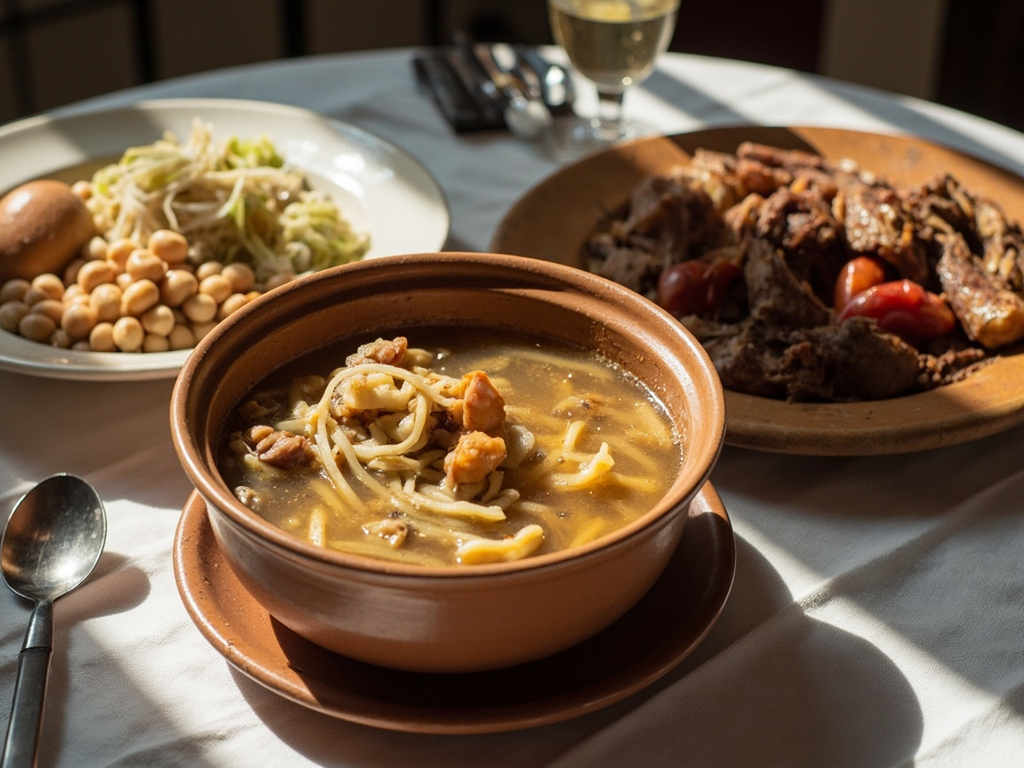
A pot-au-feu of chickpeas, meats, bacon, and vegetables, long-simmered. It is served in several courses (the 'vuelco'): first the broth with vermicelli (*sopa*), then the chickpeas and vegetables, and finally the meats — a single dish, three servings.
At home, *cocido* isn't a dish, it's a whole afternoon! We serve it backwards: first the *sopa*, that golden broth with its *fideos*, then the tender *garbanzos* with cabbage and potato, and only at the end the meats and chorizo. My advice as a researcher who loves sources: let it simmer without boiling too hard, otherwise the broth gets cloudy, and keep a little spoonful of *pimentón* for the final touch. The real goal, you'll have guessed, is to stay at the table for hours, putting the world to rights.
- •Chickpeas (garbanzos) — a large measure, soaked overnight (base)
- •Beef shank and marrow bone — according to guests (broth and meat)
- •Hen or free-range chicken — a few pieces (meat)
- •Bacon and chorizo — as much as you like (fat and colour)
- •Cabbage, potato, carrot — seasonal vegetables (vegetables)
- •Pimentón de la Vera — a spoonful (colour and smokiness)
- •Vermicelli (fideos) — a handful (for the soup)
Cocido madrileño
A pot-au-feu of chickpeas, meats, bacon, and vegetables, long-simmered. It is served in several courses (the 'vuelco'): first the broth with vermicelli (*sopa*), then the chickpeas and vegetables, and finally the meats — a single dish, three servings.
Why this dish? The great Sunday and family dish of Madrid, the one you share slowly and that invites an endless *sobremesa*. For Ana, it's the reunion meal: when a Madrid conference ends, you prolong the exchanges around a pot of *cocido*, exactly as you would prolong an academic debate.
At home, *cocido* isn't a dish, it's a whole afternoon! We serve it backwards: first the *sopa*, that golden broth with its *fideos*, then the tender *garbanzos* with cabbage and potato, and only at the end the meats and chorizo. My advice as a researcher who loves sources: let it simmer without boiling too hard, otherwise the broth gets cloudy, and keep a little spoonful of *pimentón* for the final touch. The real goal, you'll have guessed, is to stay at the table for hours, putting the world to rights.
Ingredients (period version)
- Chickpeas (garbanzos) — a large measure, soaked overnight (base)
- Beef shank and marrow bone — according to guests (broth and meat)
- Hen or free-range chicken — a few pieces (meat)
- Bacon and chorizo — as much as you like (fat and colour)
- Cabbage, potato, carrot — seasonal vegetables (vegetables)
- Pimentón de la Vera — a spoonful (colour and smokiness)
- Vermicelli (fideos) — a handful (for the soup)
Ingredients
- Dried chickpeas — 400 g (soaked 12 h) (base)
- Beef shank — 400 g (broth and meat)
- Marrow bone — 1 (richness of broth)
- Chicken thighs — 2 (meat)
- Smoked bacon — 150 g (fat)
- Mild chorizo — 1 (150 g) (colour and flavour)
- Green cabbage — 1/4 (vegetable)
- Potatoes — 2 (vegetable)
- Carrots — 2 (vegetable)
- Pimentón de la Vera — 1 tsp (seasoning)
- Fine vermicelli — 60 g (soup)
Method
- Place the soaked chickpeas in a large pot with the meats, marrow bone, and bacon. Cover with cold water and bring gently to a simmer, skimming off any foam.
- Let simmer over low heat for 2 to 2½ hours, without boiling hard, to keep the broth clear.
- Add the carrots, potatoes, and chorizo partway through cooking; cook the cabbage separately so it doesn't cloud the broth.
- Ladle out some broth and cook the vermicelli in it for a few minutes: this is the *sopa*, the first course.
- Then serve the chickpeas and vegetables, seasoned with a little *pimentón*, and finally the sliced meats: three plates, one pot.
How it was made : The *cocido* descends from *adafina*, a slow-cooked Sabbath stew from medieval Sephardic Jewish cuisine, later Christianised by the addition of pork (bacon, chorizo). Traditionally served on Sundays and feast days, it structured the entire week for Madrid families.
The contemporary twist : A chef's plating: present the three courses in three small vessels in a row, from the translucent broth to the meats, like a 'timeline' of the same dish.
Sources : Simone Ortega, 1080 recetas de cocina, Alianza Editorial · Inés Ortega, La cocina española
Ana García · Charactorium