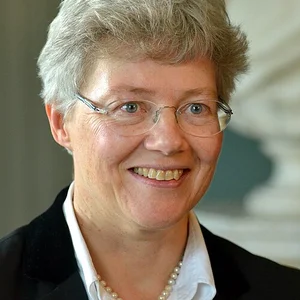

Andrea Ghez is an American astrophysicist born in 1965 who specializes in observing the galactic center. Her work provided proof of the existence of a supermassive black hole at the heart of the Milky Way. She received the Nobel Prize in Physics in 2020.
Andrea Ghez(1965 — ?)
Andrea Ghez
États-Unis
6 min read
Frequently asked questions
Key Facts
- Born on June 16, 1965, in New York.
- Professor of astronomy and astrophysics at the University of California, Los Angeles (UCLA).
- Uses the Keck Observatory in Hawaii and adaptive optics to track stars near the galactic center.
- Demonstrated the existence of a supermassive black hole (Sagittarius A*) at the center of the Milky Way.
- Received the Nobel Prize in Physics in 2020, the 4th woman to win this distinction.
Works & Achievements
Demonstration that stars orbit at very high speed around an invisible and extremely massive central object. The first solid observational evidence of a black hole at the center of the Milky Way.
Precise determination of a mass roughly 4 million times that of the Sun concentrated at the galactic center. A benchmark result for modern astrophysics.
Observation of an entire orbit (about 16 years) of a star around the black hole. This Keplerian trajectory confirms the nature of the central object.
Detection of the gravitational redshift of light from S0-2, in line with Einstein's predictions. A verification of physics within an extreme gravitational field.
Heading a pioneering research team in the study of the galaxy's center. This group has trained many astronomers and refined observational techniques.
Award given for the discovery of a supermassive compact object at the center of our galaxy. A worldwide recognition of her decades of observation.
Anecdotes
In 2020, Andrea Ghez became the fourth woman in history to receive the Nobel Prize in Physics, after Marie Curie (1903), Maria Goeppert-Mayer (1963), and Donna Strickland (2018). At the announcement, she emphasized that she hoped to inspire young girls to pursue careers in science.
As a child, Andrea Ghez dreamed of becoming the first woman to walk on the Moon: the Apollo missions, which she followed on television, had fired up her imagination. It was this longing for space that gradually led her toward astronomy.
To unlock the secrets of the center of the Milky Way, Andrea Ghez and her team tracked a star named S0-2 for more than twenty years. By watching it orbit an invisible point, they proved that a giant black hole was hiding there, since only an object so massive could bend its path in this way.
Earth's atmosphere makes the image of stars twinkle and shimmer, which greatly hindered observations. Ghez was a pioneer of “adaptive optics”: a mirror that deforms hundreds of times per second to correct this blur and make images almost as sharp as those taken from space.
The supermassive black hole at the heart of our galaxy, named Sagittarius A*, weighs about 4 million times the mass of the Sun, yet it is packed into a surprisingly small region. Ghez's work made it possible to measure its mass with unprecedented precision.
Primary Sources
Measurements of the proper motions of stars near the galactic center imply the presence of a dark central mass on the order of a few million solar masses, confined within a very small region.
We have been able to track individual stars orbiting the center of our galaxy and to demonstrate that they revolve around an invisible, compact, and extremely massive object: a supermassive black hole.
The prize is awarded to Reinhard Genzel and Andrea Ghez for the discovery of a supermassive compact object at the center of our galaxy, and to Roger Penrose for his theoretical work on black holes.
Key Places
Birthplace of Andrea Ghez in 1965.
University where she earned her bachelor's degree in physics in 1987.
Institute where she defended her doctorate in astrophysics in 1992.
University where she is a professor and leads the galactic center research group.
Volcanic summit nearly 4,200 meters high, home to the giant telescopes used for her observations.
Capital where the Nobel Prize in Physics is awarded, which she received in 2020.
Typical Objects

A giant 10 meters in diameter installed at the summit of Mauna Kea, in Hawaii. It is the main instrument with which Ghez observed the center of the galaxy for decades.
A device including a deformable mirror that adjusts hundreds of times per second to correct atmospheric turbulence. It makes images of the stars much sharper.
A laser beam projected into the sky to create an artificial reference star. It is used to measure the distortions of the atmosphere in real time in order to correct them.
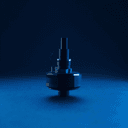
A detector sensitive to infrared light, able to pierce the clouds of dust that hide the galactic center in visible light. It makes it possible to photograph the stars hidden at the heart of the Milky Way.
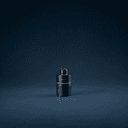
An instrument that breaks down a star's light into its colors to measure its speed and composition. It made it possible to detect the shift in the light of the star S0-2 near the black hole.
School Curriculum
Vocabulary & Tags
Key Vocabulary
Tags
Daily Life
Morning
Andrea Ghez often begins her day at the university, between preparing her classes and supervising her doctoral students. Mornings are also devoted to reading the most recent scientific papers and planning research.
Afternoon
Afternoons are paced by analyzing the data collected by the telescopes: the slightest movement of stars is tracked across images taken year after year. Team meetings are a chance to discuss results and prepare future observations.
Evening
During the “observing nights,” the rhythm flips completely: you work at night to take advantage of the darkness, sometimes from Hawaii, sometimes remotely by computer. Evenings may also be devoted to lectures or to sharing science with the general public.
Food
As a twenty-first-century scientist, her diet is that of modern daily life, often grabbed quickly between two work sessions. During long observing missions, meals adapt to the shifted nighttime schedule.
Clothing
She wears the ordinary, comfortable clothes of a contemporary researcher. At the summit of Mauna Kea, where the air is cold and thin, warm clothing is essential despite Hawaii's tropical latitude.
Housing
She lives in Los Angeles, where her university is located. Her work regularly takes her to observatories and to stays near the great telescopes during observing campaigns.
Historical Timeline
Period Vocabulary
Liens externes & ressources
Références
Œuvres
Étude des étoiles à mouvement rapide autour de Sagittarius A*
1998
Mesure de la masse du trou noir supermassif central
2008
Suivi de l'orbite complète de l'étoile S0-2
2018
Test de la relativité générale près du trou noir
2019
Direction du UCLA Galactic Center Group
1995–aujourd'hui
Prix Nobel de physique
2020