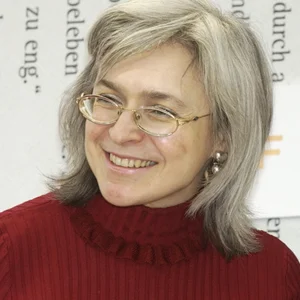

Russian journalist and activist, Anna Politkovskaya distinguished herself through her courageous reporting on the Chechen wars and human rights abuses under Putin. Assassinated in Moscow in 2006, she became a symbol of press freedom and resistance against authoritarian regimes.
Anna Politkovskaya(1958 — 2006)
Anna Politkovskaya
États-Unis, Russie, Union soviétique
7 min read
Frequently asked questions
Famous Quotes
« War is always a humanitarian catastrophe, whatever cause it is waged in the name of.»
« I am an enemy of the Kremlin because I report what I see.»
Key Facts
- Born on August 30, 1958, in New York to Soviet diplomat parents
- Journalist at Novaya Gazeta from 1999, an independent Russian newspaper
- Author of several books on the Chechen wars, including Putin's Russia (2004)
- Poisoned on a flight in 2004 while traveling to cover the Beslan hostage crisis
- Assassinated in Moscow on October 7, 2006, Putin's birthday
Works & Achievements
One of the first major works on the Second Chechen War, based on her field reporting. It exposes the brutality of the Russian army and the suffering of civilians.
A collection of first-hand testimonies from civilian victims, soldiers, and families, forming a human archive of the war that the official Russian press chose to ignore.
A critical analysis of the Putin regime: its authoritarian drift, corruption, muzzling of the press, and the return of the police state. Translated into more than 20 languages.
More than 500 articles and investigations published in Novaya Gazeta covering the Chechen wars, enforced disappearances, and human rights violations.
Published in France by Buchet-Chastel, this work describes the daily reality of Chechen civilians caught in the crossfire between fighters and the Russian army.
Anecdotes
Anna Politkovskaya was known for traveling to Chechnya herself — sometimes clandestinely — to meet ordinary civilians and soldiers. Colleagues reported that she carried medicines and medical supplies in her luggage for local populations, refusing to remain a mere observer.
In October 2002, during the Dubrovka theater hostage crisis in Moscow, Politkovskaya was one of the few journalists to make contact with the Chechen hostage-takers in an attempt to negotiate the release of civilians. She helped secure the release of several hostages before the fatal assault by Russian special forces.
In September 2004, during the Beslan school siege, Politkovskaya was poisoned on the plane taking her to the scene. She survived, but remained convinced that the poisoning was deliberate — intended to prevent her from covering the event. The episode did not stop her work.
Anna Politkovskaya was the mother of two children and campaigned for her readers to understand that behind every war statistic lay real families. She regularly published testimonies from Russian and Chechen mothers who had lost sons in the conflict, building a human bridge between the two communities.
She was murdered on October 7, 2006, in the lobby of her Moscow apartment building — the very day of Vladimir Putin's birthday. This detail, noted by many observers, was seen as symbolic by her loved ones and advocates, even though those who ordered the killing were never officially convicted.
Primary Sources
We live in a country where it is dangerous to be a journalist, where people who ask uncomfortable questions pay with their lives.
Chechnya has become a black hole at the heart of Russia. What happens there barely filters through, if at all, into the official press.
I know I am in danger. I also know that staying silent would be a betrayal of those whose stories I report. I have no choice but to continue.
Press freedom is not a journalist's privilege. It is every citizen's right to know what is being done in their name.
Key Places
The site where Anna Politkovskaya was assassinated on October 7, 2006, in the entrance hall of her apartment building. This location has become a place of remembrance for defenders of press freedom.
Capital of the Chechen Republic, devastated by two successive wars. Politkovskaya traveled there many times to document the destruction and human rights violations.
The office where she worked and published her investigations. This independent newspaper, co-founded with the financial backing of Mikhail Gorbachev, remained one of the last spaces for a free press in Russia.
The site of the October 2002 hostage crisis, where Politkovskaya played a mediating role, helping to secure the release of civilians before the special forces stormed the building.
The town where the tragic school hostage siege took place in September 2004. Politkovskaya attempted to travel there to cover the event and was poisoned on her way.
Typical Objects

Politkovskaya filled notebooks during her field investigations in Chechnya, recording civilian testimonies, victims' names, and precise dates to support her articles.

She visually documented the destruction and violence she witnessed, with her photographs serving as additional evidence alongside her reporting.

Essential for communicating from war zones where conventional networks were cut off or monitored by Russian military authorities.

The independent newspaper founded in 1993 for which she worked from 1999; one of the few Russian media outlets bold enough to openly criticize Kremlin policy.

She consistently brought medicine on her trips to Chechnya to distribute to the civilian populations she encountered, blending journalism with humanitarian commitment.

Protective gear she wore during her reporting in conflict zones, a symbol of the constant danger she deliberately exposed herself to.
School Curriculum
Vocabulary & Tags
Key Vocabulary
Tags
Daily Life
Morning
Anna Politkovskaya started her days early, often before dawn, combing through wire dispatches and NGO reports on the situation in Chechnya. She drank strong black tea — a typically Russian habit — while annotating her notes from the day before, then headed to the Novaya Gazeta newsroom.
Afternoon
Her afternoons were devoted to interviews with witnesses, refugees, or officials, often in discreet locations to protect her sources. When reporting in the Caucasus, she spent hours making her way through military checkpoints, negotiating passage with a press card and sheer determination.
Evening
In the evenings, she wrote her articles in her Moscow apartment or at the newsroom, proofread copy, and responded to letters from readers who sent her their testimonies. She came home late, fully aware of the risks she was taking, and routinely checked that she was not being followed.
Food
Her diet was simple and typically Russian: borscht, kasha (buckwheat porridge), rye bread, and potatoes. In the field, she ate whatever the families she was interviewing offered her, rarely refusing out of respect for their difficult living conditions.
Clothing
She dressed functionally and inconspicuously: a dark coat, warm clothes suited to Russia's harsh climate and demanding fieldwork. During assignments in conflict zones, she often wore a bulletproof vest under her clothing, never seeking to project any kind of heroic image.
Housing
She lived in a standard Soviet-era apartment in a residential building in central Moscow — the same building where she was murdered. That ordinary apartment, filled with books, files, and notebooks, reflected a life devoted entirely to journalistic work rather than material comfort.
Historical Timeline
Period Vocabulary
Visual Style
Un style visuel ancré dans le photojournalisme documentaire, avec des tons froids et désaturés évoquant les hivers russes et la gravité des sujets traités.
Sound Ambience
L'univers sonore d'Anna Politkovskaïa oscille entre le bruissement fiévreux d'une rédaction de presse indépendante à Moscou et les sons âpres des zones de guerre tchétchènes.
Liens externes & ressources
Références
Œuvres
La Deuxième Armée du monde
2000
Au pays de la peur — Témoignages de Tchétchénie
2003
La Russie selon Poutine
2004
Reportages pour Novaya Gazeta (1999–2006)
1999–2006
Une petite coin d'enfer
2003