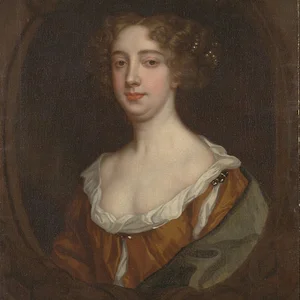

Aphra Behn (1640-1689) was the first English woman to earn her living by the pen. A prolific playwright, novelist, and spy in the service of Charles II, she defied the conventions of her time by making her mark in the male-dominated literary world.
Aphra Behn(1640 — 1689)
Aphra Behn
royaume d'Angleterre
8 min read
Frequently asked questions
Famous Quotes
« Money speaks sense in a language all nations understand.»
« Each moment of a happy lover's hour is worth an age of dull and common life.»
Key Facts
- Born around 1640 in Kent, England
- Spy for Charles II in the Netherlands around 1666
- Published Oroonoko (1688), one of the first English novels to condemn slavery
- Wrote more than 19 plays, including The Rover (1677)
- Died in 1689 and was buried in Westminster Abbey
Works & Achievements
Behn's first play, performed successfully for six nights. It marks her entry into the world of professional theatre and immediately establishes her signature themes: forced marriage and female freedom.
Her dramatic masterpiece, following exiled Royalist cavaliers and their romantic adventures in Naples. The play was a triumph and remains the most frequently performed work in her repertoire.
A bold comedy about mercenary marriages and women's freedom. In her preface, Behn asserted her equal right to explore 'masculine' subjects, sparking lively critical debate.
A poetry collection blending amorous, erotic, and political verse. It demonstrates Behn's mastery of a genre that had until then been dominated by men.
A proto-modern novel telling the story of an African prince enslaved in Surinam. Considered one of the earliest anti-slavery texts in English literature, it influenced the epistolary novel and the sentimental novel of the 18th century.
An epistolary novel in three volumes inspired by a real aristocratic scandal. It is regarded as one of the earliest prose novels in English literature.
Anecdotes
In 1666, Aphra Behn was sent to Antwerp by Charles II as a spy, operating under the code name 'Astrea'. Her mission was to monitor the plans of the Dutch enemy during the Second Anglo-Dutch War. Despite her valuable intelligence reports, the Crown never reimbursed her expenses, and she was forced to borrow money to return to London — even risking imprisonment for debt.
Before becoming a writer, Aphra Behn spent time in Surinam (present-day Suriname), an English colony in South America, where she is said to have witnessed the revolt of an enslaved African prince. This experience directly inspired her novel Oroonoko (1688), one of the earliest works of English literature to condemn the slave trade.
Behn was the first woman in England to earn a professional living by her pen. She responded to critics who condemned her boldness with sharp wit: 'I value fame as much as if I had been born a hero.' She published under her own name at a time when women, at best, signed their work 'A Lady'.
Her play The Rover (1677) was an immediate hit on the London stages of the Restoration. Charles II himself attended several performances and enjoyed them greatly, which shielded Behn from her most zealous censors. The play was revived throughout the eighteenth century.
Upon her death in 1689, Aphra Behn was buried in the cloister of Westminster Abbey — a rare honor granted to a woman of letters. Virginia Woolf, in A Room of One's Own (1929), would write more than two centuries later that 'all women together ought to let flowers fall upon the grave of Aphra Behn.'
Primary Sources
I was myself an eye-witness to a great part of what you will find here set down; and what I could not be witness of, I received from the mouth of the chief actor in this history.
Willmore: 'Faith, Child, I was born a Rover; and a Rover I'll die; unless thou canst give me reasons for being otherwise.'
I have done my duty to my King and country to the utmost of my ability, and I humbly request that my charges may be reimbursed, having received nothing to support me in so costly an employment.
Love in fantastic triumph sat, / Whilst bleeding hearts around him flowed, / For whom fresh pains he did create, / And strange tyrannic power he showed.
All I ask, is the Privilege for my Masculine Part the Poet in me… if I must not, because of my Sex, have this Freedom… I lay down my Quill, and you shall hear no more of me.
Key Places
The heart of Restoration theatrical life, Covent Garden was home to the coffeehouses, theatres, and publishing houses that Behn frequented regularly. It was here that she built her reputation as a playwright.
In 1666, Behn was sent there as a spy under the code name 'Astrea'. She gathered military intelligence on the Dutch navy on behalf of Charles II.
Behn stayed in this English colony around 1663–1664. There she encountered enslaved Africans and indigenous peoples, an experience that directly inspired her novel Oroonoko.
Aphra Behn's burial place since 1689, in the abbey's cloisters. This posthumous honour is a testament to public recognition of her literary significance.
The probable birthplace of Aphra Behn, around 1640. This village in the county of Kent represents her modest origins before her London life and overseas travels.
Typical Objects

The everyday tool of any literate person in the 17th century. Behn used them to write her plays, novels, poems, and spy reports — often under urgent financial pressure.

Plays circulated as manuscripts before being copied out for the actors. Behn produced nineteen of them, delivered directly to the companies at the Duke's Theatre or the King's Theatre.

During her mission in Antwerp in 1666, Behn used encrypted correspondence and code names — her own was 'Astrea' — to relay intelligence to the English Crown.

Restoration-era women's fashion demanded heavily structured corsets and gowns with generous necklines. Moving in aristocratic circles and backstage at the theatres, Behn had to maintain a polished appearance.

Night-time lighting in London depended on candles. Often forced to write through the night to meet her deadlines, Behn spent a considerable share of her income on candles and tapers.

The rise of print allowed Behn to publish her works and opinions. She used this medium to publicly defend women's right to write and to be paid for their work.
School Curriculum
Vocabulary & Tags
Key Vocabulary
Tags
Daily Life
Morning
Aphra Behn rose early in her modest London lodgings, often in the bustling neighborhood of Covent Garden. She began her day by rereading the previous night's pages in daylight, correcting and revising her manuscripts before the noise of the street broke her concentration.
Afternoon
In the afternoons, she made her way to rehearsals at the Duke's Theatre or Dorset Garden Theatre to oversee the staging of her plays, discuss roles with actors, and negotiate with company managers. She also frequented the coffeehouses of Covent Garden — hubs of literary and political debate where she rubbed shoulders with poets, satirists, and journalists.
Evening
Evenings were often devoted to theatrical performances, sometimes attended by Charles II himself. After the show, Behn joined the lively suppers of literary and aristocratic circles before returning home to write late into the night by candlelight, driven by her deadlines.
Food
Like most Londoners of modest means, she ate bread, cheese, boiled meat, and light ale on a daily basis. At dinners hosted by patrons, she enjoyed far more refined tables — roasts, meat pies, French wines — luxuries that stood in sharp contrast to her usual financial hardships.
Clothing
Behn wore the typical dress of an educated middle-class woman during the Restoration: silk or wool gowns in dark colors (burgundy, ochre, black), a whalebone corset, lace collar, and finely embroidered cuffs. Her clothes were neat but never extravagant, reflecting her social ambitions without exceeding her often limited means.
Housing
Behn lived in rented rooms across London, moving several times as her finances fluctuated. Her quarters held the essentials of a woman of letters: a heavy desk piled with manuscripts, a shelf of borrowed or second-hand books, and writing materials always within reach.
Historical Timeline
Period Vocabulary
Visual Style
L'esthétique baroque de la Restauration anglaise : portraits à l'huile dans la tradition de Peter Lely, lumières de bougie, soieries sombres et ornements théâtraux dorés évoquant les scènes londoniennes du XVIIe siècle.
Sound Ambience
L'univers sonore d'Aphra Behn mêle le brouhaha des théâtres londoniens de la Restauration, le crissement de la plume sur le parchemin dans une chambre modeste, et les bruits de rue de Covent Garden.
Liens externes & ressources
Références
Œuvres
The Forced Marriage, or The Jealous Bridegroom
1670
The Rover, or The Banished Cavaliers
1677
The Lucky Chance, or An Alderman's Bargain
1686
Poems upon Several Occasions, with A Voyage to the Island of Love
1684
Oroonoko, or the Royal Slave
1688
Love Letters Between a Nobleman and His Sister
1684-1687