
Apophis is the great serpent of chaos in Egyptian mythology, the embodiment of darkness and absolute disorder. The eternal enemy of the sun god Ra, he attempts each night to swallow the solar barque during its journey through the underworld. The Egyptians performed daily rituals to ward off his attacks and preserve cosmic order.
Apophis
Apophis
9 min read
Frequently asked questions
Key Facts
- Apophis is attested as early as the Coffin Texts of the Middle Kingdom (c. 2055–1650 BCE)
- He is described as an enormous serpent measuring several dozen meters in length, dwelling in the depths of the Nun (the primordial ocean)
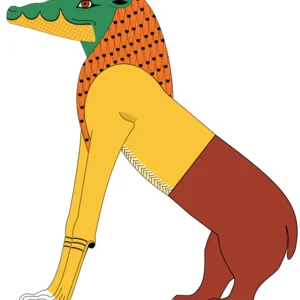
- Each night, during Ra's journey through the Duat, Apophis attacks the solar barque; he is repelled by Seth, then by Sobek and the other gods
- The 'Books of Apophis' (the Papyrus of Herihor, c. 1070 BCE) compile the magical spells and rituals used to neutralize him
- Unlike other Egyptian deities, Apophis receives no cult worship: he is burned and execrated in effigy during daily temple ceremonies
Works & Achievements
The first major royal funerary text to describe hour by hour the nocturnal journey of Ra, including successive confrontations with Apophis. It is the most complete mythological source on the serpent's cosmic role.
A collection of magical spells designed to protect the deceased in the afterlife. Chapter 39, devoted entirely to repelling the serpent Apophis, attests to the central place this figure held in Egyptian funerary beliefs.
A royal funerary text illustrating the twelve hours of the night and their divine guardians. Apophis is depicted in chains near the eastern horizon, definitively defeated at dawn after the final battle.
A royal funerary text depicting the enemies of Ra, including Apophis, bound and tormented in the depths of the Duat. The serpent is shown cut apart and burned to neutralize his chaotic power.
The most comprehensive document devoted to the rituals of Apophis's destruction. It contains his secret names, spells to annihilate him, and detailed instructions for performing the daily magical ceremonies.
Anecdotes
Apophis is one of the rare beings in Egyptian mythology to have no temple or official cult: he was not worshipped — he was fought. In great temples such as Karnak, priests recited magical spells every day, spat upon his image, and burned wax figurines representing him, to ensure that Ra would triumph once again that night.
In Egyptian mythology, Set — the storm god often regarded as malevolent — was also the great defender of the solar barque. Each night, it was he who stood at the prow of Ra's vessel and drove his spear through Apophis's body, allowing the sun to continue on its journey. Set was therefore at once a feared deity and an indispensable hero of the cosmic order.
Solar eclipses plunged the Egyptians into intense terror: they believed that Apophis had managed, if only for a moment, to swallow Ra's barque. Ritual ceremonies would immediately intensify to 'free' the sun from the serpent's belly and restore order to the world.
A late ritual text known as the 'Book of Apophis,' preserved in the Bremner-Rhind Papyrus (4th century BCE), provides precise instructions for destroying the serpent: speak his name in a low voice, draw his image on papyrus, trample it, then burn it. This handbook of symbolic destruction bears witness to the importance of magical ritual in Egyptian religion.
Apophis was described as a serpent of colossal size — some texts suggest a length of several dozen meters — whose body could block the entire night sky. His roar caused earthquakes, and his breath poisoned the darkness. Despite his power, he was defeated every single night without exception, which underscored the indestructible strength of Ra and the cosmic order (Ma'at).
Primary Sources
"The serpent is beneath the feet of the king. The king crosses the sky; the serpent of chaos cannot reach him."
"Drive Apophis away from the bark of millions of years, so that Re may appear on the eastern horizon each morning."
"Back, Apophis! You shall not prevail over Re in the bark of eternity. Thoth binds you, Sekhmet chains you."
"In the fifth hour of the night, the bark of Re confronts the great serpent Apophis, who seeks to swallow it in the darkness."
"Fall back, Apophis, enemy of Re! You are defeated, you are driven away. Re triumphs over you each day. Your name is cursed, your body is burned, your soul is annihilated."
Key Places
The mythical kingdom of the dead located beneath the earth, traversed each night by the barque of Ra during the twelve hours of darkness. This is where Apophis permanently dwells, lying in ambush for the sun in an attempt to swallow the light.
The great sacred city of the Nile Delta and the center of the solar cult of Ra and Atum. It was here that the fundamental solar myths developed, including that of Apophis as the cosmic enemy of the sun and destroyer of Ma'at.
A vast temple complex where priests performed daily rituals to ward off Apophis. Magic spells were recited there and figurines of the serpent were solemnly burned in ceremonial rites.
The royal necropolis whose tombs are decorated with scenes drawn from the Amduat and the Book of Gates, depicting Ra's nightly journey and his repeated confrontations with Apophis, hour by hour.
The sacred city of the god Thoth in Upper Egypt, where magic rituals (heka) were performed against Apophis. Thoth, master of magic spells and writing, played a key role in binding and neutralizing the serpent.
Typical Objects

A small wax statuette representing the serpent Apophis, used during daily rituals: priests would trample it, spit on it, and burn it to symbolically neutralize chaos and protect Ra's barque.

A symbolic weapon used during ceremonies of Apophis's destruction. Its sharp blade represented the victory of order over chaos, and it appears frequently in the texts and paintings of royal tombs.

Scrolls containing spells from the Book of Apophis or the Book of the Dead, recited by priests to protect the solar barque and drive back the great serpent. Some named Apophis directly in order to gain magical control over him.

The divine vessel on which Ra traveled during his nightly journey through the Duat. It was Apophis's primary target — every night the serpent attempted to swallow it whole in the primordial darkness.

The divine weapon wielded by the god Set to pierce Apophis during the nocturnal crossing. It symbolizes the raw power needed to hold chaos at bay, even when in the hands of a god who is himself morally ambiguous.

Depicted in many tomb scenes, these divine restraints kept Apophis bound after each defeat. Thoth, master of magic, recited the spells that shackled the serpent and neutralized its destructive forces.
School Curriculum
Vocabulary & Tags
Key Vocabulary
Tags
Daily Life
Morning
At dawn, Apophis is defeated once again: the barque of Ra has crossed the Duat and the sun rises on the eastern horizon. The serpent's body, pierced by Set's spear and bound by Thoth's magical spells, recoils into the depths of the underworld. His defeat is total but temporary — he is already regenerating in the darkness.
Afternoon
During the daylight hours, Apophis lies lurking in the deepest, darkest recesses of the Duat, within the primordial waters of chaos known as the Nun. His colossal body slowly reconstitutes itself in the darkness, his hatred for Ra undiminished, his destructive energy fully restored for the coming night. No divine light ever reaches him.
Evening
At sunset, Apophis springs back to life with renewed power. As the barque of Ra enters the first hour of the night, the great serpent stirs in the depths of the Duat, uncoiling his enormous body to block the sun's path. The eternal confrontation begins again, as inevitable as night itself.
Food
Apophis does not feed in any ordinary sense — he is a cosmic force whose sole appetite is to devour Ra's solar barque and plunge the world into endless chaos. Some texts suggest that he 'drinks' darkness and sustains himself on disorder (Isfet), the direct opposite of Ma'at, who nourishes the gods and upholds the order of the universe.
Clothing
As a non-human primordial force, Apophis wears no clothing or divine attributes. He is depicted as a massive serpent with black or red scales, sometimes shown with multiple coils of his body forming a chaotic spiral. His only adornments are the chains and magical bonds with which the gods bind him during his ritual defeat.
Housing
Apophis's domain is the Duat, the Egyptian underworld — and more precisely, the primordial waters of the Nun, the watery void that existed before creation. He dwells in the darkest and deepest regions, where no divine light ever penetrates, waiting each night for the solar barque to venture into his territory so he can attempt to destroy it.
Historical Timeline
Period Vocabulary
Visual Style
Inspiré des peintures tombales du Nouvel Empire, le style visuel d'Apophis joue sur les contrastes entre les ténèbres abyssales de la Douat et l'éclat doré de la barque solaire, avec la rigueur géométrique et la frontalité caractéristiques de l'art égyptien antique.
Sound Ambience
L'environnement sonore d'Apophis est celui de la Douat nocturne : un silence oppressant traversé par des sifflements caverneux, le crépitement des rituels magiques et le grondement sourd du chaos cosmique qui cherche à engloutir la lumière.
Liens externes & ressources
Références
Œuvres
Amdouat — Livre de ce qu'il y a dans la Douat
vers 1500 av. J.-C.
Livre des Morts — Chapitre 39
à partir de 1550 av. J.-C.
Livre des Portes
vers 1300 av. J.-C.
Livre des Cavernes
vers 1200 av. J.-C.
Papyrus Bremner-Rhind — Livre d'Apophis
vers 310 av. J.-C.