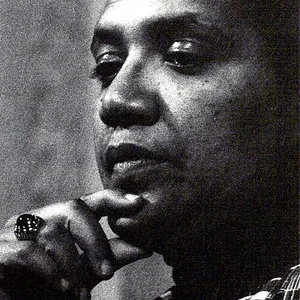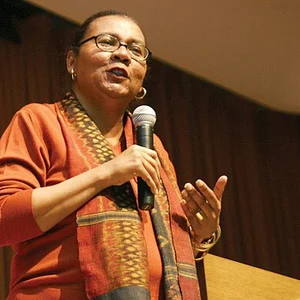

An American intellectual, writer, and feminist activist, bell hooks dedicated her life to analyzing the connections between race, gender, and class. The author of more than thirty books, she profoundly reshaped feminist thought by centering the experiences of Black women.
bell hooks(1952 — 2021)
bell hooks
États-Unis
8 min read
Frequently asked questions
Famous Quotes
« Feminism is for everybody.»
« Education as the practice of freedom.»
Key Facts
- Born in 1952 in Hopkinsville, Kentucky, into a working-class African American family
- Published her first major work, Ain't I a Woman, in 1981, focused on Black women and feminism
- Developed the concept of intersectionality before it was formally named, articulating the interplay of race, gender, and class
- Taught at several American universities, including Yale and the City College of New York
- Died on December 15, 2021, in Berea, Kentucky
Works & Achievements
bell hooks' first major work critiques white feminism for ignoring Black women and analyzes the intertwining of racism and sexism from the era of slavery onward. The title is borrowed from Sojourner Truth's famous 1851 speech.
bell hooks argues that the most marginalized women — Black, poor — must be placed at the center of feminist theory, not at its edges. A foundational text for the intersectional approach.
A collection of autobiographical and theoretical essays in which bell hooks reflects on Black women's right to speak in a society that silences them.
A pedagogical manifesto inspired by Paulo Freire, in which bell hooks champions a liberatory, engaged, and transgressive approach to education. Highly influential in critical teaching circles.
bell hooks examines love as a social and political practice, showing how patriarchy and capitalism obstruct authentic human bonds. The first volume in a trilogy on love.
An analysis of Black masculinity in America, in which bell hooks shows how Black men are simultaneously victims of racism and carriers of patriarchal values. A pioneering work in masculinity studies.
A poetry collection in which bell hooks returns to her Appalachian roots and explores attachment to one's native landscape as a form of cultural resistance.
Anecdotes
bell hooks deliberately chose to write her name in lowercase so that attention would be placed on her ideas rather than on herself. She was inspired by her grandmother Bell Blair Hooks, whose memory she wanted to honor while rejecting the traditional literary ego.
When her first book 'Ain't I a Woman?' was published in 1981, bell hooks had written the manuscript while still in high school, at the age of nineteen. The work waited several years before finding a publisher, but quickly became a landmark text of intersectional feminism.
bell hooks taught at many prestigious American universities, but she often rejected formal academic conventions. She arranged her classrooms in circles rather than rows, convincing her students that the classroom was a space of freedom and collective transformation.
In 2014, during a widely discussed public debate involving singer Beyoncé, bell hooks described her image as a 'capitalist terrorist' to criticize the way feminism could be co-opted by the entertainment industry. The exchange illustrated her commitment to never compromising her analysis, even when faced with popular icons.
Shortly before her death in 2021, bell hooks had founded the bell hooks Institute at Berea College in Kentucky, her home region, to root her work in the working-class and rural community where she had grown up.
Primary Sources
The sexualization of black womanhood in the United States has been a persistent feature of racist and sexist ideology. It began with the institution of slavery.
To be in the margin is to be part of the whole but outside the main body. As black Americans living in a small Kentucky town, we were on the margin of that town.
The classroom remains the most radical space of possibility in the academy. For years it has been a place where education has been undermined by teachers and students alike.
The word 'love' is most often defined as a noun, yet we would all love better if we used it as a verb. We would all love better if we used it as a practice.
The first act of violence that patriarchy demands of males is not violence toward women. Instead patriarchy demands of all males that they engage in acts of psychic self-mutilation.
Key Places
bell hooks' hometown, in rural and deeply segregated Kentucky. It was here that she developed her awareness of race, gender, and class as lived experiences.
bell hooks earned her doctorate here in 1983 with a dissertation on Toni Morrison. Stanford marked her entry into the dominant academic world that she would spend her career challenging.
bell hooks taught here and founded the bell hooks Institute in 2014, seeking to root her work in the working-class and rural Kentucky community she came from.
bell hooks taught here in the 1990s, in the heart of the most diverse city in the United States. New York was a major site of intellectual and activist engagement for her.
An iconic city of African American Southern culture, which bell hooks frequently referenced in her analyses of structural racism and the cultural resistance of Black communities.
Typical Objects

The author of more than thirty books and numerous essays, bell hooks spent a large part of her day writing. For her, writing was a political act as much as an intellectual one.

bell hooks was known for her intensive reading and her margin annotations. Her references ranged from Paulo Freire to Toni Morrison, as well as the critical theorists of the Frankfurt School.

In her classes, bell hooks arranged the chairs in a circle to dissolve the hierarchy between teacher and students. This spatial setup gave physical form to her philosophy of liberatory education.

bell hooks was an exceptional public speaker who gave frequent talks, lectures, and debates at universities across the United States. Her vibrant spoken word extended and amplified her theoretical writings.

bell hooks dedicated several essays to the visual representation of Black women in media and art. She collected and analyzed images to deconstruct racist and sexist stereotypes.

bell hooks was an active contributor to numerous activist and academic publications, including Feminist Studies and Black Scholar, which formed the intellectual network in which she worked.
School Curriculum
Vocabulary & Tags
Key Vocabulary
Tags
Daily Life
Morning
bell hooks started her mornings early, often before dawn, writing in the quiet of her study. Morning writing was a sacred ritual for her: she would record her thoughts in notebooks before moving on to more formal drafting. She drank tea or black coffee while rereading the previous day's pages.
Afternoon
Her afternoons were divided between teaching, meetings with students, and reading. In the classroom, she favored dialogue and circle discussions, encouraging each student to speak from their own personal experience. She annotated other people's texts heavily and prepared her public talks.
Evening
In the evenings, bell hooks often took part in lectures, debates, or public readings at activist bookstores and on college campuses. Back home, she read poetry and fiction — Toni Morrison, Audre Lorde, Lucille Clifton — which she considered just as essential as theory. She listened to Mississippi blues and jazz.
Food
Rooted in her Kentucky rural origins, bell hooks appreciated African American Southern cooking: beans, greens, cornbread. She valued shared meals as a community practice and an act of cultural resistance against industrial food.
Clothing
bell hooks dressed simply but with attention to textiles and color. She often wore African fabrics or clothing in warm tones, asserting a visual identity rooted in the Black diaspora. She rejected the formal dress codes of academia in favor of a style that allowed her to move freely.
Housing
bell hooks lived in several American university towns — San Francisco, New York, Oberlin — before returning to her native Kentucky in her final years. She loved spaces filled with books, plants, and photographs. Her return to Berea was, for her, a political act: reinvesting in the working-class rural community she came from.
Historical Timeline
Period Vocabulary
Visual Style
Style photographique documentaire chaud et terreux, évoquant les campus universitaires américains et les publications du mouvement féministe noir des années 1980–2000.
Sound Ambience
Ambiance d'une salle de séminaire universitaire américaine des années 1990 : voix engagées, livres feuilletés, jazz en sourdine et pluie sur les fenêtres du campus.
Liens externes & ressources
Références
Œuvres
Ain't I a Woman: Black Women and Feminism
1981
Feminist Theory: From Margin to Center
1984
Talking Back: Thinking Feminist, Thinking Black
1989
Teaching to Transgress: Education as the Practice of Freedom
1994
All About Love: New Visions
2000
We Real Cool: Black Men and Masculinity
2004
Appalachian Elegy: Poetry and Place
2012