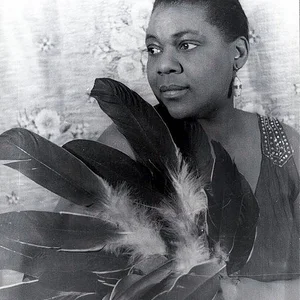

Bessie Smith (1894–1937) was an American singer nicknamed the “Empress of the Blues.” A towering figure of classic blues in the 1920s, she helped popularize the genre and paved the way for Black American artists.
Bessie Smith(1894 — 1937)
Bessie Smith
États-Unis
9 min read
Frequently asked questions
Famous Quotes
« Nobody in town can bake a sweet jelly roll like mine.»
Key Facts
- Born on April 15, 1894, in Chattanooga, Tennessee, into a very poor family
- Recorded her first record with Columbia Records in 1923: 'Down Hearted Blues' sold over 750,000 copies
- At the height of her fame in the 1920s, she was the highest-paid Black artist in the United States
- Died on September 26, 1937, from injuries sustained in a car accident in Mississippi
- Inducted into the Grammy Hall of Fame and recognized as one of the greatest voices in the history of American music
Works & Achievements
Bessie Smith's first recording for Columbia Records, selling over 780,000 copies in six months. This phenomenal commercial success immediately established her national reputation and revolutionized the race records industry.
A recording of the famous W.C. Handy standard alongside trumpeter Louis Armstrong. This collaboration between two giants of Black American music is considered one of the most important recordings in the history of blues and jazz.
A song with bold lyrics addressing sexuality and female loneliness, recorded in two parts. The work exemplifies Bessie Smith's freedom of expression and her refusal to conform to the conventions imposed on Black women of her era.
A melancholic blues describing how friends disappear in times of hardship, recorded just months before the stock market crash. Covered by Eric Clapton and dozens of other artists, this song remains one of the most iconic in her repertoire.
A 17-minute short film representing the only known filmed footage of Bessie Smith in performance. Produced by RCA Victor, it shows her performing the W.C. Handy song and stands as an exceptional audiovisual historical document.
A powerful recording showcasing Bessie Smith's ability to evoke violence and racial injustice through the blues, made despite the severe commercial decline brought on by the Great Depression.
Anecdotes
In 1923, Bessie Smith signed with Columbia Records and recorded “Downhearted Blues.” The record sold more than 780,000 copies in just six months, a staggering figure for the era. This meteoric success made her the highest-paid blues singer in the United States and transformed the “race records” industry.
During a tour through the Deep South, members of the Ku Klux Klan one evening attempted to sabotage her show by pulling up the tent stakes. Bessie Smith then marched out to confront the group, shouting at them to leave, according to accounts from her musicians reported by biographer Chris Albertson. The men retreated, apparently intimidated by the boldness of the woman nicknamed the “Empress.”
Bessie Smith traveled between cities in her own private railroad car, an extremely rare luxury for a Black artist of the era. The car allowed her to avoid whites-only hotels and the daily humiliations of racial segregation. It also served as a dressing room, dining room, and sleeping quarters for her entire orchestra.
In 1929, the Great Depression hit the record industry hard and sales collapsed. Bessie Smith then recorded “Nobody Knows You When You’re Down and Out,” a song that resonates as an autobiographical testament to the brutal fall from success. Ironically, the track became one of her most celebrated recordings and most covered songs among subsequent generations.
On September 26, 1937, Bessie Smith died from injuries sustained in a serious car accident on Route 61 in Mississippi. An urban legend long claimed she had been turned away from a whites-only hospital, but historical investigations — notably the testimony of Dr. Hugh Smith, who was present at the scene — established that she was taken directly to the G.T. Thomas African American Hospital in Clarksdale, where she succumbed to her injuries.
Primary Sources
Bessie Smith signed with Columbia Records on February 15, 1923. The contract provided for the recording of "race records" aimed at the African-American market, at a time when record labels were beginning to grasp the considerable commercial potential of that audience.
Bessie Smith's first commercial recording, released in February 1923. The record sold nearly 780,000 copies in six months, establishing Bessie Smith as the leading star of race records and proving the economic viability of female vocal blues.
Bessie Smith appears in this 17-minute film adapted from W.C. Handy's song of the same name. It is the only known audiovisual record featuring her performance and has been preserved by the Library of Congress as a historical document of the first importance.
Recorded in May 1929, just months before the October stock market crash, this song captures with striking clarity the way friends disappear in times of hardship. It would be covered decades later by Eric Clapton and countless other artists.
Influential jazz producer John Hammond published an article incorrectly claiming that Bessie Smith had been turned away from a whites-only hospital after her accident. Though inaccurate on this crucial point, the article helped make her death a symbol of the brutality of racial segregation in 1930s America.
Key Places
Bessie Smith's hometown, where she grew up in extreme poverty and began singing in the streets to survive after the early death of her parents. It was here that her older brother Clarence introduced her to the world of traveling entertainment.
The epicenter of the Harlem Renaissance and the heart of the record business in the 1920s. It was in New York that Bessie Smith recorded for Columbia Records, rubbed shoulders with Louis Armstrong and Duke Ellington, and established herself as the queen of classic blues.
Bessie Smith's primary place of residence from the 1920s onward, where she settled with her husband Jack Gee. She led a more settled life there between her relentless tours across the country.
The site of the fatal car accident on September 26, 1937, on the famous "Blues Highway" that connects Memphis to New Orleans through the heart of the Mississippi Delta. Bessie Smith was taken to the G.T. Thomas Afro-American Hospital in Clarksdale, where she succumbed to her injuries.
One of the most iconic venues on the TOBA (Theatre Owners Booking Association) circuit, where Bessie Smith performed regularly before Black audiences. This network of venues formed the primary infrastructure for showcasing Black artists across the segregated South.
Typical Objects

Standard recording technology in 1920s studios. Bessie Smith sang at full voice into these devices, her natural vocal power compensating for the severe limitations of these rudimentary instruments, which could only capture a very narrow frequency range.

The standard recording medium of the era — fragile, heavy, and holding only three to four minutes of music per side. Bessie Smith's records were sold as "race records" in African American communities across the North and South.

Extravagant costumes adorned with sequins, ostrich feathers, and beads that Bessie Smith wore on stage. These lavish outfits were a deliberate statement of her star status, standing in stark contrast to the social hardship expressed in her lyrics.

Bessie Smith's mode of transport and mobile home during her tours through the segregated South. Named the "Empress," the car allowed her to avoid the humiliations imposed on Black Americans in public transportation and hotels.

Characteristic accompaniment instruments of classic 1920s blues. Bessie Smith frequently performed alongside a pianist such as Fletcher Henderson, in a minimalist lineup that let the full power of her voice take center stage.

The canvas structures used by vaudeville and minstrel troupes touring the American South. Bessie Smith began her career in these traveling shows before conquering the theaters of the TOBA circuit and the music halls of the North.
School Curriculum
Vocabulary & Tags
Key Vocabulary
Tags
Daily Life
Morning
Bessie Smith, accustomed to nighttime performances, rarely rose before noon. During tours in the South, her mornings began aboard her private railway car, traveling to the next stop on the circuit. She had a late breakfast with her musicians and worked out the logistical details for the coming evening.
Afternoon
Afternoons were devoted to rehearsals, costume fittings at African-American tailors who dressed Black stars, and negotiations with theater managers. In northern cities like New York or Philadelphia, she also handled business matters with her husband and impresario Jack Gee and gave interviews to the Black press, such as the *Chicago Defender*.
Evening
In the evenings, Bessie Smith took the stage with a commanding presence that immediately captivated her audience. Her performances could last two to three hours, alternating between melancholic blues and lively numbers. After the show, she often joined other musicians at speakeasies or rent parties, celebrating with an enthusiasm that fed her legend as much as her excesses.
Food
Bessie Smith was known for her hearty appetite and deep attachment to Southern soul food: fried chicken, cornbread, collard greens, and pork chops. During her stays in Harlem, she frequented the neighborhood's African-American restaurants. Her substantial alcohol consumption throughout her life was part of a musical culture in which drinking together was a cornerstone of social bonding.
Clothing
On stage, Bessie Smith wore long sequined gowns, headdresses adorned with ostrich feathers, and flashy jewelry that earned her the title of Empress. In everyday life, she dressed with the understated elegance typical of prosperous Black women of the era: well-tailored suits, cloche hats, and gloves. She placed great importance on her appearance as a visible affirmation of her success and dignity.
Housing
Bessie Smith owned a home in Philadelphia with her husband Jack Gee, a rare fixed base for an artist who spent most of the year on tour. On the road, her private railway car served as a mobile home, furnished with her own belongings and a small kitchen. In cities without TOBA infrastructure, she stayed with local families in Black neighborhoods, as hotels were often barred to her under Jim Crow segregation laws.