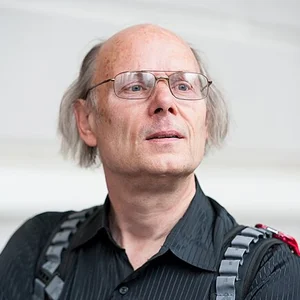

Danish computer scientist born in 1950, Bjarne Stroustrup is the creator of the C++ programming language, developed in the 1980s at Bell Labs. He is also a professor and author of numerous reference works in computer science.
Bjarne Stroustrup(1950 — ?)
Bjarne Stroustrup
États-Unis, Royaume de Danemark
7 min read
Frequently asked questions
Famous Quotes
« C makes it easy to shoot yourself in the foot; C++ makes it harder, but when you do it blows your whole leg off.»
« There are only two kinds of languages: the ones people complain about and the ones nobody uses.»
Key Facts
- Born on December 30, 1950 in Aarhus, Denmark
- Created the C++ language between 1979 and 1983 at Bell Labs (AT&T)
- PhD from the University of Cambridge in 1979
- Author of 'The C++ Programming Language' (1985), a worldwide reference work
- Elected member of the United States National Academy of Engineering in 2004
Works & Achievements
The creation of C++, first under the name 'C with Classes' (1979) and then officially named C++ (1983), is Stroustrup's masterwork. The language combines the performance of C with object-oriented programming and is today one of the most widely used in the world.
The first commercially released C++ compiler, Cfront translates C++ code into C before compilation. This tool enabled rapid adoption of C++ by the software industry without waiting for a dedicated native compiler.
The first reference book on C++, written by its creator and regularly updated (1991, 1997, 2013). Considered the definitive reference for learning and mastering C++, it has been translated into many languages.
A book in which Stroustrup traces the history and design decisions behind C++. An invaluable primary source, it explains why the language was designed the way it was.
Stroustrup played a central role in the international standardization of C++ by ISO/IEC. This standard ensured the portability and consistency of the language on a global scale.
A concise and modern introduction to C++ written by Stroustrup, aimed at experienced programmers looking to quickly get up to speed with contemporary C++. Regularly updated to keep pace with new versions of the standard.
Anecdotes
In 1979, Bjarne Stroustrup began developing 'C with Classes' at Bell Labs to simulate distributed computer networks. He drew inspiration from the Simula language, invented by Norwegian researchers, which introduced the concepts of objects and classes — but he found Simula too slow for industrial applications and decided to combine its ideas with the power of C.
The name 'C++' was suggested in 1983 by his colleague Rick Mascitti. In the C language, the '++' operator means 'increment by one': C++ can therefore be read as 'an improved version of C'. Stroustrup recounts that he had initially considered the name 'D', but that choice seemed too plain for a language he hoped would establish itself as a lasting standard.
To make C++ immediately usable, Stroustrup developed 'Cfront', a preprocessor that automatically translated C++ code into standard C code. This pragmatic solution allowed any programmer with a C compiler to use C++ as early as 1985, without waiting for a dedicated compiler — significantly accelerating the adoption of the new language.
Stroustrup earned his doctorate at the University of Cambridge in 1979, under the supervision of David Wheeler, one of the pioneers of computer science. This rigorous academic training gave him the theoretical tools needed to design a language that was both powerful and formally consistent — two qualities that are evident throughout the design of C++.
In 1998, after years of standardization work involving hundreds of international experts, C++ was officially standardized by ISO under the name C++98. This standard ensures that a correct C++ program behaves identically across very different computers, helping to make the language one of the most widely used in the software industry.
Primary Sources
C++ is a general purpose programming language designed to make programming more enjoyable for the serious programmer. Except for minor details, C++ is a superset of the C programming language.
C++ was designed primarily so that my friends and I would not have to program in assembler, C, or various modern high-level languages. It was designed to give the individual programmer tools for defining new types that are as good as the built-in types.
The emphasis on efficiency and flexibility led to design decisions that have had lasting effects on the language: classes, derived classes, strong typing, and the absence of a garbage collector.
C++ has changed considerably since its early days, and I consider that a good thing. C++ has grown in response to real-world problems and to insights gained from practical use.
Key Places
Birthplace of Bjarne Stroustrup, where he studied mathematics and computer science at the University of Aarhus before leaving for Cambridge.
Stroustrup earned his PhD in computer science here in 1979 under the supervision of David Wheeler. It was here that he deepened his mastery of programming language design.
The legendary research laboratory where Stroustrup worked from 1979 and developed C++ over more than fifteen years. This same place had seen the birth of the C language a decade earlier.
University where Stroustrup held a professorial chair from 2002 to 2014, continuing to teach language design and to advance the C++ standard.
University where Stroustrup has been a professor since 2014, continuing his work on memory safety and the evolution of C++ within an academic setting.
Typical Objects

In the 1980s, Stroustrup worked on terminals connected to large shared computers (mainframes). It was on this kind of spartan hardware that he wrote and tested the first versions of C++.

The reference work written by Stroustrup himself, first published in 1985 and regularly updated. Translated into many languages, it is considered the 'bible' of the C++ language and has been used by millions of programmers.

Software written by Stroustrup to translate C++ code into standard C code. This preprocessor was the key tool for spreading C++ before dedicated native compilers existed.

Stroustrup's everyday reference, since C++ is a superset of C. This grammar of C formed the foundation on which he built his own language.

Before writing a single line of code, Stroustrup designed the syntax and semantics of C++ on paper, precisely defining the rules of the language. These notes gradually took shape as the official specifications.
School Curriculum
Vocabulary & Tags
Key Vocabulary
Tags
Daily Life
Morning
In the 1980s, Stroustrup arrived early at Bell Labs, where he would first go through his technical correspondence and internal reports on language design. He took part in informal meetings with fellow researchers, exchanging ideas and feedback on new C++ features.
Afternoon
Afternoons were devoted to writing code and drafting formal language specifications. Stroustrup tested new syntactic constructs on the lab's terminals, fixed bugs in the Cfront compiler, and wrote technical reports detailing his design decisions.
Evening
In the evenings, Stroustrup often worked on his writings — particularly the various editions of *The C++ Programming Language* — and replied to mail from users discovering the new language. Reading academic papers in computer science and mathematics was a regular part of his intellectual routine.
Food
As a researcher at a major American corporation in the 1980s, Stroustrup shared meals in the Bell Labs cafeteria, a place known for encouraging informal exchanges among researchers from a wide range of disciplines. The lab's culture valued these convivial moments as incubators of ideas.
Clothing
In Bell Labs' relaxed professional environment, researchers typically dressed casually: a shirt and slacks, with no requirement for a suit. This attire reflected the informal yet intellectually demanding culture of that elite research laboratory.
Housing
Stroustrup lived in the residential suburbs of New Jersey, close to Bell Labs in Murray Hill. This setting — typical of American middle-class life in the 1980s, with a detached house and a garden — stood in contrast to the glowing terminals and servers of the lab where he spent most of his days.
Historical Timeline
Period Vocabulary
Liens externes & ressources
Références
Œuvres
C++ (langage de programmation)
1979–1985
Compilateur Cfront 1.0
1985
The C++ Programming Language
1985
The Design and Evolution of C++
1994
Standard ISO/IEC C++98
1998
A Tour of C++
2013