 flip
flipShchi — sour cabbage soup
Shchi — sour cabbage soup
Why this dish? Shchi is THE everyday soup in Russia, from peasant huts to writers' dachas. Pasternak, who ate simply — soups, potatoes, garden vegetables — surely inhaled its tangy aroma a thousand times in the kitchen at Peredelkino, where cabbage fermented in its barrel to last through winter.
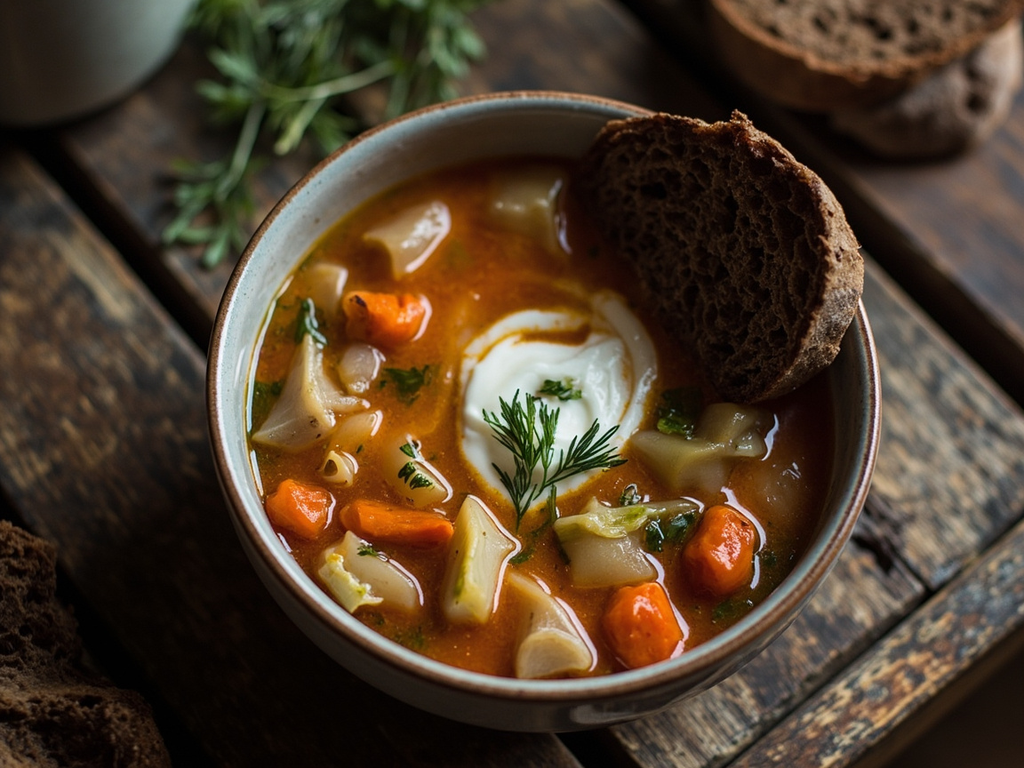
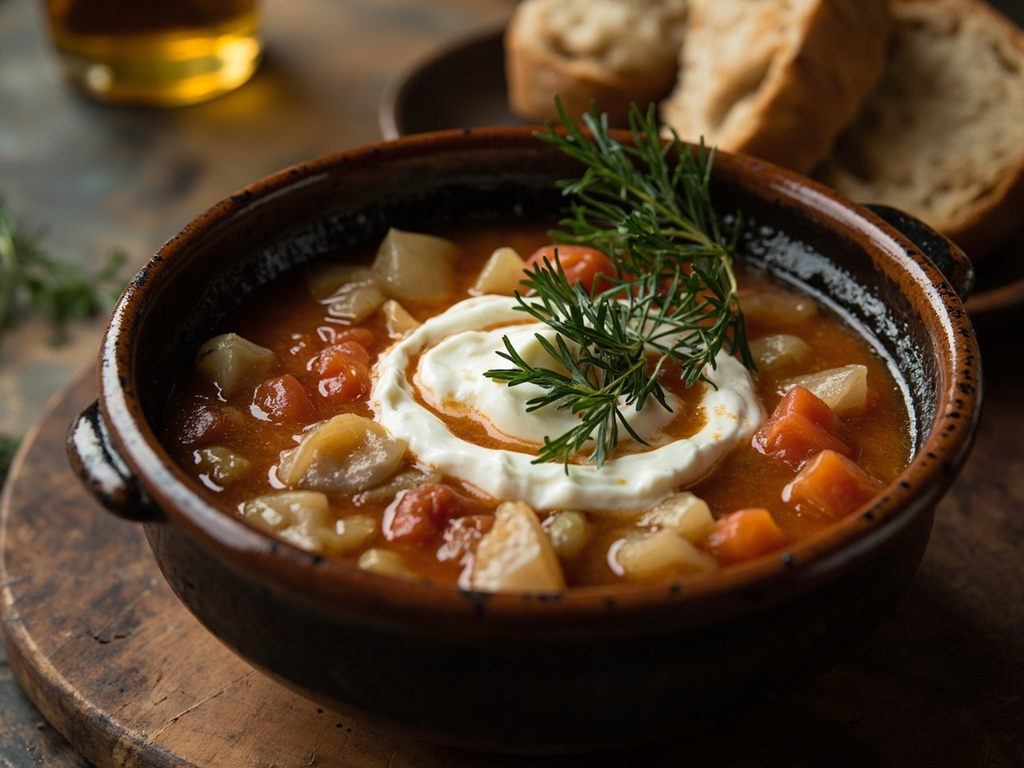
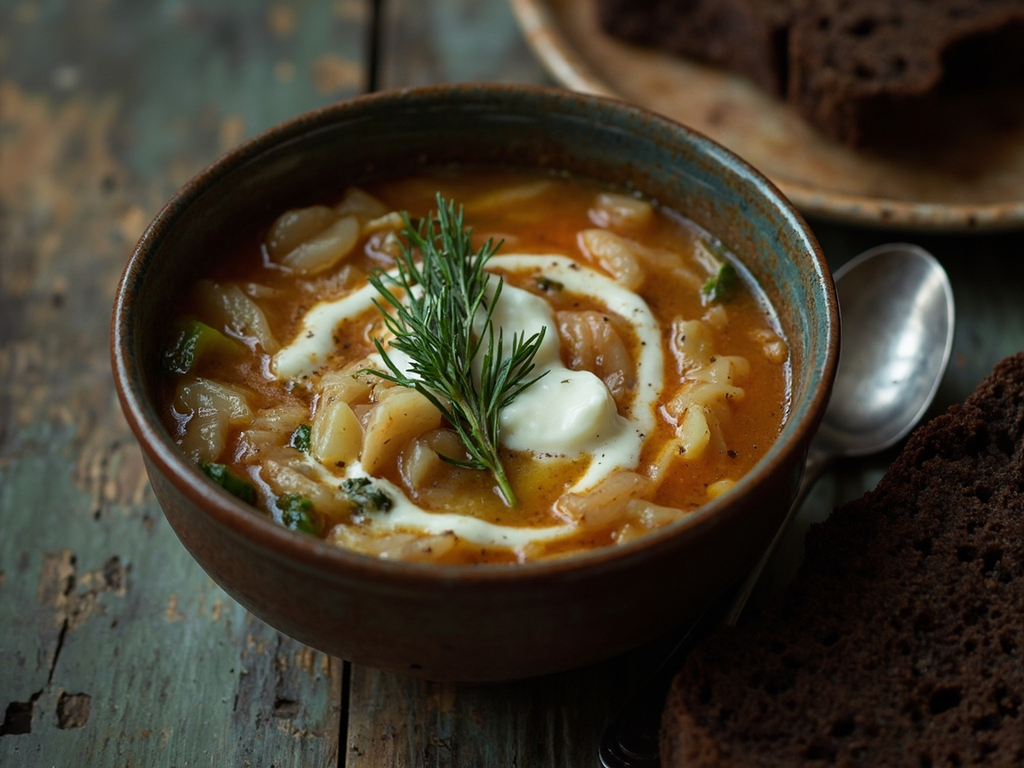
A deep and hearty soup of sour cabbage (sauerkraut), simmered with root vegetables and a marrow bone, which draws its soul from the lacto-fermented cabbage. It is served piping hot, crowned with a spoonful of *smetana* and dill.
You see, for us, shchi is not a dish, it's a season put into a pot. The cabbage soured all winter in its barrel at the back of the dacha, and you only had to grab a handful for the kitchen to smell of snow and burnt wood. You let it simmer on low heat a whole morning — the smell rises, sure and gray, all the way up to the verses you're scribbling upstairs. A spoonful of sour cream on top, black bread on the side, and the whole table warms up.
- •Sour cabbage (homemade lacto-fermented) — two large handfuls (acidic and fermented base)
- •Beef marrow bone — one (rich broth)
- •Carrot, onion, parsley root — one of each (aromatic base)
- •Potatoes — a few (thickening and body)
- •Bay leaf, peppercorns — a little (seasoning)
- •Smetana (sour cream) — as desired (serving)
- •Fresh dill — a bunch (freshness at serving)
Shchi — sour cabbage soup
A deep and hearty soup of sour cabbage (sauerkraut), simmered with root vegetables and a marrow bone, which draws its soul from the lacto-fermented cabbage. It is served piping hot, crowned with a spoonful of *smetana* and dill.
Why this dish? Shchi is THE everyday soup in Russia, from peasant huts to writers' dachas. Pasternak, who ate simply — soups, potatoes, garden vegetables — surely inhaled its tangy aroma a thousand times in the kitchen at Peredelkino, where cabbage fermented in its barrel to last through winter.
You see, for us, shchi is not a dish, it's a season put into a pot. The cabbage soured all winter in its barrel at the back of the dacha, and you only had to grab a handful for the kitchen to smell of snow and burnt wood. You let it simmer on low heat a whole morning — the smell rises, sure and gray, all the way up to the verses you're scribbling upstairs. A spoonful of sour cream on top, black bread on the side, and the whole table warms up.
Ingredients (period version)
- Sour cabbage (homemade lacto-fermented) — two large handfuls (acidic and fermented base)
- Beef marrow bone — one (rich broth)
- Carrot, onion, parsley root — one of each (aromatic base)
- Potatoes — a few (thickening and body)
- Bay leaf, peppercorns — a little (seasoning)
- Smetana (sour cream) — as desired (serving)
- Fresh dill — a bunch (freshness at serving)
Ingredients
- Raw sauerkraut (not cooked in wine) — 300 g (acidic and fermented base)
- Marrow bone or beef shank — 400 g (rich broth)
- Carrot — 1 (aromatic base)
- Onion — 1 (aromatic base)
- Potatoes — 3 medium (body)
- Bay leaf — 1 leaf (seasoning)
- Thick crème fraîche or smetana — 4 tbsp (serving)
- Fresh dill — 1/2 bunch (serving)
Method
- Cover the bone with 2 liters of cold water, bring to a simmer and skim; cook on low heat for 1 h 30 min.
- Remove the meat, detach it from the bone and return it to the strained broth.
- Add the rinsed and squeezed sauerkraut; simmer for 40 minutes to soften the acidity.
- Add the potatoes in large chunks, the carrot, the sliced onion and the bay leaf; cook for 25 minutes.
- Adjust salt (the sauerkraut already provides some). Serve boiling hot with a spoonful of smetana and lots of dill, with rye bread on the side.
How it was made : Shchi was once cooked in a Russian brick oven: the pot spent hours at declining heat, giving the cabbage its particular tenderness. It was said that yesterday's shchi, reheated, was always better — hence the saying "щи да каша — пища наша" (shchi and kasha, that's our food).
The contemporary twist : A dash of apple juice in the broth rounds out the acidity without betraying the spirit of the dish; serve in a thick bowl with a shard of toasted black bread stuck on top.
Sources : V. Pokhlebkin, *Национальные кухни наших народов* (The National Cuisines of Our Peoples) · Elena Molokhovets, *Подарок молодым хозяйкам* (A Gift to Young Housewives), 1861
Boris Pasternak · Charactorium