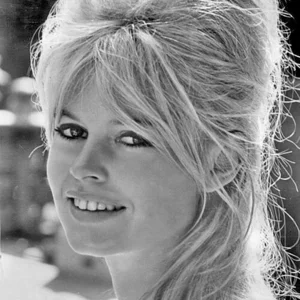

French actress, model, and singer, Brigitte Bardot became a global symbol of femininity and freedom during the 1950s and 1960s. An icon of the French New Wave and popular culture, she retired from cinema in 1973 to dedicate herself to animal rights activism.
Brigitte Bardot(1934 — 2025)
Brigitte Bardot
France
8 min read
Frequently asked questions
Famous Quotes
« I am really an animal. I live in harmony with animals.»
« Old age is something that passes you by when you have good health.»
Key Facts
- 1934: born in Paris into a middle-class family
- 1952: beginning of her film career
- 1956: international breakthrough with And God Created Woman, directed by Roger Vadim
- 1962: Andy Warhol turns her into a pop culture icon
- 1973: retirement from cinema and founding of the Brigitte Bardot Foundation for the Protection of Animals
Works & Achievements
Roger Vadim's film that launched Bardot to worldwide stardom. Shot in Saint-Tropez, it revolutionized the portrayal of femininity in cinema and sparked the fashion for beach culture on the French Riviera.
Claude Autant-Lara's film in which Bardot stars opposite Jean Gabin. It demonstrates her dramatic range beyond the sex-symbol role and was warmly received by critics.
A popular comedy that confirmed Bardot's status as the leading star of French cinema in the late 1950s, showcasing her ability to blend lightness with screen presence.
Jean-Luc Godard's film adapted from Alberto Moravia's novel. Considered one of the masterpieces of the French New Wave, it established Bardot as a prestigious international actress alongside Michel Piccoli.
An iconic song that remains one of the most recognizable hits in French pop music of the 1960s. It captures the simple happiness and freedom of living in the sun — values closely associated with Bardot's image.
A two-volume autobiography in which Bardot reflects on her career, her loves, her withdrawal from show business, and her commitment to animal welfare. A firsthand account of an era and a milieu.
Anecdotes
In 1956, Roger Vadim's film 'And God Created Woman', shot in Saint-Tropez, transformed this small fishing village into a world-famous destination. Thousands of tourists flocked to the French Riviera hoping to catch a glimpse of Bardot, forever changing the image and economy of the region.
In 1959, philosopher Simone de Beauvoir devoted a lengthy essay to Brigitte Bardot in the American magazine Esquire, titled 'Brigitte Bardot and the Lolita Syndrome'. She portrayed BB as a free woman, independent of men, embodying a new kind of femininity — a surprising analysis coming from the great feminist intellectual.
In 1970, pop artist Andy Warhol created a series of screen prints featuring Brigitte Bardot, alongside Mao Zedong and Marilyn Monroe. This choice cemented BB's status as a global icon of 20th-century popular culture, on a par with the most photographed figures of her era.
In 1973, Brigitte Bardot announced her permanent retirement from cinema at the age of 39 to devote herself entirely to animal welfare. She sold her jewelry and fur coats to fund her foundation, established in 1992, and led high-profile campaigns against the baby seal trade in Canada.
In 1999, Brigitte Bardot's likeness was chosen as the official model for the depiction of Marianne, symbol of the French Republic, on postage stamps and the busts displayed in town halls across France — a national recognition of her status as a French icon, even though she herself had an ambivalent relationship with French institutions.
Primary Sources
I had become a myth, and I didn't quite know what to do with that myth. People no longer saw the woman — they saw the image. That image devoured me.
I gave everything up for animals because animals don't lie, don't betray, and have no ambition. They saved me.
BB is neither perverse nor submissive; she is independent. She owns her body without being imprisoned by it, and treats it as something that belongs to her.
On behalf of millions of outraged people, I am asking you to put an end to this annual massacre of baby seals. France and the entire world are watching what is happening on your ice.
Key Places
Bardot discovered Saint-Tropez in 1956 while filming 'And God Created Woman'. She purchased La Madrague there, a villa that would become her refuge, and transformed the village into the world capital of beach tourism.
Born at 36 avenue de La Bourdonnais in Paris, Brigitte Bardot grew up in a bourgeois Parisian household. The capital was the backdrop for her early years as a model and the launch of her career.
The Boulogne-Billancourt film studios were the filming location for many French productions of the 1950s and 1960s, including several featuring Bardot. A landmark of post-war French cinema production.
A villa acquired by Bardot in 1958, which became her permanent retreat after her withdrawal from cinema. She lived there in seclusion for decades, dedicating herself to her animal welfare foundation.
In 1977, Bardot traveled to the Canadian ice floes to protest the harp seal pup hunt. Photographs showing her alongside a white seal pup circled the globe and became defining images in the history of environmental activism.