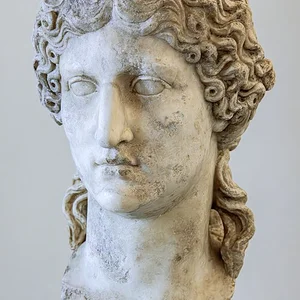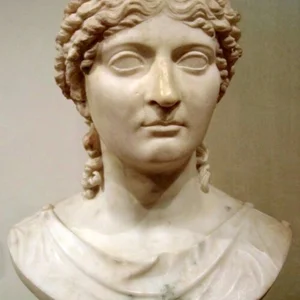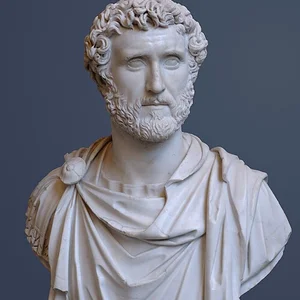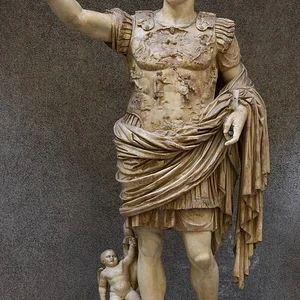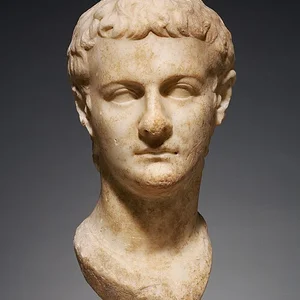

The third Roman emperor, Caligula ruled from 37 to 41 AD. After a promising start, his reign descended into tyranny and extravagance. He was assassinated by officers of the Praetorian Guard.
Caligula(12 — 41)
Caligula
Rome antique
8 min read
Frequently asked questions
Key Facts
- Born in 12 AD, son of Germanicus, a popular general
- Came to power in 37 AD, succeeding Tiberius
- Reign marked by cruelty, executions, and extravagant spending
- Assassinated in 41 AD by officers of the Praetorian Guard
- His nickname 'Caligula' (little boot) was given to him by soldiers during his childhood
Works & Achievements
Caligula initiated the first studies to expand the port of Ostia, a project later taken up and completed under Claudius. This initiative reflects a genuine concern for Rome's grain supply.
Caligula had the temple dedicated to his great-great-grandfather Augustus completed and consecrated, thereby affirming the dynastic continuity of the Julio-Claudian line and his own imperial legitimacy.
A floating bridge stretching over five kilometers was built across the Bay of Baiae — a remarkable feat of engineering, even if it served only a single spectacular crossing. It illustrates Roman engineering's ability to carry out large-scale temporary constructions.
Caligula had the Circus Maximus enlarged and adorned with new ornaments, continuing the imperial tradition of grand beautification projects in Rome and of popular entertainment.
He had the Egyptian obelisk moved from Heliopolis to the circus on the Vatican Hill, on the very site where St. Peter's Square stands today. This obelisk is still visible in Rome to this day.
Anecdotes
Caligula's nickname comes from the small military sandals (caligae) he wore as a child in the legionary camps of his father Germanicus. The soldiers adored him and affectionately called him by this name — a nickname that stuck with him for life, even though it annoyed him once he became emperor.
During a campaign in Germania and Britain, Caligula allegedly ordered his soldiers to collect seashells on the shore of the English Channel as 'spoils of the Ocean' — symbolic plunder from a victory over the sea itself. This episode, recorded by Suetonius, illustrates the growing eccentricity of his reign.
Caligula had a floating bridge more than five kilometers long built across the Bay of Baiae, between Puteoli and Baiae, so he could cross it in a chariot while wearing the breastplate of Alexander the Great. According to Suetonius, he staged this feat to defy the astrologer Thrasyllus, who had predicted he had as much chance of becoming emperor as of riding a horse across the bay.
Several ancient sources report that Caligula appointed his horse Incitatus as a priest and was considering making him a consul — a sign, to his contemporaries, of his utter contempt for republican institutions. Modern historians tend to see it instead as a deliberate provocation aimed at the Senate.
After a serious illness in 37 AD, which struck only a few months after he came to power, Caligula's behavior changed radically according to ancient sources. He began to believe himself a living god, demanded worship in his honor, and had his statue installed in temples — including the Temple in Jerusalem, triggering a major crisis in Judea.
Primary Sources
He had lived at first in poverty and restraint; then, having become emperor, he changed so completely that people said of him there had never been a better slave nor a worse master.
Germanicus was of singular beauty, of proven valor, and though he died in the flower of his age, he was celebrated for his glory, and even more celebrated for his untimely death.
He did all manner of senseless and cruel things, whether out of pride, anger, natural desire for pleasure, or mere chance.
He was convinced he was a god and relied upon his own divinity, despising all other human beings as infinitely inferior to him.
Key Places
Coastal town in Latium where Caligula was born in 12 AD and where he owned an imperial villa. He returned there regularly and held a particular fondness for the place.
The hill in Rome where the imperial palace (Domus Caesaris) stood, Caligula's primary residence. It was here that he was assassinated during the Palatine Games on January 24, 41 AD.
A famous seaside resort on the Bay of Naples where Caligula had his renowned pontoon bridge constructed — stretching over three miles — which he crossed in a chariot. The site stands as a symbol of the extravagance and eccentricities of his reign.
A volcanic lake in the Castelli Romani hills where Caligula had two enormous pleasure barges built, rediscovered in the 20th century. These ships, destroyed during World War II, stand as testament to the extraordinary luxury of his building projects.
The Rhine region where Caligula spent his childhood in the military camps of Germanicus, growing up among the legions. It was here that soldiers gave him his nickname, a sign of the deep affection they felt for him.
Typical Objects

The hobnailed sandal worn by Roman soldiers, which Caligula wore as a child in the camps of his father Germanicus — the origin of his nickname. It symbolizes his ties to the army and the dynastic legitimacy he drew from his father's popularity.

An ornate breastplate worn during ceremonies and triumphs, which Caligula famously donned during his procession across the Bay of Baiae. It represented military power and the imperial claim to a heroic glory comparable to that of Alexander the Great.

Divine insignia that Caligula reportedly adopted to present himself as a living god, identifying himself with Jupiter and other deities of the Roman pantheon. This shocked Romans, for whom apotheosis was reserved for emperors after death.

Imperial coins bearing the portrait of Caligula and members of his family, a powerful tool of political propaganda throughout the Empire. They spread the dynastic image of the Julio-Claudian house and the legitimacy inherited from Germanicus.

A ceremonial vehicle drawn by four white horses, used during military triumphs in Rome. Caligula made conspicuous use of it for military victories that were widely disputed, invoking the tradition of victorious generals while distorting it.

Luxury vessels used by Caligula on Lake Nemi, uncovered by archaeological excavations in the twentieth century. These sumptuously decorated ships bear witness to the extravagance and love of spectacle that defined his reign.
School Curriculum
Vocabulary & Tags
Key Vocabulary
Daily Life
Morning
Caligula often rose late according to ancient sources, indulging in long lie-ins contrary to the Augustan ideal of frugality. His mornings were devoted to imperial audiences and administrative affairs, surrounded by his freedmen and advisors in the reception halls (tablinum) of the Palatine palace.
Afternoon
His afternoons were structured around Senate sessions when he attended them, public audiences, and increasingly — as his reign progressed — spectacles, gladiatorial games, and chariot races at the Circus Maximus, of which he was passionate. He reportedly sometimes took part himself in races or gladiatorial exhibitions.
Evening
Caligula's evenings were notorious for their extravagant banquets (convivia), bringing together senators, freedmen, artists, and courtiers in a mix that shocked the Roman aristocracy. Suetonius describes prolonged late-night feasts flowing with fine wines, accompanied by musical entertainment and dancing.
Food
The imperial table under Caligula was renowned for excessive luxury: rare delicacies such as flamingo tongues, exotic fish, prized game, and fine wines imported from across the Empire. Like any Roman aristocrat, he also consumed bread, legumes, olive oil, and fruit — but his reputation for extravagance dominates the ancient accounts.
Clothing
Caligula wore the purple toga reserved for triumphators and emperors, often adorned with gold, a symbol of his absolute power. Sources report that he favored exotic and theatrical attire, sometimes dressing as Greek or Roman gods, which scandalized traditionalist Romans attached to the gravitas (dignity) of the senatorial toga.
Housing
Caligula lived primarily in the imperial palace on the Palatine Hill, which he reportedly had enlarged and embellished with extravagant luxury according to Suetonius. He also owned villas at Antium, his birthplace, and at Baiae, as well as secondary residences where he stayed regularly to escape Rome and its political obligations.
Historical Timeline
Period Vocabulary
Visual Style
Esthétique de la Rome impériale julio-claudienne : marbre blanc et or, fresques pompéiennes éclatantes, portraits sculptés d'un réalisme saisissant, contrastes entre la magnificence du palais et la violence des jeux du cirque.
Sound Ambience
L'univers sonore de Caligula mêle le tumulte des foules romaines au Circus Maximus, les fanfares militaires, le claquement des sandales des prétoriens sur le marbre et le murmure de la Méditerranée à Baïes.
Liens externes & ressources
Références
Œuvres
Construction du port d'Ostie (débuts des travaux)
37-41 apr. J.-C.
Achèvement du temple d'Auguste
37 apr. J.-C.
Construction du pont de bateaux sur la baie de Baïes
39 apr. J.-C.
Extension et réforme du Circus Maximus
37-41 apr. J.-C.
Transfert de l'obélisque du Vatican
37 apr. J.-C.