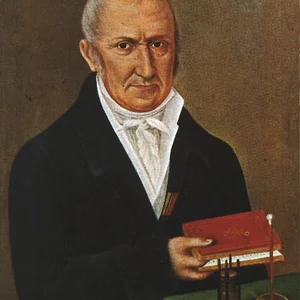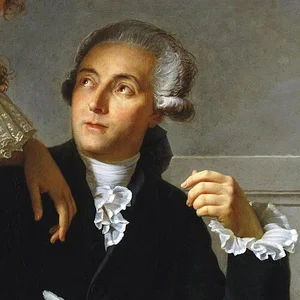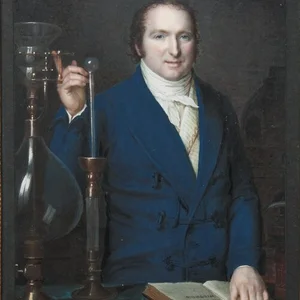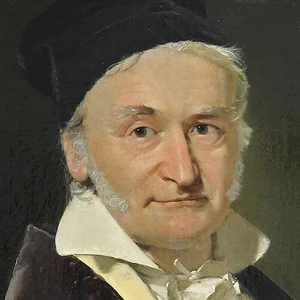

Carl Friedrich Gauss (1777–1855) was a German mathematician, astronomer, and physicist regarded as one of the greatest mathematicians in history. He made groundbreaking contributions to algebra, geometry, number theory, and physics.
Carl Friedrich Gauss(1777 — 1855)
Carl Friedrich Gauss
Confédération du Rhin, royaume de Hanovre
8 min read
Frequently asked questions
Famous Quotes
« Mathematics is the queen of the sciences, and arithmetic is the queen of mathematics.»
« It is easier to measure than to reason.»
Key Facts
- 1777: born in Brunswick (Duchy of Brunswick-Wolfenbüttel)
- 1796: discovered that the regular 17-sided polygon (heptadecagon) is constructible with compass and straightedge
- 1801: published Disquisitiones Arithmeticae, a foundational work in number theory
- 1801: calculated the orbit of Ceres, enabling astronomers to relocate the asteroid
- 1855: died in Göttingen, where he had directed the astronomical observatory
Works & Achievements
A foundational treatise on modern number theory, written when Gauss was just 21 years old. In it, he introduces the concept of congruence and lays the groundwork for abstract algebra, influencing every generation of mathematicians that followed.
Gauss rigorously proved that every polynomial with real coefficients has at least one complex root. He went on to provide four different proofs of this result over the course of his life.
A work in which Gauss presents his methods for calculating planetary orbits and formalizes the method of least squares. This text established both precision astronomy and modern mathematical statistics.
A groundbreaking memoir in differential geometry, in which Gauss proves the Theorema Egregium: the curvature of a surface is an intrinsic property. This work paved the way for non-Euclidean geometries and general relativity.
An optical instrument used to signal geodetic points over long distances by reflecting sunlight. This practical invention transformed cartography and land surveying.
The first functional telegraph, connecting the Göttingen Observatory to the Physics Institute over a distance of 1.5 km. This invention foreshadowed modern communication networks.
The result of an international collaboration coordinated by Gauss to measure Earth's magnetic field. This work founded the field of geophysics and made it possible to locate the South Magnetic Pole.
Anecdotes
At the age of 3, Gauss is said to have corrected an arithmetic error in his father's accounts. This anecdote, recounted by Gauss himself late in life, illustrates an extraordinary gift for numbers that revealed itself long before any formal schooling.
At 10, his teacher Büttner asked the class to add up all the integers from 1 to 100, hoping to keep the students busy for a while. Gauss found the answer — 5,050 — in a matter of seconds, having noticed that symmetric pairs (1+100, 2+99…) each summed to 101, giving 50 pairs of 101.
In 1796, at age 19, Gauss proved that a regular heptadecagon (a 17-sided polygon) could be constructed with a compass and straightedge — a problem that had been open since antiquity. He was so proud of this discovery that he requested a heptadecagon be carved on his tombstone.
Gauss kept a scientific diary from 1796 to 1814, in which he recorded his discoveries in Latin as brief, cryptic notes. This notebook, found after his death, revealed that he had anticipated several major results that other mathematicians would independently discover decades later.
When his friend and fellow mathematician Farkas Bolyai shared his son János's work on non-Euclidean geometry, Gauss replied that he had long entertained the same ideas himself but had never dared to publish them, fearing the controversy they would provoke. This caution drew posthumous criticism, yet it speaks to his unwavering commitment to absolute rigor.
Primary Sources
The investigations contained in this work belong to higher arithmetic and concern principally the positive integers. We shall distinguish prime numbers from composite ones and set forth the properties of residues.
The method of least squares, applied to the determination of planetary orbits, yields the most probable value of an unknown quantity from a series of observations subject to inevitable errors.
ΕΎΡΗΚΑ! num = Δ + Δ + Δ. [Eureka! Every positive integer is the sum of at most three triangular numbers.]
I have calculated the orbit of the new planet from Piazzi's observations and can state with certainty that the elements I propose will allow it to be recovered at the indicated position.
The curvature of a surface at a point is an intrinsic quantity that does not depend on how the surface is embedded in space — this is what we call the Theorema Egregium.
Key Places
Gauss's birthplace, where he grew up in a modest family. The Duke of Brunswick recognized his genius and funded his studies, enabling him to attend university.
Gauss began studying here in 1795 and spent most of his career as director of the observatory. The university was at the time one of the most important intellectual centers in Europe.
Gauss served as its director from 1807 to 1855. From this observatory, he conducted research in astronomy, geodesy, and terrestrial magnetism, and co-invented the electromagnetic telegraph with Weber.
The highest peak of the Harz mountains, used by Gauss as a triangulation summit during the geodetic survey of Hanover (1818–1825). Measurements taken here contributed to his work on the curvature of surfaces.
The university where Gauss defended his doctoral thesis in 1799, proving the fundamental theorem of algebra — a cornerstone of modern mathematics.
Liens externes & ressources
Références
Œuvres
Disquisitiones Arithmeticae
1801
Démonstration du théorème fondamental de l'algèbre (thèse de doctorat)
1799
Theoria Motus Corporum Coelestium
1809
Disquisitiones Generales Circa Superficies Curvas
1827
Invention de l'héliotrope
1821
Télégraphe électromagnétique (avec Wilhelm Weber)
1833