 flip
flipRice congee with salted vegetables (xián zhōu)
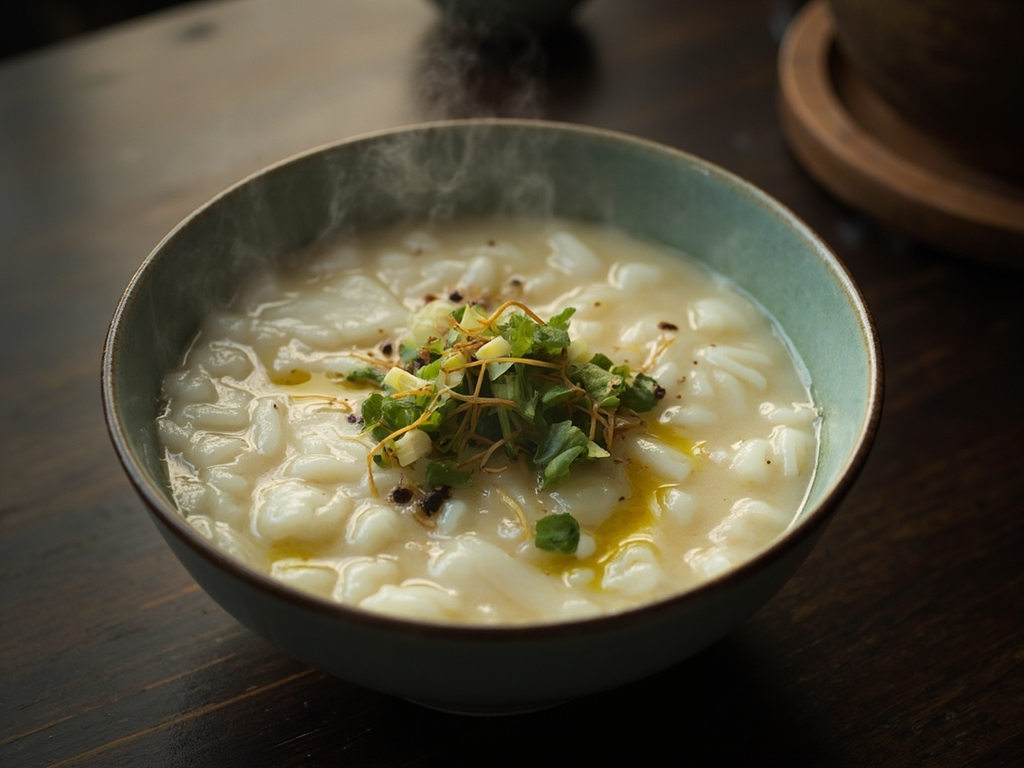
Rice congee with salted vegetables (xián zhōu)
Why this dish? Daughter of Liuhe, in the rice-growing heart of Jiangsu, Wu began every childhood morning with a steaming bowl of zhōu. It is the humblest comfort of Lower Yangtze cuisine, the one you make when time is short but your belly demands — the food of a hardworking life, like hers in the laboratory.
Rice slowly cooked until it breaks down into a silky porridge, scattered with salted fermented vegetables and a drizzle of sesame oil. Light, warm, infinitely comforting.
Permettez-moi de vous offrir d'abord ce que ma mère me servait à Liuhe, avant que le jour ne se lève sur les rizières. Un bon zhōu ne se précipite pas : le riz doit s'ouvrir lentement, grain après grain, exactement comme une expérience que l'on conduit sans hâte — la patience décide de tout. J'y ajoutais une cuillerée de légumes salés et trois gouttes d'huile de sésame, jamais davantage. Même à New York, dans mes années les plus chargées, ce bol m'a tenu lieu de patrie.
- •White rice from Jiangsu — one bowl (foundation)
- •Spring water — in abundance (cooking)
- •Salted fermented vegetables (zhà cài or preserved mustard greens) — a handful (umami seasoning)
- •Toasted sesame oil — a few drops (aroma)
- •Chopped scallion — a little (freshness)
Rice congee with salted vegetables (xián zhōu)
Rice slowly cooked until it breaks down into a silky porridge, scattered with salted fermented vegetables and a drizzle of sesame oil. Light, warm, infinitely comforting.
Why this dish? Daughter of Liuhe, in the rice-growing heart of Jiangsu, Wu began every childhood morning with a steaming bowl of zhōu. It is the humblest comfort of Lower Yangtze cuisine, the one you make when time is short but your belly demands — the food of a hardworking life, like hers in the laboratory.
Permettez-moi de vous offrir d'abord ce que ma mère me servait à Liuhe, avant que le jour ne se lève sur les rizières. Un bon zhōu ne se précipite pas : le riz doit s'ouvrir lentement, grain après grain, exactement comme une expérience que l'on conduit sans hâte — la patience décide de tout. J'y ajoutais une cuillerée de légumes salés et trois gouttes d'huile de sésame, jamais davantage. Même à New York, dans mes années les plus chargées, ce bol m'a tenu lieu de patrie.
Ingredients (period version)
- White rice from Jiangsu — one bowl (foundation)
- Spring water — in abundance (cooking)
- Salted fermented vegetables (zhà cài or preserved mustard greens) — a handful (umami seasoning)
- Toasted sesame oil — a few drops (aroma)
- Chopped scallion — a little (freshness)
Ingredients
- Short-grain or jasmine rice — 150 g (foundation)
- Water — 1.5 L (cooking)
- Zhà cài (Sichuan preserved mustard in jar) or Chinese pickles — 60 g, rinsed and sliced (salty umami)
- Toasted sesame oil — 1 tsp (aroma)
- Scallion — 2, chopped (garnish)
- Ginger — 2 slices (roundness)
Method
- Rinse the rice, put it in a large pot with the water and ginger slices.
- Bring to a boil, then reduce to very low heat; let it simmer for 50 minutes, stirring occasionally to prevent sticking.
- The congee is ready when the grains have burst and the texture is creamy like a thick soup.
- Ladle into bowls, scatter with sliced zhà cài, scallion, and drizzle with sesame oil. Serve piping hot.
How it was made : In Jiangnan, zhōu was cooked in an earthenware pot over a dying fire, sometimes overnight. The salted, fermented vegetables — precious because they kept without ice — provided the umami and salt that plain rice lacked.
The contemporary twist : Top the bowl with a runny soft-boiled egg and a few drops of light soy sauce for a 'New York physicist' brunch.
Chien-Shiung Wu · Charactorium