 flip
flipShanghai red-braised pork (hóngshāo ròu)
Shanghai red-braised pork (hóngshāo ròu)
Why this dish? Wu was known for serving Shanghai specialties to her American colleagues at academic receptions. Hóngshāo ròu is THE emblematic dish of Shanghai and Jiangnan: this glossy, generous dish embodied her hospitality of an 'abundant table'.
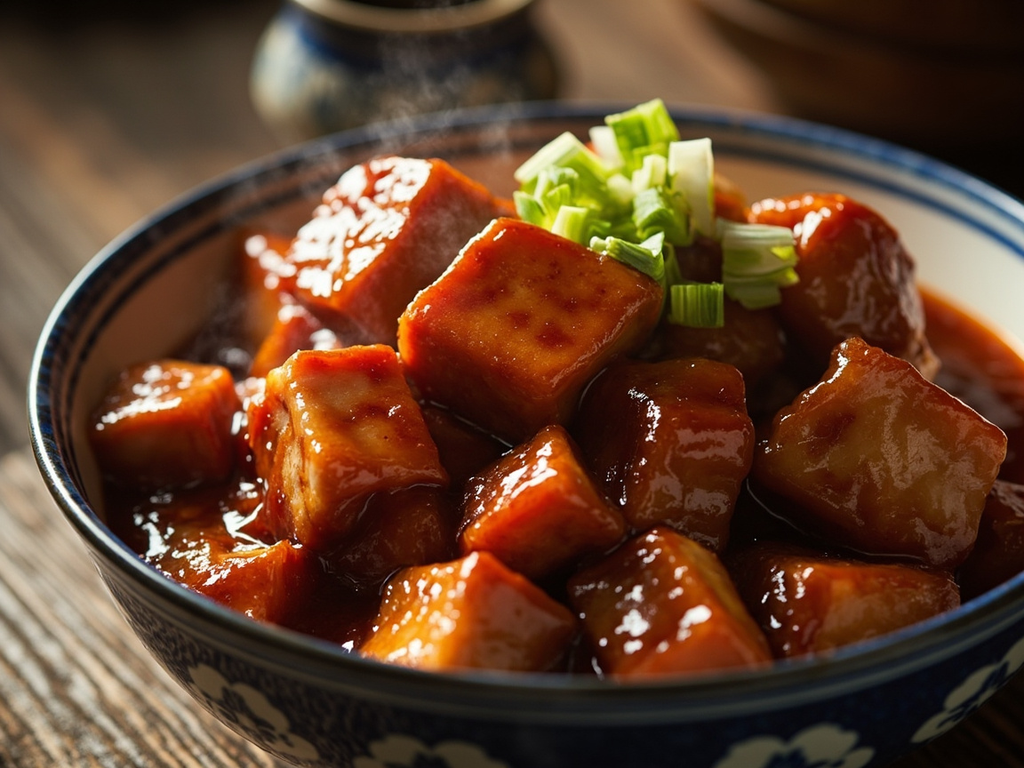
Cubes of pork belly simmered for hours in soy sauce, caramelized rock sugar, and Shaoxing wine, until meltingly tender, lacquered and glossy like amber.
Voici le plat dont je couvrais ma table quand recevais mes collègues à Columbia. Le secret n'a rien d'un mystère : on caramélise d'abord le sucre candi jusqu'à l'ambre, ni trop clair ni brûlé — là encore, une affaire de mesure exacte. Puis on laisse le porc s'attendrir des heures durant dans le vin de Shaoxing ; il faut savoir attendre que la matière se transforme. Mes hôtes américains, m'a-t-on dit, n'oubliaient jamais ce plat ; j'aimais leur prouver qu'une physicienne pouvait aussi tenir parfaitement sa cuisine.
- •Pork belly with skin — a nice piece (heart of the dish)
- •Rock sugar — a few lumps (caramelized lacquer)
- •Light soy sauce and dark soy sauce — to taste (saltiness and color)
- •Shaoxing yellow wine — one bowl (aroma, tenderizing)
- •Ginger and star anise — a few slices, 1 star (aromatics)
- •Scallion — a few stalks (aromatic)
Shanghai red-braised pork (hóngshāo ròu)
Cubes of pork belly simmered for hours in soy sauce, caramelized rock sugar, and Shaoxing wine, until meltingly tender, lacquered and glossy like amber.
Why this dish? Wu was known for serving Shanghai specialties to her American colleagues at academic receptions. Hóngshāo ròu is THE emblematic dish of Shanghai and Jiangnan: this glossy, generous dish embodied her hospitality of an 'abundant table'.
Voici le plat dont je couvrais ma table quand recevais mes collègues à Columbia. Le secret n'a rien d'un mystère : on caramélise d'abord le sucre candi jusqu'à l'ambre, ni trop clair ni brûlé — là encore, une affaire de mesure exacte. Puis on laisse le porc s'attendrir des heures durant dans le vin de Shaoxing ; il faut savoir attendre que la matière se transforme. Mes hôtes américains, m'a-t-on dit, n'oubliaient jamais ce plat ; j'aimais leur prouver qu'une physicienne pouvait aussi tenir parfaitement sa cuisine.
Ingredients (period version)
- Pork belly with skin — a nice piece (heart of the dish)
- Rock sugar — a few lumps (caramelized lacquer)
- Light soy sauce and dark soy sauce — to taste (saltiness and color)
- Shaoxing yellow wine — one bowl (aroma, tenderizing)
- Ginger and star anise — a few slices, 1 star (aromatics)
- Scallion — a few stalks (aromatic)
Ingredients
- Pork belly (with skin if possible) — 800 g (heart of the dish)
- Rock sugar (or brown sugar) — 40 g (caramel/lacquer)
- Shaoxing wine — 200 ml (braising liquid)
- Light soy sauce — 3 tbsp (saltiness)
- Dark soy sauce — 1 tbsp (color)
- Ginger — 4 slices (aromatic)
- Scallion — 3 stalks (aromatic)
- Star anise — 1 star (aroma)
- Hot water — to cover (braising liquid)
Method
- Cut the pork belly into 3 cm cubes. Blanch in boiling water for 2 minutes, then drain.
- In a dry pot with a drizzle of oil, melt the rock sugar over medium heat until it turns amber.
- Add the pork cubes, coat them in the caramel for 2-3 minutes.
- Pour in the Shaoxing wine, both soy sauces, ginger, scallion, and star anise. Cover with hot water to just submerge.
- Bring to a simmer, cover, and braise over low heat for 1 hour 30 minutes.
- Uncover and let reduce for 15-20 minutes over higher heat, basting the meat, until the sauce is syrupy and glossy, coating the pieces.
How it was made : Hóngshāo ròu was cooked in a cast-iron pot on the family stove. Rock sugar (rather than white sugar) provided the characteristic sheen; Shaoxing wine, fermented from glutinous rice, was the aromatic pillar of all Jiangnan cuisine.
The contemporary twist : Plate three lacquered cubes on a spoonful of cabbage purée, like a lecture-hall bite — a nod to Wu's blackboard.
Chien-Shiung Wu · Charactorium