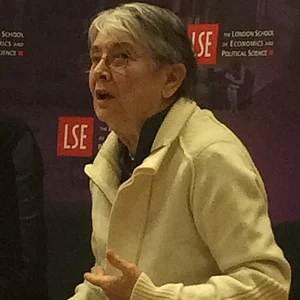

French materialist feminist sociologist, Christine Delphy co-founded the Women's Liberation Movement in 1970. She theorized patriarchy as a system of economic exploitation of women and developed the concept of the domestic mode of production.
Frequently asked questions
Famous Quotes
« Feminism is a social movement whose aim is the abolition of patriarchy.»
« Women constitute a social class oppressed by men.»
Key Facts
- Born in 1941 in Paris, research director at the CNRS
- Co-founds the Women's Liberation Movement (MLF) in 1970
- Publishes *The Main Enemy* (1970), a foundational text of French materialist feminism
- Co-founds the journal *Questions féministes* in 1977 with Simone de Beauvoir
- Develops the theory of the domestic mode of production, analyzing housework as economic exploitation
Works & Achievements
A founding article of French materialist feminism, published in the journal *Partisans*. Delphy demonstrates that women constitute a socially exploited class, economically exploited by men through unpaid domestic labor, and that marriage is the central relation of production underpinning this exploitation.
Together with Simone de Beauvoir and other feminists, Delphy founded this academic journal, which became the leading platform for Francophone materialist feminism. Following an internal crisis, it was relaunched as *Nouvelles Questions féministes* in 1981, and is still published today.
A collection of her major texts published since 1970, synthesizing her theory of patriarchy as a system of economic exploitation distinct from capitalism. An essential reference in gender studies in France and the French-speaking world.
A second collection in which Delphy deepens her thinking on the social construction of gender, arguing that gender precedes and shapes our perception of biological sex — a position that has sparked significant debate in international feminism.
A work in which Delphy extends her analysis to intersectionality, weaving together gender, race, and social class. She notably critiques the rise of Islamophobia in France and explores the shared logics underlying different systems of domination.
Anecdotes
On August 26, 1970, Christine Delphy takes part in a founding symbolic act of French feminism: a group of women from the nascent MLF attempts to lay a wreath beneath the Arc de Triomphe, dedicated to “the wife of the unknown soldier, more unknown than he.” The participants are arrested, but the event is covered by the press and marks the public birth of the Women’s Liberation Movement.
Before becoming the theorist of materialist feminism, Christine Delphy studied sociology in the United States in the 1960s, notably in Chicago and at Berkeley. This time abroad allowed her to discover the early American feminist circles and debates on women’s unpaid labor, which would fuel her thinking for decades to come.
In 1970, Christine Delphy published “The Main Enemy,” an article that caused a scandal: she argued that women form a social class economically exploited by men, in the same way that workers are exploited by employers. The comparison between patriarchy and capitalism shocked as much as it fascinated, and the text was quickly translated into many languages.
In 1977, Christine Delphy co-founded with Simone de Beauvoir the journal *Questions féministes*, which became the platform for materialist feminism in France. The journal sparked heated debates even within the feminist movement, particularly around one central question: are the differences between men and women biological, or entirely constructed by society? Delphy firmly defended the second position.
As a research director at the CNRS, Christine Delphy spent years fighting to have feminism recognized as a serious academic discipline. By the 1980s, her concept of the “domestic mode of production” — the idea that women’s unpaid household labor is a form of economic exploitation comparable to wage labor — was beginning to find its place in sociology curricula across France and Europe.
Primary Sources
Women constitute a social class whose exploitation takes the form of unpaid domestic labor provided within marriage. This exploitation is not incidental: it is the material foundation of women's oppression.
The women's liberation movement cannot be content with demanding equality within a system built on inequality. The goal is to transform the basic structures of society, not simply to integrate women into them on equal terms.
Domestic work is not unpaid because it is without value; it has no market value because it is performed for free, within a specific relation of production: marriage.
Gender precedes sex: it is not biological difference that creates gender, but gender that gives social meaning to biological difference. Gender is a category of hierarchy, not of difference.
Key Places
Christine Delphy was born in Paris in 1941 and carried out her entire intellectual and activist work there. The Left Bank — Saint-Germain-des-Prés, the Latin Quarter — was the heart of the academic and feminist life in which she thrived.
On 26 August 1970, Christine Delphy took part in a symbolic action by the MLF at the Arc de Triomphe, attempting to lay a wreath for "the wife of the unknown soldier." The site became a founding symbol of French second-wave feminism.
Christine Delphy studied sociology there in the 1960s, discovering American critical sociology and early feminist circles that would profoundly reshape her thinking on labour and exploitation.
Christine Delphy worked there as a research director for the greater part of her career. It was within this institutional setting that she developed and published her theories on patriarchy and the domestic mode of production.
The academic institution where Christine Delphy regularly led seminars. The EHESS is one of the key sites for the academic legitimation of gender studies in France, to which Delphy made lasting contributions.
Typical Objects

Christine Delphy drafts her founding articles on a typewriter in the 1970s. Her texts first circulate as mimeographed copies (hand-duplicated documents) before being published in academic journals.

This journal co-founded by Delphy in 1977 is the central vehicle for spreading French materialist feminism. Each issue is collectively reviewed and debated by the editorial committee before publication, embodying the movement's principle of collective work.

A fieldwork researcher, Delphy uses notebooks to record her observations on domestic labor and economic inequalities within households — the empirical foundation of her theories on the domestic mode of production.

The first MLF actions in which Delphy takes part make use of hand-painted banners. The one planned for the Arc de Triomphe in August 1970 — "to the wife of the unknown soldier, more unknown than he" — has become a symbol of French feminism.

During her studies in the United States in the 1960s, Delphy discovers the work of American sociologists on the family and unpaid labor, which would feed her theoretical thinking for decades.

As a research director at the CNRS, Christine Delphy compiles documentary files on household economic statistics, family law, and women's working conditions — the essential empirical base for her theoretical arguments.
School Curriculum
Vocabulary & Tags
Key Vocabulary
Daily Life
Morning
Christine Delphy begins her days by reading the French and foreign press and academic journals. As a research director at the CNRS, she goes to her laboratory or works from home, annotating sociological texts and drafting her own theoretical articles.
Afternoon
Her afternoons are often devoted to collective work: editorial board meetings of *Questions féministes*, feminist working groups, seminars at the EHESS, or academic conferences. The collective dimension of intellectual production is a core value in her practice.
Evening
Evenings are frequently taken up by public debates, lectures in university auditoriums, or activist meetings in Parisian apartments. Christine Delphy is also an avid reader of philosophy, literature, and international political theory.
Food
Like many Parisian intellectuals of her generation, Christine Delphy frequents the bistros and cafés of the Left Bank — informal spaces for discussion and exchange. Meals are as much occasions for socializing as for eating, during which theoretical debates naturally carry on.
Clothing
Christine Delphy favors a sober, functional style, characteristic of second-wave feminist activists who consciously reject dress codes they consider alienating. Trousers, practical jackets, unstyled hair: the way she dresses is itself a deliberate refusal of the expectations imposed on women.
Housing
Christine Delphy lives in an apartment on the Parisian Left Bank, close to academic institutions and the hubs of intellectual life. Like several feminists of her generation, she chooses to live alone, rejecting the model of the traditional household that she analyzes as a structure of economic exploitation.
Historical Timeline
Period Vocabulary
Liens externes & ressources
Références
Œuvres
L'ennemi principal (article)
1970
Co-fondation de la revue 'Questions féministes'
1977
L'ennemi principal, tome 1 : Économie politique du patriarcat
1998
L'ennemi principal, tome 2 : Penser le genre
2001
Classer, dominer. Qui sont les 'autres' ?
2008