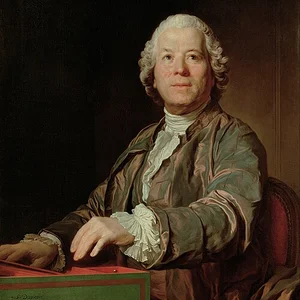

Austro-Bohemian composer (1714–1787), Gluck revolutionized opera in the 18th century by prioritizing dramatic expression over vocal virtuosity. His reform profoundly influenced European lyric music.
Christoph Willibald Gluck(1714 — 1787)
Christoph Willibald Gluck
royaume de Bohême, archiduché d'Autriche
8 min read
Frequently asked questions
Famous Quotes
« I sought to restrict music to its true role: that of supporting poetry in order to strengthen the expression of feeling.»
Key Facts
- Born in 1714 in Bavaria (Holy Roman Empire), died in Vienna in 1787
- Published *Orfeo ed Euridice* in 1762, the first work of his reform
- Wrote the preface to *Alceste* in 1767, the manifesto of his operatic reform
- Settled in Paris in 1773, sparking the quarrel between the Gluckists and Piccinnists
- Composed more than 40 operas, including *Iphigénie en Aulide* (1774) and *Iphigénie en Tauride* (1779)
Works & Achievements
The first landmark opera of the Gluckian reform, it abandons the traditional da capo aria in favor of continuous, emotionally driven drama. The celebrated aria 'Che farò senza Euridice' is one of the most beautiful in the entire Western operatic repertoire.
A masterpiece of the reform, accompanied by a preface-manifesto that sets out its principles with remarkable clarity. Gluck strips away superfluous ornamentation and subordinates music to text and dramatic emotion.
The third installment of his collaboration with librettist Ranieri de' Calzabigi, exploring with great refinement the clash between two cultures — Greek and Spartan — through the myth of Paris and Helen.
Gluck's first great Parisian triumph, set to a libretto inspired by Racine. The work won over French audiences thanks to the support of Marie-Antoinette and the dramatic power of the score.
An opera set to a libretto by Quinault that had already been set to music by Lully, proving that Gluck could rival the French masters on their own ground. The work crystallized the rivalry between the Gluckists and the Piccinnists.
Regarded as the ultimate achievement of Gluck's reform, this opera combines dramatic coherence with musical intensity. To this day, it remains one of the most frequently performed operas of the 18th century worldwide.
Anecdotes
Gluck had been the music teacher of the young Marie-Antoinette in Vienna. When she became Dauphine and then Queen of France, she actively supported her former teacher during his Parisian stays, helping secure his triumph at the Paris Opéra against his detractors.
The quarrel between Gluckists and Piccinists divided Paris in the 1770s: supporters of Gluck's reforms clashed with those of the Italian Niccolò Piccinni in salons, cafés, and newspapers. This musical controversy touched on deeper questions of aesthetics and Enlightenment philosophy.
The premiere of Orfeo ed Euridice in 1762 in Vienna marked a historic turning point. Gluck entrusted the role of Orpheus to the castrato Gaetano Guadagni, whose stage performance he personally shaped, demanding natural dramatic expression rather than the usual vocal acrobatics — scandalizing lovers of traditional opera.
Gluck died in part a victim of his own excesses at the table. His doctors had strictly forbidden him alcohol after several strokes. One November evening in 1787, he drank a few glasses of liqueur after dinner despite the prohibition: a few hours later, a final stroke carried him off.
In the preface to his opera Alceste (1767), Gluck set down in writing the principles of his reform, declaring his wish to "restrict music to its true role, that of serving poetry." This text is considered one of the most important aesthetic manifestos in the entire history of Western music.
Primary Sources
I have sought to restrict music to its true function, that of serving poetry in order to strengthen the expression of feelings and the interest of situations, without interrupting the action or cooling it with superfluous ornaments.
Whatever talent a singer may possess, as soon as he permits himself the slightest addition to what the composer has written, he is guilty toward the composer, toward the author of the words, and toward the work as a whole.
I endeavored to imitate nature in its beautiful simplicity; I avoided displaying a vain luxury of difficult and elaborate sounds, because they can never move us and serve only to satisfy curiosity.
I seek to forget that I am a musician when I set an opera to music, and to remember only the poet and the character. Musical beauty is that which suits the subject.
Key Places
It was in this imperial theatre that *Orfeo ed Euridice* (1762) and *Alceste* (1767) were premiered — the founding works of Gluck's operatic reform. Gluck worked there under the direct patronage of the Habsburg court.
The most prestigious stage in Europe, where Gluck triumphed with *Iphigénie en Aulide* (1774) and *Iphigénie en Tauride* (1779). It was here that the famous quarrel between the Gluckists and the Piccinnists played out.
The Bavarian village where Gluck was born on **2 July 1714**, into a forester's family of Bohemian origin. This modest rural setting stands in sharp contrast to the princely courts where he would go on to build his entire career.
It was in Italy that Gluck first made his mark, composing *opere serie* in the traditional style. Those years allowed him to master the very conventions he would later reform so profoundly.
The royal residence where Marie-Antoinette, a former pupil of Gluck, used her influence to ease her teacher's reception in France. Gluck was welcomed there on several occasions by the royal family.
Typical Objects

The instrument on which Gluck composed and accompanied rehearsals. The gradual shift from harpsichord to fortepiano symbolizes the aesthetic transition toward greater expressiveness that his reform championed.

Gluck revised his operas right up to the final rehearsal, producing numerous handwritten versions. His scores sometimes carry dramatic annotations intended as much for the singers as for the musicians.

The librettos for his operas, often written by Ranieri de' Calzabigi, were distributed to the audience before the performance. The poetic quality of the text was central to Gluck's reform.

The emblematic hairstyle of 18th-century men, worn by composers, singers, and aristocrats alike. Portraits of Gluck always show him wearing one, in keeping with the fashion of the court.

Theatre lighting in the 18th century relied entirely on candles and oil lamps. Gluck had to compose with this intimate, dim atmosphere in mind, as it was itself part of the dramatic experience.

Gluck was closely involved in the staging and costumes of his operas, demanding a dramatic coherence that was revolutionary for the time, when singers typically performed in their everyday clothes.

Gluck received numerous honors from Empress Maria Theresa, who appointed him court composer in Vienna. These decorations reflect his high social standing in the aristocratic society of the Enlightenment.
School Curriculum
Vocabulary & Tags
Key Vocabulary
Daily Life
Morning
Gluck rose early and devoted his mornings to composition, working at the fortepiano in his Viennese apartment. He was known for his perfectionism, tirelessly reworking the same passages until he deemed them dramatically convincing. These sessions could last several hours without interruption.
Afternoon
Afternoons were often taken up by theatre rehearsals, which Gluck conducted with an authority that could border on tyranny. He did not hesitate to impose his vision on singers, dancers, and stagehands alike, demanding that every scenic detail serve the drama. These rehearsals frequently gave rise to lively discussions with his librettists.
Evening
On performance nights, Gluck stationed himself in the wings or in the auditorium, alert to every detail of the execution. On ordinary evenings, he frequented the aristocratic salons of Vienna or Paris, where he debated aesthetics with Enlightenment philosophers and his patrons. He enjoyed good food and wine, sometimes to excess despite his doctor's warnings.
Food
Gluck was renowned for his pronounced taste for fine dining, typical of the aristocratic and wealthy bourgeois circles he moved in. Meals of the era featured roasted meats, game, fish, and elaborate pastries. His dietary excesses and his consumption of wines and liqueurs brought on several strokes in his final years.
Clothing
Like any man integrated into court circles in the eighteenth century, Gluck wore the *habit à la française*: an embroidered coat, knee-length breeches fitted tightly at the knee, white silk stockings, and shoes with silver buckles. The powdered wig was obligatory in aristocratic and theatrical circles. His portraits show him dressed with understated elegance befitting his rank as a court composer.
Housing
In Vienna, Gluck lived in a comfortable apartment in a bourgeois neighborhood close to the city centre, reflecting his status as a recognized composer handsomely remunerated by the imperial court. During his extended stays in Paris (1773–1779), he rented apartments in private mansions near the Opéra, where he received the musicians and men of letters who gravitated around him.