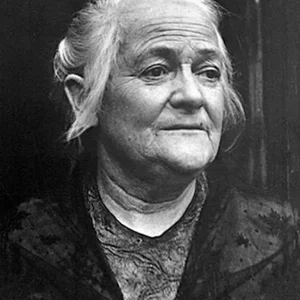

German socialist and feminist activist (1857–1933), Clara Zetkin was the driving force behind International Women's Day. A leading figure of the Second International, she championed the emancipation of women within the framework of the class struggle.
Clara Zetkin(1857 — 1933)
Clara Zetkin
Allemagne, Union soviétique, république de Weimar, Empire allemand, royaume de Saxe
8 min read
Frequently asked questions
Famous Quotes
« The emancipation of women is inseparable from the emancipation of the working class.»
« We do not want to be the equals of unequal men.»
Key Facts
- 1857: Born in Wiederau, Saxony
- 1910: At the International Conference of Socialist Women in Copenhagen, proposes the creation of an International Women's Day
- 1914–1918: Firmly opposes the First World War and signs the Zimmerwald Manifesto against the war
- 1920: Elected to the Reichstag, where she serves until 1933
- 1933: As the eldest member of the house, delivers the opening address to the Reichstag just weeks before her death, calling for resistance to fascism
Works & Achievements
For twenty-five years, Zetkin turned this journal into a demanding political platform for women in the labor movement, refusing to reduce it to a simple household magazine. The publication reached more than 100,000 subscribers.
A founding text adopted in Copenhagen proposing an annual day of international mobilization for women's rights. This is the act that gave birth to March 8th as we know it today.
A landmark address in which Zetkin systematically articulated for the first time the link between class struggle and women's emancipation, forcing this debate onto the agenda of international socialism.
A memoir recounting her conversations with Lenin on the women's question and Soviet policy — a valuable document on the theoretical debates of the era.
Zetkin's final great political act: presiding over the session as the eldest member, she delivered a passionate call for an antifascist united front before Nazi deputies who attempted to shout her down.
A body of theoretical and polemical texts in which Zetkin developed her central thesis: the emancipation of women cannot be achieved without a socialist transformation of society — and vice versa.
Anecdotes
In August 1910, at the Second International Conference of Socialist Women in Copenhagen, Clara Zetkin solemnly proposed the establishment of an International Women's Day. Her motion was unanimously adopted by delegates from seventeen countries. As early as March 19, 1911, more than one million women marched in Germany, Austria, Denmark, and Switzerland to demand the right to vote and equality in the workplace.
In August 1932, at seventy-six years old and gravely ill, Clara Zetkin had herself transported by ambulance to the Reichstag to preside, as the eldest member, over the opening session of the German parliament. From her chair, she delivered a rousing speech calling for a united front against rising fascism, to the jeers of Nazi deputies. It was her last public appearance in Germany.
Clara Zetkin and Rosa Luxemburg formed an intellectual and personal partnership as celebrated as it was inseparable in European socialist circles. They exchanged hundreds of letters blending political analysis, personal confidences, and jokes. The assassination of Rosa Luxemburg in January 1919, during the suppression of the Spartacist uprising, deeply shattered Clara Zetkin, who carried that grief until her death.
Clara Zetkin led the socialist women's newspaper “Die Gleichheit” (Equality) for twenty-five years, from 1892 to 1917. Under her direction, this modest bulletin became an international journal read by hundreds of thousands of working women. She published rigorous political analyses in it, refusing to reduce the women's press to domestic columns — which earned her sharp tensions with the leadership of the Social Democratic Party.
During her stay in Moscow in 1920, Clara Zetkin had lengthy conversations with Lenin, which she faithfully recorded. Lenin, whom she admired but did not hesitate to contradict, reportedly confided his reservations about feminist discussion circles, which he considered too removed from the class struggle. Clara Zetkin, for her part, argued that women's emancipation was a condition of the socialist revolution, not a consequence of it.
Primary Sources
The economic emancipation of women is the prerequisite for their social and political emancipation. No woman can be truly free as long as she is economically dependent on man or on capital.
In agreement with the political and trade union organizations of proletarian women, we are establishing an International Women's Day, whose primary goal is to win universal suffrage for women.
He told me: 'The cause of women's emancipation is not a separate cause — it is an integral part of the great social cause.' I replied that this was no excuse for treating it as a secondary one.
The most urgent duty of the hour is to form a united front of all working-class organizations to block the path of fascism. It is in this spirit that I open this session of the German Reichstag.
We do not demand women's rights out of charity or pity. We demand them because they are the sine qua non of a truly just society. The woman question is a class question.
Key Places
Clara Zetkin's birthplace, born on 5 July 1857 in this small Saxon village. Her father worked there as a schoolteacher, which gave her access to a solid education.
The city where Clara Zetkin studied at the Women's Teacher Training Institute and first encountered the socialist movement and circles of working-class women activists.
The city where she settled for many years and edited *Die Gleichheit*; it also hosted the 1907 International Socialist Congress, where she established herself as a leading figure.
Site of the Second International Conference of Socialist Women in August 1910, where Zetkin proposed and secured the adoption of an International Women's Day.
The seat of the German parliament, where Clara Zetkin served as a Communist deputy from 1920 to 1933 and delivered her last major anti-fascist speech in August 1932.
The place where she died on 20 June 1933, having taken refuge there after the Nazi seizure of power. Her ashes were interred in the Kremlin Wall in Moscow.
Typical Objects

A socialist women's journal that Clara Zetkin edited for twenty-five years. She made it the primary tool for the political education of women in the labor movement.

Zetkin was a tireless writer and correspondent; she exchanged hundreds of letters with Rosa Luxemburg, Lenin, and activists around the world.

A symbol of her commitment to the German workers' party, which she had belonged to since the 1880s before joining the Communist Party (KPD) in 1919.

Large public rallies and political conferences were her preferred arena; posters announcing her speaking engagements circulated across working-class Europe.

The universal symbol of the international socialist movement, which Zetkin carried and championed from her earliest struggles to her final public appearances.

A plain, practical outfit adopted by many socialist activists of the era, marking a consciously working-class identity set against bourgeois dress codes.
School Curriculum
Vocabulary & Tags
Key Vocabulary
Daily Life
Morning
Clara Zetkin began her days very early, devouring the national and international press to fuel her editorials. She wrote her articles and answered her voluminous correspondence before breakfast, drawing on an iron discipline inherited from her Saxon upbringing.
Afternoon
Her afternoons were devoted to party branch meetings, gatherings with delegations of working-class women, or the preparation of public lectures. She traveled extensively by train across Germany and Europe to speak at trade union and political rallies.
Evening
In the evenings, Zetkin often hosted fellow activists at home for political discussions that stretched late into the night. She also read widely — Marx, Engels, but also novels and poetry — and kept up an intense correspondence with Rosa Luxemburg and other figures of international socialism.
Food
Like many socialist activists of her era, Clara Zetkin lived modestly. Her diet was simple and frugal: rye bread, potatoes, seasonal vegetables, and the occasional cold cuts. The long stretches of rally touring left little room for elaborate meals.
Clothing
Zetkin wore dark, plain dresses in wool or cotton, with no unnecessary ornamentation. This practical, austere style was both an ideological choice — a rejection of bourgeois ostentation — and a practical necessity for days of intense activism.
Housing
She lived for many years in modest-sized apartments in Stuttgart, in the heart of working-class neighborhoods. Her home resembled an office more than a bourgeois dwelling: piles of newspapers, files, books, and pamphlets overran every available room.
Historical Timeline
Period Vocabulary
Liens externes & ressources
Références
Œuvres
Direction de 'Die Gleichheit' (L'Égalité)
1892–1917
Résolution pour la Journée internationale des femmes
1910
Discours au Congrès socialiste international de Stuttgart
1907
Souvenirs sur Lénine (Erinnerungen an Lenin)
1925
Discours d'ouverture du Reichstag
30 août 1932
Articles et brochures sur la question féminine (Die Frauenfrage)
1889–1920