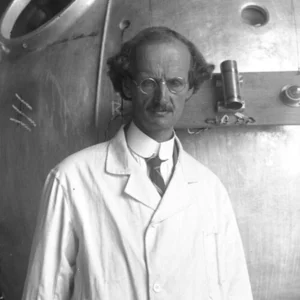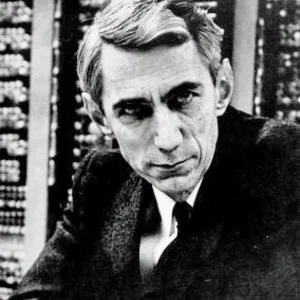

American mathematician and engineer (1916-2001), founder of information theory. His 1948 paper laid the mathematical foundations of digital communication and data encoding.
Claude Shannon(1916 — 2001)
Claude Shannon
États-Unis
9 min read
Frequently asked questions
Famous Quotes
« The fundamental problem of communication is that of reproducing at one point either exactly or approximately a message selected at another point.»
Key Facts
- 1916: Born in Petoskey, Michigan
- 1937: His master's thesis demonstrates that Boolean algebra can be applied to electronic circuits
- 1948: Publication of “A Mathematical Theory of Communication”, the founding work of information theory
- 1949: Pioneering work in cryptography with “Communication Theory of Secrecy Systems”
- 2001: Died in Medford, Massachusetts
Works & Achievements
Shannon's master's thesis at MIT, in which he demonstrates that Boolean algebra can be applied to electrical circuits. This work lays the theoretical foundations for the design of all modern computers.
Paper published in the Bell System Technical Journal, considered the founding document of information theory. Shannon defines the concept of the 'bit' as a measure of information, and establishes the fundamental laws of data transmission.
Shannon lays the mathematical foundations of modern cryptography, demonstrating that encryption systems can be analyzed as communication channels. This work, classified during the war, remained secret for several years.
An expanded and annotated version of the 1948 paper, published by the University of Illinois Press. Warren Weaver adds an introduction aimed at a general audience, making information theory accessible to other disciplines.
A foundational paper in which Shannon describes how a computer program could analyze and play chess. He defines strategies for exploring possibilities that would directly influence artificial intelligence for decades.
An experimental device built by Shannon: a small magnetic robot capable of memorizing and solving a maze. Presented to the general public, it concretely illustrated the principles of machine learning and caused a sensation at the time.
Anecdotes
In 1937, at just 21 years old, Shannon wrote his master's thesis at MIT, demonstrating that Boolean algebra — an abstract mathematical logic created in the 19th century — could be applied directly to electrical circuits. This discovery laid the theoretical foundations for all of modern computing, and many historians of science consider it the most influential master's thesis of the 20th century.
Shannon was known throughout the halls of Bell Labs for getting around on a unicycle while juggling balls. He had built several unusual mechanical contraptions himself, including an automatic juggling machine. His colleagues would recount how he sometimes showed up to meetings on his unicycle, juggling three balls, only to sit down and solve complex mathematical problems within minutes.
In 1950, Shannon built a small robot he named 'Theseus': an electromagnetic mouse capable of memorizing the paths of a maze and solving it faster with each successive attempt. It was one of the first concrete demonstrations of a device capable of learning from its mistakes, foreshadowing modern artificial intelligence.
Shannon had a passion for games and puzzles. He built a machine capable of playing chess and in 1950 wrote a landmark paper on how a computer might analyze chess positions — a text that directly inspired the researchers who, forty years later, created programs such as Deep Blue. He also enjoyed inventing absurd gadgets, including a box whose only mechanism was to switch itself off the moment it was turned on, which he mischievously called the 'ultimate machine'.
In 1943, while Shannon was working on secret communications for the U.S. Army at Bell Labs, he met Alan Turing during the British mathematician's visit to New York. The two men had lunch together and held long conversations about the possibility of building thinking machines. Neither knew at the time that the other had independently developed revolutionary ideas about computation and logic.
Primary Sources
It is possible to perform complex mathematical operations by means of relay circuits. The hindrance function of a series connection is the sum of the hindrance functions of the elements.
The fundamental problem of communication is that of reproducing at one point either exactly or approximately a message selected at another point. Frequently the messages have meaning... These semantic aspects of communication are irrelevant to the engineering problem.
The problems of cryptography and secrecy systems furnish an interesting application of communication theory. We consider a message source which generates plaintext messages M and a key source which generates keys K.
This paper is concerned with the problem of constructing a program allowing a digital computer to play legal chess. Although perhaps of no practical importance, the question is of theoretical interest.
Information theory has, in the last few years, become something of a scientific bandwagon... Our fellow scientists in many different fields, attracted by the fanfare and by the new avenues opened to scientific analysis, are using these ideas in their own domains.
Key Places
Birthplace of Claude Shannon, born on April 30, 1916. He grew up in the nearby town of Gaylord, in a family that encouraged him toward science and mechanics from an early age.
Shannon earned his two bachelor's degrees in mathematics and electrical engineering here in 1936. This dual training later allowed him to bridge abstract theory with practical applications.
Shannon completed his master's degree (1937) and doctorate (1940) here, and returned as a professor in 1956. It was at MIT that he wrote his groundbreaking thesis on logic circuits.
Shannon worked here from 1941 to 1972, at one of the most productive research laboratories of the 20th century. It was there that he wrote his landmark 1948 paper and developed the bulk of his work.
Shannon spent his final years in this town near Boston, where he passed away on February 24, 2001, after several years living with Alzheimer's disease.
Typical Objects

Shannon regularly rode a unicycle through the hallways of Bell Labs. This unusual mode of transportation reflected his curiosity about balance, mechanics, and physical challenges, which he approached with the same rigor as mathematical problems.

Shannon juggled every day and developed mathematical equations to model juggling. He authored a formula linking the number of balls, flight time, and hand time, foreshadowing what would be called “scientific juggling.”

A ubiquitous electronic measurement instrument in laboratories of the era, the oscilloscope allowed Shannon to visualize electrical signals and experimentally analyze phenomena he was modeling theoretically.

Shannon was a passionate chess player who saw the game as an ideal testing ground for exploring machines' ability to reason. His 1950 paper on programming a chess-playing machine is a foundational text in artificial intelligence.

Shannon built with his own hands this small automaton capable of memorizing the paths through a maze. This experimental device gave concrete form to his theories on information transmission and mechanical learning.

A central device in the communications of the era, the teletype transmitted messages in the form of binary codes. Shannon used it as a concrete example to develop his theories on coding and the capacity of communication channels.

Shannon often worked alone, filling notebooks with proofs and diagrams. He was known for his ability to solve difficult problems by combining visual intuition with rigorous mathematical formalism.
School Curriculum
Vocabulary & Tags
Key Vocabulary
Tags
Daily Life
Morning
Shannon arrived at the laboratory at irregular hours, with little regard for convention. He often began his day with a period of solitary reflection — sometimes lying across his desk or standing at a blackboard, trying to formulate a problem in his mind before even picking up a pencil. He was known for not responding immediately to colleagues when an idea had taken hold of him.
Afternoon
Much of his afternoons at Bell Labs were spent in his office, cluttered with electronic devices, mechanical toys, and spare parts. He alternated between intense sessions of calculation on paper, experiments with his electrical setups, and breaks during which he juggled or rode a unicycle through the corridors. He attended few formal meetings, preferring informal discussions with a handful of chosen colleagues.
Evening
Shannon often came home late, his mind still occupied by a problem in progress. At home, he continued tinkering with gadgets and working on mechanical puzzles. He enjoyed playing chess and building small ingenious machines. His evenings had the same quality of serious intellectual play as his working days.
Food
Daily life in postwar America was characterized by simple, standardized eating: white bread, meat, potatoes, dairy products. Laboratory cafeterias like the one at Bell Labs served meals typical of the American middle class in the 1950s and 1960s. Shannon did not stand out in any particular way for his eating habits and seemed largely indifferent to such matters.
Clothing
Like most American engineers and researchers of the era, Shannon typically wore a shirt, tie, and plain sport coat. He placed little importance on his appearance and allowed himself a degree of informality — keeping on his lab coat or riding his unicycle through the halls in decidedly unpretocolar attire.
Housing
Shannon lived in typical residential suburbs of New Jersey and later Massachusetts, in single-family homes characteristic of the postwar American intellectual middle class. His interior was likely crowded with his many constructions and prototypes. He had enough space to set up a workshop where he built his machines and inventions.
Historical Timeline
Period Vocabulary
Liens externes & ressources
Références
Œuvres
A Symbolic Analysis of Relay and Switching Circuits
1937-1938
A Mathematical Theory of Communication
1948
Communication Theory of Secrecy Systems
1949
The Mathematical Theory of Communication (livre avec Warren Weaver)
1949
Programming a Computer for Playing Chess
1950
Thésée — la souris électronique apprenante
1950