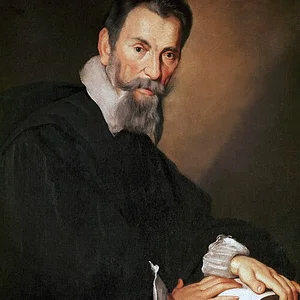

Italian composer born in Cremona in 1567 and died in Venice in 1643. A pioneer of opera with L'Orfeo (1607), he marks the transition between the Renaissance and the Baroque. Maestro di cappella at St Mark's Basilica in Venice, he revolutionized vocal and instrumental music.
Claudio Monteverdi(1567 — 1643)
Claudio Monteverdi
république de Venise
9 min read
Frequently asked questions
Famous Quotes
« L'oraison sia padrona dell'armonia e non serva. (Let the word be mistress of the harmony, not its servant.)»
Key Facts
- 1567: born in Cremona, musical training from childhood under Marc'Antonio Ingegneri
- 1590: enters the service of the Duke of Mantua as a viol player and singer
- 1607: premiere of L'Orfeo in Mantua, considered the first opera in the Western repertoire
- 1613: appointed maestro di cappella at St Mark's Basilica in Venice, the most prestigious post in Italy
- 1642: L'Incoronazione di Poppea, a late masterpiece establishing historical opera
Works & Achievements
Regarded as the first great opera in history, L'Orfeo tells the myth of Orpheus descending into the Underworld to bring Eurydice back. Monteverdi invents within it the expressive recitative, the dramatic orchestra, and the dramatic structure that would define the operatic genre.
A landmark of Baroque sacred music, these Vespers blend the ancient style of Palestrina with modern concertato innovations. Published in the hope of securing a post in Rome, they reveal Monteverdi's mastery of every style of his era.
The only surviving fragment of the opera L'Arianna, this lament ("Lasciatemi morire") was the most celebrated melody of the seventeenth century. Its expressive power, rooted in the natural declamation of the text, defines the aesthetic of the new Baroque style.
Monteverdi published nine books of madrigals over more than sixty years, tracing the entire evolution of vocal music from the Renaissance to the Baroque. These pieces for voices and instruments served as a laboratory in which he experimented with chromaticism, expressive dissonances, and new forms.
A late opera inspired by Homer's *Odyssey*, premiered in Venice as part of the new public theatre movement. This work exemplifies the maturity of Monteverdi's style: economy of means, psychological depth of character, and expressive power of recitative.
His artistic testament, premiered the very year of his death at the age of seventy-five. The first opera in history based on a real historical subject — the court of Nero — it explores without moral judgment the themes of desire, power, and ambition.
Anecdotes
When Monteverdi created *L'Orfeo* in 1607 for the Mantua carnival, he revolutionized music by calling for an orchestra of around forty musicians — a colossal ensemble for the time. He specified precisely which instruments should play at which moment, a practice almost unheard of until then. This work is considered the first complete opera in the history of music.
In 1600, the theorist Giovanni Maria Artusi published a scathing pamphlet against Monteverdi's modern style, accusing him of violating every rule of classical harmony. Monteverdi struck back in the preface to his fifth book of madrigals (1605), drawing a distinction between the *prima prattica* (the old school) and the *seconda prattica* (his innovative style). This public dispute is one of the first great aesthetic debates in musical history.
In 1608, just weeks after the premiere of his opera *L'Arianna* in Mantua, the lead singer died suddenly, and then his own wife Claudia passed away in September. Exhausted and overwhelmed by grief, Monteverdi wrote to his patron that he could no longer compose. The *Lamento d'Arianna* — the heroine's lament at being abandoned — is the only surviving piece from that opera, and the most celebrated melody of its time.
After the sack of Mantua by imperial troops in 1630 and the devastating plague epidemic that swept through Venice the same year, Monteverdi, then over sixty years old, took holy orders in 1632. This man who had spent his entire life composing for princely courts became a priest — yet never stopped writing operas.
At the age of seventy-five, Monteverdi composed *L'incoronazione di Poppea* (1643), a work of startling modernity depicting the scandalous love affair between Emperor Nero and Poppaea, with virtue and morality cast aside. He died just a few months after the premiere, leaving behind a work that would not be fully rediscovered until the twentieth century.
Primary Sources
I read that the Fable Your Lordship sends me to set to music is for La Favola of Tritons and Sirens... I find that the Fable as a whole does not move me... the winds do not speak, and the winds do not weep.
There are two practices of composition: the first and the second. The first practice is that which treats harmony as mistress; the second is that which makes harmony the servant of the word.
This fruit, born in the theatre of Your Most Serene Highness, now returns in humble homage to Your Highness, whose light and favour gave rise within me to this small work.
I most humbly beseech Your Lordship to do me the grace of presenting this music to Our Lord the Pope, so that, should it please him, His Holiness might grant me some benefice.
Key Places
Monteverdi's birthplace, renowned for its luthiers (Stradivari would be born there a few decades later). It was here that he received his musical training under Marc'Antonio Ingegneri, choirmaster of the cathedral.
Residence of the Gonzaga dukes, where Monteverdi worked for over twenty years as court musician. It was in the Sala degli Specchi of this palace that *L'Orfeo* received its premiere in February 1607.
Monteverdi was appointed choirmaster of St Mark's in 1613 and held the post until his death in 1643. This basilica, with its two organs and polychoral tradition, allowed him to reach the pinnacle of his career.
Capital of the Grand Duchy of Tuscany and the birthplace of opera, thanks to the Camerata Fiorentina. Monteverdi visited the city and encountered the earliest experiments in accompanied monody that would transform his own compositional style.
One of the first public opera houses in Venice, where Monteverdi's final works were most likely premiered. The opening of ticketed theatres in Venice in 1637 transformed opera into a spectacle accessible to all.
Typical Objects

A plucked-string instrument ubiquitous in Baroque music, the harpsichord provided the basso continuo in Monteverdi's works. It was among the forty instruments required for L'Orfeo.

A large lute with a long neck and double string courses, the theorbo was the emblematic instrument of Baroque vocal accompaniment. Monteverdi uses it frequently to support the recitatives in his operas.

A bowed string instrument held between the legs and a forerunner of the cello, the viola da gamba was the noble instrument of European courts in the 16th and 17th centuries. Monteverdi entrusted it with important expressive roles.

A wooden wind instrument covered in leather, with a tone close to the human voice, it was particularly prized in Venetian music. Monteverdi pairs it with trombones for the solemn scenes in L'Orfeo.

Essential tools of the composer, Monteverdi wrote all his scores, letters, and recitatives by hand with a quill. His manuscript correspondence is today preserved in the Mantua Archives.

A large bound volume containing liturgical chants, used by choirs during services at St Mark's Basilica in Venice. As maestro di cappella, Monteverdi oversaw its copying and daily use.

St Mark's Basilica in Venice had two large organs facing each other, enabling the practice of the Venetian polychoral style (cori spezzati). Monteverdi exploited this unique acoustic arrangement in his sacred compositions.
School Curriculum
Vocabulary & Tags
Key Vocabulary
Daily Life
Morning
Monteverdi rose early to attend liturgical services at the Basilica of St. Mark, where he directed a choir of several dozen singers and instrumentalists. He then devoted the first hours of the morning to composition, taking advantage of the quiet to work on his madrigals or the sacred music commissioned for religious feast days.
Afternoon
Afternoons were dedicated to choir administration and teaching: Monteverdi trained young singers and composers, overseeing rehearsals and the copying of scores. He also handled correspondence from nobles and dukes who commissioned works from him, carefully negotiating fees and deadlines.
Evening
Evenings might be spent at opera rehearsals or musical entertainments in the palaces of the Venetian noblemen who patronized him. In Mantua earlier in his career, he had enlivened court banquets and balls, improvising with his musicians; in Venice, musical life shifted to academies and aristocratic salons.
Food
A court musician's table reflected the Mediterranean diet of the era: pasta, legumes, vegetables, and fish in abundance in Venice, along with bread, cheese, and local wines. On feast days, roasted meats and confections were served; during Lent, the diet became strictly lean, in keeping with the religious rules that Monteverdi — ordained a priest in 1632 — observed scrupulously.
Clothing
As maestro di cappella, Monteverdi wore a black cassock during services, and a clerical cap after his ordination. On official occasions at the Mantuan court, he dressed in dark velvet garments with a white lace ruff, marking his status as a respected musician while remaining subordinate to his aristocratic patrons.
Housing
In Venice, Monteverdi lived in lodgings near St. Mark's, provided or subsidized by the basilica's procuratorship. His apartment, modest compared to the palaces of his employers, was cluttered with scores, librettos, and instruments — a true musical workshop where copyists and pupils sometimes worked alongside him.