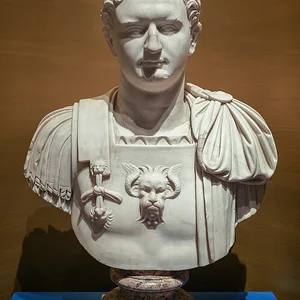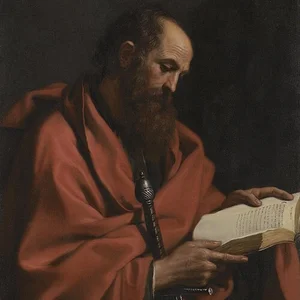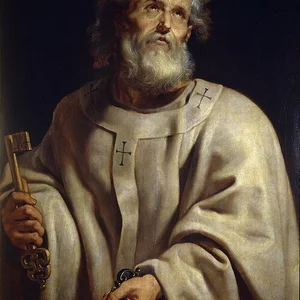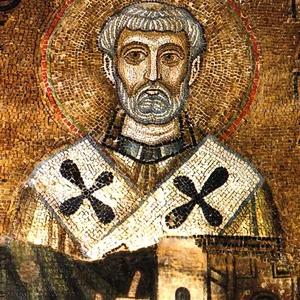

Bishop of Rome at the end of the 1st century, Clement is considered one of the earliest popes of the Christian Church. He is best known for his epistle to the Corinthians, a valuable testimony to the organization of the early Church.
Clement of Rome(100 — 99)
Clement of Rome
Rome antique
7 min read
Frequently asked questions
Famous Quotes
« Let us therefore humble our proud thoughts, and curb our arrogance, and restrain our tongue from slander.»
Key Facts
- Bishop of Rome around 88–99 AD, considered the fourth pope
- Author of the First Epistle of Clement to the Corinthians (c. 96 AD)
- Contemporary of the apostles Peter and Paul, whose disciple he is said to have been
- Martyred according to tradition, feast day on November 23
- One of the four Apostolic Fathers, direct or close witnesses to the apostolic generation
Works & Achievements
The only authenticated work of Clement, this lengthy letter addressed to the Church of Corinth is the oldest known Christian document outside of the New Testament. It lays the foundations of ecclesiology and episcopal authority.
An apocryphal collection published under Clement's name, composed of twenty homilies recounting his fictionalized life and travels with the Apostle Peter. An important document for the history of Judeo-Christian currents, despite its non-authentic character.
An apocryphal text attributed to Clement, parallel to the Homilies, narrating the story of his separated family reunited through the Apostle Peter. It bears witness to the popularity of the figure of Clement in early Christian literature.
Formerly attributed to Clement, this homily is now recognized as apocryphal and of later date. It is nonetheless the oldest surviving Christian sermon, which gives it considerable historical value.
Anecdotes
Clement of Rome is the author of the oldest surviving Christian letter outside the New Testament. Around the year 96, he wrote to the Christians of Corinth to resolve an internal dispute: younger members of the community had overthrown their elders. His letter, firm yet fraternal, is an exceptional witness to life in the earliest Churches.
According to tradition, Clement was the third or fourth Bishop of Rome after Peter. Some Church Fathers claim he personally knew the apostle Paul and perhaps Peter himself, which would make him a direct witness to the apostolic generation.
The legend of his martyrdom is particularly striking: according to a later tradition, Clement was condemned by Emperor Trajan to be thrown into the sea with an anchor tied around his neck. This is why the anchor became his iconographic symbol in medieval Christian art.
His Epistle to the Corinthians was so significant that it was read in some Churches as though it were part of Sacred Scripture, even though it never entered the New Testament canon. The text already reveals a clear awareness of the authority of the Church of Rome over other Christian communities.
Apocryphal writings known as the 'Clementine Homilies' and 'Pseudo-Clementine Recognitions' were falsely attributed to him in the 2nd century. These texts invent a romanticized life for Clement, which speaks to the immense prestige this figure had acquired in early Christian memory.
Primary Sources
Owing to the sudden and repeated calamities and adversities which have befallen us, we consider that our attention has been somewhat delayed in turning to the matters in dispute among you, beloved brethren.
During the reign of Domitian, Clement governed the Church of Rome. A letter is attributed to him, acknowledged as authentic and of great value, remarkable for its style and the excellence of its teaching.
Clement, who had seen the apostles and conversed with them, in whose ears the preaching of the apostles still echoed, governed the Church of Rome in third place after Peter and Paul.
The Roman Church has the apostles themselves as its founders, and the apostle Paul associated Clement with his ministry.
Key Places
Clement carried out his episcopal ministry in Rome, most likely in the working-class neighborhoods of Trastevere, where a large community of Jewish and Christian immigrants had settled. It was here that the first Roman house-churches took shape.
A Roman church built in multiple overlapping layers: the medieval basilica stands atop a 4th-century early Christian church, which itself was built over 1st-century ruins associated with the tradition of Clement. A major archaeological site for the study of early Christian history.
The recipient of Clement's famous letter, the Christian community of Corinth was going through a serious crisis of authority. The port city of Corinth was one of the most important in the Greek and Roman world.
According to late legendary tradition, Clement was exiled by Trajan to the mines of Crimea, where he reportedly evangelized thousands of prisoners before being martyred in the Black Sea.
Typical Objects

The primary writing medium in the ancient Roman world, used to compose and circulate ecclesiastical letters. It is very likely on such a scroll that Clement dictated his Epistle to the Corinthians around 96 AD.

The traditional iconographic symbol of Clement of Rome, referencing the legend of his martyrdom by drowning with an anchor tied to him. It appears in his depictions throughout early Christian and medieval art.

An essential everyday object in early Christian communities, which often gathered at night or at dawn to avoid persecution. Nocturnal liturgical meetings in first-century Rome required many such lamps.

Used for drafts and everyday correspondence in the Roman world. Early bishops used these tablets to prepare their sermons and manage the administrative affairs of their communities.

A new book format — sewn sheets of parchment — that began spreading among first-century Christians for copying the Scriptures. Clement's Roman community was likely among the first to adopt this format for sacred texts.

The breaking of bread during the Eucharist lay at the heart of the liturgical life described by Clement. His Epistle references the liturgical rites of the Roman community, making it a precious witness to early Christian worship.
School Curriculum
Vocabulary & Tags
Key Vocabulary
Tags
Daily Life
Morning
Clement rose at dawn, as all Romans did, to make the most of natural light. He devoted the early hours to prayer and reading the Scriptures, perhaps with a few members of his community. Early Christians sometimes celebrated their Eucharistic synaxis at daybreak before members went about their daily activities.
Afternoon
The afternoon was dedicated to leading the Roman Christian community: receiving visitors, delegates from other Churches, and addressing the needs of the poor and widows the Church cared for. Clement likely dictated his correspondence to a secretary, or drafted it himself on wax tablets before having it copied onto papyrus.
Evening
In the evening, liturgical or catechetical gatherings would take place in private homes known as domus ecclesiae. The community came together to share a fraternal meal (the agape) and celebrate the Eucharist, with the discretion required by the threat of persecution under Domitian.
Food
Clement's diet was that of a modest or middle-class Roman city dweller: bread, olives, cheese, dried legumes, salted fish, and occasional meat. Early Christians avoided meat sacrificed to idols, which set them apart socially and could put them in an awkward position at Roman banquets.
Clothing
Clement wore a simple Roman toga or tunic, without the conspicuous marks of social rank. Liturgical vestments did not yet exist in the first century. A bishop might have been distinguished by the understated quality of his clothing — a quiet dignity suited to a community that sought to avoid drawing attention to itself.
Housing
Clement most likely lived in a domus, a Roman townhouse built around an inner courtyard, which also served as a meeting place for the community. Tradition places his home on the site of the present-day Basilica of San Clemente, in the Caelian Hill district. These house-churches were the heart of early Christian communal life in Rome.
Historical Timeline
Period Vocabulary
Visual Style
Style inspiré des fresques des catacombes romaines et des portraits du Fayoum : tons chauds d'ocre et de terre cuite, lumière à la bougie, figure épiscopale sobre et digne dans l'environnement urbain de Rome antique.
Sound Ambience
L'ambiance sonore de Rome populaire sous Domitien et Trajan : une ville bruyante et cosmopolite, où les premiers chrétiens se réunissent discrètement dans des maisons privées au son des psaumes chantés en grec.
Liens externes & ressources
Références
Œuvres
Première Épître aux Corinthiens (I Clementis)
vers 96 apr. J.-C.
Homélies clémentines (Pseudo-Clément)
IIe-IIIe siècle
Reconnaissances pseudo-clémentines
IIIe siècle
Deuxième Épître aux Corinthiens (II Clementis)
vers 140-160 apr. J.-C.