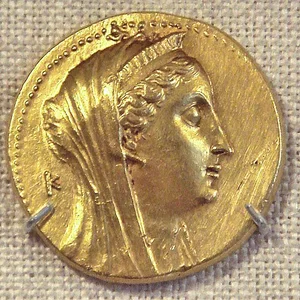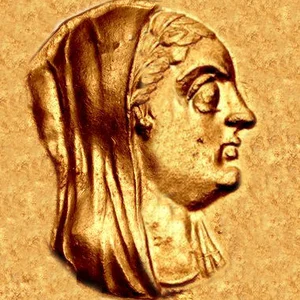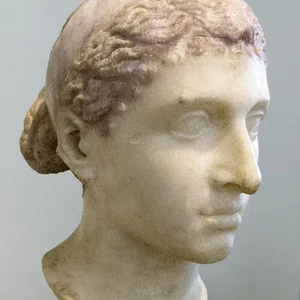

The last queen of Egypt's Ptolemaic dynasty, Cleopatra VII ruled from 51 to 30 BC. A woman of power and learning, she allied herself with Julius Caesar and later Mark Antony in an effort to preserve her kingdom's independence against Rome.
Cleopatra(68 av. J.-C. — 29 av. J.-C.)
Cleopatra
royaume ptolémaïque
8 min read
Frequently asked questions
Key Facts
- Born around 69 BC, she ascended to the throne in 51 BC at the age of 18
- Political alliance and relationship with Julius Caesar beginning in 48 BC
- Birth of Caesarion (Ptolemy XV), Caesar's son, around 47 BC
- Alliance with Mark Antony beginning in 41 BC, with whom she had three children
- Suicide on August 12, 30 BC following the defeat at Actium and the invasion of Octavian — Egypt became a Roman province
Works & Achievements
Cleopatra pursued an active economic policy: controlled devaluation of bronze coinage, state monopolies on oil and papyrus, and tax administration. Her reign saw a relative stabilization of the Egyptian economy.
Cleopatra persuaded Caesar to support her militarily against her brother Ptolemy XIII. The victory allowed her to rule alone, transforming Egypt into a key ally of Rome while preserving its formal independence.
Through this major diplomatic agreement, Cleopatra obtained from Antony Cyrenaica, Cyprus, and part of Syria, temporarily reconstituting an extended Ptolemaic empire across the Near East.
A temple originally dedicated to Julius Caesar, reflecting Cleopatra's policy of merging Egyptian dynastic and Roman cults. Two obelisks flanked it — the "Cleopatra's Needles" now standing in London and New York.
Cleopatra maintained complex diplomatic relations with Herod's Judea, the Arabian kingdoms, and Greek cities, making Egypt an indispensable hub of eastern Mediterranean trade.
Anecdotes
To meet Julius Caesar in 48 BC, Cleopatra reportedly concealed herself inside a linen sack (some sources say a carpet) and was smuggled into the palace of Alexandria right under the nose of her enemy-brother Ptolemy XIII. This daring entrance impressed the Roman general and marked the beginning of their alliance.
Cleopatra spoke at least nine languages, including Demotic Egyptian — something none of her Ptolemaic predecessors had mastered — as well as Greek, Latin, Hebrew, Aramaic, and Ethiopian. She was the first ruler of her dynasty to communicate directly with her Egyptian subjects without an interpreter.
According to Pliny the Elder, during a wager with Mark Antony, Cleopatra dissolved a priceless pearl in vinegar and drank it, to prove she could host the most expensive banquet in history. The gesture was a calculated display of her wealth and audacity.
Cleopatra presented herself publicly as the goddess Isis made flesh, adopting her ritual attributes during ceremonies. This divine identification gave her religious legitimacy in the eyes of Egyptians while impressing the foreign delegations who visited her court.
After the defeat at Actium in 31 BC, Cleopatra flatly refused to be paraded in Octavian's triumph in Rome. To deny him that victory, she took her own life in 30 BC — traditionally by the bite of a snake, though ancient historians also mention poison.
Primary Sources
Caesar was so captivated by Cleopatra that he spent more time in Alexandria than was necessary to defeat his enemies, and even risked war for love of her.
She came to Antony on the river Cydnus in a barge with a gilded stern, purple sails spread wide, and silver oars that kept time to the music of flutes, oboes, and lyres. She reclined beneath a canopy embroidered with gold, arrayed like Aphrodite.
Cleopatra dissolved in a cup of vinegar the largest pearl ever seen, worth ten million sesterces, thereby surpassing in a single meal all of Antony's extravagance.
Cleopatra died by allowing herself to be bitten by an asp that had been brought to her hidden among figs. She was found lying on a golden couch, adorned in her royal regalia.
King Ptolemy, leaving Caesar's camp with a large fleet, engaged in battle on the Nile. Cleopatra's supporters, backed by Caesar's legions, secured the victory.
Key Places
Capital of the Ptolemaic kingdom and Cleopatra's main residence. At the time, it was the largest city in the Mediterranean world, home to the famous Library of Alexandria and the Lighthouse, one of the Seven Wonders of the Ancient World.
The palace complex where Cleopatra received Julius Caesar and later lived with Mark Antony. Now submerged beneath the sea, this palace once occupied a large portion of Alexandria's eastern harbor.
Cleopatra stayed in Rome from 46 to 44 BC at Caesar's villa in the Trastevere district, arousing both curiosity and hostility among Romans. It was here that fears of an "eastern monarchy" threatening republican values began to take hold.
A cape on the Ionian Sea where, in 31 BC, the decisive naval battle between Octavian and the combined forces of Cleopatra and Antony took place. This defeat marked the end of their dream of an independent Greco-Oriental empire.
The city where Cleopatra met Mark Antony in 41 BC during a spectacular arrival by boat on the Cydnus River. This meeting, famously described by Plutarch, sealed their political and personal alliance.
Typical Objects

A gold headband adorned with precious stones, symbol of Hellenistic royalty. Cleopatra wore it during official ceremonies to assert her dynastic legitimacy.

A sacred animal associated with the goddess Isis and a symbol of divine kingship in Egypt. According to ancient tradition, Cleopatra chose this creature to end her life, refusing to be paraded through Rome.

Essential writing and reading instruments for a queen renowned for her scholarship. Cleopatra corresponded in several languages with foreign heads of state, managed her administration, and frequented the famous Library of Alexandria.

A richly decorated vessel of gold and purple used for official journeys on the Nile. Cleopatra's meeting with Mark Antony at Tarsus aboard such a barge became one of the most celebrated events of all Antiquity.

A metal percussion instrument associated with the cult of the goddess Isis. Cleopatra, presenting herself as Isis incarnate, used this instrument during religious rituals to assert her divine nature.

Mediterranean luxury goods present at the court of Alexandria. Cleopatra was known for the opulence of her banquets, described by ancient writers as the most lavish of their era.
School Curriculum
Vocabulary & Tags
Key Vocabulary
Tags
Daily Life
Morning
Cleopatra began her day with religious rituals in her role as high priestess of Isis, attended by priests and royal handmaidens. She donned her dynastic regalia and received reports from her ministers and stewards in her private apartments within the Brucheion palace.
Afternoon
The afternoon was devoted to official audiences and affairs of state: receiving foreign ambassadors — whom she addressed in their own languages — making administrative decisions, and managing the kingdom's finances. She also oversaw diplomatic correspondence drafted on papyrus.
Evening
Palace evenings were marked by lavish banquets in the company of her court, philosophers, poets, and her Roman allies. Cleopatra was renowned for the sophistication of these gatherings, which blended music, literary readings, and political discussion well into the night.
Food
The royal table at Alexandria offered the finest produce the Mediterranean world had to give: fish and seafood from the Nile and the Mediterranean, roasted meats, vegetables and grains from Egypt, Greek wines from Chios and Lesbos, figs, dates, honey, and spices from Arabia and India brought in via the trade routes.
Clothing
Cleopatra wore gowns of finely pleated linen — the traditional Egyptian fabric — as well as Greek-style drapes in silk and wool dyed in Tyrian purple. Her jewelry combined gold, lapis lazuli, and precious stones in motifs that blended Greek and pharaonic aesthetics. During religious ceremonies, she wore the attributes of Isis: the horned headdress and solar disk.
Housing
Cleopatra resided in the Brucheion palace, a vast coastal complex in Alexandria that included hanging gardens, private libraries, personal temples, and baths. The palace spread across several hectares overlooking the Great Harbor, with a view of the Pharos lighthouse. The royal apartments were adorned with mosaics, painted columns, and works of art gathered from across the Mediterranean.
Historical Timeline
Period Vocabulary
Visual Style
Esthétique gréco-égyptienne ptolémaïque : fusion du raffinement hellénistique et de la solennité des arts pharaoniques, dans une palette d'or, de lapis-lazuli et de pourpre.
Sound Ambience
Ambiance sonore du palais royal d'Alexandrie et du port : mélange de musique grecque, de rituels égyptiens et de l'activité marchande de la ville cosmopolite.
Liens externes & ressources
Références
Œuvres
Réforme monétaire et économique de l'Égypte ptolémaïque
51–30 av. J.-C.
Alliance avec Jules César — Guerre d'Alexandrie
48–47 av. J.-C.
Traité d'Antioche — Donations d'Antoine
37 av. J.-C.
Construction du Caesareum d'Alexandrie
Vers 44 av. J.-C.
Traités diplomatiques avec les royaumes voisins
51–30 av. J.-C.