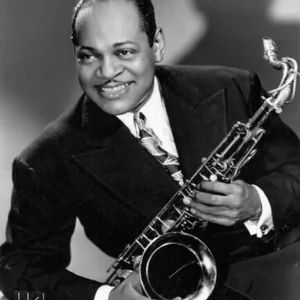

Coleman Hawkins (1904-1969) was an American tenor saxophonist widely regarded as the father of the jazz saxophone. He was one of the first to establish the saxophone as a jazz solo instrument and influenced generations of musicians.
Coleman Hawkins(1904 — 1969)
Coleman Hawkins
États-Unis
9 min read
Frequently asked questions
Famous Quotes
« If you don't make mistakes, you aren't really trying.»
« A musician who plays the same way twice is not a jazz musician.»
Key Facts
- Born November 21, 1904, in Saint Joseph, Missouri
- Recorded 'Body and Soul' in 1939, considered one of the earliest examples of bebop before the style had a name
- Member of Fletcher Henderson's orchestra from 1923 to 1934, toured Europe from 1934 to 1939
- A major figure in the Harlem Renaissance and the development of modern jazz
- Died May 19, 1969, in New York, leaving behind an extensive discography
Works & Achievements
A landmark solo recording, considered one of the greatest improvisations in jazz history. Hawkins dismantles the standard through a succession of advanced harmonies, directly anticipating the bebop of the 1940s.
One of the first recordings to showcase the tenor saxophone as a jazz solo instrument. This track marks the beginning of the saxophone's transformation — previously regarded as a marching band instrument — into an expressive voice of jazz.
Recorded during the first official bebop session in history. Hawkins's participation in this session reflects his open-mindedness and his lasting influence on the musicians of the next generation.
An unaccompanied tenor saxophone solo, one of the earliest works of its kind in jazz. Hawkins demonstrates that a saxophone alone can build a coherent and emotionally powerful piece, much like a violinist playing Bach.
An album recorded for the Riverside label that showcases Hawkins at the height of his artistic maturity. He plays alongside younger musicians such as J.J. Johnson and Idrees Sulieman, cementing his status as a living bridge between swing and hard bop.
A live recording that documents the legendary musical battles from the Jazz at the Philharmonic tours organized by Norman Granz. Hawkins goes head-to-head with other great soloists, displaying undiminished vitality and inventiveness after thirty years of performing.
Anecdotes
In 1939, Coleman Hawkins recorded 'Body and Soul' in a single take, improvising almost entirely over the original melody. The recording immediately became a classic and is today considered one of the high-water marks of jazz history. It demonstrated that the tenor saxophone could stand as a solo instrument with an expressiveness equal to that of the violin or the trumpet.
Between 1934 and 1939, Coleman Hawkins spent time in Europe, performing in Paris, London, Amsterdam, and Copenhagen. Far from being an exile, the journey was a triumph: he was adored by European audiences and recorded alongside the continent's finest musicians. The stay also allowed him to escape the racial segregation that was still rampant in the United States at the time.
In 1944, Coleman Hawkins took part in one of the first bebop recording sessions, alongside Dizzy Gillespie and Thelonious Monk. While most musicians of his generation dismissed this new style as overly complex, Hawkins embraced it with enthusiasm, proving his ability to constantly reinvent himself.
Early in his career during the 1920s, Hawkins played with Fletcher Henderson's orchestra, one of the first major Black American big bands. It was on tour that he met Louis Armstrong, with whom he traded and clashed musically in “cutting contests” — those improvised jousts where musicians competed in virtuosity to win over the crowd.
Coleman Hawkins was known for his relentless work ethic and professional discipline. He was one of the few jazz musicians of the era to have studied music theory in depth, having attended Washburn College in Kansas. This solid musical grounding allowed him to analyze chord changes with a sophistication that directly influenced the complex harmonies of bebop.
Primary Sources
Recorded on October 11, 1939 for the Bluebird/RCA Victor label. Hawkins improvises almost entirely over the harmonic chord changes of the standard, quoting the original melody only briefly. This recording is preserved at the Library of Congress.
Hawkins declares: “I don’t play notes, I play ideas. Music has to come from the heart and the head at the same time.” He also discusses his relationship with harmony and his admiration for European classical composers.
The first influential tenor saxophone solo recorded by Hawkins for Columbia Records. This track illustrates the gradual transformation of the saxophone from a marching band instrument into a jazz solo voice.
Hawkins recalls his time in Europe: “In Europe, people really listened to the music. They didn’t just come to dance — they wanted to understand what I was saying with my instrument. That’s where I realized jazz was a true art music.”
Coleman Hawkins takes part in the first recognized bebop recording session. The tracks 'Woody’n You' and 'Bu-Dee-Daht' demonstrate his ability to adapt to the advanced new harmonies championed by the younger generation.
Key Places
Coleman Hawkins's birthplace, where he was born in 1904 into a middle-class African American family. His mother, a pianist, introduced him to music at a very early age, laying the foundation for his lifelong vocation.
The New York neighborhood that served as the heart of the African American Renaissance during the 1920s and 1930s. Hawkins settled there with Fletcher Henderson's orchestra and frequented legendary venues such as the Savoy Ballroom and the Cotton Club.
The cultural capital where Hawkins spent time during his grand European tour (1934–1939). He recorded there with French and Belgian musicians and was welcomed with great enthusiasm in Parisian cabarets and concert halls.
The city where Hawkins lived for several months during his European stay and recorded some of his finest sessions of that period for the Decca label. Amsterdam was at the time a stronghold of jazz in continental Europe.
A major musical hub where Hawkins developed his skills and launched his career, in an environment highly conducive to jazz and blues. Kansas City was renowned for its fiery jam session scene, which shaped the musicians of his generation.
Typical Objects

Hawkins played tenor saxophones by the French brand Selmer, renowned for the warmth and roundness of their tone. He was one of the first musicians to unlock the full expressive potential of the instrument, from the deep low register all the way up to the piercing high notes.

The mouthpiece and reed are the essential components that produce the saxophone's sound. Hawkins paid close attention to selecting these elements, testing them carefully, since they directly shape the timbre and tonal power that are central to his distinctive style.

Hawkins's recordings were first released on fragile 78 RPM discs made from shellac. These records could only hold a few minutes of music per side, which forced musicians to condense their improvisations — as heard in the famous 'Body and Soul'.

Jazz musicians of the 1930s–1950s cultivated an image of studied elegance: dark suit, white shirt, tie, and a wide-brimmed hat. This distinguished attire was a way of asserting the dignity and professionalism of African American artists in a segregated society.

In big bands such as Fletcher Henderson's orchestra, musicians used music stands to read written arrangements. Hawkins, trained in music theory, could sight-read and annotate scores, which allowed him to build harmonically sophisticated solos.

This microphone, used in American recording studios from the 1930s onward, captured the warm nuances of the tenor saxophone with great precision. The recording of 'Body and Soul' was made with this type of equipment, contributing to the warm, intimate sound of the performance.
School Curriculum
Vocabulary & Tags
Key Vocabulary
Tags
Daily Life
Morning
Like most jazz musicians who worked nights in clubs, Coleman Hawkins generally got up late in the morning. He spent part of this time listening to records — particularly European classical music, for which he had a deep passion — and studying scores to deepen his knowledge of harmony.
Afternoon
Afternoons were often devoted to rehearsals with the orchestra or sidemen to prepare for the evening. Outside of sessions, Hawkins would sometimes receive young musicians eager to learn from him, or head to a recording studio for sessions frequently called at the last minute by record labels.
Evening
Evening and night were at the heart of his professional life: a concert at a New York jazz club such as the Village Vanguard or Minton's Playhouse, followed by informal jam sessions that could stretch until dawn. These improvised musical jousts were for him the true space of creation.
Food
Hawkins enjoyed traditional African-American soul food: fried chicken, beans, corn, and spare ribs. During his years in Europe, he was introduced to French cuisine and developed a taste for wines and refined dining, adopting the habits of the Parisian artistic circles he frequented.
Clothing
Hawkins was known for his impeccable elegance, typical of African-American musicians who saw their polished appearance as an assertion of dignity. He wore tailored three-piece suits, a white shirt, silk tie, and shined shoes, topped off with a wide-brimmed fedora — even off the stage.
Housing
In New York, Hawkins lived in Harlem, the epicenter of African-American cultural life. He occupied comfortable apartments that reflected his professional success, and owned an impressive collection of records and music theory books that took pride of place in his home.