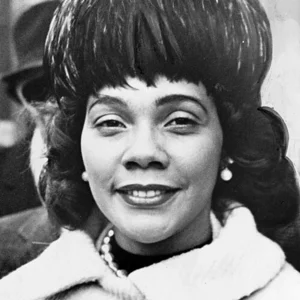

American civil rights activist and wife of Martin Luther King Jr. After her husband's assassination in 1968, she continued his fight for racial equality and peace, founding the King Center in Atlanta.
Coretta Scott King(1927 — 2006)
Coretta Scott King
États-Unis
9 min read
Frequently asked questions
Famous Quotes
« The civil rights struggle is a struggle for human rights.»
« Freedom and justice cannot exist for only part of society.»
Key Facts
- 1927: born in Heiberger, Alabama, in the segregated South
- 1953: married Martin Luther King Jr.
- 1968: after MLK's assassination, she took leadership of the movement
- 1968: founded the Martin Luther King Jr. Center for Nonviolent Social Change in Atlanta
- 1983: key activist in establishing Martin Luther King Day as a federal holiday
Works & Achievements
As early as 1968, Coretta Scott King established this institution in Atlanta to preserve the archives of the civil rights movement and spread the principles of nonviolence. The King Center is today a site on the National Register of Historic Places.
A personal account of the Kings' shared struggle, offering a window into the daily life of an activist family living under constant threat, and providing an essential female perspective on the civil rights movement.
For fifteen years, Coretta Scott King led a nationwide campaign that culminated in President Reagan signing the holiday into law in 1983. This posthumous victory for her husband stands as one of her greatest political achievements.
A selection and presentation of her husband's major writings compiled for a general audience, allowing the ideas of the movement to reach far beyond the American context.
Coretta Scott King organized and performed in concerts where she sang and narrated texts about freedom, helping to raise funds for the movement and spread its values through culture.
Anecdotes
Before becoming the wife of one of the world's most celebrated civil rights leaders, Coretta Scott was an accomplished classical singer. She studied at the New England Conservatory of Music in Boston, where she met Martin Luther King Jr. She had envisioned a career as a concert performer, but chose to set that dream largely aside in order to fully commit herself to the struggle for equality.
Just four days after her husband's assassination in Memphis, on April 8, 1968, Coretta Scott King led a march in support of striking sanitation workers in that same city. Dressed in black, surrounded by her four children, she delivered a speech of heartbreaking dignity before thousands of people, transforming her personal grief into a political act.
For fifteen years, Coretta Scott King waged a tireless campaign to make her husband's birthday a national holiday. Facing resistance in Congress, she gathered more than six million petition signatures. President Reagan finally signed the legislation in 1983, and the first Martin Luther King Jr. Day was officially observed in January 1986.
In 1969, Coretta Scott King founded the King Center in Atlanta — the first institutional memorial dedicated entirely to the memory of a civil rights figure. She led it for decades, building it into a center for nonviolence training and a living archive of the movement. The site, listed on the National Register of Historic Places, holds the tomb of Martin Luther King Jr. and welcomes hundreds of thousands of visitors each year.
In 1962, while her husband stood at the heart of the civil rights movement, Coretta Scott King represented the United States at the Women's Strike for Peace conference in Geneva. There she spoke out for international peace and nuclear disarmament, reflecting a commitment that reached far beyond racial justice to embrace human rights in their universality.
Primary Sources
Martin always told me that I was his strength, that without me he could not have held on. I knew that our mission went beyond our family; it belonged to an entire people.
“I come here tonight not to mourn, but to bear witness that we will continue Martin’s struggle. Violence cannot kill the movement; it can only make it stronger.”
“Millions of Americans of all races and faiths support this legislation. They know that the greatness of Martin Luther King belongs to all of America, and that he deserves to be honored by the nation he served.”
“I understood very early that the civil rights struggle was not just a matter of race. It was a matter of human dignity, justice, and peace for all the peoples of the world.”
Key Places
Birthplace of Coretta Scott in 1927, in Perry County, in the heart of the segregationist South. She grew up there in an African American family that faced daily racial violence and humiliation.
The institution where Coretta Scott pursued advanced training as a classical singer in the early 1950s, and where she met Martin Luther King Jr. This place represents both her own intellectual life and the starting point of their shared commitment.
The city where the King family settled after their marriage and where the bus boycott erupted in 1955. The Kings' family home was bombed in 1956; Coretta and her children escaped unharmed.
Institution founded by Coretta Scott King in 1968, shortly after her husband's assassination. She led it for decades; the site holds the tomb of Martin Luther King Jr. and serves as a national memorial to the civil rights movement.
The capital where Coretta Scott King campaigned for years to establish Martin Luther King Jr. Day, and where she took part in numerous marches and ceremonies, including the 1963 March on Washington.
The city where Martin Luther King Jr. was assassinated on April 4, 1968. Coretta returned four days later to lead the march herself in support of striking sanitation workers, making Memphis a place of mourning but also of resistance.
Typical Objects

A remarkable orator, Coretta Scott King spoke at hundreds of rallies, conferences, and ceremonies around the world. The microphone symbolizes her own voice — distinct from her husband's — carrying a message of peace and justice.

A classically trained pianist and singer, Coretta sometimes wove music into her activism: she performed at benefit concerts for the civil rights movement, singing and narrating texts about freedom.
A woman of deep faith, Coretta Scott King drew on biblical scripture for the strength to carry on the struggle after her husband's death. The Bible was a central object in the King household, where prayer and political commitment were woven together daily.

After April 4, 1968, Coretta often appeared dressed in black, transforming grief into a symbol of dignity and resistance. The outfit she wore during the Memphis march, four days after the assassination, has become an iconic image in American history.

To secure the establishment of Martin Luther King Jr. Day, Coretta gathered millions of signatures and presented countless petitions to the United States Congress. These papers represent the patient, institutional side of her activism.

Coretta Scott King was fond of white flowers, a symbol of peace and purity in the Christian tradition. At memorial ceremonies, she often held white lilies or roses, which became closely associated with her public image.
School Curriculum
Vocabulary & Tags
Key Vocabulary
Tags
Daily Life
Morning
Coretta Scott King began her day with prayer and scripture reading, a practice rooted in her deep Christian upbringing and strengthened by the hardships she endured. She would then get her four children ready for school, balancing her role as a mother with a full activist's schedule of meetings, phone calls, and correspondence.
Afternoon
Her afternoons were devoted to work at the King Center, preparing speeches, or meeting with political leaders and journalists. She also took part in committees, community gatherings, and conferences on civil rights or international peace, traveling frequently across the United States and abroad.
Evening
In the evenings, Coretta gathered her family for dinner, placing great importance on family life despite her many commitments. She read, corresponded with activists around the world, and sometimes turned to music, remaining attached to the piano and singing that had shaped her early formation.
Food
Coming from a modest family in the rural South, Coretta had grown up with traditional African American cooking: garden vegetables, chicken, cornbread, and sweet potatoes. As she grew older and deepened her commitment to community health, she became increasingly attentive to questions of healthy eating and wellness.
Clothing
Coretta Scott King dressed with elegance and understated refinement. She often wore classic dresses or tailored suits, sometimes a shawl or a coat in muted colors, and frequently adorned herself with flower brooches or flowers in her hair. After 1968, black became a recurring color in her wardrobe for commemorative ceremonies.
Housing
The Kings lived in a modest house in Montgomery, Alabama, and later in Atlanta, Georgia. Despite her husband's growing fame, Coretta ran a simple household that was frequently exposed to threats and attacks. After 1968, she continued to live in Atlanta, close to the King Center she had founded.
Historical Timeline
Period Vocabulary
Liens externes & ressources
Références
Œuvres
Fondation du King Center (The Martin Luther King Jr. Center for Nonviolent Social Change)
1968
My Life with Martin Luther King, Jr. (autobiographie)
1969
Campagne pour l'institution du Martin Luther King Jr. Day
1968-1983
The Words of Martin Luther King, Jr. (anthologie)
1983
Concerts-bénéfice pour le mouvement des droits civiques
1956-1968