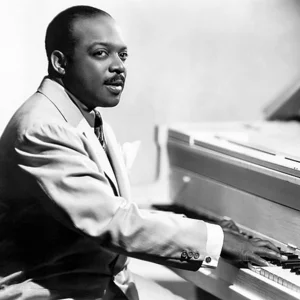

William James Basie, known as Count Basie (1904-1984), was an American pianist, organist, and bandleader. A major figure in jazz, he led one of the most famous big bands in history, contributing to the rise of swing in the 1930s–1940s.
Count Basie(1904 — 1984)
Count Basie
États-Unis
9 min read
Frequently asked questions
Famous Quotes
« I don't dig that two-beat jive the New Orleans cats play, because it's all stiff and mechanical.»
« You've got to play it like you mean it.»
Key Facts
- Born in 1904 in Red Bank (New Jersey), died in 1984 in Hollywood (Florida)
- Founded the Count Basie Orchestra in Kansas City in 1935
- Recorded classics such as 'One O'Clock Jump' (1937) and 'Jumpin' at the Woodside' (1938)
- Won 9 Grammy Awards over the course of his career
- His orchestra remained one of the few big bands to continue performing after the end of the golden age of swing
Works & Achievements
Count Basie's orchestra signature theme, recorded for Decca Records. Built on a B-flat blues, this piece became one of the most celebrated and widely performed jazz tunes of the 1930s and 1940s.
An emblematic composition of the Kansas City style, built on repetitive riffs and a relentless rhythm section. It perfectly captures the art of the collective head arrangement that defined the Basie orchestra.
A recording that showcases tenor saxophonist Lester Young, considered one of the high points of jazz improvisation in the late 1930s and a precious sonic document of the Kansas City style at its peak.
An album recorded for Verve Records whose title track became one of the best-selling jazz records of the 1950s. Basie revisits a Broadway standard with the effortless elegance that defined his big band.
A masterpiece of big band jazz, entirely arranged by Neal Hefti. This album redefined the possibilities of the big band in the bebop era and remains an essential reference in the jazz discography.
A live recording at the Sands Hotel in Las Vegas, born from the collaboration between Count Basie and Frank Sinatra. The album captures the perfect union of American popular song and the swing of a great orchestra.
Anecdotes
William Basie received his nickname “Count” around 1936, when a Kansas City radio announcer bestowed a noble title on him — in the tradition of Duke Ellington and Earl Hines. The gesture was meant to elevate his status and draw the attention of a national audience. The nickname stuck for the rest of his career.
In 1935, critic and producer John Hammond accidentally picked up a live broadcast on his car radio from the Reno Club in Kansas City, where Basie's orchestra was playing. Captivated by the powerful, swinging sound, he traveled to Kansas City to see the band in person, then helped them sign with Decca Records in 1937 — launching their national career.
Count Basie was famous for his minimalist piano style: where other pianists played cascading runs of notes, he chose a few perfectly placed ones, letting the music breathe. Critics and his own musicians often noted that his greatest gift was knowing what *not* to play, creating space for the full orchestra to express itself.
The iconic tune “One O’Clock Jump” came about almost by accident during a live broadcast: a radio announcer asked Basie to name the piece he was improvising. Glancing at a clock that read nearly 1 a.m., he blurted out the title on the spot. The theme became the orchestra’s signature and one of the most-played jazz pieces of the 1930s and 1940s.
In December 1938, Count Basie’s orchestra performed at Carnegie Hall in New York as part of the “From Spirituals to Swing” concert organized by John Hammond. It was one of the first times African American music — jazz, blues, and gospel — was presented in that temple of classical music before a mixed audience. The event marked a decisive milestone in the cultural recognition of jazz in the United States.
Primary Sources
I had a good band in Kansas City, and we were swinging. I just wanted to keep the music going and keep it honest. When things started moving fast after New York, I tried not to forget where we came from.
Count Basie and his Orchestra, direct from Kansas City, represent the finest flowering of the Kansas City style — a music of riffs, blues, and irresistible swing that belongs on any great stage.
Basie's band represents something entirely new in jazz — a looseness, a swing, a collective blues feeling that no New York band has yet achieved. This orchestra must be heard by the whole country.
The piano is just a tool to help the band. I try to stay out of the way and let the musicians find the music themselves. Less is always more in this business.
Key Places
Hometown of William James Basie, born here on August 21, 1904, where he received his first music lessons. The city honors his memory today with a museum and a street bearing his name.
Jazz club where Basie and his orchestra performed regularly in the mid-1930s, broadcast live on radio. It was from this modest stage that the Kansas City sound conquered America.
The temple of swing in New York, where Basie's orchestra faced off against the best big bands of the era in legendary battles of the bands, most notably against Chick Webb's orchestra in January 1938.
The legendary concert hall where Basie performed at the historic "From Spirituals to Swing" concert in December 1938, marking jazz's recognition as music worthy of the world's greatest stages.
Iconic New York jazz club of the 1950s and 1960s, named in tribute to Charlie Parker. Basie and his reconstituted orchestra performed there regularly, cementing their place at the pinnacle of world jazz.
Typical Objects

Count Basie performed on concert grand pianos in the great ballrooms and concert halls of his era. His economical approach to the keyboard — a few well-chosen notes rather than virtuosic runs — was a radically original use of the instrument for its time.

Unlike other orchestras, Basie's band often relied on "head arrangements" — collectively developed arrangements memorized rather than written down. The few pieces of sheet music that existed were passed around among musicians during rehearsals and recording sessions.

Radio broadcasts from the Reno Club in Kansas City used RCA ribbon microphones, characteristic of the warm sound of the 1930s. It was through one of these broadcasts that John Hammond first discovered Basie's orchestra.

Count Basie always presented himself impeccably dressed: a dark or pinstriped suit, a tie, and often a felt hat. Sartorial elegance was a standard for big bands, who carefully cultivated their professional image.

Like most African American big bands of the 1930s and 1940s, Basie's orchestra traveled by bus between cities on the circuit. During segregation, this mode of transportation was a way to avoid being turned away from hotels and restaurants reserved for white patrons.

Recordings by Basie's orchestra were pressed onto 78 rpm records, the standard format of the era, sold in music stores and played on jukeboxes in bars and cafés across America.
School Curriculum
Vocabulary & Tags
Key Vocabulary
Tags
Daily Life
Morning
Like most jazz musicians of the 1930s–1950s, Count Basie rarely rose before noon — concerts often ended in the early hours of the morning. He would have a late breakfast — coffee, eggs, and toast — in his hotel room or at a nearby diner, often with members of his orchestra.
Afternoon
Afternoons were devoted to rehearsals, working on arrangements, and traveling between cities on the circuit. On the road, the orchestra traveled by bus for hours, with musicians playing cards or sleeping in the seats. Basie used the time to listen to other musicians and refine his ideas.
Evening
The evening began with the soundcheck and setting up the venue, then the show typically started around 9 p.m. in ballrooms or clubs. The orchestra often played until 2 or 3 a.m. for crowds who came out to swing dance. After the show, the musicians would gather for informal jam sessions.
Food
Life on the road meant making do with whatever food was available: roadside diners, sandwiches, takeout. Due to racial segregation in many states, the orchestra could not always stop at just any restaurant. Basie enjoyed African American soul food — fried chicken, pork chops, beans — whenever the opportunity arose.
Clothing
On stage, Count Basie and his musicians wore sharp suits — often a tuxedo or dark suit with a tie — carefully pressed despite the demands of touring. A polished, professional image was a requirement of the major ballrooms and a point of collective pride for Black musicians who wanted to be taken seriously.
Housing
While touring the South and many Northern cities, the orchestra stayed in Black-owned boarding houses and hotels, due to Jim Crow segregation laws. In New York, Basie lived in apartments in Harlem, which was at the time the most vibrant cultural center of the African American community in the United States.