
Greek goddess of agriculture and the harvest, venerated in ancient Greek religion. Daughter of Cronus and Rhea, she is the mother of Persephone. Her myth, passed down through oral tradition and later codified by the Greeks, explains the cycle of the seasons.
Demeter
Demeter
9 min read
Frequently asked questions
Famous Quotes
« "I search for my daughter across all the earth, and until I find her again, no seed shall germinate." (words attributed by tradition in the Homeric Hymn to Demeter)»
Key Facts
- Cult attested in Mycenaean texts (Linear B tablets, around the 14th century BCE) in the form 'da-ma-te'
- The Homeric Hymn to Demeter (around the 7th–6th century BCE, written source) recounts the abduction of Persephone by Hades and the origin of the seasons
- The Eleusinian Mysteries, celebrated in her honor near Athens, were one of the most important initiation rites in the ancient Greek world
- Her myth explains the alternation of the seasons: Demeter's grief causes winter, while her renewed joy brings spring
- Identified with the Roman goddess Ceres, whose name gave rise to the word 'cereals'
Works & Achievements
The most important and secretive initiatory rites of ancient Greece, celebrating the myth of Demeter and Persephone. For nearly nine centuries, thousands of initiates — men, women, enslaved people, and later Roman emperors — traveled to Eleusis seeking a promise of a better life after death.
An annual three-day festival celebrated throughout Greece by married women in honor of Demeter Thesmophoros ("law-bearer"). These fertility rites, tied to the autumn sowing season, were among the most widespread women's religious festivals in the Greek world.
A long epic poem of 495 lines recounting the abduction of Persephone and the origins of the Eleusinian Mysteries. It is the most complete and oldest literary source on the myth of Demeter, transmitted under the name of Homer.
A large hypostyle hall capable of holding up to 3,000 initiates for the central nocturnal ceremony of the Mysteries. Designed by the architect Ictinus (who also worked on the Parthenon), it was one of the most impressive religious buildings in the Greek world.
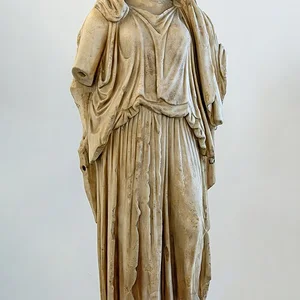
A masterpiece of classical Greek sculpture depicting Demeter seated, veiled, in a posture of mourning for her lost daughter. Held at the British Museum, it is one of the finest sculpted portraits of the goddess.
Roman games and festivities in honor of Ceres (the Roman counterpart of Demeter), celebrated each April. They included theatrical performances, food distributions, and chariot races, illustrating the central importance of grain worship in Roman civic life.
Anecdotes
When Hades abducted Persephone and took her to the Underworld, Demeter wandered the earth for nine days and nine nights, carrying two blazing torches, neither eating nor sleeping, searching for her daughter. All the while, she abandoned her divine duties, and the earth fell barren: the grain stopped growing, the fruit trees bore nothing, and humans began to starve.
It was ultimately Hecate, goddess of the night, and Helios, the all-seeing sun god, who revealed Persephone's fate to Demeter. Zeus was forced to intervene and negotiate with Hades: Persephone would spend part of the year in the Underworld and the rest with her mother. Each yearly separation marks autumn and winter; each reunion, spring and summer.
According to myth, it was Demeter herself who taught agriculture to humanity, entrusting the Eleusinian prince Triptolemus with a winged chariot drawn by serpents and seeds of wheat. She sent him to travel the world and teach mankind to plow, sow, and harvest, guiding them from wild foraging to civilized farming.
A Thessalian king named Erysichthon dared to cut down the sacred trees of a grove consecrated to Demeter in order to build a banquet hall. The goddess punished him with a ravenous, insatiable hunger: he devoured everything he owned, sold his own daughter into slavery to buy food, and ultimately consumed himself. This myth illustrated the terrible fate awaiting those who violated the nurturing forces of nature.
Primary Sources
"I begin to sing of Demeter, the lovely-haired, august goddess, and of her slim-ankled daughter whom Hades seized... Demeter wandered nine days over the fruitful earth, holding blazing torches in her hands."
"Rhea, joined with Cronus, bore a glorious offspring: Hestia, Demeter, golden-sandaled Hera, mighty Hades... and Zeus the Wise, father of gods and men."
"Ceres [Demeter] first turned the earth with the curved plough, she first gave men harvests and gentle nourishment; she first gave them laws."
"The Sicilians say that it was on their island, near Enna, that Persephone was abducted... and that Demeter, to reward the piety of the Eleusinians, first taught them the cultivation of wheat."
"As fair-haired Demeter separates the grain from the chaff on the great threshing floor when the wind blows and the sheaves turn pale..."
Key Places
The most sacred site of Demeter's cult, where the famous Eleusinian Mysteries were held every autumn. This sanctuary, about twenty kilometers from Athens, welcomed thousands of initiates from across the Greek and Roman world for nearly nine centuries.
A city in central Sicily considered, according to Sicilian tradition, to be the site where Persephone was abducted by Hades. A great sanctuary of Demeter-Ceres stood there, and all of Sicily was regarded as the goddess's sacred land — the breadbasket of the ancient world.
This sanctuary of Demeter yielded a celebrated marble statue of the goddess (4th century BCE), now housed in the British Museum. It was one of the major centers of Demeter's cult in Hellenistic Asia Minor.
A sanctuary reserved for Athenian women, where the Thesmophoria was celebrated — a three-day festival in honor of Demeter held in autumn. These rites, connected to fertility and the sowing of crops, were strictly forbidden to men.
An important sanctuary of Demeter in the Hellenistic kingdom of the Attalids, whose archaeological excavations uncovered a well-preserved temenos (sacred precinct). It stands as testimony to the spread of Demeter's cult throughout the Greek-speaking East.
Liens externes & ressources
Références
Œuvres
Les Mystères d'Éleusis
fondés vers le VIIe siècle av. J.-C., célébrés jusqu'en 392 apr. J.-C.
Les Thesmophories
attestées dès le Ve siècle av. J.-C.
Hymne homérique à Déméter
VIIe-VIe siècle av. J.-C.
Télestérion d'Éleusis
construit et agrandi entre le VIe et le IVe siècle av. J.-C.
Statue de Déméter de Cnide
vers 330 av. J.-C.
Les Ludi Cereales (Rome)
institués vers 204 av. J.-C.