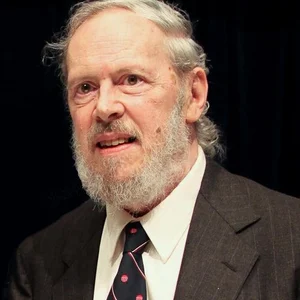

An American computer scientist, Dennis Ritchie is the creator of the C programming language and co-creator of the Unix operating system. His work at Bell Labs in the 1970s laid the foundations of modern computing.
Dennis Ritchie(1941 — 2011)
Dennis Ritchie
États-Unis
7 min read
Frequently asked questions
Key Facts
- 1941: Born in Bronxville, New York
- 1967: Joins Bell Laboratories, where he would spend most of his career
- 1969–1973: Co-creates Unix with Ken Thompson at Bell Labs
- 1972: Creates the C programming language, which becomes the foundation of most modern systems
- 1983: Receives the Turing Award, the highest distinction in computer science, alongside Ken Thompson
- 2011: Dies in Berkeley Heights, New Jersey
Works & Achievements
A multi-user, multitasking operating system, Unix revolutionized computing by introducing a simple and portable architecture. It is the direct ancestor of Linux, macOS, and Android.
Designed to rewrite Unix, C established a new standard for clarity and efficiency. It is the origin of virtually all modern programming languages (C++, Java, Python, JavaScript) and remains massively used to this day.
This reference manual, nicknamed 'K&R', is one of the best-selling technical books in history. It has trained millions of programmers around the world and popularized the now-universal 'Hello, World!' program.
Published in Communications of the ACM, this paper introduced Unix to the international scientific community. It is considered one of the most influential papers in the history of computing.
An experimental successor to Unix designed by Ritchie and his team, Plan 9 rethought the "everything is a file" philosophy to its furthest conclusions. Less widely adopted than Unix, it nonetheless influenced modern distributed systems.
Anecdotes
In 1969, Dennis Ritchie and his colleague Ken Thompson were looking for a way to run a video game, Space Travel, on an old unused PDP-7. To do so, they wrote a small, minimalist operating system: this brilliant hack would go on to become Unix, one of the most influential pieces of software in history.
Ritchie was legendarily low-profile in the computing world. While far less important inventors made the covers of magazines, he kept quietly working in his Bell Labs office, turning down most interviews and preferring to let his code speak for itself.
Dennis Ritchie died on October 12, 2011, just one week after Steve Jobs. While the death of Apple's co-founder made headlines around the world, Ritchie's passing went almost unnoticed by the general public — even though Jobs's own iPhone ran on a system descended directly from Unix and written in C.
The C language was born from radical simplification: Ritchie drew inspiration from a language called B, itself derived from BCPL. By stripping away everything superfluous and adding data types, he created a language so efficient and readable that it is still taught and used worldwide more than fifty years later.
In 1973, Ritchie and Thompson achieved an unprecedented feat: they completely rewrote the Unix kernel in the C language. Until then, operating systems were written in assembly, specific to each machine. This rewrite made Unix portable to other computers, establishing the foundational principle of modern operating systems.
Primary Sources
UNIX is a general-purpose, multi-user, interactive operating system for the Digital Equipment Corporation PDP-11/40 and 11/45 computers. It offers a number of features seldom found even in larger operating systems.
C is a general-purpose programming language which features economy of expression, modern control flow and data structures, and a rich set of operators. C is not a 'very high level' language, nor a 'big' one, and is not specialized to any particular area of application.
The C programming language was devised in the early 1970s as a system implementation language for the nascent Unix operating system. Conceptually, it is a descendant of the B language, which was written by Ken Thompson.
We were essentially in search of a way to do our work more conveniently, and in the process stumbled onto something that turned out to be more generally useful.
Key Places
Dennis Ritchie was born in this suburban New York town on September 9, 1941. His father, Alistair Ritchie, was an engineer at Bell Labs, which exposed Dennis from an early age to the world of technological research.
Ritchie completed his higher education here, earning a bachelor's degree in physics and then a doctorate in mathematics in 1968. It was there that he acquired the theoretical foundations that would later inform his work in computer science.
The heart of Ritchie's entire career: he joined the Computing Science Research Center there in 1967 and would work there until the end of his life. It was in this legendary laboratory that Unix and the C language were born.
It was in this New Jersey municipality, not far from Murray Hill, that Dennis Ritchie spent his final years and passed away on October 12, 2011, at the age of 70.
Typical Objects

It was on this Digital Equipment Corporation computer, already obsolete by 1969, that Ritchie and Thompson wrote the first lines of Unix. The machine's severely limited resources forged the philosophy of conciseness that would come to define Unix and the C language.

The DEC PDP-11 was the true development machine for Unix throughout the 1970s. It was for this platform that the C language was finalized, and the rewriting of the Unix kernel on it proved that an operating system could be portable.

Before graphical displays, Bell Labs researchers interacted with computers through electric typewriter-like machines called teletypes. This purely text-based mode of interaction deeply shaped Unix's command-line philosophy.

Co-written by Ritchie and Brian Kernighan in 1978, this slim manual of fewer than 300 pages became the bible for generations of programmers. It is celebrated for its conciseness, clarity, and its introductory 'Hello, World!' program, which has since become a universal ritual.

Early in his career in the 1960s, Ritchie, like all his contemporaries, programmed by submitting stacks of punched cards to the operator of a large mainframe computer, then waited hours to receive the printed output.

Ritchie contributed to writing the first editions of the Unix reference manual, a technical document internal to Bell Labs that initially circulated informally and went on to become the foundation of modern software documentation.
School Curriculum
Vocabulary & Tags
Key Vocabulary
Tags
Daily Life
Morning
Ritchie arrived early at the Bell Labs Computing Science Research Center in Murray Hill. He would begin his day by going through the internal mail — technical memos and reports from colleagues — before settling in at his terminal to continue his programming work or theoretical research.
Afternoon
Afternoons were devoted to intensive programming and informal exchanges with colleagues. Bell Labs fostered a culture of intellectual freedom: researchers could chat freely in the hallways, test ideas on the blackboard, or collaborate spontaneously, with no mandatory meetings. It was in this environment that Unix and C were born.
Evening
Ritchie kept a very private personal life. He was known for his calm demeanor, subtle humor, and strong sense of camaraderie. Evening gatherings with Bell Labs colleagues sometimes gave rise to passionate discussions about mathematics, physics, and the future of computing.
Food
As an American researcher working from the 1970s through the 1990s, Ritchie likely shared the ordinary eating habits of the East Coast intellectual middle class: cafeteria lunches at the lab, simple home-cooked meals in the evening. No source points to any particular dietary habits.
Clothing
Ritchie dressed in the classic style of the American researcher of his era: a plaid or solid-color shirt, slacks, and occasionally a jacket. He had no taste for sartorial display, in keeping with his understated personality and indifference to appearances.
Housing
Ritchie spent his entire career in the New Jersey suburbs, close to Bell Labs in Murray Hill. He lived in a typical American middle-class single-family home. A bachelor with no children, he spent much of his life living alone, surrounded — according to those who knew him — by a large collection of books and computing equipment.
Historical Timeline
Period Vocabulary
Liens externes & ressources
Références
Œuvres
Unix (avec Ken Thompson)
1969–1973
Langage de programmation C
1972
The C Programming Language (avec Brian Kernighan)
1978
The UNIX Time-Sharing System (article scientifique, avec Ken Thompson)
1974
Plan 9 from Bell Labs (avec une équipe Bell Labs)
1992