 flip
flipMillet Flatbread and Prison Paste (barley rotika)
Millet Flatbread and Prison Paste (barley rotika)
Why this dish? In Kamsa's prison, Devaki no longer receives the refined dishes of Mathura but the frugal food of the jailers: a coarse grain flatbread, without ghee or sweetness. This poor bread, which keeps and travels, tells of her fall from princess to prisoner, and the patience of a mother awaiting deliverance.
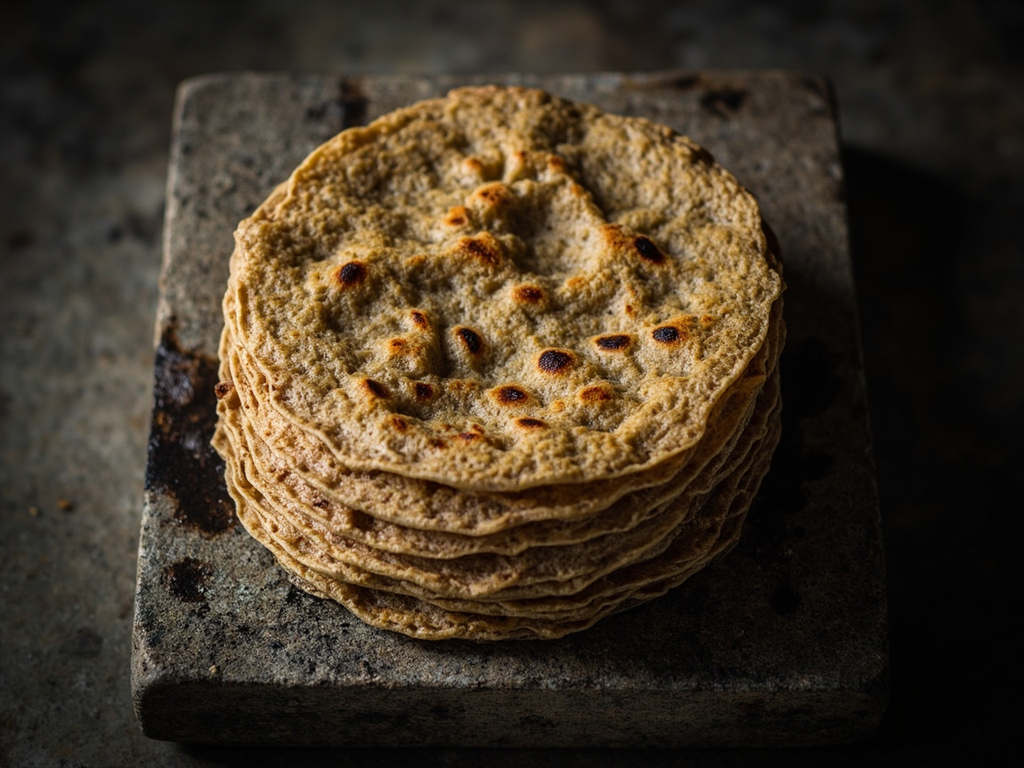
A thick, rustic flatbread of barley or millet, barely salted, cooked on a hot stone. Dry, slightly bitter, it keeps and is eaten with fingertips in the darkness.
Do not turn away from this grey flatbread, traveler. It was my bread for countless seasons. The jailer placed it on the ground without a word: crushed barley, a little water, the coarsest salt, cooked on the hearth stone. No butter, no honey — just enough to keep standing. I bit into it thinking of the fragrant rice of my childhood, and I kept half, out of motherly habit, for a child I was not allowed to keep.
- •Barley flour (or millet) — two handfuls (base)
- •Water — as needed (binder)
- •Rock salt — a meager pinch (seasoning)
Millet Flatbread and Prison Paste (barley rotika)
A thick, rustic flatbread of barley or millet, barely salted, cooked on a hot stone. Dry, slightly bitter, it keeps and is eaten with fingertips in the darkness.
Why this dish? In Kamsa's prison, Devaki no longer receives the refined dishes of Mathura but the frugal food of the jailers: a coarse grain flatbread, without ghee or sweetness. This poor bread, which keeps and travels, tells of her fall from princess to prisoner, and the patience of a mother awaiting deliverance.
Do not turn away from this grey flatbread, traveler. It was my bread for countless seasons. The jailer placed it on the ground without a word: crushed barley, a little water, the coarsest salt, cooked on the hearth stone. No butter, no honey — just enough to keep standing. I bit into it thinking of the fragrant rice of my childhood, and I kept half, out of motherly habit, for a child I was not allowed to keep.
Ingredients (period version)
- Barley flour (or millet) — two handfuls (base)
- Water — as needed (binder)
- Rock salt — a meager pinch (seasoning)
Ingredients
- Barley flour or millet flour (bajra) — 150 g (base)
- Warm water — about 90 ml (binder)
- Salt — 1 pinch (seasoning)
- A little wheat flour — 2 tbsp (helps shaping (optional))
Method
- Mix the flour and salt, add warm water gradually until a firm, non-sticky dough forms.
- Knead for 5 minutes, then let rest for 15 minutes under a cloth.
- Divide into balls and flatten by hand or with a rolling pin into thick flatbreads.
- Cook on a hot stone or a very hot cast-iron skillet, without fat, 2 to 3 minutes per side until brown spots appear.
- Serve plain to stay true to the prison… or with a little ghee to soften the evocation.
How it was made : Before the spread of soft wheat, barley and millets were the daily cereals of the common people in ancient India. Unleavened flatbreads, cooked on stone or tava, kept well and were easy to transport — prison, travel, or peasant food, as opposed to the white rice of nobles.
The contemporary twist : Serve warm with a drizzle of ghee and a pinch of smoked salt: a 'flatbread of waiting' that tells the whole story in one bite.
Devaki · Charactorium