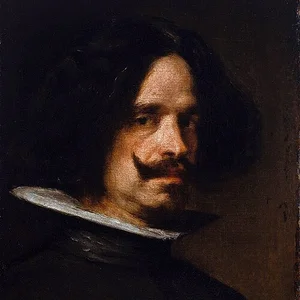

Diego Velázquez (1599–1660) was the greatest Spanish painter of the Golden Age. As official painter to King Philip IV, he revolutionized painting through his mastery of light and realism. His masterpiece, Las Meninas, remains one of the most analyzed works in the history of art.
Diego Velázquez(1599 — 1660)
Diego Velázquez
Espagne
8 min read
Frequently asked questions
Key Facts
- 1599: born in Seville
- 1623: appointed official painter to King Philip IV of Spain
- 1629 and 1649: two trips to Italy, influenced by Titian and Rubens
- 1656: creation of Las Meninas, a masterpiece of Baroque painting
- 1660: died in Madrid, just weeks after organizing the marriage of Infanta Maria Theresa
Works & Achievements
An early painting made in Seville, representative of the bodegones (popular genre scenes) that Velázquez had already mastered at the start of his career. The naturalistic precision in rendering textures and light already foreshadows his genius.
A commissioned portrait depicting Philip IV's all-powerful minister in a heroic pose. Velázquez demonstrates his mastery of monumental composition and political portraiture.
A large historical composition painted for the Buen Retiro Palace, celebrating the Spanish victory over the Dutch in 1625. It stands out for its remarkable humanization of the defeated, who are treated with dignity.
A masterpiece of portraiture, this painting captures the pope's personality with formidable psychological acuity. It would profoundly influence art history, right up to Francis Bacon's reinterpretations in the 20th century.
A rare female nude in Spanish painting of the period, given the religious constraints imposed by the Inquisition. The figure is shown from behind, reflected in a mirror held by Cupid.
Velázquez's absolute masterpiece and one of the most studied works in the history of Western art. The complex composition questions the relationships between the painter, the subject, and the viewer, anticipating the concerns of modern painting.
A large composition with a dual reading, depicting workers in a tapestry workshop with a mythological scene in the background. This work bears witness to Velázquez's ultimate maturity in his handling of light and space.
Anecdotes
Velázquez was appointed official painter to King Philip IV at just 24 years old, after producing a portrait so lifelike that the king declared he would allow no one else to paint him. This privileged relationship lasted their entire lives, and the king would often come to watch the painter work in his studio at the Alcázar palace.
In Las Meninas (1656), Velázquez depicted himself in the act of painting, with the red cross of the Order of Santiago on his chest. At the time the painting was made, however, he had not yet received this honor — the cross is believed to have been added afterward, perhaps by King Philip IV himself, to mark the painter's ennoblement in 1659.
Velázquez made two trips to Italy, in 1629 and 1649. During his second stay in Rome, he painted the portrait of Pope Innocent X, which was so striking that the pope himself reportedly exclaimed that the painting was 'too true' (troppo vero). That portrait is now held at the Galleria Doria Pamphilj in Rome.
After being appointed aposentador mayor (chief palace chamberlain) in 1652, Velázquez was tasked with organizing royal ceremonies and festivities — an exhausting role that ate into his painting time. He died in 1660, shortly after returning from the French-Spanish border, where he had organized the marriage of Infanta Maria Theresa to Louis XIV.
Primary Sources
Diego de Silva Velázquez, mi yerno, [...] fue recibido por pintor del rey [...] con salario, casa de aposento y médico y botica.
Las Meninas is the Theology of Painting; and just as in Theology the greatest achievement is to believe without seeing, in Painting the greatest mastery is to see without believing.
Troppo vero. (Too true.) — reaction attributed to Pope Innocent X upon seeing his portrait by Velázquez.
Por la satisfacción que tengo de la persona de Diego de Silva Velázquez, mi pintor de cámara [...] le nombro por mi Aposentador Mayor de Palacio.
Key Places
Velázquez's birthplace, where he trained under Francisco Pacheco and developed his naturalistic style influenced by Caravaggio. The city was then the commercial heart of the Spanish empire.
The primary residence of King Philip IV, where Velázquez had a studio and spent most of his career. It was here that he painted Las Meninas and most of his royal portraits.
Velázquez visited twice (1629 and 1649–1651), studying the masters of the Renaissance and Baroque periods. During his second stay, he painted the celebrated portrait of Pope Innocent X.
The principal museum housing Velázquez's work today, with over 50 paintings including Las Meninas, The Spinners, and the large equestrian compositions created for the Buen Retiro Palace.
The site where Velázquez organized the ceremonies for the marriage of Infanta Maria Theresa to Louis XIV in June 1660. The exhaustion from this event contributed to his death just a few weeks later.
Typical Objects

Velázquez worked with a palette of dark, earthy tones characteristic of Spanish tenebriism, which he gradually enriched with luminous greys and subtle nuances through his encounter with Venetian painting.

The painter used long brushes that allowed him to work at a distance from his canvas — a technique visible in his self-portrait in Las Meninas, which gave his brushwork a free and airy quality.

The mirror is a central object in Velázquez's work, most notably in Las Meninas, where a mirror at the back of the room reflects the figures of the king and queen, raising a fundamental question about representation and the act of looking.

Velázquez depicted with striking precision the stiff, dark garments of Philip IV's court: black doublets, starched ruffs, and lace collars, capturing the austere grandeur of the Spanish monarchy.

The painter prepared his canvases with ochre or brown grounds that sometimes show through in the final composition, contributing to the warmth and depth of his works.

As aposentador mayor, Velázquez carried a large golden key symbolizing his authority over the organization of the royal palace — a sign of his exceptional social rise.
School Curriculum
Vocabulary & Tags
Key Vocabulary
Daily Life
Morning
Velázquez rose early in his apartments at the Alcázar Palace, where he lived first as the king's painter and later as his chamberlain. He would often begin the day by overseeing his assistants' preparation of canvases and pigments, before receiving his subjects — courtiers, members of the royal family, or distinguished visitors — for sitting sessions.
Afternoon
The afternoon was devoted to painting itself, in the north light of his palace studio. Philip IV would sometimes stop by to watch him work, seated in an armchair kept there for that purpose. Velázquez painted standing up, at a considerable distance from his canvas, using his long brushes to assess the overall effect.
Evening
In the evenings, as aposentador mayor from 1652, Velázquez was responsible for overseeing the practical running of the palace — managing staff and planning the court's movements. He also attended official receptions and ceremonies, bearing the large golden key that came with his office. As a result, the time he could devote to painting was often cut short.
Food
The Spanish royal table of the 17th century was lavish: roasted meats (mutton, pork, game), white bread, legumes, cheeses, and fruit. As a palace officer, Velázquez received a food allowance provided by the court, known as gajes, in addition to his salary. Hot chocolate, introduced from the Americas, was a fashionable drink at the Spanish court.
Clothing
In the studio, Velázquez wore plain working clothes, typically in dark cloth. For court ceremonies, he dressed in the formal Spanish fashion: black doublet and breeches, a ruff or white lace collar, and — after 1659 — the red cross of the Order of Santiago embroidered on his chest, a distinction visible in his self-portrait in Las Meninas.
Housing
Velázquez lived in the service apartments of the Alcázar Palace, made available to him by the king. These quarters were comfortable but subject to the constraints of court life. He also had a spacious studio with good north-facing light — essential for his work as a painter.
Historical Timeline
Period Vocabulary
Visual Style
L'esthétique du baroque espagnol : fonds sombres et luminosité dorée, matières précieuses rendues avec un réalisme saisissant, et une touche picturale libre qui préfigure l'impressionnisme.
Sound Ambience
L'atmosphère sonore du palais royal de Madrid au XVIIe siècle : entre le froissement des étoffes de cour, le grincement des lourdes portes et les sons discrets de l'atelier du peintre — pinceaux, broyage des pigments et murmures feutrés.
Liens externes & ressources
Références
Œuvres
Portrait équestre du comte-duc d'Olivares
c. 1634
La Reddition de Breda (Les Lances)
1635
Les Fileuses (La Fable d'Arachné)
c. 1657