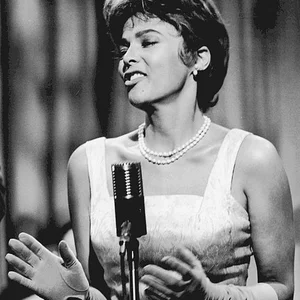

An African-American actress, singer, and dancer, Dorothy Dandridge became in 1955 the first Black woman nominated for the Academy Award for Best Actress, for Carmen Jones. An icon of Golden Age Hollywood, she broke racial barriers in a deeply segregated industry.
Dorothy Dandridge(1922 — 1965)
Dorothy Dandridge
États-Unis
10 min read
Frequently asked questions
Famous Quotes
« What I want is to be a person.»
Key Facts
- Born on November 9, 1922, in Cleveland, Ohio, into an artistic family
- First Black woman nominated for the Academy Award for Best Actress, for Carmen Jones (1954)
- First African-American woman to appear on the cover of Life magazine (1954)
- A victim of segregation: her hotel drained the swimming pool after she dipped her feet in it
- Died on September 8, 1965, in Los Angeles, aged 42
Works & Achievements
Otto Preminger's adaptation of Bizet's opera Carmen featuring an all-Black cast. The title role, played by Dandridge, earned her an Academy Award nomination and cemented her status as Hollywood's first Black superstar.
Adaptation of George Gershwin's celebrated opera, with Dandridge as Bess opposite Sidney Poitier. The film was controversial within the African American community for its perceived stereotypical portrayal, but stands as a testament to the scarcity of substantial roles available to Black actors in Hollywood.
A daring film for its time, depicting an interracial romance between Dandridge and John Justin. It was banned in several Southern U.S. states, making it an act of cultural resistance.
A film by John Berry shot in France in which Dandridge played a mixed-race enslaved woman aboard a slave ship who rebels against her captors. Her first major international production, it gave her a temporary escape from the constraints of Hollywood.
Dandridge was one of the first Black artists to headline the major hotels on the Las Vegas Strip. Her performances received critical acclaim and drew racially mixed audiences, gradually helping to erode segregation in entertainment venues.
Dorothy Dandridge's memoirs, completed by Earl Conrad and published after her death. A landmark historical document on the life of a Black artist navigating fame and discrimination in 1950s Hollywood.
Anecdotes
In 1955, Dorothy Dandridge became the first Black woman in history to be nominated for the Academy Award for Best Actress, for her role in Carmen Jones. The nomination made front pages across the country, yet Hollywood had no idea what to do with this newfound fame: no major studio offered her a role worthy of her talent in the years that followed.
Despite her celebrity, Dorothy Dandridge ran headlong into racial segregation even at the height of her career. When she performed at the Frontier Hotel in Las Vegas in the 1950s, she was forced to enter through the service entrance, barred from staying in the hotel, and not permitted to use the swimming pool — the very pool her stardom had helped fill with paying customers.
To protest this absurd segregation, Dandridge pointedly dipped the tip of her finger into the pool of a hotel that refused to let her swim in it. The manager immediately ordered the entire pool drained and disinfected — a humiliating act that the press reported widely, laying bare the hypocrisy of a system that worshipped her performances onstage while treating her as a second-class citizen.
Dorothy Dandridge endured an immense personal grief: her daughter Lynn, born in 1951, suffered severe brain damage at birth. Dandridge devoted a considerable portion of her earnings to Lynn's care, placing her in a specialized facility — a commitment that steadily undermined her finances throughout her life.
At the time of her death in 1965, at just 42 years old, Dorothy Dandridge was nearly penniless. An accidental overdose of medication ended her life just weeks before she might have had the chance to start over. Her passing went almost unnoticed in the press, overshadowed by the upheaval of the civil rights movement — a cruel irony for a woman who had been one of its earliest icons, almost in spite of herself.
Primary Sources
Dorothy Dandridge describes her childhood in an unstable family, her early stage appearances alongside her sister Vivian, and the constant tension between the Hollywood dream and the reality of the racial discrimination she faced throughout her career.
The magazine headlined “the first Black woman nominated for the Oscar for Best Actress” and described Dandridge as a “revelation” in Carmen Jones, while highlighting the systemic obstacles she had to overcome in a still deeply segregated Hollywood.
Dandridge confided: “I am a Black woman in Hollywood. That means I have to be twice as good to get half the opportunities.” She spoke about the roles she was denied because of her skin color and her hope that things would change for future generations.
The official records document Dorothy Dandridge’s nomination for the Best Actress award for her role in Carmen Jones (Otto Preminger, 1954), the first time an African American woman had been nominated in that category since the awards were established.
Bosley Crowther wrote: “Miss Dandridge sings and acts with an intensity and sensuality that make her the magnetic center of the film. Her performance is of rare power and deserves all the attention it will receive.”
Key Places
Birthplace of Dorothy Dandridge, born on November 9, 1922. Her difficult childhood in this industrial Midwest city forged her resilience and her determination to escape through performance.
A landmark of African American culture and jazz during the 1930s and 1940s, the Cotton Club was one of the first major stages where Dandridge performed, allowing her to gain recognition in the entertainment industry.
The heart of the American film industry, where Dandridge built her acting career. It was here that she filmed *Carmen Jones*, *Porgy and Bess*, and her other major pictures — in a glamorous but deeply segregated environment.
Dandridge was one of the first Black performers to headline the grand showrooms of the Strip's hotel-casinos (the Frontier Hotel, the Sands). She enjoyed enormous success there while simultaneously enduring segregation: she was forbidden from staying in the very establishments where she performed.
It was at the 1955 Academy Awards ceremony that Dandridge became the first Black woman nominated for Best Actress, making history in American cinema. This landmark moment took place in the grand theater that hosted Hollywood's most celebrated ceremonies.
The place where Dorothy Dandridge was found dead on September 8, 1965, at the age of 42, in her apartment. Her premature death in relative obscurity stood in tragic contrast to the stardom she had known a decade earlier.
Typical Objects

Dandridge was known for her sumptuous stage costumes, often sheath or strapless dresses that accentuated her figure. These garments, designed by Hollywood costumers, were part of her image as a glamour icon and were essential to her presence both on stage and on screen.

An emblematic fixture of the cabarets and jazz clubs of the 1940s–1950s where Dandridge performed. This type of stand microphone was the symbol of live entertainment in the grand venues of Las Vegas and New York where she built her international reputation.

The scripts from Otto Preminger's productions, heavily annotated by the actors, reflect the intense preparation work that Hollywood demanded. For *Carmen Jones*, Dandridge had to work on her diction, singing, and acting with particular rigor, as her character sang in English to Bizet's music.

Stage makeup in the 1950s was designed for powerful stage lights and black-and-white film stock, then color. For Dandridge, it also carried a particular weight: Hollywood sometimes sought to “lighten” the complexion of Black actors to make them more palatable to white audiences — a practice she actively fought against.

Dandridge recorded several singles and albums throughout the 1950s. The 78 rpm vinyl record, followed by the 33 rpm LP, was the medium that spread her music across the United States and helped extend her reach far beyond the concert hall.

The promotional posters for *Carmen Jones* and her other films are valuable historical documents: they reveal how Hollywood presented a Black star in the 1950s, caught between celebrating her glamour and perpetuating racial stereotypes in the graphic design and advertising copy.
School Curriculum
Vocabulary & Tags
Key Vocabulary
Tags
Daily Life
Morning
Dandridge began her filming days very early, often called to the set as early as 6 a.m. for hair and makeup sessions that could last two hours. Her mornings outside of filming were devoted to vocal rehearsals and correspondence with her agent, in a Hollywood apartment she rented on her own after her divorce.
Afternoon
Working afternoons were split between the sets of major studios (20th Century Fox, Columbia) and rehearsals for her cabaret shows. When not on set, she frequently met with journalists for interviews — an exercise she handled with great care to manage her image in a press that scrutinized her as much for her glamour as for the color of her skin.
Evening
On performance nights, Dandridge appeared on stage for one to two hours, in a state of total concentration. Her Hollywood evenings, when she was invited to receptions, were lived under tension: welcomed into the parties of white stars, she was often the only Black woman present, navigating between fascination and being kept at arm's length.
Food
Like many Hollywood actresses of the 1950s, Dandridge strictly monitored her diet to maintain the figure the industry demanded. She ate lightly in the morning — coffee, fruit — and preferred simple meals outside of social obligations. Studio-imposed diets, often severe, placed additional pressure on her health.
Clothing
Off set, Dandridge wore elegant, polished outfits, well aware that a Black actress in 1950s Hollywood had to be impeccable at all times to avoid giving any grounds for criticism. She favored belted suits, dresses with understated prints, and wide-brimmed hats, in keeping with the sophisticated style of the era.
Housing
Dandridge lived in a Hollywood apartment, in a neighborhood where racial restrictions on property purchases (known as “racial covenants”) made it difficult for African Americans — even famous ones — to access the most desirable neighborhoods. She spent much of her life in rented housing, never attaining the villa that symbolized Hollywood success, despite the talent that could have made it possible.