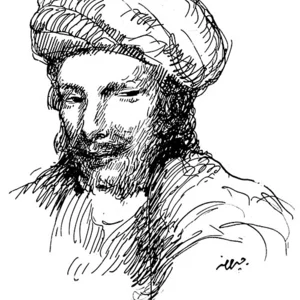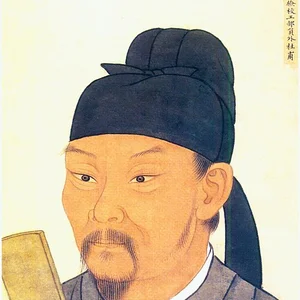

Du Fu (712–770) is considered one of the greatest poets of imperial China, nicknamed the "Sage of Poetry." A contemporary of Li Bai, he lived under the Tang dynasty and witnessed the devastating An Lushan Rebellion. His deeply humanist body of work bears witness to the suffering of ordinary people and the upheavals of his time.
Frequently asked questions
Famous Quotes
« The nation is broken; mountains and rivers remain. Spring comes to the city; grass and trees grow deep.»
« I have suffered all my life, and my poems reflect my suffering.»
Key Facts
- Born in 712 in Gong (Henan province) under the Tang dynasty
- Failed the imperial civil service examinations multiple times, which were the gateway to public office
- The An Lushan Rebellion (755–763) upended his life and inspired his darkest poems
- Composed more than 1,400 surviving poems, regarded as masterpieces of world literature
- Died in 770 while traveling by boat on the Xiang River
Works & Achievements
One of Du Fu's first great political poems, denouncing the endless wars waged by Emperor Xuanzong on the frontiers. It marks the beginning of the realistic and humanist style that would define the greatness of his work.
Composed during his captivity in Chang'an, then occupied by rebel forces, this eight-line poem is one of the most celebrated in all of Chinese literature. Through striking imagery, it conveys the anguish of witnessing one's country torn apart by war.
A series of six narrative poems depicting the devastation of civil war on ordinary people: forced conscription, family separations, and grief. Masterpieces of social realism, these poems are sometimes compared to the novels of Victor Hugo for their compassion toward the downtrodden.
A poem born from a domestic incident — a storm that destroyed his hut — transformed into a universal meditation on human suffering. Its conclusion, expressing a wish for shelter for all the poor of the world, is one of the finest expressions of humanism in world poetry.
A sequence of eight lyric poems composed in Kuizhou when Du Fu was old and ill. Regarded as the technical pinnacle of his art, they combine perfect formal mastery with profound melancholy, and are studied in every major Chinese anthology.
A collection of approximately 1,500 poems attributed to Du Fu, compiled after his death. It is one of the richest poetic corpora in classical Chinese literature, spanning forty years of creative output.
Anecdotes
Du Fu failed the imperial examinations twice, in 735 and again in 747. The second failure was particularly humiliating: Prime Minister Li Linfu, jealous of independent scholars, deliberately failed all candidates on the pretext that no new talent was worthy of promotion. Du Fu, already recognized as a poet, had to wait many years before obtaining a modest position at court.
In 744, Du Fu met Li Bai in Luoyang during a journey. The two men spent weeks wandering the countryside together, drinking wine and exchanging poems. This friendship between the two greatest poets of classical China — the 'Sage of Poetry' and the 'Immortal of Poetry' — became legendary in Chinese literary history. Du Fu composed several poems expressing his deep admiration for Li Bai.
In 759, a violent autumn storm tore the thatched roof from his modest hut in Chengdu. Contemplating his ruined home and his children shivering in the cold, Du Fu thought not of his own misery but of all the poor throughout the empire. He immediately composed the poem 'My Thatched Roof Torn by the Autumn Wind,' concluding: 'Oh, that a vast mansion of a thousand rooms might rise, sheltering all the world's destitute scholars!'
During the An Lushan Rebellion, Du Fu attempted to reach the emperor in exile but was captured by rebels and held prisoner in occupied Chang'an from 756 to 757. He witnessed the destruction of the capital and the looting of the imperial palace — scenes that inspired his poem 'Spring View' (春望), in which he writes: 'The empire has shattered, yet mountains and rivers remain; / spring returns to the city, and grasses and trees grow green.' This poem is today one of the most studied in Chinese schools.
Du Fu's final years were marked by illness and wandering along the rivers of Hunan. According to legend, after being stranded for several days by floods with nothing to eat, a local official sent him roast beef and white wine. Weakened as he was, Du Fu ate too much and died shortly afterward on his boat in 770, at the age of 58, never having seen his hometown again.
Primary Sources
The empire is broken; mountains and rivers remain. Spring comes to the city; grass and trees grow deep. Moved by the troubled times, even flowers draw tears; grieved by separation, even birds break the heart.
Carts rumble, horses neigh, soldiers march with bows and arrows at their belts. Fathers, mothers, wives, and children run to see them off; the dust of Xianyang swallows the bridge.
Ah! If only a vast mansion of a thousand rooms could suddenly appear, sheltering all the poor scholars of the world, every face bright with joy! Even if my hut alone were ruined and I froze to death — that would be enough for me!
The old man of Shihao — soldiers come in the night to seize men. The old man escapes over the wall; his old wife goes out to meet them. The soldiers' fury is fearsome, the old woman's lament is bitter.
White dew devastates the maple forests of Wu and the Gorges; the waves of the Wushan river touch the sky in dark mist. The chrysanthemums have bloomed twice — tears for days gone by; the solitary boat has always been moored to my homeward heart.
Key Places
Capital of the Tang dynasty and the most populous city in the world at the time, with over one million inhabitants. Du Fu spent many difficult years there, failing the imperial examinations and seeking a position at court, before being driven out by the An Lushan Rebellion.
Du Fu had this modest bamboo-and-thatch dwelling built in 759, on the banks of the Huanhua River in Chengdu. He lived there for four relatively peaceful years and composed more than 240 poems; the site is now a classified national museum.
An ancient imperial capital where Du Fu spent his childhood and youth, and where he met Li Bai in 744. The city was sacked during the An Lushan Rebellion, and Du Fu mourned its destruction in several poems.
Du Fu passed through these spectacular gorges during his journeys between Chengdu and Hunan. This grand and melancholy landscape inspired his celebrated 'Autumn Meditations', composed at Kuizhou (present-day Fengjie) while he was held back by illness.
It was on the shores of this great lake in Hunan that Du Fu spent his final years, drifting from town to town on a boat, sick and destitute. He died there in 770, far from everything he had ever known.
Typical Objects
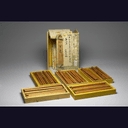
The essential tool of the Chinese scholar, made from animal hair mounted on a bamboo or wooden handle. Du Fu used it to calligraph his poems on silk or paper scrolls, the physical form of the poem being inseparable from its writing.
📷 CC BY 4.0 · Wikimedia Commons ↗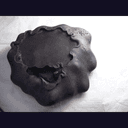
A polished stone on which the ink stick was ground with a few drops of water to prepare Chinese ink. A prized possession of the scholar, it symbolized his status and his art.
📷 CC BY-SA 3.0 · Wikimedia Commons ↗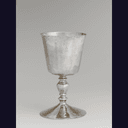
Millet or rice wine was an essential part of Tang poetic life. Du Fu constantly invokes wine in his work, as a remedy for sorrow and a companion to poetic creation.
📷 CC0 · Wikimedia Commons ↗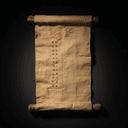
The traditional medium of Chinese literature, the scroll was used to copy and circulate poems. Du Fu collected and distributed his works in this form, with some scrolls reaching as far as the imperial court.
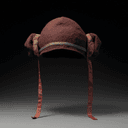
The distinctive headdress worn by officials and scholars of the Tang dynasty, featuring two stiff side flaps. Du Fu, even in poverty, kept the vestimentary markers of his status as a scholar-official.
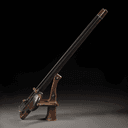
A noble musical instrument associated with scholarly culture, the qin zither symbolized virtue and wisdom. Although Du Fu was above all a poet, music and poetry were inseparable in Tang culture.
School Curriculum
Vocabulary & Tags
Key Vocabulary
Daily Life
Morning
Du Fu rose at dawn, often awakened by the crowing of neighboring roosters or the sounds of the river. He began his day with a cup of hot tea, brewed over the small hearth of his thatched cottage, then meditated while gazing at the garden and bamboo. On mornings of inspiration, he would immediately reach for his brush to capture the poetic images that had come to him in dreams.
Afternoon
Afternoons were often devoted to writing and revising his poems — an activity that could absorb him for hours on end. Du Fu was known for reworking a poem until he found precisely the right word. He sometimes received learned visitors or official friends, with whom he discussed politics, literature, and philosophy over a cup of wine.
Evening
In the evenings, Du Fu read Confucian classics or ancient poetry anthologies by candlelight. He would record his reflections and often composed his most melancholic poems at this hour, gazing at the stars from his bamboo terrace. Weighed down by illness and old age, he went to bed early, though insomnia brought on by worry and pain was a frequent companion.
Food
Du Fu's diet was simple and often inadequate, reflecting his chronic poverty. Plain boiled rice, stir-fried vegetables — cabbage, turnips, wild greens — beans, and millet porridge made up his daily fare. During periods of hardship, his poems speak openly of his own hunger and that of his children; in better times, a little river fish or tofu would enrich the meal.
Clothing
As a scholar-official, Du Fu wore the long robes characteristic of his station: layered tunics of silk or linen depending on the season, in muted colors (grey, indigo, brown), held in place by a leather or cloth belt. He wore the fútóu, the black winged hat worn by Tang dynasty officials. In the poverty of his final years, his clothes were patched and offered little protection against the cold of Sichuan.
Housing
Du Fu lived in very modest conditions for a scholar of his standing. His most celebrated home is the Caotang ('thatched cottage') in Chengdu: a bamboo-framed hut with mud-daub walls and a thatched roof, built on rented land beside the Huanhua River. It had a few low-ceilinged rooms, a kitchen garden where he grew scallions and vegetables, and was surrounded by bamboo that he had planted himself.
Historical Timeline
Period Vocabulary
Visual Style
Esthétique de la peinture à l'encre de Chine (水墨画) de la dynastie Tang : paysages de montagnes brumeuses, bambouseraies et chaumière modeste, lettré en robes de soie indigo contemplant un fleuve sous un ciel d'automne.
Sound Ambience
Atmosphère sonore du Sichuan rural au VIIIe siècle : la rivière Huanhua près de la chaumière, la pluie sur le chaume, les oies sauvages de l'automne et le murmure du pinceau sur le papier.
Liens externes & ressources
Références
Œuvres
Ballade des chariots de guerre (兵车行)
vers 750
Vue du printemps (春望)
757
Trois fonctionnaires, Trois adieux (三吏三别)
759
Ma chaumière déchirée par le vent d'automne (茅屋为秋风所破歌)
759
Méditations automnales (秋兴八首)
766
Œuvres complètes de Du Fu (杜工部集)
compilées après 770