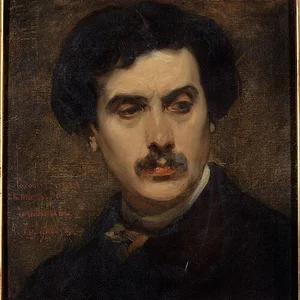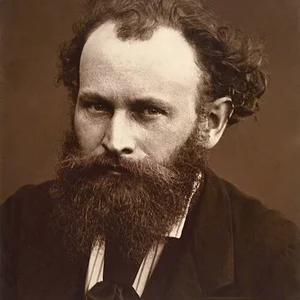

French painter and printmaker (1832–1883), Manet is a pivotal figure between Realism and Impressionism. His provocative works such as Le Déjeuner sur l'herbe and Olympia overturned academic conventions.
Édouard Manet(1832 — 1883)
Édouard Manet
France
10 min read
Frequently asked questions
Famous Quotes
« There is only one true thing: to paint at first glance what you see.»
« Conciseness in art is both a necessity and an elegance.»
Key Facts
- 1832: Born in Paris into a bourgeois family
- 1863: Le Déjeuner sur l'herbe causes a scandal at the Salon des Refusés
- 1865: Olympia sparks controversy at the official Salon
- 1874: Refuses to take part in the first Impressionist exhibition despite his close ties to the group
- 1883: Dies in Paris, leaving behind a body of work foundational to modern painting
Works & Achievements
Exhibited at the Salon des Refusés, this work depicts a nude woman seated alongside men in bourgeois dress in a pastoral setting. The direct confrontation between the female nude and Parisian modernity deliberately breaks with the conventions of academic painting.
A frontal, unidealized portrait of a reclining woman who meets the viewer's gaze with confidence, flanked by a Black maidservant and a black cat. This reworking of Titian's *Venus of Urbino* scandalized the 1865 Salon and marked a decisive turning point in the history of Western art.
A portrait of a young military musician rendered in flat areas of color inspired by Japanese woodblock prints, set against a neutral background. Rejected by the Salon, this painting perfectly captures Manet's modernity: no academic perspective, a crisp silhouette, and a direct palette.
A tribute to the critic and writer who championed Manet in his articles. In the background, a reproduction of *Olympia* and a Japanese print are visible — a true iconographic manifesto of Manet's sources of inspiration.
A group of figures on a Parisian balcony, loosely inspired by Goya, in which the painter Berthe Morisot can be recognized. The work embodies the cool, detached gaze Manet turns on contemporary bourgeois life — no anecdote, no sentiment.
Painted during his stay alongside Monet on the banks of the Seine, this canvas shows Manet opening up to a lighter, more luminous palette, bearing witness to the fertile cross-influence between the two painters at a pivotal moment.
Manet's last major work, exhibited at the Salon the year before his death. Its unsettling mirror play, the melancholy of the barmaid facing the music-hall crowd, and the virtuosity of its light handling make it one of the most analyzed paintings in nineteenth-century art.
Anecdotes
In 1863, Manet submitted *Le Déjeuner sur l'herbe* to the official Salon, which rejected it as scandalous. The work was then shown at the Salon des Refusés, established by decree of Napoleon III to display rejected canvases. The painting shocked the public: a nude woman in the company of men in bourgeois dress seemed to defy all the moral conventions of the time.
In 1865, when his *Olympia* was exhibited at the Salon, the scandal was even more intense. The frontal, unidealized nude of a woman who gazes directly at the viewer — with neither modesty nor mythological veil — provoked such hostility that the painting had to be guarded by two attendants. Manet, worn down by the attacks, retreated to Spain to discover Velázquez, whose work he had admired for years.
In February 1870, Manet fought a pistol duel against the critic and novelist Edmond Duranty, following the publication of an article deemed insufficiently flattering about his painting. The duel took place in the forest of Saint-Germain-en-Laye and ended without serious injury to either man. This episode illustrates the passion with which artistic debates were conducted in Second Empire Paris.
Unlike his friends Monet, Renoir, or Degas, Manet always refused to take part in the independent Impressionist exhibitions, organized from 1874 onward. He insisted on submitting his works to the official Salon, the only showcase he considered legitimate for winning public recognition. Paradoxically, he was the very artist who had inspired an entire generation of painters who would come to be called "Impressionists.
From 1879, Manet was afflicted by a serious neurological condition (locomotor ataxia) that progressively robbed him of the use of his legs. Unable to stand for long hours before large canvases, he turned to pastels and small formats, producing portraits of women and bouquets of flowers of remarkable freshness. In April 1883, gangrene forced the amputation of his left leg; he died ten days later, at only 51.
Primary Sources
M. Manet wanted to be of his time and paint what he saw. He produced an honest, vital art that commands attention through its directness and absolute sincerity.
Do you think you are the first man to find himself in such a position? Do you have more genius than Chateaubriand or Wagner? They were mocked too, and yet they did not die of it.
The Velázquezes enchanted me. He is the painter of painters. He does not astonish — he enchants. There you see paintings unlike anything seen anywhere else.
The painting by M. Manet entitled Le Bain is rejected on grounds of its improper character, contrary to the moral standards of the Salon and to the rules of good taste established by the Académie.
I wish I had the health to paint more. There are so many things I have not yet said. It would be a shame to go now.
Key Places
Manet's principal studio from 1872 until his death, located in the Europe quarter (9th arrondissement). It was here that he received his artist friends, painted his major compositions, and welcomed the young Impressionists who regarded him as a master.
Manet's weekly meeting place with the Batignolles group from 1866 onward: Degas, Zola, Monet, and Renoir gathered here to debate modernity in art. These lively discussions forged the ideas that would give birth to Impressionism.
In 1874, Manet stayed in Argenteuil where Monet was working. There he painted several canvases en plein air directly facing the Seine, momentarily adopting a brighter palette under the influence of his young friend, in a fruitful artistic exchange.
The museum that today houses virtually all of Manet's masterpieces: Olympia, Le Déjeuner sur l'herbe, The Fifer, The Balcony, and A Bar at the Folies-Bergère. It is the essential destination to discover Manet's painted work as a whole.
The home of the annual official Salon where Manet stubbornly submitted his works, alternating between resounding rejections and rare acceptances. This building, now demolished, was the nerve center of the Parisian academic art world in the 19th century.
Typical Objects

Manet worked with a palette loaded with bold, direct colors, including black — which he rehabilitated in reaction against the Impressionists. His practice of mixing directly on the canvas produced the broad, decisive, instantly recognizable brushwork that defines his style.

The industrial invention of metal paint tubes, widespread by the 1840s, freed artists from the studio. Manet used tube colors to work more spontaneously, sometimes painting outdoors along the banks of the Seine at Argenteuil.

Manet constantly sketched Parisian life in his notebooks: café scenes, quick portraits, compositional studies. These preparatory drawings reveal his sharp eye for urban modernity and his habit of working from direct observation.

Like many artists of his generation, Manet collected Japanese prints. Their taste for flat areas of color, clean outlines, and bold cropping deeply influenced the way he composed his paintings, most notably *The Fifer*.

When illness prevented him from standing for long hours before large canvases, Manet turned to pastel. He produced a series of female portraits and flower bouquets of remarkable lightness — works that are today among the most sought-after of his entire output.

Manet was an elegant bourgeois who took scrupulous care of his appearance. The top hat, frock coat, and walking cane announced his place in polite society, in sharp contrast to the romantic image of the bohemian painter that his critics liked to project onto him.

Light and portable, this easel accompanied Manet during his stays in Argenteuil and Bellevue, allowing him to paint directly in front of his subjects outdoors, under the growing influence of his Impressionist friends.
School Curriculum
Vocabulary & Tags
Key Vocabulary
Daily Life
Morning
Manet rose relatively late, as befitted a prosperous Parisian bourgeois. After a hearty breakfast, he walked or took a cab to his studio on the rue de Saint-Pétersbourg, where his models and works in progress awaited him. He favored the morning light for capturing the most accurate color effects.
Afternoon
In the afternoons, Manet would often join his friends at the Café Guerbois, and later at the Café de la Nouvelle-Athènes on the place Pigalle. These gatherings brought together Degas, Zola, Monet, Renoir, and Duranty for lively debates on modernity, official criticism, and new directions in painting. Manet readily took on the role of the brilliant central figure among them.
Evening
Manet's evenings were often social affairs: family dinners or gatherings in bourgeois circles, gallery openings, visits to the Folies-Bergère, the Opéra, or literary salons. He was a regular at the salon of Nina de Callias, a patron and singer where artists and writers mingled. He kept late hours, showing a vitality that held firm for a long time despite his declining health.
Food
Manet enjoyed fine food and good wine, in keeping with the habits of the Parisian bourgeoisie of his day. He frequently lunched at restaurants near the Opéra or with his family. In his final years of illness, his diet became plainer and more closely monitored on medical advice.
Clothing
Manet was known for his careful elegance: a dark frock coat or morning coat, top hat, cane, and gloves. This impeccable appearance reflected his upper-bourgeois background and stood in sharp contrast to the romantic image of the bohemian painter that his critics tried to pin on him, making him a striking presence in Parisian society.
Housing
Manet lived in a comfortable bourgeois apartment in Paris, separate from his studio. He occupied several addresses on the Right Bank, notably on the rue de Saint-Pétersbourg in the 9th arrondissement. For health reasons, he spent some summers in the countryside or the suburbs — Bellevue, Versailles — where he painted outdoors and received friends.
Historical Timeline
Period Vocabulary
Visual Style
Style audacieux mêlant aplats influencés par l'estampe japonaise et les maîtres espagnols, avec des noirs profonds et des blancs crayeux tranchant avec le modelé lisse et gradué de la peinture académique.
Sound Ambience
Brouhaha des cafés parisiens et rumeur des grands boulevards haussmanniens, ponctués par les sons feutrés de l'atelier — une bande sonore qui incarne la modernité urbaine que Manet a su transformer en œuvres d'art.
Liens externes & ressources
Références
Œuvres
Olympia
1863 (exposée en 1865)
Le Balcon
1868-1869