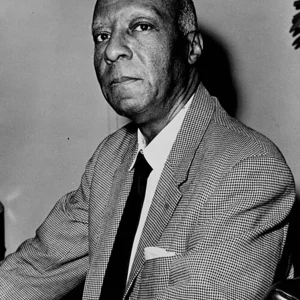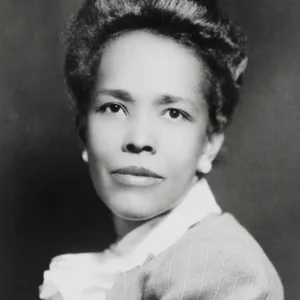

An American civil rights activist, Ella Baker dedicated her life to community organizing and the fight against racial segregation. Co-founder of the SNCC, she shaped a generation of activists by championing collective leadership over individual charisma.
Ella Baker(1903 — 1986)
Ella Baker
États-Unis, Royaume-Uni de Grande-Bretagne et d'Irlande
7 min read
Frequently asked questions
Famous Quotes
« Give light and people will find the way.»
« Strong people don't need strong leaders.»
Key Facts
- 1903: born in Norfolk, Virginia
- 1940–1943: director of NAACP local branches
- 1957: co-founder of the Southern Christian Leadership Conference (SCLC) alongside Martin Luther King
- 1960: co-founder of the Student Nonviolent Coordinating Committee (SNCC)
- 1986: died in New York, on her 83rd birthday
Works & Achievements
Baker's greatest achievement: she organized the founding conference of the SNCC at Shaw University, giving Black students an autonomous tool for resistance that would become the most radical organization of the civil rights movement.
As regional and then national director, Baker built a network of local chapters across the South, bringing NAACP membership to record levels and forging a lasting activist infrastructure.
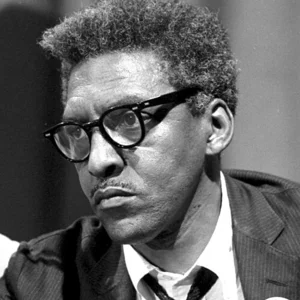
Together with Bayard Rustin and Stanley Levison, Baker co-founded this New York organization to provide financial support to victims of racist repression in the South, particularly in the wake of the Montgomery Bus Boycott.
Baker oversaw the day-to-day operations of the Southern Christian Leadership Conference, structuring the organization while championing a vision of collective grassroots activism that stood in tension with Martin Luther King's charismatic leadership style.
Baker provided crucial organizational support to the MFDP, which sought to challenge the all-white Mississippi delegation at the 1964 Democratic National Convention — a landmark episode in the struggle for voting rights.
Anecdotes
In the 1940s, Ella Baker drove alone through the segregated South to recruit members for the NAACP. Despite the very real dangers — “Whites Only” signs, hostile roads, risks of assault — she traveled thousands of miles, convincing rural communities to join the fight for civil rights.
Ella Baker was in deep disagreement with the vision of the “great charismatic leader” embodied by Martin Luther King Jr. She coined the now-famous phrase: “Strong people don’t need strong leaders.” To her, real power had to come from the people themselves, not from a towering figure at the top.
In April 1960, Baker organized the founding conference of SNCC at Shaw University in Raleigh, North Carolina. She refused to let the students be absorbed into Martin Luther King’s SCLC, insisting they form their own independent organization — a decision that gave birth to the most radical and innovative movement of the civil rights struggle.
Ella Baker died on December 13, 1986, the exact date of her 83rd birthday. She had devoted more than fifty years of her life to community organizing, never seeking the spotlight or honorary titles. Her funeral brought together hundreds of activists she had trained or inspired over the decades.
Baker was known for her extraordinary gift for listening. Where other speakers loved to talk, she asked precise questions and helped ordinary people identify the problems in their community for themselves. This method, which she called “group-centered leadership,” shaped an entire generation of autonomous and empowered activists.
Primary Sources
The student leadership has demonstrated that it will not stop short of its goal of freedom and human dignity. We in the adult community have the obligation to support, encourage, and to assist them in every way possible.
In order for us as poor and oppressed people to become part of a society that is meaningful, the system under which we now exist has to be radically changed.
I have always felt it was a handicap for oppressed peoples to depend so largely upon a leader, because unfortunately in our culture, the charismatic leader usually becomes a leader because he has found a spot in the public limelight.
Progress in the states of the Old South is slow but real. Rural communities are beginning to understand that collective organization is their only protection against the arbitrary enforcement of Jim Crow laws.
Key Places
Ella Baker's birthplace, where she was born on December 13, 1903, into a family that would instill in her a sense of community and resistance to injustice.
A small Southern town where Baker grew up at her maternal grandparents' home, in a close-knit Black community whose spirit of mutual support permanently shaped her vision of collective leadership.
The neighborhood where Baker settled in the 1930s and developed her first activist work, taking part in the intellectual and political ferment of the Harlem Renaissance.
Headquarters of the SCLC, where Baker served as Associate Executive Director from 1957 to 1960, before leaving the organization to allow students to found SNCC on their own terms.
Historic site of the founding conference of SNCC in April 1960, organized by Baker, marking the birth of the most radical student wing of the civil rights movement.
Typical Objects

An essential tool for activist correspondence, Baker drafted reports, organizing letters, and leaflets on her typewriter — the only way to spread information at scale before the digital age.

Indispensable during her NAACP recruitment tours across the South in the 1940s, Baker drove alone through segregated states where every stop could be dangerous for a Black woman.

Baker distributed and collected thousands of these membership cards across the South, with each new member representing a step toward building a network of organized resistance.

Baker took meticulous notes at every community meeting, recording residents' grievances, local contacts, and action strategies — a invaluable activist record.

A central coordination tool for Baker, who spent hours maintaining activist networks across the country, weaving connections between isolated rural communities and national organizations.

A core cultural and symbolic object in Black Southern communities, the Bible served as a shared reference at church meetings — which were essential gathering places for the civil rights movement.
📷 CC BY-SA 2.0 · Wikimedia Commons ↗School Curriculum
Vocabulary & Tags
Key Vocabulary
Tags
Daily Life
Morning
Ella Baker started her days early, often after a night cut short by late meetings. She took time to read the Black press carefully — the Chicago Defender, the Pittsburgh Courier — to stay connected to the realities of the communities she served and to spot local struggles worth supporting.
Afternoon
Her afternoons were devoted to one-on-one conversations and meetings in organization offices, church halls, or activists' homes. She listened more than she spoke, asking pointed questions to help each group define its own strategy for action.
Evening
Evenings were the most intense: community meetings in churches, training sessions for young activists, strategic discussions that stretched past midnight. Baker treasured these late-night exchanges, when people spoke more freely than they did in the middle of the day.
Food
Like many activists of her generation, Baker ate simply, sharing meals with the families who housed her during her tours through the South. Southern Black cuisine — beans, rice, greens, cornbread — was the everyday fare of her recruitment travels.
Clothing
Baker dressed with the careful sobriety of a respected professional: well-tailored suits, elegant hats in keeping with the dress codes of the era. This appearance allowed her to be taken seriously by Black elites and white institutions alike.
Housing
Baker spent most of her life in Harlem, in modest apartments. During her tours through the South, she stayed with activist families — a common practice at a time when hotels were segregated and establishments willing to accommodate Black travelers were extremely rare.
Historical Timeline
Period Vocabulary
Liens externes & ressources
Références
Œuvres
Fondation du SNCC (Student Nonviolent Coordinating Committee)
1960
Travail d'organisation nationale pour la NAACP
1938-1946
Co-fondation d'In Friendship
1956
Direction exécutive associée de la SCLC
1957-1960
Soutien au Mississippi Freedom Democratic Party
1964