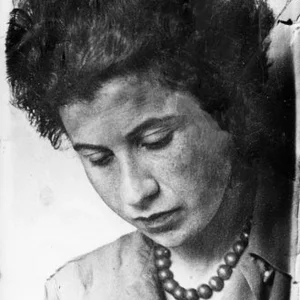

A major Italian novelist of the 20th century, Elsa Morante is known for her powerful works blending realism with a mythic dimension. Her novel *La Storia* (1974) paints a moving portrait of the Second World War through the eyes of ordinary people.
Elsa Morante(1912 — 1985)
Elsa Morante
Italie, royaume d'Italie
8 min read
Frequently asked questions
Famous Quotes
« History is a scandal.»
Key Facts
- Born 18 August 1912 in Rome, died 25 November 1985
- Publication of *La Storia* in 1974, a best-seller both disputed and celebrated
- Viareggio Prize in 1957 for *Arturo's Island*
- Wife of novelist Alberto Moravia from 1941 to 1962
- A major figure of post-war Italian literature
Works & Achievements
Elsa Morante's first major novel, a family fresco blending love, deceit, and illusion against the backdrop of the southern Italian bourgeoisie. Awarded the Viareggio Prize, it immediately reveals her expansive style and mastery of epic storytelling.
A coming-of-age novel recounting Arturo's solitary childhood on the island of Procida, caught between the idealization of his father and the brutal discovery of reality. Awarded the Premio Strega, it is one of the masterpieces of twentieth-century Italian literature.
A hybrid work blending poetry, prose, and song, in which Morante expresses her rejection of consumer society and her faith in the innocence of children in the face of a corrupt adult world. A committed testament to the ferment of 1968.
A monumental novel retracing the Second World War through the eyes of Ida Ramundo, a Roman schoolteacher, and her son Useppe. Deliberately published at a low price to reach the widest possible audience, it established itself as one of the great books of the century.
Elsa Morante's final novel, a dark and introspective account of a man retracing the memory of his lost mother. Often read as Morante's literary testament, written when she was exhausted and ill, it closes an oeuvre haunted by love and loss.
Anecdotes
When La Storia was published in 1974, Elsa Morante made a radical decision: she demanded that Einaudi sell the novel at a very low price in a paperback edition, so that the ordinary people whose lives she was portraying could afford to buy it. This gesture caused a scandal in literary circles, but the book sold hundreds of thousands of copies within its first few weeks.
During the Second World War, Elsa Morante and her husband Alberto Moravia had to flee Rome in 1943 to escape Nazi persecution — Moravia being of Jewish origin. They took refuge for nine months in the mountains of Ciociaria, living in poverty and destitution. This traumatic experience deeply informed La Storia, a novel in which she depicts the war through the eyes of the most downtrodden.
Elsa Morante shared a deep intellectual friendship with the filmmaker and poet Pier Paolo Pasolini, with whom she debated literature, politics, and Italian society. When Pasolini was murdered in November 1975, Morante was devastated by his loss, and her mental health gradually deteriorated in the years that followed.
She began publishing short stories at the age of 18 in Roman literary journals, while giving private lessons to support herself. She had left the family home to live independently, which was still very rare for a young Italian woman in the 1930s.
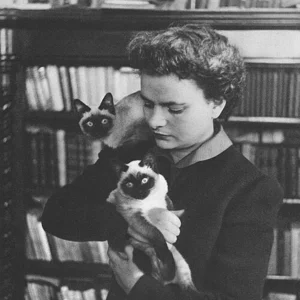
Elsa Morante was known for her extraordinary passion for cats, which she regarded as noble and untameable companions. She took in many throughout her life and gave them a symbolic place in her work, seeing in them a form of freedom from the constraints of the human world.
Primary Sources
Elsa Morante dedicates her novel 'A tutti' (To all), refusing any dedication to an elite and affirming that this story belongs to every human being, to the humble and the forgotten of History.
Morante explains her choice of a low price for La Storia: 'I want this book to be read by the people I write about, not only by those who can afford expensive books.'
Morante develops her vision of literature as the only form of resistance against the destructive power of industrial and military modernity, declaring that the poet and the writer are the last guardians of humanity.
Elsa Morante shares her obsession with the inner truth of characters and her refusal of the purely political or ideological novel, which in her view betrays literature by reducing it to a mere instrument.
Key Places
Born and died in Rome, Morante grew up in the working-class neighborhoods of Trastevere and Testaccio, whose vibrant atmosphere would permeate her entire body of work. The city, the central setting of *La Storia*, was for her both a refuge and a symbol of History with a capital H.
Between 1943 and 1944, Elsa Morante and Alberto Moravia took refuge in this mountainous region south of Rome to flee the Nazis. These nine months of poverty and wandering stand as one of the formative experiences that shaped her vision of war and the downtrodden.
This fishing island in the Gulf of Naples, which Morante visited and deeply loved, inspired the setting of *L'isola di Arturo*, her novel awarded the Premio Strega in 1957. There she found a closed, insular world well suited to exploring childhood and myth.
Elsa Morante and Alberto Moravia lived together in this Roman apartment, which became an informal literary salon frequented by Pasolini, Calvino, and other leading figures of postwar Italian literature.
Morante stayed on Capri several times, an island cherished by Italian artists and intellectuals, where she worked and found renewal. These stays nourished her reflections on beauty, isolation, and the human condition.
Typical Objects

Like many Italian writers of her generation, Morante typed her manuscripts on an Olivetti typewriter, a symbol of postwar Italian literary modernity. She would type her texts after long phases of handwritten preparation.

Morante filled numerous notebooks with drafts, narrative outlines, and psychological portraits of her characters before beginning the final draft. These notebooks bear witness to her meticulous creative process and exacting standards.

An avid reader, Morante owned an extensive library where the great Russian authors (Tolstoy, Dostoevsky), the Bible, Shakespeare, and Italian poets stood side by side. These readings nourished the epic and moral dimensions of her novels.

To write *History*, Morante surrounded herself with photographic documents of occupied and bombed Rome, seeking to faithfully recreate the atmosphere of terror and hardship endured by the civilian population.

Elsa Morante was a heavy smoker, like many intellectuals of her era, and cigarettes were an integral part of her long nocturnal work sessions in her Roman apartment.

Cats held a central place in Morante's daily life; she loved them deeply. Their silent, independent presence was indispensable to her writing, and they appear symbolically in several of her texts.
School Curriculum
Vocabulary & Tags
Key Vocabulary
Daily Life
Morning
Elsa Morante rose late, around 10 or 11 in the morning, according to those close to her. She would begin her morning with a strong coffee and the newspapers, following political news with passionate attention. Mornings were rarely devoted to writing, which she saved for the later hours of the day.
Afternoon
In the afternoons, Morante often went for walks around Rome, observing passersby, markets, and children in the streets of working-class neighborhoods — all living material for her novels. She might also receive friends or fellow writers, with whom she debated literature and politics with a vigor that could sometimes be intimidating.
Evening
It was in the evening and at night that Elsa Morante worked best. She would sit down at her typewriter after dinner and could write until the early hours of the morning, surrounded by her cats. These long, solitary nights were her way of shutting out the world in order to immerse herself fully in the lives of her characters.
Food
Morante appreciated simple, everyday Roman cooking — pasta, vegetables, braised dishes — without any pretension. During the war, she had known hunger in the mountains of the Ciociaria, an experience that left a lasting mark on her relationship with material pleasures and food.
Clothing
Elsa Morante paid little attention to fashion and dressed plainly, as an independent woman unconcerned with bourgeois conventions. She preferred comfortable, practical clothes suited to her long Roman walks and late-night work sessions.
Housing
For many years, Morante lived with Alberto Moravia in an apartment in central Rome on Via dell'Oca, which became an informal literary salon. After their separation in the 1960s, she moved into her own Roman apartment, simply furnished, with books everywhere and her cats as her sole companions.
Historical Timeline
Period Vocabulary
Liens externes & ressources
Références
Œuvres
Menzogna e sortilegio (Mensonge et sortilège)
1948
L'isola di Arturo (L'île d'Arturo)
1957
Il mondo salvato dai ragazzini (Le monde sauvé par les enfants)
1968
La Storia (L'Histoire)
1974
Aracoeli
1982