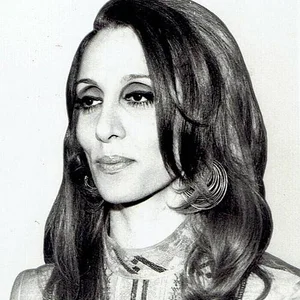

A Lebanese singer born in 1934, Fairuz is considered one of the most iconic voices in the Arab world. A symbol of national unity, she refused to perform for either side during the Lebanese Civil War. Her repertoire, shaped alongside the Rahbani Brothers, blends classical Arab music, Levantine folk traditions, and modern compositions.
Fairuz(1935 — ?)
Fairuz
Liban
9 min read
Frequently asked questions
Key Facts
- Born on November 21, 1934, in Beirut, under the name Nouhad Wadie' Haddad
- Launched her career in the 1950s in collaboration with the Rahbani Brothers composers
- During the Lebanese Civil War (1975–1990), refused to perform for any of the warring factions out of commitment to national unity
- Her repertoire includes more than 1,000 songs and around fifty albums
- Awarded the French Legion of Honor in 1988, along with numerous Arab and international distinctions
Works & Achievements
Song composed by the Rahbani brothers in the wake of the fall of Jerusalem during the Six-Day War. It became one of the most powerful anthems in the Arab world on the Palestinian cause and continues to be broadcast every week in several Arab countries.
A heartrending song set to words by Tunisian poet Fouad Salam, written after the siege and destruction of Beirut in 1982. Fairuz performs it with devastating restraint, transforming personal lament into an anthem of collective resistance.
One of the most celebrated songs in the Arabic-language repertoire and a true standard of Levantine music. Its melody, blending Eastern modes with modern harmonies, exemplifies the musical revolution brought about by the Fairuz-Rahbani trio.
A musical show created for the Baalbeck Festival, weaving together theater, music, and song in a celebration of an imaginary Lebanese village. This operetta, like some twenty others of its kind, asserts Lebanese cultural identity with unparalleled poetic inventiveness.
A romantic ballad showcasing Fairuz's rare ability to move millions of listeners through melodic simplicity and emotional depth. It remains one of the most covered and re-arranged songs in the Arabic-language repertoire.
A live recording of the Baalbeck concerts capturing the unique alchemy between Fairuz's voice, the Rahbanis' compositions, and the monumental setting of the Roman ruins. The album stands as a testament to the artistic peak reached by their collaboration at its height.
Anecdotes
Born Nouhad Haddad in the modest Beirut neighborhood of Zokak el-Blatt, she received her stage name “Fairuz” (turquoise in Arabic) when she began performing at Radio Lebanon in the 1950s. Artistic director Halim El-Roumi, dazzled by her crystalline voice, bestowed this nickname in reference to the beauty and rarity of the precious stone — a name that would endure forever.
During the Lebanese Civil War (1975–1990), Fairuz categorically refused to perform for either armed faction, declaring that she belonged to all Lebanese people without distinction. She chose voluntary exile in Paris rather than lend any legitimacy to her country's division — an act of neutrality that earned her universal respect across the entire Arab world.
In 1967, in the aftermath of the Six-Day War and Israel's capture of East Jerusalem, Fairuz recorded “Zahrat Al-Madâ'in” (The Flower of Cities), a deeply moving lament dedicated to Jerusalem. The song immediately became a pan-Arab anthem and is still broadcast every Friday on Jordanian radio as a mark of collective remembrance.
Her triumphant return to the stage in Beirut in 1994, for a concert at the BIEL, became a powerful symbol of national reconciliation after fifteen years of civil war. Tens of thousands of Lebanese from every religious community queued for hours to hear her voice again in their wounded capital — a moment many witnesses describe as a genuine act of collective healing.
Fairuz is renowned for her near-monastic discretion: she almost never gives interviews and makes public appearances only on rare occasions. Egyptian president Nasser reportedly confided, “Every morning I listen to Fairuz so my day gets off to a good start” — a phrase that captures her status as an icon transcending political borders and rivalries between Arab states.
Primary Sources
“Lebanon is greater than the war. I sing for all Lebanese people, not for one side against another. My voice belongs to no militia.”
“For Beirut, with its wind, with its rain… For Beirut, I weep and I laugh, and I embrace your stones of the sea…”
“We will return to Jerusalem, Jerusalem the flower of cities… I pray for you at the doorway of our homes…”
“Music is my homeland when the homeland is tearing itself apart. I need no words: I sing, and people understand.”
Key Places
A working-class neighborhood of Beirut where Fairuz was born in 1934 into a modest family. This humble milieu shaped her deep connection to ordinary people and inspired the themes of her early artistic period.
It was at Radio Liban that Fairuz made her debut in the 1950s, discovered by musician Mohammed Flayfel and then introduced to the Rahbani brothers. Radio was at the time the primary means of musical distribution throughout the Arab world.
A magnificent Roman archaeological site in the Lebanese Bekaa Valley, which from 1956 onward hosted the Baalbek International Festival. Fairuz gave memorable concerts before its ancient columns, turning this site into a worldwide symbol of Arab culture.
Fairuz went into exile in Paris during the 1980s to escape the Lebanese Civil War, refusing to lend her name to any of the warring factions. There she recorded several albums while maintaining her bond with Lebanon from this symbolic distance.
The venue of Fairuz's historic 1994 concert — her first on Lebanese soil since the end of the civil war. This return before tens of thousands of spectators is regarded as a moment of symbolic national reconciliation.
Typical Objects

Fairuz recorded her first albums at Radio Lebanon in the 1950s using classic ribbon-style microphones. This object embodies her early career and the distinctive sonic warmth that left its mark on an entire generation of Arab listeners.

Assi and Mansour Rahbani composed and orchestrated all of Fairuz's songs on scores blending Western notation with Arabic musical modes (*maqam*). These manuscripts represent the heart of their shared musical revolution.

A central instrument in classical Arab music, the oud frequently accompanies Fairuz's voice in her recordings. Assi Rahbani was himself an oud player, and this fretless string instrument symbolizes the rootedness of her work in the musical tradition of the Levant.

On stage and throughout the Rahbani operettas, Fairuz wore costumes inspired by Lebanese peasant dress, featuring colorful embroidery. These garments contributed to a romantic celebration of Lebanese identity and stood as a cultural affirmation against the surrounding cosmopolitanism.

Fairuz sold tens of millions of vinyl records across the Arab world from the 1950s through the 1980s. These records played in cafés, homes, and on the radio were the primary vehicle for her transcontinental fame, long before the internet.

The Baalbeck International Festival, associated with Fairuz for decades, produced illustrated posters that fused ancient Roman ruins with contemporary creation. These posters symbolized the meeting point between age-old Eastern civilization and modern Arab artistic expression.
School Curriculum
Vocabulary & Tags
Key Vocabulary
Tags
Daily Life
Morning
Fairuz is renowned for her solitary mornings and very regular work habits. She rose early, practiced quiet vocal exercises, and listened to music — European classical and Levantine traditional songs — to train her ear before the day's rehearsals.
Afternoon
Afternoons were devoted to intensive rehearsals with Assi and Mansour Rahbani at their house in Antelias, in the northern suburbs of Beirut. The trio worked on arrangements, memorized lyrics, and refined the nuances of interpretation for hours on end, constantly pushing the boundaries of artistic excellence.
Evening
Evenings, particularly during the summer festival seasons, were given over to stage performances. Fairuz would arrive at the theater with calm composure, collect herself backstage, then take the stage before thousands of spectators who had come from across the Arab world to experience the *tarab*.
Food
Coming from a modest family, Fairuz maintained simple eating habits throughout her life. Traditional Lebanese cuisine — mezze, labneh, pita bread, grilled vegetables, fresh herbs — formed the basis of her diet, far from the ostentatious luxury that her fame could have afforded her.
Clothing
In everyday life, Fairuz is known for great sartorial sobriety, avoiding the flashiness of certain Arab stars. On stage, she wore costumes created by Lebanese couturiers, often inspired by traditional dress: embroidered robes in the colors of the Lebanese mountains, shawls and folk headdresses that reinforced her image as a guardian of cultural identity.
Housing
Fairuz lived in Antelias and then in residential neighborhoods of Beirut with her family. Her home was renowned as a retreat closed to journalists and the curious: she always protected her private life with an almost monastic rigor, cultivating a mystery that only served to amplify her legend.