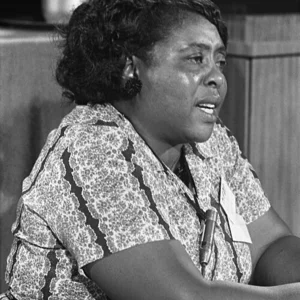

An American civil rights activist, Fannie Lou Hamer was a leading figure in the movement for Black voting rights in Mississippi. Co-founder of the Mississippi Freedom Democratic Party, she challenged American apartheid through her courage and her voice.
Fannie Lou Hamer(1917 — 1977)
Fannie Lou Hamer
États-Unis
9 min read
Frequently asked questions
Famous Quotes
« I'm sick and tired of being sick and tired.»
« Nobody's free until everybody's free.»
Key Facts
- 1917: born in Montgomery County, Mississippi, into a Black sharecropper family
- 1962: attempted to register to vote and was evicted from her plantation
- 1963: arrested and brutally beaten in jail in Winona, Mississippi
- 1964: co-founded the Mississippi Freedom Democratic Party (MFDP) and challenged the all-white Democratic delegation at the national convention
- 1977: died in Ruleville, Mississippi, after a lifetime of fighting for equality
Works & Achievements
Speech delivered live on national American television, demanding the recognition of Mississippi's Black delegates. This testimony about violence and discrimination became one of the founding moments of the civil rights movement.
Alternative political party created to challenge the white, segregationist Democratic Party of Mississippi, allowing tens of thousands of Black citizens excluded from the ballot box to participate symbolically in the democratic process.
Autobiographical text in which Fannie Lou Hamer traces her journey, from her childhood in the cotton fields to her activist commitment. A primary document for understanding the lived reality of Black people in the segregationist South.
Agricultural cooperative founded in Sunflower County to enable poor Black families to access land ownership and food self-sufficiency, feeding up to 1,500 families in one of the most disadvantaged regions of the United States.
The first candidacy of a Black woman for the Mississippi State Senate, made possible by the Voting Rights Act of 1965. Though unsuccessful, it demonstrated the political transformation achieved through years of struggle for voting rights.
Anecdotes
In August 1962, at the age of 44, Fannie Lou Hamer attempted for the first time to register to vote in Sunflower County, Mississippi. On her return, the owner of the plantation where she had lived for eighteen years drove her off his land. She reportedly replied with calm: “I didn’t register for you — I registered for myself.”
In June 1963, returning from a civil rights training workshop in South Carolina, Fannie Lou Hamer was arrested in Winona, Mississippi. In jail, she was savagely beaten on the orders of the guards, who had fellow prisoners carry out the assault. The physical after-effects — damaged kidneys, an injured leg — would cause her suffering for the rest of her life.
On August 22, 1964, Fannie Lou Hamer testified live on national television before the Democratic National Convention in Atlantic City, demanding that the Black delegates of the Mississippi Freedom Democratic Party be seated and recognized. Her speech was so powerful that President Johnson, fearing a political scandal, hastily organized a press conference to draw the cameras away. The networks broadcast her full testimony that same evening, reaching millions of Americans.
In 1969, Fannie Lou Hamer founded the Freedom Farm Cooperative in Sunflower County. Using funds collected partly from supporters in the North, she purchased farmland that poor Black families could cultivate collectively to feed themselves. At its peak, the cooperative fed more than 1,500 families in one of the most disadvantaged regions of the United States.
Despite the fame she had gained after the 1964 convention, Fannie Lou Hamer lived until the end in relative poverty in Ruleville, Mississippi. In 1976, shortly before her death, she declared in an interview: “I’m exhausted from being exhausted from being exhausted” — an echo of her famous phrase “I’m sick and tired of being sick and tired,” which had become the rallying cry of an entire generation of activists.
Primary Sources
All of this is on account we want to register, to become first-class citizens, and if the Freedom Democratic Party is not seated now, I question America.
I used to think that if I could go North, I would be free. There's no such thing as being free anywhere in the United States for a Negro.
I'm sick and tired of being sick and tired. We have a chance here to do something that hasn't been done in this state before.
They beat me and they beat me with the long flat blackjack. I screamed to God in pain.
Key Places
A county in the Mississippi Delta where Fannie Lou Hamer was born in 1917, the twentieth child of a sharecropping family. This deeply segregationist territory was both the site of her oppression and the arena of her political struggle.
A small town in the Delta where Fannie Lou Hamer lived and worked as a sharecropper on the Marlow plantation. It was from here that she set out to register to vote in 1962, and where she carried out her community organizing work.
In June 1963, Fannie Lou Hamer was arrested here and beaten by guards upon returning from a voter registration training workshop. This episode, recounted before the Civil Rights Commission, illustrates the state violence used to suppress the movement.
The site of Fannie Lou Hamer's historic testimony before the Democratic National Convention on August 22, 1964. Her televised speech, describing the violence she had endured, brought her struggle to the attention of all of America.
An agricultural cooperative founded by Fannie Lou Hamer in 1969, giving hundreds of poor Black families access to land so they could grow their own food. A symbol of her commitment to economic self-sufficiency.
A historically African American town in the Delta where Fannie Lou Hamer died on March 14, 1977. Her funeral drew several thousand people from across the country, gathered to pay tribute to this towering figure of the civil rights movement.
Typical Objects
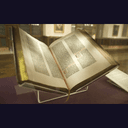
Daughter of a deeply Christian family, Fannie Lou Hamer always carried a Bible. Her faith was the foundation of her commitment: she would lead negro spirituals before every meeting to give courage to the activists.
📷 CC BY-SA 2.0 · Wikimedia Commons ↗
This simple administrative document was at the heart of Hamer's struggle. In 1962, attempting to fill it out cost her her home and her job — but marked the beginning of her activism.

Fannie Lou Hamer's powerful, melodic voice was her primary weapon. Her testimony at the microphone before the 1964 Democratic National Convention remains one of the most moving speeches in the history of the civil rights movement.

Having started working in the cotton fields at the age of six, Fannie Lou Hamer spent most of her life farming the land as a sharecropper. These tools symbolize the economic reality of segregation: backbreaking work with no ownership and no rights.

In 1964, tens of thousands of Black Mississippians registered with the MFDP, a parallel party created to challenge the white, segregationist Democratic Party. Simply holding this card was an act of political resistance.

Fannie Lou Hamer dressed with the plainness of rural African American women from the South. Even during television appearances, she refused to present herself as anything other than who she was — that authenticity only strengthened the power of her message.
School Curriculum
Vocabulary & Tags
Key Vocabulary
Tags
Daily Life
Morning
Fannie Lou Hamer rose at dawn, like every sharecropper in the Mississippi Delta. Before sunrise, she headed to the cotton fields to begin picking — exhausting work she had known since the age of six. She would often sing negro spirituals while working, a habit that stayed with her throughout her life, from the fields to activist meetings.
Afternoon
During her years of activism (1962–1977), her afternoons were devoted to community organizing: visiting Black families to persuade them to attempt to register on the electoral rolls, holding meetings in churches, and running civil rights training sessions. These gatherings often took place in discreet locations, as the threat from white supremacist groups was constant.
Evening
Evenings were the time for large political gatherings in Mississippi churches. Fannie Lou Hamer would take the floor with a natural eloquence, weaving political speeches together with religious songs. Negro spirituals — such as “This Little Light of Mine” — were for her both a tool for mobilization and an act of faith.
Food
Like most Black sharecroppers in Mississippi, Fannie Lou Hamer ate simply: beans, corn, garden vegetables, salt pork. Hunger was not an abstraction — one of the driving forces behind the Freedom Farm Cooperative was precisely to ensure that Black families could feed themselves without depending on hostile white landowners.
Clothing
Fannie Lou Hamer dressed with the simplicity of rural African American women in the South: printed cotton dresses suited to the heat and physical labor, often covered by an apron. Even during her public and televised appearances, she refused to present herself as anything other than what she was — this authenticity only strengthened the power of her message.
Housing
For decades, Fannie Lou Hamer lived in a simple sharecropper's house on the Marlow plantation in Ruleville — housing that belonged to her employer. After her eviction in 1962, she settled in a modest house in Ruleville, surrounded by the structural poverty that defined Black life in the segregationist South.
Historical Timeline
Period Vocabulary
Liens externes & ressources
Références
Œuvres
Témoignage à la Convention nationale démocrate
22 août 1964
Cofondation du Mississippi Freedom Democratic Party (MFDP)
Avril 1964
To Praise Our Bridges — récit autobiographique
1967
Candidature au Sénat de l'État du Mississippi
1971