 flip
flipWhite Emmer Bread from the House of Potiphar
White Emmer Bread from the House of Potiphar
Why this dish? Mistress of a great Egyptian house, she had the finest white bread, kneaded by servants in heated molds. This superior bread, reserved for people of rank, graced her table every day — far from the coarse flatbread of the fields.
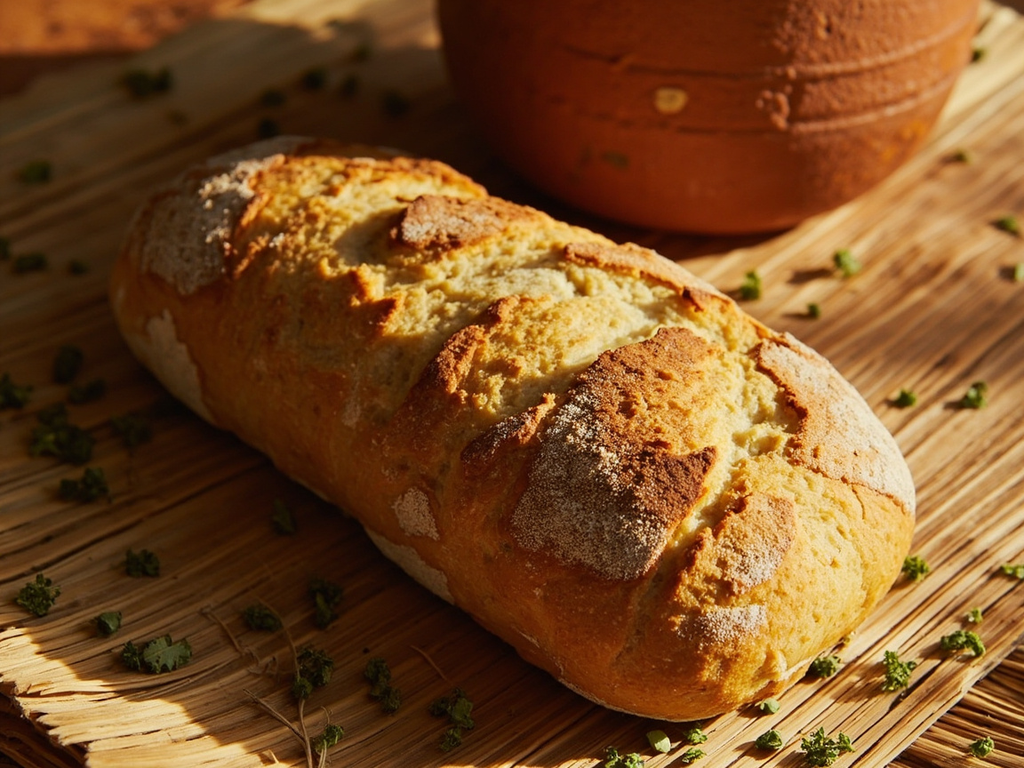
A dense, golden loaf of emmer wheat (the ancestor of Egyptian wheat), lightly salted and spiced with a hint of coriander, baked in a clay mold. The daily bread of the elite, the foundation of every meal and every offering.
Approach, stranger, and see what my maids knead before the sun is high. The grain is ground, winnowed, and sifted until the flour is white as the linen of my robe — no bran or millstone dust under my people's teeth. The clay mold is heated in the fire, the dough is poured in, and the bread rises full and tender. Let the serfs chew their barley cakes: on the table of a house like mine, the bread must be worthy to be set before the gods.
- •Finely sifted emmer wheat flour (Egyptian wheat) — a large bowlful (base)
- •Sourdough starter from yesterday's dough — a handful (fermentation)
- •Warm Nile water — as needed for consistency (binding)
- •Sea salt — a pinch (seasoning)
- •Crushed coriander seeds — a few (flavoring)
White Emmer Bread from the House of Potiphar
A dense, golden loaf of emmer wheat (the ancestor of Egyptian wheat), lightly salted and spiced with a hint of coriander, baked in a clay mold. The daily bread of the elite, the foundation of every meal and every offering.
Why this dish? Mistress of a great Egyptian house, she had the finest white bread, kneaded by servants in heated molds. This superior bread, reserved for people of rank, graced her table every day — far from the coarse flatbread of the fields.
Approach, stranger, and see what my maids knead before the sun is high. The grain is ground, winnowed, and sifted until the flour is white as the linen of my robe — no bran or millstone dust under my people's teeth. The clay mold is heated in the fire, the dough is poured in, and the bread rises full and tender. Let the serfs chew their barley cakes: on the table of a house like mine, the bread must be worthy to be set before the gods.
Ingredients (period version)
- Finely sifted emmer wheat flour (Egyptian wheat) — a large bowlful (base)
- Sourdough starter from yesterday's dough — a handful (fermentation)
- Warm Nile water — as needed for consistency (binding)
- Sea salt — a pinch (seasoning)
- Crushed coriander seeds — a few (flavoring)
Ingredients
- Small spelt flour (or spelt flour) — 500 g (base)
- Active sourdough starter (or 7 g dry yeast) — 100 g (fermentation)
- Warm water — about 300 ml (binding)
- Fine salt — 1 tsp (seasoning)
- Crushed coriander seeds — 1 tsp (flavoring)
Method
- Mix the flour, salt, and coriander, then incorporate the starter and water to form a soft dough.
- Knead for 10 minutes until smooth, cover with a damp cloth, and let rise for 3 to 4 hours.
- Fold the dough, shape it into a small greased clay or cast-iron mold, and let rise for another hour.
- Bake in a hot oven (220 °C) for 30 to 35 minutes until the crust sounds hollow.
- Let cool slightly, then break the bread by hand, Egyptian style.
How it was made : The Egyptians baked bread in preheated conical molds (*bedja*) or directly under ash. Emmer wheat (*Triticum dicoccum*) and barley were the main cereals; the fineness of sifting distinguished the bread of the rich from that of the common people. Bread also served as currency and funerary offering.
The contemporary twist : Presented as a round loaf slit with a line, brushed with orange blossom water and sprinkled with toasted coriander, in the style of a "Pharaoh's bread" from an artisan bakery.
Potiphar's Wife · Charactorium