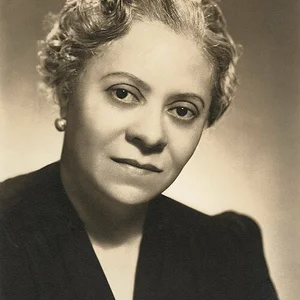

Florence Price (1887-1953) was an American composer and pianist, the first African American woman to have a symphony performed by a major American orchestra. Her work blends European classical influences with African American spirituals.
Florence Price(1887 — 1953)
Florence Price
États-Unis
9 min read
Frequently asked questions
Key Facts
- 1887: Born in Little Rock, Arkansas
- 1906: Graduated from the New England Conservatory of Music
- 1933: Her Symphony No. 1 premieres with the Chicago Symphony Orchestra — a first for an African American woman composer
- She composed over 300 works (symphonies, concertos, piano pieces, songs)
- 1953: Dies in Chicago; her scores are rediscovered in 2009 in an abandoned house
Works & Achievements
Winner of the 1932 Wanamaker Prize, premiered by the Chicago Symphony Orchestra in 1933. The first symphony by an African American woman performed by a major American orchestra, the work weaves spirituals and juba dance into a European classical form.
Also awarded a Wanamaker Prize in 1932, this sonata reveals Price's full command of classical form, enriched with blues inflections and African American spirituals.
Premiered by Florence Price herself at the piano with the Women's Symphony Orchestra of Chicago, this concerto showcases her dual career as a virtuoso performer and ambitious composer.
An arrangement for voice and orchestra of this traditional African American spiritual, popularized by contralto Marian Anderson. One of Price's most frequently performed pieces, it stands as a symbol of her deliberate rootedness in the Black American musical tradition.
Long unknown to the general public, it was rediscovered among the 2009 manuscripts and recorded for the first time in the twenty-first century. It confirms the breadth of Price's orchestral language beyond the symphony alone.
Rediscovered among the 2009 manuscripts, this symphony confirms the maturity and stylistic ambition Price brought to large-scale orchestral writing at the end of her career.
Anecdotes
In 1933, Florence Price's Symphony No. 1 was performed by the Chicago Symphony Orchestra at the “Century of Progress” World's Fair. It was the first time a major American orchestra had performed a symphony composed by an African American woman — a historic triumph wrested from a deeply segregationist America.
In 1943, Florence Price wrote a poignant letter to conductor Serge Koussevitzky: “I have two handicaps — that of being a woman and that of having Black blood in my veins. I wish to be judged on my merits.” This letter, discovered in the Boston archives, illustrates the obstacles the composer faced throughout her life.
In 2009, buyers discovered in an abandoned house in St. Anne, Illinois, entire crates of Florence Price's scores, believed lost since her death. These manuscripts revealed a substantial body of work and sparked a worldwide reassessment of her place in the history of American music.
Following a wave of racial violence in Arkansas, Florence Price left Little Rock in 1927 with her two daughters to settle in Chicago, a hub of the Great Migration. There she taught piano to make ends meet and composed without ceasing, transforming her forced exile into an extraordinary outpouring of creative work.
In 1932, Florence Price won first prize from the Wanamaker Foundation for both her Symphony No. 1 and her Piano Sonata. This double triumph caught the attention of conductor Frederick Stock, who decided to program her symphony with the Chicago Symphony Orchestra — a decisive moment for the recognition of Black American composers.
Primary Sources
To begin with I have two handicaps — those of sex and race. I am a woman; and I have some Negro blood in my veins. I should like to be judged on merit alone. Will you be so kind as to look at my orchestral score?
Symphony in E minor, Florence B. Price — world premiere by the Chicago Symphony Orchestra, conducted by Frederick Stock, at the Century of Progress World's Fair.
First Prize: Florence B. Price, Symphony in E minor. First Prize: Florence B. Price, Piano Sonata in E minor. The Wanamaker Foundation recognized works by African-American composers submitted in competition.
Florence Beatrice Smith completed with distinction the composition and organ program at the New England Conservatory of Music, Boston, Massachusetts.
Price discusses her difficulties in having her orchestral works performed by major American musical institutions, and the necessity for a Black woman to assert her talent in an environment doubly closed to her.
Key Places
Florence Price's hometown, where she grew up in a cultured family and began her musical career. The racially segregated environment of the American South profoundly shaped her path and ultimately forced her into self-imposed exile to the North.
The institution where Price completed her advanced training in composition and organ (1903–1906), graduating with distinction despite the racial discrimination she faced upon enrollment.
The city Price adopted when she settled there in 1927, spending the greater part of her creative career within its boundaries. Chicago, a hub of the Great Migration, offered her a vibrant African American artistic community and professional opportunities that were out of reach in the South.
The hall where the Chicago Symphony Orchestra premiered her Symphony No. 1 in June 1933, during the Century of Progress World's Fair. This landmark moment secured Florence Price's place in the history of American music.
The Illinois village where, in 2009, hundreds of Florence Price's autograph manuscripts were discovered in an abandoned house — sparking a worldwide reassessment of her work and her place in the American classical repertoire.
Typical Objects

The central instrument in Florence Price's life, both as a concert pianist and as a tool for composition. She taught piano lessons at her Chicago home to support herself financially while composing her major orchestral works.

Price composed entirely by hand, filling manuscript notebooks with the staves of her symphonies, concertos, and songs. Hundreds of these pages were discovered in 2009 in an abandoned house in Illinois.

Price drew on the sacred songs of the Black American tradition to shape her musical language. These spirituals, born during the era of slavery, are one of the foundational sources of her style.

A prize-winning masterwork in 1932, premiered by the Chicago Symphony Orchestra in 1933. The original score nearly vanished forever and is today a major piece of heritage in American musical history.

An essential tool for any piano teacher of the era. Price gave lessons for decades to fund her composing career, often sacrificing time she might have spent creating in order to teach.

Proof of the rigorous classical training she received at one of Boston's most prestigious institutions, despite the racial barriers she had to navigate in order to gain access.
School Curriculum
Vocabulary & Tags
Key Vocabulary
Tags
Daily Life
Morning
Florence Price rose early to dedicate the first hours of the day to composition, before her teaching duties began. She worked at her desk or directly at the piano in her South Side Chicago apartment, writing out her scores by hand in manuscript notebooks.
Afternoon
The afternoon was largely devoted to piano lessons for her students, the main source of income for this single mother raising her two daughters alone after her divorce. She welcomed students into her home, in African American neighborhoods where demand for musical instruction was high.
Evening
In the evenings, Price took part in Chicago's vibrant cultural life: concerts, meetings of the National Association of Negro Musicians, and gatherings with fellow composers and performers. She often worked late into the night by lamplight, making clean copies of her scores.
Food
Like most African American families in Chicago at the time, Price cooked according to Southern culinary traditions: slow-simmered vegetables, braised meats, and cornbread. Resources were often tight, as the Great Depression of the 1930s hit even professional musicians hard.
Clothing
Price dressed with the understated elegance befitting a respectable teacher and musician of the Black American middle class: long dresses in classic cuts, often dark or with subtle patterns. For public appearances and concerts, she wore more polished outfits — a mark of dignity and membership in an African American cultural elite keenly aware of its image.
Housing
In Chicago, Price lived in the South Side neighborhoods, the historic heart of the city's African American community. Her home was modest but well kept, and housed a grand piano essential to her dual daily work as composer and music teacher.