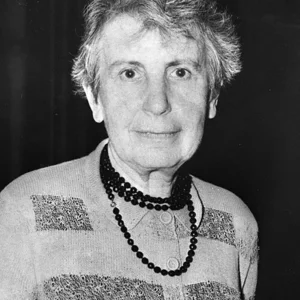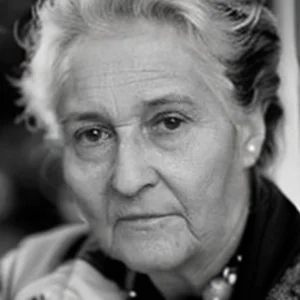

French pediatrician and psychoanalyst (1908–1988), Françoise Dolto revolutionized the understanding of children and their psychological development. She brought psychoanalysis to a wide public audience and championed children's rights.
Françoise Dolto(1908 — 1988)
Françoise Dolto
France
8 min read
Frequently asked questions
Famous Quotes
« Everything is language.»
« Children are human beings in their own right.»
Key Facts
- 1908: born in Paris
- 1939: receives her medical degree and trains in psychoanalysis with Jacques Lacan
- 1976: creation of the Maison Verte, a welcoming space for young children and their parents
- 1977–1978: radio broadcasts "Lorsque l'enfant paraît" on France Inter, making psychoanalysis accessible to the general public
- 1988: dies in Paris
Works & Achievements
Her medical thesis, the first to bring together psychoanalysis and pediatrics in France. She argues that the child is a full subject from birth, laying the groundwork for her entire body of work.
A detailed clinical account of the psychoanalytic treatment of a severely troubled adolescent. An international reference, it illustrates her method of radical listening and her absolute trust in the child's own voice.
A transcription of her radio programme on France Inter. These three accessible volumes form a practical compendium on child-rearing and development, selling hundreds of thousands of copies.
A reading of the Gospels through a psychoanalytic lens. This bold work reveals the spiritual and humanist dimension of her thought, in which she sees Jesus as a therapist who treats people as subjects in their own right.
Her great autobiographical and political manifesto for children's rights. She traces her own journey and calls for a cultural revolution in the way society regards and treats its children.
A collection of lectures summarising her thinking on the language of the body, symptoms, and behaviour. One of her most synthetic and accessible works for understanding her method.
A profound meditation on solitude as a fundamental human condition, written late in life. Dolto explores the necessity of creative solitude for the developing child.
Anecdotes
At the age of twelve, Françoise loses her sister Jacqueline, carried off by typhoid fever. Her mother, devastated by grief, tells her she would have preferred it to be Françoise who disappeared. This founding trauma becomes the driving force of her entire vocation: understanding and defending the psychological suffering of the child, so that no child would ever again be treated as a second-rate being.
In 1939, Françoise Dolto defends her medical thesis on “Psychoanalysis and Pediatrics,” combining the two disciplines in France for the first time. Her medical jury, skeptical of the approach, considers the work revolutionary but unorthodox. This pioneering study, not published until 1971, lays the foundations of French psychoanalytic child psychiatry.
From 1976 to 1978, Françoise Dolto answers parents’ questions live on France Inter in the program “When the Child Appears.” The success is staggering: hundreds of thousands of letters pour into the radio station. For the first time in France, child psychoanalysis enters ordinary kitchens and living rooms, demystified by a gentle and direct voice.
In 1979, Françoise Dolto co-founds La Maison Verte in Paris, a welcoming space where parents can bring children under three years old without appointments or therapeutic goals. The idea, radical for its time, is to prevent psychological difficulties before they take root. The place still exists today and has inspired hundreds of similar initiatives around the world.
In her famous “Dominique case” (1971), Dolto treats an adolescent who communicates only through a language of incomprehensible neologisms. Through drawing sessions and free exchanges, she deciphers his inner world and gives him back his voice. This clinical account, published in full with her notes, becomes a reference manual for psychoanalysts working with children and adolescents in severe distress.
Primary Sources
From birth, the child is a full subject in their own right, whose inner life deserves to be heard and respected. To treat a child is to treat a desiring being, not a mere object of care.
What guided me in Dominique's treatment was the conviction that everything he expressed had meaning, even when that meaning eluded me at first. I had to trust him as a speaking subject.
Children often suffer because adults have not spoken truthfully to them. A child who is lied to about their situation becomes anxious, because they sense the truth without being able to name it.
Children are people. They have rights. They have a psychic life even before birth. The fact that they cannot yet vote does not mean they have nothing to say about their own lives.
The body speaks. Symptoms speak. When a child is repeatedly ill, when they stutter, when they wet the bed, they are saying something that no one has yet heard in words.
Key Places
Birthplace of Françoise Marette, born into a bourgeois Catholic family. It was in this comfortable yet emotionally rigid environment that she developed her deep sensitivity to the suffering of misunderstood children.
The hospital where Dolto worked as a pediatrician and conducted her first psychoanalytic consultations with children. It was here that she refined her method uniting medicine and psychoanalysis.
A parent-child drop-in center co-founded by Dolto in 1979, open without appointments to children under three and their families. An international model for early childhood mental health prevention, it remains active today.
The studio from which the programme "Lorsque l'enfant paraît" was broadcast on France Inter (1976–1978), introducing Dolto to millions of French listeners and transforming the way parents related to child psychology.
Her Parisian practice, at the heart of the city's intellectual neighbourhood, where she saw patients for decades and rubbed shoulders with the leading figures of French psychoanalysis, including Jacques Lacan.
Typical Objects

Dolto used drawing as a central therapeutic tool with children. She asked them to draw themselves in order to access their "unconscious body image," a founding concept of her entire theory.

Inherited from the Freudian tradition, the couch allowed patients to speak freely. Dolto adapted it for children, who could draw or play rather than lie still.

The emblematic object of her popular reach. The France Inter microphone allowed her to connect with millions of families from 1976 to 1978 and to bring child psychoanalysis to a mainstream audience in France.

Dolto kept meticulous notes on each of her patients after every session. These clinical records fed into her major works, including the celebrated "Case Dominique."

Her consulting room was filled with games and symbolic objects. For Dolto, play is the child's natural language and reveals their inner conflicts more clearly than any direct conversation.

Hundreds of thousands of letters were sent to her, especially following her radio program. She personally replied to many of them, seeing it as a direct extension of her clinical work.
School Curriculum
Vocabulary & Tags
Key Vocabulary
Daily Life
Morning
Françoise Dolto began her days very early, often with reading and correspondence. She personally replied to many letters from parents who wrote to her, viewing this task as a direct extension of her clinical work and social mission.
Afternoon
Her afternoons were devoted to consultations in her Parisian practice, where she received children of all ages and their families. Her sessions, sometimes lengthy and unconventional, could include drawing, free play, and exchanges that seemed innocuous but were clinically invaluable.
Evening
In the evenings, Dolto would write up her clinical notes, work on her books, or attend seminars and lectures. She moved in Parisian intellectual circles and maintained regular exchanges with Jacques Lacan and other psychoanalysts of her generation.
Food
Coming from a bourgeois Catholic family, Dolto had grown up in a traditional French culinary culture. In her writings, she emphasized the importance of family meals as a vital moment of socialization and conversation for children, long before academic studies on commensality.
Clothing
Françoise Dolto had a simple, unpretentious appearance, with no sartorial ostentation. She stood out through her piercing gaze and distinctive voice rather than her style, typically wearing classic, functional outfits — those of a practitioner above all.
Housing
She lived and worked in Paris, in an apartment-cum-practice typical of the Parisian intellectual bourgeoisie. Her consultation space was intentionally arranged to put children at ease, with toys, illustrated books, and drawing materials within easy reach.
Historical Timeline
Period Vocabulary
Liens externes & ressources
Références
Œuvres
Psychanalyse et Pédiatrie
1939 (thèse), publié 1971
Le cas Dominique
1971
Lorsque l'enfant paraît (3 volumes)
1977-1979
L'Évangile au risque de la psychanalyse (2 volumes)
1977-1978
La Cause des enfants
1985
Tout est langage
1987
Solitude
1987