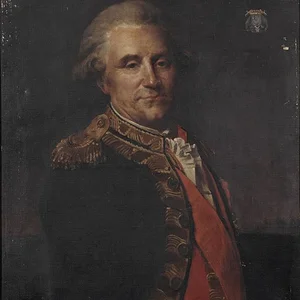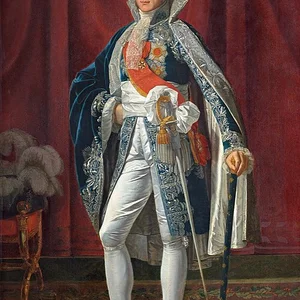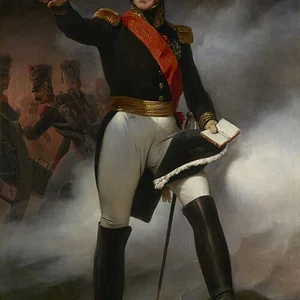

French general who served in the Revolutionary and Napoleonic Wars, distinguishing himself at Zurich, Wagram, and in Spain. Elevated to the dignity of Marshal of France in 1823 following the Spanish campaign under the Restoration.
Gabriel Molitor(1770 — 1849)
Gabriel Jean Joseph Molitor
France
9 min read
Frequently asked questions
Key Facts
- 1791: enlists as a volunteer in the armies of the Revolution
- 1799: distinguishes himself at the Battle of Zurich under Masséna
- 1809: takes part in the Battle of Wagram
- 1823: commands an army corps during the French intervention in Spain (the Hundred Thousand Sons of Saint Louis)
- 1823: elevated to the dignity of Marshal of France by Charles X
Works & Achievements
For several days, Molitor held the position at Zurich against numerically superior Russian forces, allowing Masséna to prepare his decisive victorious maneuver. This military feat is regarded as the founding exploit that established his reputation as a steady and reliable general.
Leading his infantry division at the decisive Battle of Wagram, Molitor contributed to the French victory over Archduke Charles's Austrian army. Napoleon personally praised his conduct in the official bulletins of the Grande Armée.
Molitor commanded one of the four corps of the Army of the Pyrenees during the French intervention in Spain under the Restoration. His column advanced into Catalonia and secured the capitulation of the Spanish constitutional forces, earning him the marshalate of France.
Following his elevation to the marshalate, Molitor sat in the Chamber of Peers and held various command positions under the Restoration and the July Monarchy. His later career illustrates the ability of veterans of the Revolution and the Empire to find their place in post-Napoleonic France.
Anecdotes
During the Second Battle of Zurich in September 1799, Molitor was ordered to defend the city's bridgehead with a handful of men against the Russian troops of Marshal Suvorov. For several days he withstood repeated assaults, holding his position until the arrival of Masséna, who won a decisive victory over the coalition forces. This episode made Molitor one of the heroes of the Swiss campaign and definitively launched his career.
At the Battle of Wagram in July 1809, Molitor commanded an infantry division and had to contend with fierce Austrian counterattacks under murderous artillery fire. His composure and steadiness impressed his superiors so greatly that Napoleon praised him in the bulletins of the Grande Armée. It was this kind of battlefield endurance that forged his reputation as a dependable general who could be counted on in the most difficult moments.
In 1823, Molitor commanded one of the four columns of the Army of the Pyrenees during the French intervention in Spain, aimed at restoring Ferdinand VII to his constitutional throne. His column crossed the Pyrenees, swept aside Spanish forces in Catalonia, and contributed to the swift collapse of Madrid's liberal regime. As a reward for this success, Louis XVIII awarded him the baton of Marshal of France in September 1823, crowning a military career spanning more than thirty years.
Born into a modest family from Lorraine, Molitor climbed every rung of the military hierarchy on merit alone, rising from common soldier to Marshal of France over half a century. His journey perfectly embodies the military meritocracy born of the Revolution, where valor in combat mattered more than noble birth. He stands as a representative of that generation of soldiers who rose from the ranks and whom the Revolutionary Wars propelled to the highest offices of the state.
Primary Sources
We held our positions for five days against forces vastly superior in number, repelling each attack with the utmost determination. The soldiers performed prodigies of valor and deserve the highest commendation of the Republic.
The King, wishing to give Lieutenant-General Count Molitor a signal mark of his satisfaction for the eminent services he rendered at the head of his army corps in Spain, appointed him Marshal of France by ordinance of 19 September 1823.
Molitor's division distinguished itself by the steadfastness of its resistance and the vigor of its attacks; the general displayed throughout that day all the qualities that mark a great military commander.
I must make particular mention of General Molitor, whose stubborn resistance at the Zurich bridgehead made possible the maneuver that decided the day in our favor.
Key Places
Town in Lorraine where Gabriel Molitor was born on 26 November 1770. This border region, historically contested between France and the Germanic Empire, shaped the combative and tenacious character of the future marshal.
The scene of the defining feat of arms that made Molitor's reputation: in September 1799, he held the city's bridgehead for several days against the Russian forces of Marshal Suvorov, allowing Masséna to win a decisive victory.
On the plains of Wagram in July 1809, Molitor commanded a division during one of the largest battles of the Napoleonic era. His steadiness under fire earned him personal praise from Napoleon in the bulletins of the Grande Armée.
In 1823, Molitor crossed the Pyrenees at the head of an army corps to restore Ferdinand VII to the Spanish throne. His swift campaign in Catalonia against the constitutional forces earned him the baton of Marshal of France.
The capital where Molitor settled in the latter part of his career, holding various official positions under the Restoration, and where he died on 28 January 1849. He was buried at Père-Lachaise Cemetery, the pantheon of France's great figures.
Typical Objects

The supreme emblem of French military dignity, the marshal's baton was presented to Molitor in 1823. Covered in blue velvet strewn with gold stars, it symbolized the reward of an entire career in the service of France.

The weapon carried by Molitor throughout his campaigns, the slightly curved-blade sabre was the visible symbol of a general's authority on the battlefield and during troop reviews.

An indispensable tool for any Napoleonic general, the spyglass allowed Molitor to observe enemy movements from his command post. It was with this instrument that he directed his divisions during major battles such as Zurich and Wagram.

The blue coat with gold epaulettes and the bicorne with its white plume — hallmarks of Empire generals — gave Molitor a recognizable silhouette amid the chaos of battle and reinforced his visual authority over his troops.

Topographic maps were General Molitor's daily working tool for planning operations and choosing routes. The Napoleonic cartographic school had greatly improved the accuracy of these representations of the terrain.

Founded by Napoleon in 1802, the *Légion d'honneur* rewarded civil and military services rendered to the nation. Molitor, raised to its highest grades, wore the star-shaped plaque at official ceremonies under both the Empire and the Restoration.
School Curriculum
Vocabulary & Tags
Key Vocabulary
Daily Life
Morning
During campaigns, Molitor rose before dawn to receive reports from his staff officers and examine maps with them before any movement. He personally inspected the outposts, checked the condition of his troops, and issued his orders for the day. These studious mornings, often in the cold of the bivouac, were essential to the tactical preparation of his operations.
Afternoon
The afternoon was devoted to military operations proper: column movements, terrain reconnaissance, engaging or pursuing the enemy. From an elevated vantage point, telescope in hand, Molitor observed the progress of the battle and relayed his orders via mounted couriers. Outside of combat, he received reports from his brigade generals and planned the following day's movements.
Evening
In the evenings at the bivouac, Molitor gathered his staff to review the day and settle the dispositions for the next. He wrote or dictated his reports to his superiors and official correspondence by the light of a lantern. These evenings ended early, as the military dawn always began before sunrise.
Food
In camp, the general often shared the condition of his soldiers: vegetable soup, camp bread, salted or smoked meat. During stops in towns, he had access to locally requisitioned resources, including wine, fresh meat, and white bread. The table of a Napoleonic general constantly swung between the austerity of the bivouac and the abundance of the towns passed through.
Clothing
On campaign, Molitor wore the blue coat of a division general, adorned with gold-fringed epaulettes and regulation embroidery, completed by riding boots and a plumed bicorne. After 1823, the Marshal of France uniform — even more laden with insignia and embroidery — was reserved for the grand ceremonies of the Restoration and the July Monarchy. These costly outfits represented a considerable investment for senior officers.
Housing
In the field, Molitor lodged in a command tent pitched as close as possible to his troops, or in a requisitioned house converted into headquarters. During lengthy campaigns such as those in Spain, he occupied the residences of local notables, adapted to the needs of command. Upon returning to Paris at the end of his career, he resided in a private mansion befitting his rank as Marshal and Peer of France.
Historical Timeline
Period Vocabulary
Liens externes & ressources
Références
Œuvres
Défense de la tête de pont de Zurich
Septembre 1799
Commandement d'une division à la bataille de Wagram
5-6 juillet 1809
Campagne d'Espagne — Corps de Catalogne
Avril-septembre 1823
Pair de France et gouvernorat militaire
1823-1849