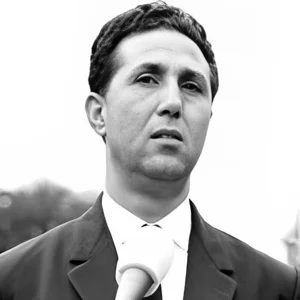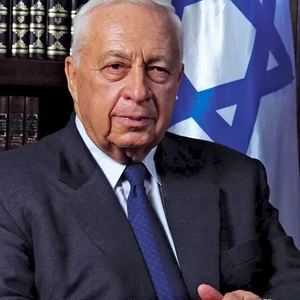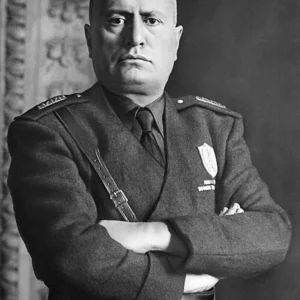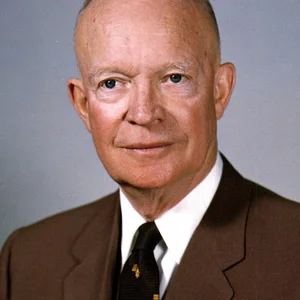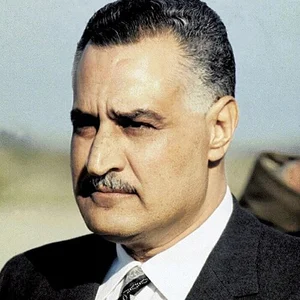

Egyptian military officer and statesman (1918–1970), Nasser was the chief architect of the 1952 revolution that overthrew the monarchy. President of Egypt from 1956 until his death, he became the embodiment of Arab nationalism and Third Worldism.
Frequently asked questions
Famous Quotes
« The Suez Canal belongs to the Egyptians.»
« We shall not allow anyone to control our resources or our sovereignty.»
Key Facts
- 1952: Co-leads the Free Officers' coup that overthrows King Farouk
- 1956: Nationalizes the Suez Canal, triggering the Suez Crisis against France, the United Kingdom, and Israel
- 1958–1961: Founds the United Arab Republic (a union of Egypt and Syria)
- 1967: Suffers military defeat against Israel in the Six-Day War
- 1970: Dies of a heart attack, mourned by millions across the Arab world
Works & Achievements
A landmark political act by which Egypt reclaimed control of an infrastructure built by its own workers but operated by a Franco-British company. The event triggered the Suez Crisis and made Nasser the defining symbol of decolonization across the Arab world.
A programmatic text in which Nasser laid out his vision of Egypt at the crossroads of three circles: Arab, African, and Islamic. It is the ideological manifesto of Nasserism, translated into numerous languages and studied in universities throughout the Arab world.
The founding document of Nasserist 'Arab socialism,' defining a program of nationalizing major enterprises, land reform, and a welfare state. It shaped Egypt's economic and social policy for decades to come.
A political union of Egypt and Syria under Nasser's presidency, the first concrete attempt at Arab unity since the medieval Arab conquests. Despite its collapse three years later, it remains the most powerful symbol of the pan-Arab dream.
A massive construction project financed and built with Soviet assistance after the United States withdrew its support, designed to tame the Nile, irrigate 400,000 hectares, and supply half of Egypt's electricity. It remains the most visible material legacy of Nasserism, despite its controversial ecological consequences.
Within the first weeks of the revolution, Nasser championed a law capping land ownership at 200 feddans per family and redistributing land to landless peasants (fellahs). The measure broke the power of the great feudal families and won the Egyptian countryside over to the revolution.
Anecdotes
On July 26, 1956, during a speech in Alexandria, Nasser repeatedly uttered the name 'Ferdinand de Lesseps,' founder of the Suez Canal Company. It was actually a coded signal: the moment Egyptian soldiers heard that name, they had orders to seize the canal's installations. Within hours, Egypt had taken control of an infrastructure the West had considered untouchable.
After the crushing defeat of the Six-Day War in June 1967, Nasser appeared on Egyptian television to announce his resignation, holding himself responsible for the military disaster. But the next day, millions of Egyptians spontaneously poured into the streets of Cairo and Alexandria in tears, begging their president to stay. Deeply moved, Nasser withdrew his resignation — it remains one of the most striking scenes in twentieth-century Arab political history.
In 1955, at the Bandung Conference in Indonesia, Nasser met Nehru (India) and Zhou Enlai (China) for the first time. This summit of newly independent Afro-Asian nations made him one of the leading global figures of the Non-Aligned Movement. He was only 37 years old and had been leading Egypt for less than two years.
To fund the construction of the massive Aswan High Dam, Nasser first sought loans from the United States and the World Bank. Washington flatly refused in 1956, angered by his purchases of Soviet weapons. It was this humiliation that directly triggered his decision to nationalize the Suez Canal, whose transit fees would now finance the dam instead.
Nasser was known for his marathon speeches lasting several hours, partly improvised before crowds of hundreds of thousands. His deep voice and Cairene colloquial Arabic made him accessible to all Arabs, from Nile Delta farmers to Beirut intellectuals. Egyptian radio, 'The Voice of the Arabs,' broadcast his speeches across the entire Arab world.
Primary Sources
"The Suez Canal was dug by the sons of Egypt — 120,000 Egyptians died building it. […] We will build the High Dam as we see fit. […] In the name of the nation, I hereby enact the law nationalizing the Universal Company of the Suez Canal."
"We stand at a crossroads of history. Every people has a mission in history. Egypt's mission is threefold: Arab, African, and Islamic."
"I have decided to withdraw completely and definitively from every official position and all political responsibility. […] I am ready to be held accountable for what happened in the war."
"Arab socialism is the path Egypt has chosen to achieve freedom, socialism, and unity. Ownership of the means of production must belong to the people."
"We, the nations of Asia and Africa, who have suffered under colonialism, assert our right to independence, sovereignty, and cooperation grounded in equality among peoples."
Key Places
It was here that Nasser delivered his famous speech on July 26, 1956, announcing the nationalization of the Suez Canal before a massive crowd. He pronounced the code word 'de Lesseps' to trigger the operation. This moment transformed the course of Arab history.
The official residence and heart of Nasserist power, where Nasser received heads of state and governed Egypt for eighteen years. It was here that he died suddenly on September 28, 1970, at the age of 52.
An artificial waterway stretching 193 km and linking the Mediterranean to the Red Sea, its nationalization in 1956 was the defining political act of Nasserism. Nasser's diplomatic victory against the Anglo-French expedition made him a hero across the Arab world.
A colossal undertaking inaugurated in 1971 (after Nasser's death), this 3.6 km-long dam was meant to modernize Egypt by controlling the Nile's floods and generating electricity. It stands as a symbol of both Nasserist ambitions and their ecological limitations.
The Indonesian city where the first conference of independent Afro-Asian nations was held in April 1955. Nasser established his international stature there and forged the alliances of the Non-Aligned Movement alongside Nehru, Sukarno, and Zhou Enlai.
Typical Objects

Nasser often wore a khaki senior officer's uniform adorned with his decorations, symbolizing the union of military and civilian power. This uniform embodied the legitimacy of the 1952 revolution in the face of the old aristocratic elites.

Egyptian radio was the instrument of choice for spreading Nasserism across the Arab world. Nasser used his radio speeches to bypass governments and speak directly to Arab peoples.

This massive hydraulic project, a symbol of nationalist development, held a central place in Nasser's offices. The dam was meant to irrigate new farmlands and supply electricity to the industrialized Egypt he dreamed of building.

This founding text established the Republic of Egypt, abolished the privileges of the old aristocracy, and proclaimed a socialist and Arab state. Nasser's name became as closely linked to it as to the nationalization of the canal.

An avid reader, Nasser was often photographed wearing his glasses during his late-night work sessions. He read everything from military briefings to foreign newspapers, which he had translated to keep track of international reactions to his policies.

His face was everywhere — in government offices, schools, and homes across Egypt and the Arab world. This cult of image, sustained by carefully crafted propaganda, helped make Nasser a living symbol of anti-colonial resistance.
School Curriculum
Vocabulary & Tags
Key Vocabulary
Tags
Daily Life
Morning
Nasser rose early, around 6 a.m., and began his day by reading Egyptian and foreign press reviews, often summarized and translated by his staff. He ate a simple breakfast — black tea, baladi bread, and white cheese — before receiving the first intelligence briefings of the day.
Afternoon
His afternoons were devoted to Cabinet meetings, audiences with foreign ambassadors, and consultations with his inner circle of advisors, including Abd el-Hakim Amer. He often worked standing up, a habit carried over from his military training, annotating files with a red pen.
Evening
In the evenings, Nasser enjoyed spending time with his family at his villa in Manchiyet el-Bakri in Cairo, away from the trappings of presidential life. A great fan of Egyptian cinema, he would sometimes watch films with his family. He went to bed late, often after midnight, having spent part of the evening drafting speeches or listening to BBC Arabic broadcasts.
Food
Nasser ate traditional Egyptian cuisine: ful medames (slow-cooked fava beans), koshari (rice, lentils, and pasta), grilled meat, and Nile Valley vegetables. Diagnosed with diabetes later in life, he gradually had to give up the sweets he loved, particularly honey-soaked Middle Eastern pastries. He drank little alcohol, in keeping with his convictions.
Clothing
In public, Nasser alternated between a khaki general's uniform with his decorations and the dark suit and tie of the modern statesman. Inside the palace, he readily wore the gallabiya — a traditional Egyptian garment in white or striped cotton — a way of asserting his working-class roots in contrast to the old elite.
Housing
Nasser refused to move into the lavish royal palaces of the former monarchy. He lived in a relatively modest Mediterranean-style villa in Manchiyet el-Bakri, on the outskirts of Cairo, where he raised his five children. This deliberate simplicity was central to his image as a leader who came from the people, a conscious contrast to the ostentatious luxury of King Farouk.
Historical Timeline
Period Vocabulary
Visual Style
Esthétique du réalisme politique arabe des années 1950-1960 : affiches de propagande à la facture soviétique, portraits en contre-plongée, foules immenses et symboles révolutionnaires en vert olive, noir et rouge.
Sound Ambience
Ambiance de meeting populaire cairote des années 1950-1960 : foules en liesse, discours radiodiffusés et musique patriotique arabe se mêlent aux sons de la ville et du chantier d'Assouan.
Liens externes & ressources
Références
Œuvres
Nationalisation du canal de Suez
26 juillet 1956
La Philosophie de la révolution (Falsafat al-Thawra)
1954
La Charte nationale
1962
République arabe unie (RAU)
1958–1961
Haut barrage d'Assouan
1960–1970 (inauguration 1971)
Réforme agraire de 1952
1952