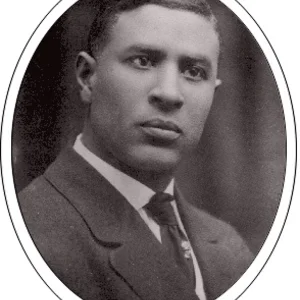

A self-taught American inventor, Garrett Morgan designed the gas mask (1914) and the three-position traffic signal (1923). His inventions saved lives and revolutionized public safety.
Garrett Morgan(1877 — 1963)
Garrett A. Morgan
États-Unis
9 min read
Frequently asked questions
Key Facts
- 1877: born in Claysville, Kentucky, into a family of formerly enslaved people
- 1914: patent filed for the safety breathing hood (forerunner of the gas mask)
- 1916: heroic use of his mask to rescue workers trapped in a flooded tunnel in Cleveland
- 1923: invention of the three-position traffic signal (stop, go, and an intermediate warning position)
- 1963: death in Cleveland, Ohio, after receiving a city medal for his contribution to public safety
Works & Achievements
Patent no. 1,090,936 granted on October 13, 1914, this breathing device revolutionized safety for firefighters and miners. Adopted by the U.S. Army during World War I, it is the forerunner of modern respiratory protective equipment.
Morgan's first major commercial success, this straightening lotion — discovered by accident — allowed him to found a profitable business serving the African American community, funding his work as an inventor.
Patent no. 1,475,024 granted on November 20, 1923, this signaling system introduced an intermediate warning phase at intersections, a direct precursor to the three-color traffic light used worldwide. Morgan sold the patent to General Electric for $40,000.
A newspaper founded by Morgan to inform and advocate for Cleveland's Black community, it would later become the *Cleveland Call & Post*. This publication reflects Morgan's civic commitment beyond his career as an inventor.
A commercial enterprise founded in Cleveland to produce and distribute his hair care products, this was Morgan's first entrepreneurial success, providing him with the financial independence needed to pursue his future inventions.
Anecdotes
In July 1916, an explosion trapped workers in tunnel no. 5 of Cleveland's water supply network, beneath Lake Erie. Garrett Morgan put on his own gas mask and entered the gas-filled tunnel multiple times, saving several lives at great personal risk. This heroic act earned him a gold medal from the city of Cleveland and national press coverage.
To sell his gas mask in the segregationist American South, Morgan had to conceal his identity. He hired a white man to pose as the inventor during demonstrations, while he played the role of his Native American assistant. When Southern buyers discovered he was Black, several canceled their orders and returned equipment that had already been delivered.
A self-taught man, Morgan left the family farm at 14 with only a sixth-grade education and a few dollars to his name. While tinkering with sewing machine needles in his Cleveland workshop, he accidentally discovered a lotion that could straighten curly hair, which allowed him to launch a thriving first business even before inventing the gas mask.
In 1923, Morgan patented his three-position traffic signal — stop, warning, and go — to make intersections safer as automobiles became increasingly common. He sold the patent to General Electric for $40,000, a considerable sum at the time, and this system is the direct ancestor of the traffic lights used around the world today.
In 1920, Morgan founded the Cleveland Call, a newspaper aimed at Cleveland's African American community. Through it, he championed civil rights and informed a population often ignored by the white press, proving that his commitment extended far beyond the field of invention.
Primary Sources
The object of the invention is to provide a portable attachment which will enable a fireman to enter a house filled with thick suffocating gases and smoke and to breathe freely for some time therein, the apparatus being of such a character that it can be adjusted for use very quickly.
This invention relates to traffic signals, and particularly to a signal for use at street crossings or intersections for directing the movement of traffic, and has for its object to provide a signal of this character which shall be simple in construction, efficient in operation.
Garrett Morgan, inventor of the safety hood, made repeated trips into the fume-filled tunnel, bringing out survivors one by one. He and his brother were among the first volunteers when rescue workers feared to enter the gas-choked passage.
The Morgan Safety Hood and Smoke Protector has been tested and approved by fire departments and recommended by the U.S. Bureau of Mines for use in mines, tunnels, and all places where noxious gases are present.
Key Places
Birthplace of Garrett Morgan in 1877. His family of formerly enslaved people lived there as sharecroppers in precarious conditions — a context that drove young Garrett to leave the South and seek his fortune in the industrial North.
The city where Morgan settled around 1895 and spent most of his working life. It was here that he founded his businesses, filed his patents, carried out the heroic rescue of 1916, and published his community newspaper.
Site of the heroic rescue of July 1916: after an underground explosion, Morgan and his brother used the gas mask to save workers trapped in this tunnel filled with toxic fumes, proving the invention under real-world conditions.
The federal institution where Morgan filed his two major patents: the gas mask (1912) and the traffic signal (1922). These official filings constituted the legal recognition of his inventions and the basis of his commercial rights.
Morgan's first stop after leaving Kentucky, around 1893–1895, where he found his first jobs in the North before settling permanently in Cleveland.
Typical Objects

A breathing hood invented by Morgan in 1914, it filters toxic fumes through a tube that draws fresh air from near the ground. Adopted by American firefighters and the military during World War I, it is the forerunner of modern respiratory protection equipment.

A patent from 1923 adding a warning phase between “stop” and “go” at intersections, the direct forerunner of today's amber light. Morgan designed it after observing the growing number of automobile accidents on the streets of Cleveland.

A central tool in Morgan's journey: it was by repairing and improving it that he developed his mechanical skills, discovered his hair-straightening cream, and raised the capital to launch his first businesses.

A product accidentally discovered around 1909, marketed under the G.A. Morgan Hair Refining Company brand. It was Morgan's first major commercial success and provided him with the capital to continue his work as an inventor.

An industrial property title issued by the United States Patent Office, it legally protects Morgan's inventions. These documents are also valuable historical records of the technical innovations of the American industrial era.

A press outlet founded by Morgan in 1920 to inform Cleveland's African American community. It illustrates how Black entrepreneurs of the early twentieth century used every available means to defend their rights in the face of segregation.
School Curriculum
Vocabulary & Tags
Key Vocabulary
Tags
Daily Life
Morning
Morgan rises early and begins his day in his Cleveland workshop, reviewing orders for his hair care products business and responding to correspondence from clients and partners. A rigorous self-taught learner, he devotes every available morning to reading technical journals and conducting mechanical experiments on new prototypes.
Afternoon
Afternoons are often taken up by commercial demonstrations of his inventions or meetings with business partners — in a world where a Black entrepreneur must work twice as hard to be taken seriously. He oversees manufacturing in his workshop, refines his patent drawings, and sometimes negotiates with representatives from fire departments or mining corps interested in his gas mask.
Evening
In the evenings, Morgan immerses himself in Cleveland's African-American community life: meetings of civil rights organizations, writing articles for his newspaper the *Cleveland Call*, or conversations with fellow Black entrepreneurs about strategies for navigating discrimination. Like many men of his generation, he constantly walks the line between personal ambition and collective commitment.
Food
Morgan's everyday cooking reflects his Southern roots: corn, beans, sweet potatoes, and smoked meats — a heritage of African-American cuisine that traces back to slavery. In Cleveland, an industrial city in the North, his growing business success gradually gave him access to a more varied and abundant diet.
Clothing
Morgan wears the understated suit and tie of early twentieth-century American businessmen: dark jacket, white shirt, and a bowler or straw boater depending on the season. Attentive to his appearance, he adopts the dress that commands respectability and credibility in a world where a Black man constantly had to prove his professional legitimacy against prejudice.
Housing
Morgan first lives in a working-class neighborhood of Cleveland, then moves into a comfortable middle-class home as his business ventures succeed — a classic arc of upward mobility for the Black middle class in the industrial North. His home serves as both family residence and workspace where he carries out his experiments, an arrangement common among inventor-entrepreneurs of the American industrial era.
Historical Timeline
Period Vocabulary
Liens externes & ressources
Références
Œuvres
Safety Hood and Smoke Protector (masque à gaz)
1914
G.A. Morgan Hair Refining Cream (lotion capillaire)
1909
Traffic Signal (feu de circulation à trois positions)
1923
Cleveland Call (journal afro-américain)
1920
G.A. Morgan Hair Refining Company
1907