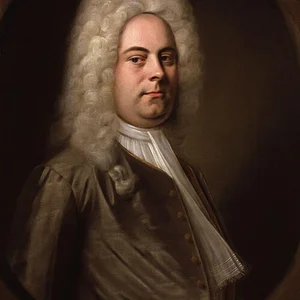

German-born Baroque composer who became a British subject (1685–1759), Handel is one of the towering figures of 18th-century music. He is celebrated for his Italian operas, oratorios, and concerti grossi. His work *Messiah* (1741) remains one of the masterpieces of Western sacred music.
George Frideric Handel(1685 — 1759)
George Frideric Handel
Saint-Empire romain germanique, Brandebourg-Prusse, royaume de Grande-Bretagne
8 min read
Frequently asked questions
Famous Quotes
« I should be sorry if I only entertained them; I wished to make them better.»
« Whether I was in my body or out of my body as I wrote it, I know not. God knows.»
Key Facts
- Born on 23 February 1685 in Halle (Holy Roman Empire), the same year as Johann Sebastian Bach
- Settled permanently in London in 1712 and became a naturalised British subject in 1727
- Composed *Messiah* in just 24 days in 1741; it premiered in Dublin in 1742
- Composed *Water Music* (1717) and *Music for the Royal Fireworks* (1749) for the British court
- Lost his sight in 1751–1752 but continued to conduct his works until his death in 1759
Works & Achievements
Oratorio in three parts set to a libretto by Charles Jennens, drawn from the Old and New Testaments. An absolute masterpiece of Western sacred music, it has been performed worldwide for nearly three centuries.
The first major opera composed specifically for the London stage, it was an immediate success and established Handel's reputation in England. It is based on Torquato Tasso's *Jerusalem Delivered*.
An orchestral suite composed for a royal celebration on the Thames in honour of George I. It remains one of the most popular works in the Baroque repertoire.
An opera seria in three acts, considered the pinnacle of Handel's operatic output. It portrays Julius Caesar and Cleopatra through music of exceptional melodic richness.
Composed to celebrate the Peace of Aix-la-Chapelle of 1748, it received its premiere in Green Park, London. The public rehearsal drew more than twelve thousand spectators and caused an enormous traffic jam.
An ambitious oratorio built almost entirely on monumental choruses, it tells the story of the Exodus of the Hebrews. It showcases Handel's genius for large choral forces.
A coronation anthem composed for George II, it has been sung without interruption at every British royal coronation since 1727. Its rising orchestral introduction is one of the most recognisable in the history of music.
Anecdotes
In August 1741, Handel composed his oratorio *The Messiah* in just twenty-one days, working almost without interruption. According to tradition, upon finishing the “Hallelujah” chorus he reportedly declared: “I did think I did see all Heaven before me, and the great God Himself.” The work premiered in Dublin on **13 April 1742** to an enthusiastic audience.
At the London premiere of *Messiah* in **1743**, King **George II** reportedly rose from his seat at the opening of the “Hallelujah” chorus. As the entire audience followed suit out of respect, the tradition of standing has endured to this day in concert halls around the world, though historians debate the exact authenticity of the episode.
Handel went bankrupt twice in London due to the failure of his Italian operas in the face of competition and artistic rivalries. Ruined and struck by a seizure in **1737**, he made a miraculous recovery and successfully reinvented himself with English-language oratorios — a genre that won lasting favor with British audiences.
From **1751** onward, Handel gradually lost his sight following a series of unsuccessful cataract operations performed by the same surgeon who had operated on **Johann Sebastian Bach**. Though blind, he continued to conduct his oratorios from memory and improvise at the organ until just days before his death in **1759**.
Handel was naturalized as a British subject in **1727** by a special Act of Parliament — an exceptional distinction for a foreign musician. That very same year, he composed four anthems for the coronation of **George II**, including the celebrated “Zadok the Priest,” which has been performed at every British royal coronation ever since without interruption.
Primary Sources
Comfort ye, comfort ye my people, saith your God. Speak ye comfortably to Jerusalem, and cry unto her, that her warfare is accomplished.
Last Night was perform'd, at Covent-Garden Theatre, for the Benefit of the Fund for the Support of Decay'd Musicians, the celebrated Oratorio call'd The Messiah, compos'd by Mr. Handel, to the Satisfaction of a very numerous and splendid Audience.
He was led to the harpsichord, where he sat and played till the tears ran down his face; and was so overpowered with the beauty of his own composition, that he wept in a most affecting manner.
Georg Friedrich Handel, of the parish of Saint George, Hanover Square, in the county of Middlesex, shall be deemed, adjudged, and taken to be one of the natural-born subjects of His Majesty.
Sr, It was indeed your Pleasure to honour me with your most valuable Instructions [...] I shall endeavour to answer your Expectation in having the Work perform'd with the utmost Care.
Key Places
Handel's birthplace, where he was born on 23 February 1685 and received his first music lessons. His childhood home has since been converted into a museum.
Handel stayed here from 1707 to 1708 and composed two Italian oratorios, *La Resurrezione* and *Il Trionfo del Tempo*. He moved in the circle of Cardinal Ottoboni, a great patron of music.
Handel's London residence from 1723, where he lived until his death in 1759. Now a museum (Handel & Hendrix in London), it stands as a testament to his deep roots in British society.
The city where *Messiah* had its world premiere on 13 April 1742 at the New Musick Hall on Fishamble Street. Dublin audiences received the work with an enthusiasm that stood in sharp contrast to its more lukewarm initial reception in London.
Handel was buried here on 20 April 1759, in the presence of around 3,000 people. A statue in his likeness, holding the score of *Messiah*, was erected in his honour.
Typical Objects

Handel's primary instrument for composition and improvisation — he owned several at his Brook Street home. He was renowned as one of the greatest harpsichordists and organists of his time.

Handel composed at extraordinary speed, covering staves in black ink with hardly a correction. His autograph manuscripts, held at the British Library, bear witness to a rapid and confident hand.

The obligatory headwear for any gentleman in eighteenth-century England, the wig marked Handel as a respected artist fully integrated into London high society.

The original manuscript of the *Messiah*, written between 22 August and 14 September 1741, is held at the British Library. It is inscribed in UNESCO's Memory of the World Register.

Handel conducted his oratorios seated at the organ, improvising interludes between the acts. Even after losing his sight, he continued to perform on the organ in concert, captivating his audiences.

Distributed to audience members at performances, these small paper booklets allowed listeners to follow the sung text. They are now valuable primary sources for musicologists.
School Curriculum
Vocabulary & Tags
Key Vocabulary
Tags
Daily Life
Morning
Handel rose early and devoted the first hours of the morning to composition, seated at his harpsichord in his study on Brook Street. He worked with extraordinary concentration and speed, covering sheets of music in ink without hardly ever crossing out a single note.
Afternoon
The afternoon was devoted to rehearsals with his singers and musicians, often at the King's Theatre in the Haymarket or at Covent Garden. Handel was a demanding and sometimes hot-tempered director, never hesitating to raise his voice against recalcitrant or capricious singers.
Evening
On performance evenings, Handel would conduct from the harpsichord or organ, improvising intermissions that delighted the audience. Outside the concert season, he frequented London's coffee houses and received visitors at his home.
Food
Handel was renowned for his hearty appetite — contemporary accounts describe him as a portly man who relished fine meals. He would often order dishes for several people at taverns, and was fond of Rhine wine, true to his German origins.
Clothing
Handel wore the standard dress of London gentlemen of the 18th century: an embroidered cloth coat, knee breeches, silk stockings, a powdered wig, and a tricorn hat. At home, he was more relaxed, wearing a dressing gown during his composing sessions.
Housing
His house on Brook Street, in the elegant Mayfair district, was a typical London middle-class residence of the 18th century: several floors, sash windows, fireplaces in every room. He fitted it out with a music room containing his instruments and a significant collection of Flemish and Dutch paintings.