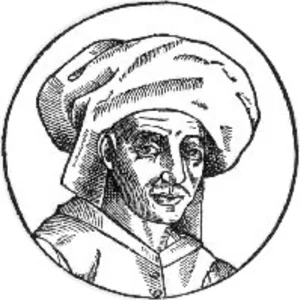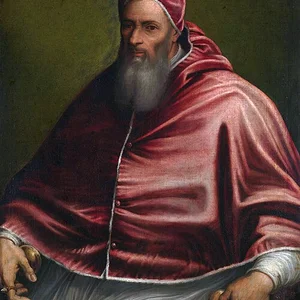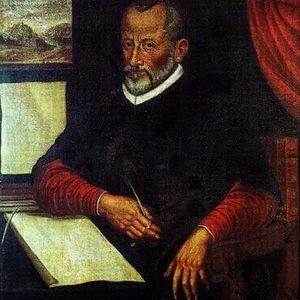

An Italian composer of the Renaissance, Palestrina is considered the master of sacred vocal polyphony. He spent most of his career in Rome in the service of the Catholic Church, notably as choirmaster at St. Peter's Basilica.
Giovanni Pierluigi da Palestrina(1525 — 1594)
Giovanni Pierluigi da Palestrina
États pontificaux
9 min read
Frequently asked questions
Key Facts
- Born around 1525 in Palestrina, near Rome, he took his name from his hometown.
- In 1551, he was appointed choirmaster at St. Peter's Basilica in the Vatican.
- He composed more than 100 masses and 250 motets, including the famous Missa Papae Marcelli (c. 1562).
- The Council of Trent (1545–1563) sought to reform church music; his work embodied the ideal of clarity and devotion championed by the Counter-Reformation.
- He died in Rome in 1594, leaving behind a monumental body of work that would influence Western music for centuries.
Works & Achievements
A masterpiece of sacred polyphony, dedicated to Pope Marcellus II. This six-voice mass is often cited as the perfect demonstration that complex polyphonic writing can remain intelligible and spiritually suited to Catholic liturgy.
Palestrina's first printed collection, dedicated to Pope Julius III. This book contains four masses and officially launched his career as a recognized composer in Rome.
A sacred work for double choir in eight voices, of great spiritual intensity. This motet is one of Palestrina's most celebrated and was long sung at the Sistine Chapel on Good Friday.
A collection of 29 motets set to the poetic and mystical texts of the Song of Songs. This work showcases Palestrina's mastery in expressing lyrical sensitivity within the framework of rigorous sacred writing.
A mass built upon a Gregorian hymn, exemplifying the technique of parody and melodic borrowing. It remains a model of imitative writing studied in theoretical treatises for centuries to come.
A solemn six-voice motet composed for St. Peter's Basilica, set to Christ's words to the Apostle Peter. This piece was regularly sung during major papal ceremonies.
Anecdotes
At the Council of Trent (1545–1563), the Catholic Church seriously considered banning polyphony from the liturgy, deeming it too complex and difficult to follow. According to tradition, Palestrina saved sacred music by composing his Missa Papae Marcelli, demonstrating that polyphony could be both beautiful and faithful to the sacred text. Though embellished over time, this legend reflects the enormous influence he had on Catholic musical reform.
Palestrina was dismissed from the Sistine Chapel in 1555 by Pope Paul IV for a surprising reason: he was married. The chapel's statutes forbade singers from being laymen or married. He lost his position but quickly recovered, going on to become choirmaster at the Basilica of Saint John Lateran, then at Santa Maria Maggiore.
After the death of his first wife Lucrezia in 1580, Palestrina seriously considered taking holy orders and even enrolled as a minor cleric. But he ultimately abandoned the idea of priesthood the following year to marry Virginia Dormoli, a wealthy widow who worked in the fur trade. Her fortune allowed him to live more comfortably in his final years.
Palestrina published his first collection of masses in 1554 with a dedication to Pope Julius III, whose protégé he had been. He was one of the rare composers of his era to be offered a place in the Sistine Chapel by direct papal decision, bypassing the usual selection process — a fact that earned him no small amount of jealousy within the institution.
Palestrina endured the heartbreak of losing two of his sons and his first wife during the devastating plague epidemic that struck Rome between 1571 and 1580. These hardships left a deep mark on his personal life, yet did nothing to slow his remarkable musical output, which includes more than 100 masses and 300 motets.
Primary Sources
Dedication to Julius III: "Most Holy Father, I have composed these masses according to the rules of musical art, for the glory of God and the adornment of your chapel…"
Palestrina expresses his intent to compose sacred music that serves the understanding of liturgical texts, in accordance with the requirements of the Council of Trent.
Dedication to Pope Pius IV in which Palestrina declares his talent devoted to the service of the Church and to the beauty of sacred chant.
"All music in which anything lascivious or impure is mingled must be kept away from churches. Let composers strive to ensure that their works are fitting for the house of God."
Appointment of Giovanni Pierluigi da Palestrina as maestro di cappella of the Basilica of Saint Peter, with mention of his liturgical duties and annual salary.
Key Places
The composer's birthplace, from which he took his surname. This small hilltop town southeast of Rome was the starting point of his musical training under the local cathedral.
The primary workplace of Palestrina in his later career: he served as choirmaster there from 1571 until his death in 1594. It was in this solemn setting that much of his sacred music was performed.
Palestrina served as singer and choirmaster there in 1555, appointed directly by Pope Julius III. Though brief, this tenure lent immense prestige to his career and placed him at the heart of papal musical life.
The first major Roman institution where Palestrina served as choirmaster (1553–1555). This prestigious post at the pope's official cathedral truly launched his Roman career.
A Jesuit institution founded as part of the Counter-Reformation, where Palestrina taught music from around 1565 to 1571. This teaching post allowed him to spread his aesthetic vision to a generation of European musicians.
Typical Objects

A large manuscript or printed music book arranged so that several singers could read it simultaneously from a central lectern. Palestrina composed his masses and motets in this format, which was used in all the Roman chapels where he served.

Essential tools of musical composition in the 16th century, used to notate scores on hand-ruled music paper. Palestrina used them to write out more than 500 works over the course of his career.

A pipe organ installed in the lofts of Rome's great basilicas, used to support or double the voices during liturgical services. As choirmaster, Palestrina oversaw its use in ceremonial occasions.

Liturgical vestments worn by musicians and cantors of the pontifical chapels during services. Although a layman, Palestrina wore these garments during ceremonies at the Sistine Chapel and St. Peter's Basilica.

A small metal or wooden instrument used to give singers their starting pitch before a performance. Essential for maintaining the intonation of an a cappella vocal ensemble of the kind Palestrina conducted.

A liturgical book containing the official prayers and texts of the Catholic Church. Palestrina drew from this collection the sacred texts — psalms, hymns, antiphons — that he set to music throughout his life.
School Curriculum
Vocabulary & Tags
Key Vocabulary
Daily Life
Morning
Palestrina rose at dawn to attend Matins, the first liturgical prayer of the day sung by the cantors of the basilica. As choirmaster, he oversaw the organization of the morning offices and made sure the singers knew their parts. He then devoted the early hours to composition, taking advantage of the morning quiet to write with a quill on sheets of ruled paper.
Afternoon
The afternoon was dedicated to rehearsals with the chapel singers — sometimes a dozen voices — whom he guided through learning his new Masses or motets. Palestrina corrected intonation errors, balanced the voices against one another, and ensured the clarity of the sung text, a paramount concern in the wake of the Council of Trent. He might also receive composition students or visiting musicians seeking his opinion.
Evening
In the evening, Palestrina took part in Vespers and Compline, the final offices of the day, where his music was often performed. Back home in the Borgo district near the Vatican, he would dine with his family and sometimes read through his scores by candlelight. On special occasions — visits from cardinals, major religious feasts — he might conduct solemn evening performances in the private chapels of Roman prelates.
Food
Like most middle-class Romans of the sixteenth century, Palestrina's diet consisted mainly of bread, vegetables, legumes (broad beans, chickpeas), and local cheeses. Meat was rarely eaten on ordinary days, especially during Lent and the many days of abstinence on the Catholic calendar. Seasonal fruits — figs, grapes, melons — rounded out his meals, washed down with wine diluted with water.
Clothing
Outside of liturgical services, Palestrina dressed in the modest attire of a Roman bourgeois: a wool doublet, fitted hose, and a dark cloak. During ceremonies, he wore the white surplice — a long linen tunic — over a black cassock, the standard dress of members of the pontifical chapels. His second wife Virginia, whose wealth came from the fur trade, allowed him to dress more comfortably in his later years.
Housing
Palestrina spent most of his life in the Borgo district of Rome, a short walk from St. Peter's Basilica. He rented a multi-room house befitting his standing as an established choirmaster. After his marriage to Virginia Dormoli in 1581, his wife's fortune enabled him to move into more comfortable lodgings, and he even came to own a property in the countryside near Rome.
Historical Timeline
Period Vocabulary
Visual Style
Esthétique de la Rome de la Contre-Réforme : intérieurs de basiliques dorées, clair-obscur de cierges, surplis blancs des choristes et manuscrits enluminés.
Sound Ambience
Ambiance sonore d'une basilique romaine du XVIe siècle : polyphonie vocale a cappella en latin, réverbération de pierre, orgue lointain et cloches liturgiques.