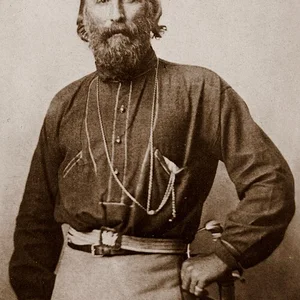

Italian general and patriot (1807–1882), Garibaldi is one of the central figures of the Risorgimento. A charismatic military leader, he unified much of Italy through his campaigns, most notably the famous Expedition of the Thousand in 1860.
Giuseppe Garibaldi(1807 — 1882)
Giuseppe Garibaldi
France, Pérou, République Riograndense, royaume d'Italie, royaume de Sardaigne
9 min read
Frequently asked questions
Famous Quotes
« Here we make Italy or we die.»
« I offer you hunger, thirst, forced marches, battles and death.»
Key Facts
- 1807: born in Nice, then part of the French First Empire
- 1848: involvement in the liberal revolutions in Italy
- 1860: Expedition of the Thousand in Sicily, conquest of the Kingdom of the Two Sicilies
- 1861: proclamation of the Kingdom of Italy, to which he made a decisive contribution
- 1882: died in Caprera
Works & Achievements
With only 1,089 volunteers, Garibaldi conquered Sicily and then all of southern Italy in five months. This lightning campaign, considered an exceptional military feat, made possible the reunification of the south with the north of Italy.
In command of the Roman Republic's forces, Garibaldi held out for three months against French, Austrian, and Neapolitan troops. Although the Republic was ultimately crushed, his heroic defense made him a legendary figure of European liberalism.
Garibaldi fought for the independence of Rio Grande do Sul (Brazil) and defended Montevideo against Argentine forces. These experiences forged his guerrilla techniques and his international reputation as a freedom fighter.
Written by Garibaldi himself with the help of collaborators, these memoirs recount his adventures in South America, Italy, and Rome. Translated into many languages, they helped shape his legend as a romantic, republican hero.
Garibaldi also wrote historical novels, including this semi-autobiographical account of the Expedition of the Thousand. This literary work reflects his intellectual breadth and his commitment to passing on the ideals of the *Risorgimento* to future generations.
Anecdotes
The famous red shirt of the Garibaldini came about by happy accident. During his exile in Montevideo in the 1840s, Garibaldi was looking for cheap uniforms to equip his legion of volunteers. He found a stock of red blouses originally intended for workers in Argentine slaughterhouses. This improvised choice became the symbol of his movement and one of the most recognizable emblems of the 19th century.
In May 1860, Garibaldi landed in Sicily with only a thousand volunteers — the Thousand — to face the Bourbon army of the King of the Two Sicilies, which numbered several tens of thousands of soldiers. Within a few months, he conquered all of southern Italy. When he handed his conquests over to King Victor Emmanuel II, he simply uttered the word *Obbedisco* (I obey), before retiring to his farm on the island of Caprera.
In 1862, Garibaldi attempted to seize Rome despite the opposition of the Italian government, which feared a conflict with France. The Italian army blocked his path at Aspromonte: Garibaldi was wounded in the ankle by a bullet and captured. The supreme irony was that it was the army of unified Italy — which he had helped create — that arrested him.
After the fall of the Roman Republic in 1849, Garibaldi fled with his wife Anita through the marshes and mountains of central Italy, pursued by the Austrian, French, Spanish, and Neapolitan armies. Anita, pregnant and exhausted, died in his arms near Ravenna. This loss devastated Garibaldi, who nonetheless continued his struggle for decades.
During his exile in New York in 1850–1851, Garibaldi — hero of two continents — was forced to work as a candle maker on Staten Island to make ends meet. This general who had commanded armies and defended Rome against the Pope's troops spent his days molding candles in a small workshop. This episode illustrates the dramatic reversals of fortune that punctuated his life.
Primary Sources
Italians! Sicily wishes to join the great Italian family... I call you under the banners of Italy and Victor Emmanuel. Italy or death!
I have fought for liberty wherever tyranny existed and wherever liberty needed to be defended. South America taught me guerrilla warfare; Italy taught me hope.
Sire, I have the honour of presenting to you the crown of Southern Italy. I beseech you to reign over these peoples whom I offer to you, free and happy.
Soldiers, I offer neither pay, nor quarters, nor provisions. I offer hunger, thirst, forced marches, battles and death. Let him who loves his country in his heart, and not merely with his lips, follow me.
Rome must be the capital of Italy. It is a historical, geographical and political necessity from which no government can escape without betraying the nation.
Key Places
Born on 4 July 1807 in Nice, then a city of the French Empire, Garibaldi grew up in a busy Mediterranean port, which set him on a path to a seafaring career before he became a military commander. Nice was ceded to France in 1860, something he experienced as a personal wound.
Having fled to South America after being sentenced to death, Garibaldi commanded the Italian Legion during the Uruguayan civil wars from 1842 to 1848. It was there that he developed his guerrilla tactics and adopted the red shirt.
In 1849, Garibaldi heroically defended the Roman Republic proclaimed by Mazzini against the French troops of Napoleon III. The resistance at Villa Borghese and the Janiculum Hill remains one of the most celebrated episodes of his military career.
On 11 May 1860, Garibaldi and his Thousand volunteers landed at Marsala, in Sicily, to launch their campaign to conquer southern Italy. This daring landing marked the beginning of the decisive phase of the Risorgimento.
Garibaldi settled on this remote Sardinian island from 1855 onwards, living as a farmer between his military campaigns. He died there on 2 June 1882 and is buried on the island. Caprera is today a site of Italian patriotic pilgrimage.
It was at Teano, on 26 October 1860, that Garibaldi met King Victor Emmanuel II and solemnly handed over to him the Kingdom of the Two Sicilies he had just conquered. This act of republican self-abnegation remains one of the most powerful symbols of the Risorgimento.
Typical Objects

Adopted by Garibaldi and his volunteers as a distinctive uniform, the red shirt became the symbol of his movement and of the Risorgimento. It allowed his troops to be identified on the battlefield and rallied volunteers around a shared ideal.

During his years of exile in Uruguay and Brazil, Garibaldi adopted the poncho of the Río de la Plata gauchos, often wearing it over his red shirt. This garment reflects his deep involvement in the independence struggles of Latin America.

Garibaldi was a seasoned close-quarters fighter. His sabre, used during his campaigns in both South America and Italy, symbolises his role as a frontline military commander who shared the dangers with his men.

An essential instrument for a nineteenth-century military commander, the telescope allowed Garibaldi to observe enemy positions and direct his troops from the high ground. It appears in several portraits and engravings depicting him on campaign.

Between campaigns, Garibaldi lived as a simple farmer on his island of Caprera in Sardinia, working his own fields by hand. These agricultural tools embody the paradox of this man of action who withdrew into an austere rural life between wars.

The green, white, and red of a unified Italy was the banner under which Garibaldi fought for decades. He raised it during the Expedition of the Thousand and made it the symbol of Italian national sovereignty in the face of foreign powers.
School Curriculum
Vocabulary & Tags
Key Vocabulary
Tags
Daily Life
Morning
On the island of Caprera, between campaigns, Garibaldi rose at dawn to work the fields. He personally oversaw his crops, tended his livestock, and organized land-clearing work. On military campaign, mornings were devoted to troop reviews, map study, and dispatching correspondence.
Afternoon
On Caprera, afternoons were often spent on correspondence — he received letters from around the world — and receiving visitors: journalists, politicians, or admirers who made the journey to the island. On campaign, he rode at the head of his troops, sharing the same roads and the same dangers as his soldiers.
Evening
In the evenings at Caprera, Garibaldi enjoyed gathering with his family around a simple meal. He read, wrote his memoirs, and kept up his vast correspondence with republican and liberal movements across Europe. Despite his growing rheumatic pain, he remained intellectually active well into old age.
Food
Garibaldi had modest eating habits, shaped by his years on campaign. He favored simple Mediterranean dishes — vegetables from the garden, cheeses, bread, and local Sardinian wines. His years in South America had also given him a taste for grilled meat in the gaucho tradition.
Clothing
His distinctive attire — red shirt, dark trousers, poncho or cape, and wide-brimmed hat — had become his trademark. Outside of campaigns, he dressed simply, without uniform, preferring the dress of a peasant or sailor. This deliberately non-aristocratic style matched his republican convictions.
Housing
The house on Caprera, the *Casa Bianca* (White House), was a modest dwelling built by Garibaldi himself from **1855** onward. Surrounded by fields he cultivated, it reflected his desire for a simple, rural life. On campaign, he often slept under the open sky or in bivouacs shared with his soldiers, refusing the privileges of command.
Historical Timeline
Period Vocabulary
Liens externes & ressources
Références
Œuvres
Expédition des Mille (Spedizione dei Mille)
Mai–octobre 1860
Défense de la République romaine
Avril–juillet 1849
Campagnes en Amérique du Sud
1836–1848
Memorie di Giuseppe Garibaldi (Mémoires)
1872
Roman I Mille (Les Mille)
1874