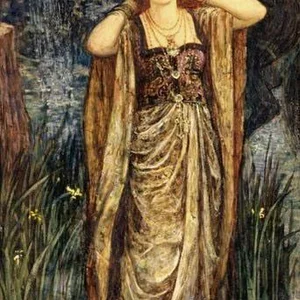

Legendary queen of Britain and wife of King Arthur in the Arthurian cycle. A central figure of medieval literature, she is also known for her tragic affair with the knight Lancelot of the Lake, which contributes to the fall of Camelot.
Guinevere
Guinevere
9 min read
Frequently asked questions
Key Facts
- Central figure of the Arthurian cycle, wife of King Arthur and queen of Logres (legendary Britain)
- Her romantic relationship with Lancelot of the Lake, the greatest knight of the Round Table, is one of the most celebrated in medieval literature
- Chrétien de Troyes portrays her as early as the late 12th century in 'The Knight of the Cart' (c. 1177)
- Her betrayal of Arthur is presented as one of the causes of the Battle of Camlann and the downfall of Camelot
- After Arthur's death, she retreats to a convent and ends her life as a nun, according to the 'La Mort le Roi Artu' (13th century)
Works & Achievements
The first developed Latin narrative to feature Guinevere, described as the most beautiful woman in Britain and of Roman lineage. Geoffrey introduces her role in the betrayal with Mordred and the fall of Arthur.
An adaptation in Norman octosyllabic verse of Geoffrey's work that gives Guinevere a more elaborate courtly setting and introduces the Round Table as a symbol of the royal court.
The founding romance of Arthurian courtly love: Guinevere is the object of Lancelot's absolute devotion, whose dedication defines the chivalric and romantic ideal of the Middle Ages.
A vast collection of prose romances forming the most complete account of Guinevere's fate: her love for Lancelot, the trial by fire, the civil war, and her final retreat to a convent.
The definitive Middle English synthesis of Arthurian legend. Guinevere is portrayed with deep humanity: guilty but repentant, she dies in a state of grace at the convent of Amesbury.
A Victorian epic poem in twelve books reimagining the Arthurian cycle. Tennyson gives Guinevere a scene of forgiveness from the dying Arthur, granting her a redemptive dimension absent from medieval texts.
Anecdotes
In medieval Arthurian tradition, Guinevere's father, King Leodegrance, gives Arthur the Round Table as a dowry upon their marriage. This table with no head and no seat of honor — a symbol of equality among the knights — becomes the heart of Camelot's court and the most precious legacy Guinevere brings to her husband.
Chrétien de Troyes, in The Knight of the Cart (around 1177), is the first to explicitly depict the affair between Guinevere and Lancelot. When Lancelot climbs into a cart of shame — a vehicle reserved for criminals — so as not to lose a single moment in his quest to rescue the captive queen, Guinevere initially holds it against him before granting him her favor. This episode codifies courtly love: suffering for one's lady is the supreme mark of chivalry.
According to the Lancelot-Grail prose cycle (13th century), Agravain and Mordred set a trap for Lancelot in Guinevere's chambers. The queen is sentenced to be burned alive for treason and adultery, but Lancelot rushes to rescue her from the pyre, killing several knights in the process — including Gawain's brothers. This intervention triggers a civil war that will permanently destroy Arthurian chivalry.
Geoffrey of Monmouth, in his Historia Regum Britanniae (around 1138), reports that while Arthur is campaigning on the continent, Guinevere allies herself with Mordred, who seizes the throne and attempts to take her as his wife by force. This version — the oldest in the literary tradition — casts Guinevere as a figure of political as much as romantic betrayal.
After the Battle of Camlann and Arthur's death, Guinevere withdraws to the convent at Amesbury in England, takes the veil, and lives a life of penance. When Lancelot comes to see her one last time, she refuses him a kiss, asks him to leave the world in turn, and dies shortly after in a state of holiness. Thomas Malory closes his Morte d'Arthur by granting her a peaceful death — the only form of reconciliation the legend offers her.
Primary Sources
Gueneveram, ex nobili Romanorum genere ortam, omnes mulieres insulae pulchritudine transcendisse. [...] Modredus eam sibi in matrimonium sociaverat et regnum in sua ditione retinuerat.
Guenievre fu bien aprise, curtaise e franche e de bon sen ; puis qu'ele fu raïne, n'ot dame en trestut le reigne ki si fust preisïe de bien.
La reïne li dit : 'Certes, chevaliers, vos feïstes pis que ne cuidiee, quant vos montastes en la charrete par neglicence.' Et il li dist : 'Dame, por ce ne me deusse pas atorner a folie, car j'avoie trop grant desir de vos veoir.'
Et la royne Genievre estoit si bele et si bien faite que onques nus hom n'avoit veu si bele dame. Et Lanceloz la regardoit tant que ses cuers s'en aloit aprés ses euz.
Queen Guenever made great dole and lamentation, and said : 'Through this man and me hath all this war been wrought, and the death of the most noblest knights of the world ; for through our love that we have loved together is my most noble lord slain.'
Key Places
The legendary capital of Arthur's kingdom and Guinevere's principal residence. Its exact location remains unknown and disputed; some scholars identify it with Cadbury Castle in Somerset or with Winchester.
In the texts of Geoffrey of Monmouth and Chrétien de Troyes, Caerleon in Wales is one of Arthur and Guinevere's residences — a city of splendour and tournaments.
The place where Guinevere withdrew after Arthur's death. She spent her final years there in prayer and penance, and was first buried there before being transferred to Glastonbury, according to Malory.
Identified with the mythical Avalon, Glastonbury is associated with the shared burial place of Arthur and Guinevere. In 1191, the monks of the abbey claimed to have discovered their tombs.
Lancelot's castle, where he sheltered Guinevere after rescuing her from the stake. Often identified with Bamburgh Castle in Northumberland, it stands as a symbol of forbidden love and impossible refuge.
Typical Objects

Symbol of Guinevere's sovereignty over Arthurian Britain, her crown appears in numerous medieval illuminations. It represents the power she holds jointly with Arthur and the nobility of her birth.

Given to Arthur as a dowry by Guinevere's father, the Round Table is the symbol of chivalric ideals and equality among knights. It is intimately linked to the court over which Guinevere presides as the first lady of the kingdom.

In several versions of the prose cycle, Lancelot carries a ring given by the Lady of the Lake, which Guinevere entrusts to him or reclaims depending on the episode. This jewel symbolizes their secret love and forms a magical bond between the two lovers.

At the end of the Arthurian cycle, Guinevere renounces her crown and takes the veil at the convent of Amesbury. The white veil of the penitent illustrates her spiritual transformation after the fall of Camelot.

In the prose cycle, a cup of poisoned wine at a royal banquet casts suspicion on Guinevere for allegedly seeking to kill a knight. The cup becomes a symbol of the fragility of her position and of medieval justice through trial by combat.

The secret messages exchanged between Guinevere and Lancelot, mentioned in several prose texts, represent the fragility and danger of their courtly love: intercepted or betrayed, they help hasten their downfall.
School Curriculum
Vocabulary & Tags
Key Vocabulary
Daily Life
Morning
Guinevere rises at dawn in her royal chambers, attended by her ladies-in-waiting who help her into silk gowns and arrange her long hair. She attends Matins in Camelot's chapel before receiving petitions and messages addressed to the royal court.
Afternoon
The queen presides over councils in Arthur's absence, receives the wives of knights, and settles disputes at court. During leisure hours, she practices falconry in the gardens or listens to readings of courtly romances in the company of her ladies.
Evening
In the evenings, Guinevere presides over the banquet in the great hall, surrounded by the knights of the Round Table. Minstrels and jesters entertain the assembly. She leads courtly conversations on honor, chivalry, and the adventures of knights gone on quests.
Food
The royal table at Camelot is a showcase of medieval splendor: roasted meats (venison, wild boar, heron), meat pies, noble fish on fast days, fine white wheat bread, aged cheeses, and imported wines. The banquets reflect the magnificence of the Arthurian court.
Clothing
Guinevere wears long gowns of silk and brocade trimmed with ermine, embroidered in gold thread and set with precious stones. A delicate crown tops a headdress or veil of fine gold cloth. The colors scarlet, royal blue, and gold proclaim her rank as first lady of the kingdom of Britain.
Housing
The queen resides in the royal apartments of Camelot, an ideal fortress adorned with tapestries bearing Arthur's coat of arms, stained glass windows, and grand fireplaces. The texts describe chambers hung with precious silks, enclosed gardens with fountains, and towers overlooking a verdant valley.
Historical Timeline
Period Vocabulary
Visual Style
Le style visuel de Guenièvre s'inspire des enluminures médiévales et de la peinture préraphaélite : robe cramoisie brodée d'or, couronne délicate et regard mélancolique dans une cour baignée de lumière gothique.
Sound Ambience
L'ambiance sonore de Guenièvre oscille entre le faste de la cour de Camelot — harpes, armures et banquets festifs — et la sérénité pénitente d'un couvent médiéval à l'aube.
Liens externes & ressources
Références
Œuvres
Historia Regum Britanniae — Geoffroy de Monmouth
vers 1138
Roman de Brut — Wace
1155
Lancelot ou le Chevalier de la Charrette — Chrétien de Troyes
vers 1177-1181
Cycle Lancelot-Graal (Vulgate arthurienne)
vers 1215-1235
Le Morte d'Arthur — Thomas Malory
1485
Idylles du Roi — Alfred Tennyson
1859-1885