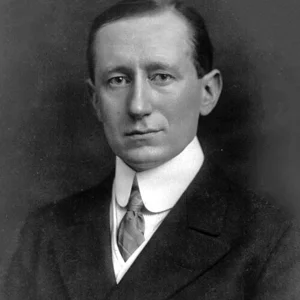

Italian physicist and inventor (1874–1937), Marconi was the pioneer of wireless radio. He achieved the first transatlantic transmission in 1901 and received the Nobel Prize in Physics in 1909.
Guglielmo Marconi(1874 — 1937)
Guglielmo Marconi
royaume d'Italie
9 min read
Frequently asked questions
Famous Quotes
« Every day sees humanity more victorious in the struggle with space and time.»
Key Facts
- 1895: first radio transmission experiments over short distances in Italy
- 1901: first transatlantic wireless transmission between England and Newfoundland
- 1909: Nobel Prize in Physics shared with Karl Ferdinand Braun
- 1912: Marconi's radio used during the sinking of the Titanic to call for rescue
- 1937: death in Rome; radio stations around the world observe two minutes of silence
Works & Achievements
The world's first patent for wireless telegraphy, filed in London. It describes the complete principle of the Hertzian wave transmitter-receiver system, the foundation of all modern radio.
The first radio signal to cross the Atlantic Ocean, from Poldhu (England) to Signal Hill (Newfoundland). This demonstration proved that radio waves could follow the curvature of the Earth and heralded a revolution in global communications.
The first international wireless transmission, covering 50 km between the English and French coasts. It was the first step toward proving that radio could overcome major geographical barriers.
Marconi developed antennas capable of directing and focusing radio transmissions toward a precise target. This invention proved fundamental for naval communications and the future development of radar.
Aboard his yacht Elettra, Marconi demonstrated that short waves (below 100 m in wavelength) could carry signals thousands of kilometres using very little energy. This research laid the groundwork for modern international broadcasting.
From his yacht at sea, Marconi remotely switched on the illuminations of the port of Genoa using microwaves. This experiment foreshadowed modern remote-control technology and radar communications.
Anecdotes
On December 12, 1901, from the station at Poldhu in Cornwall, Marconi transmitted the letter “S” in Morse code (three dots) across the Atlantic. At Signal Hill in Newfoundland — more than 3,400 km away — his assistant picked up the signal through a pair of headphones. This feat astonished scientists who had claimed that radio waves could not follow the curvature of the Earth.
When Marconi presented his first experiments in 1895, the Italian Post Office dismissed the invention as worthless and refused to fund him. His mother, Annie Jameson, of Irish descent, then encouraged him to cross the Channel. It was in London that he filed his first patent in 1896, at just twenty-two years old, and where his invention finally received a favorable reception.
In 1912, the two radio operators aboard the Titanic, employed by the Marconi company, sent out the distress calls that allowed the Carpathia to rescue 710 survivors. Marconi himself had been invited to sail on the liner as a guest of honor, but had ultimately chosen to travel on another ship a few days earlier — a chance decision that very likely saved his life.
From 1919 onward, Marconi transformed a luxury yacht, the Elettra, into a roving floating laboratory. There he conducted experiments on short waves and microwaves, and demonstrated in 1930 that he could, from his ship offshore, switch on the lights of the port of Genoa by remote control — a spectacular demonstration that foreshadowed modern remote-control technologies.
In 1909, Marconi received the Nobel Prize in Physics, but had to share it with the German Karl Ferdinand Braun, whose improvements to resonant circuits had made the system more reliable. The decision sparked debate in the scientific community: some saw it as fair recognition of the collective nature of the invention, while others felt it diminished the pioneering genius of the Italian.
Primary Sources
The invention consists of a system enabling the transmission of electrical signals through space without any intermediate conducting wire, using Hertzian oscillations produced by a transmitting device connected to a grounded vertical antenna.
The signal received at St. John's, Newfoundland, in the form of three repeated dots corresponding to the letter S, proves that electric waves can travel over very great distances without attenuating to the point of becoming imperceptible, thus defying the theoretical predictions based on straight-line propagation.
The experiments I have had occasion to carry out over the past years have convinced me that wireless telegraphy is destined to play a vital role in human communications, particularly for safety at sea, where it has already proved its value on several dramatic occasions.
I succeeded in transmitting signals between two stations separated by a distance of two kilometres, then four, and further still, using coherer receivers and elevated antennas mounted on masts. I am convinced that this distance can be very greatly increased.
In the presence of officers of the Royal British Navy, Marconi demonstrated the transmission of Morse signals over a distance of several kilometres with no wires whatsoever, the receiver being placed out of sight of the transmitter. The Admiralty expressed keen interest in applying this system to naval communications.
Key Places
The family estate where Marconi conducted his first wireless transmission experiments in the grounds in 1895. The site is now a museum and houses the inventor's mausoleum.
Marconi's birthplace, born on 25 April 1874 at the Palazzo Marescalchi. He grew up in this city and received a scientific education from private tutors.
A transmitting station built by Marconi in 1900 on the south-western tip of England, fitted with a 60-metre-high antenna. It was from here that the historic transatlantic signal was sent on 12 December 1901.
A rocky headland overlooking the Atlantic from which Marconi and his assistant received the first transatlantic signal in 1901, using a kite to carry the antenna aloft. A commemorative monument stands there today.
The city where Marconi died on 20 July 1937 in his suite at the Grand Hotel. His state funeral was accompanied by radio tributes from around the world.
The city where Marconi filed his first patent in 1896 and founded his wireless telegraphy company in 1897. It was here that his invention found its first institutional and financial backers.
Typical Objects

A glass tube filled with metal filings used as a radio wave detector in Marconi's earliest receivers. It was thanks to this instrument, invented by the Frenchman Édouard Branly, that Marconi was able to pick up the first wireless signals and carry out his pioneering experiments.

An instrument used to transmit signals in Morse code — combinations of dots and dashes. Marconi used this universal code for all his early transmissions, as Morse was far more reliable than voice when dealing with interference and weak signals.

A device that generates electromagnetic waves by producing electric sparks between two electrodes. It was the heart of Marconi's transmitter; its characteristic crackling could be heard from several tens of metres away.

A long metal wire stretched vertically along a mast, connected to the ground on one side and to the transmitter on the other. Marconi was the first to grasp that antenna height considerably extended the range of the signal — a decisive insight born from hands-on experimentation.

Used by radio operators to pick up faint Morse signals. It was with a simple pair of headphones that Marconi's assistant, in Newfoundland in 1901, heard the three dots of the transatlantic signal — a historic moment experienced in tense, concentrated silence.

A 700-tonne vessel converted into a floating laboratory from 1919 onwards. The Elettra allowed Marconi to conduct his experiments far from urban interference and to move freely between his experimental stations in the Mediterranean and the Atlantic.
School Curriculum
Vocabulary & Tags
Key Vocabulary
Daily Life
Morning
Marconi rose early and began his day by reviewing reports from his engineers and bulletins from his transmitting-receiving stations scattered across several continents. He dictated his correspondence in English or Italian depending on the recipient, managing a veritable industrial empire of communications from his Roman office or from his yacht.
Afternoon
Afternoons were devoted to technical experimentation: adjusting transmitters, measuring frequencies, calculating wave propagation. Aboard the Elettra, he worked directly with his technicians in the onboard laboratories, conducting sea trials and meticulously recording results in his scientific logbooks.
Evening
In the evenings, Marconi often received politicians, scientists, or businessmen — he was an international celebrity and an influential figure in negotiations over radio frequencies between nations. He enjoyed music, read European technical journals, and corresponded with fellow inventors such as Edison and Fleming.
Food
Marconi followed a typically Italian diet: pasta, meats, seasonal vegetables, accompanied by local wines. Aboard the Elettra, the cook prepared refined meals for distinguished guests. When traveling in England or the United States, he adapted easily to local culinary customs, particularly enjoying English-style tea.
Clothing
Marconi dressed with elegance: a dark three-piece suit, starched white collar, and understated tie, in keeping with the bourgeois and industrial style of the Belle Époque. For outdoor experiments or time on his yacht, he wore a sailor's coat and a captain's cap, which became iconic elements of his public image.
Housing
Marconi divided his time between his Roman apartment at the Grand Hotel, the family villa at Pontecchio in Emilia-Romagna, and his yacht Elettra, which served as both his laboratory and his primary residence in his later years. The Elettra, fitted with a library, luxurious salons, and modern laboratories, embodied the blend of social prestige and scientific passion that defined his life.
Historical Timeline
Period Vocabulary
Liens externes & ressources
Références
Œuvres
Brevet n° 12039 — Système de télégraphie sans fil
1896
Transmission transatlantique (lettre S en morse)
12 décembre 1901
Liaison radiotélégraphique transmanche Angleterre-France
1899
Système d'antennes directionnelles (antenne en cadre)
1905
Expériences sur les ondes courtes et les micro-ondes (aboard Elettra)
1922-1935
Démonstration de radiocommande du port de Gênes
1930